

Why Did I Do That? Mastering Regret and Guilt in Korean Like a True Local
Phase 1: Oh, No… The Universal “I-Shouldn’t-Have-Done-That” Moment
안녕하세요! (Annyeonghaseyo!) Your friendly neighborhood Korean tutor and local culture navigator here from Daily Hangul.
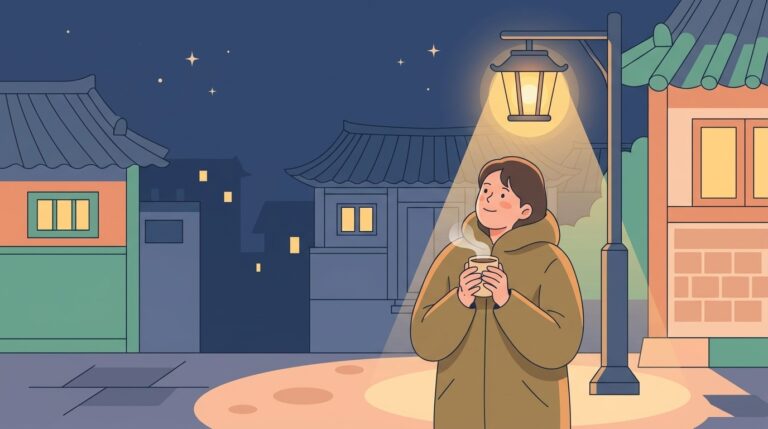
Imagine this classic K-Drama scene: You are sitting in a cozy, orange-tarped street-food tent (포장마차 – Pojangmacha) in Seoul. The rain is pattering gently outside, and you are staring blankly into a tiny cup of soju. Your Korean coworker spent three extra hours at the office fixing a mistake on a spreadsheet you submitted. You feel terrible. You want to express your deep regret and acknowledge your guilt, but the only phrase coming to your mind is a stiff, textbook-dry: “I am sorry.”
That feels so hollow, doesn’t it?
Expressing regret (후회 – Huhoe) and guilt (죄책감 – Joechaekgam) in Korea is not just about translating words; it is an emotional art form. Because Korean culture runs deeply on 정 (Jeong – social and emotional bonding), showing that you genuinely care about the consequences of your actions can instantly mend a relationship and make your Korean friends say, “Wow, they really understand us.”
In this guide, we are going to dive deep into intermediate-level expressions of regret and guilt so you can express your complex emotions with absolute precision and emotional intelligence.
Phase 2: The Core 3 Expressions of Regret & Guilt
Let’s break down the three most powerful structures you need to know. These will take you far beyond the basic “mianhaeyo” (I’m sorry).
1. -(으)ㄹ 걸 그랬어요 (-(eu)l geol geuraesseoyo)
- Pronunciation: -[eu]l geol geu-raet-seo-yo / Sound-alike: “eul-geol-gwe-ret-so-yo”
- Meaning: “I should have…” or “It would have been better if I had…”
- K-Culture Moment: You will hear this in almost every romance K-Drama when the second lead sighs under a streetlamp and mutters, “I should have told her my feelings earlier” (먼저 고백할 걸 그랬어요).
- Editor’s Insight: This is the ultimate expression of personal regret over a missed opportunity. It carries a soft, melancholic sigh in its very structure. When speaking casually to close friends, you can just drop the “그랬어요” and end with a lingering “-(으)ㄹ 걸…” to let your regret hang dramatically in the air.
- Situation Spectrum:
- Friends/Casual: ✅ (as -(으)ㄹ 걸)
- Coworkers/Semi-formal: ✅
- Boss/Strict Formal: ⚠️ (Use 후회스럽습니다 instead for business gravity)
🤔 Think About It: Notice how this grammar doesn’t focus on who made the mistake, but rather on the action that should have happened. How does your native language handle this? Do you focus more on the “I” or the “action”?
2. 제가 다 잘못했어요 (Jega da jalmothaesseoyo)
- Pronunciation: Je-ga da jal-mot-haet-seo-yo / Sound-alike: “Jay-gah dah jal-moat-teht-soy-yo”
- Meaning: “It is all my fault” / “I did everything wrong.”
- K-Culture Moment: This is the heavy-hitter phrase used when a character takes full accountability in front of an angry family member, boss, or partner.
- Editor’s Insight: The magic word here is 다 (da – all/completely). By placing “da” before “jalmothaesseoyo” (I did wrong), you are completely laying down your ego. It is a highly respectful way to absorb the blame and show you aren’t trying to make excuses.
- Situation Spectrum:
- Friends/Casual: ✅ (as 내가 다 잘못했어)
- Coworkers/Semi-formal: ✅
- Boss/Strict Formal: ✅
3. 후회돼요 (Huhwedwaeyo)
- Pronunciation: Hu-hoe-dwae-yo / Sound-alike: “Who-way-gway-yo”
- Meaning: “I feel regret” / “I regret it.”
- K-Culture Moment: Often found in melancholy K-Pop lyrics (think BTS or IU) where the singer looks back on a broken relationship.
- Editor’s Insight: Instead of using the active verb 후회하다 (to regret), native speakers prefer the passive-sounding 후회되다 (regret is happening to me / I am struck by regret). It sounds less like a logical calculation and more like an emotion that has naturally washed over you.
- Situation Spectrum:
- Friends/Casual: ✅ (as 후회돼)
- Coworkers/Semi-formal: ✅
- Boss/Strict Formal: ✅
Phase 3: Textbook Korean vs. Real-World Korean
Textbooks often teach you how to write perfect essays, not how to talk over a cup of coffee. Let’s see how native speakers actually express these feelings.
Situation 1: Missing out on a hot item at Olive Young
- 📖 Textbook Korean: “저는 그것을 사지 않은 것을 정말 후회합니다.” (I deeply regret not purchasing that.) -> Sounds like a formal business report.
- 🗣️ Real Korean: “아, 그냥 그때 살 걸!” (Ah, I should have just bought it then!)
- 💡 Why it’s different: Koreans value conversational efficiency and immediate emotional delivery. Dropping the unnecessary pronouns and using “그냥” (just) with “-ㄹ 걸” captures the sudden pang of shopping regret perfectly.
Situation 2: Forgetting your friend’s birthday
- 📖 Textbook Korean: “제가 당신의 생일을 잊어버려서 큰 죄책감을 느낍니다.” (I feel immense guilt because I forgot your birthday.) -> Too academic and clinical. It sounds like a legal confession!
- 🗣️ Real Korean: “아… 진짜 미안해, 내가 요즘 정신이 나갔었나 봐.” (Ah… I’m so sorry, I must have lost my mind lately.)
- 💡 Why it’s different: True intimacy in Korean relies on sharing your human vulnerability. Explaining that you were “out of your mind” (정신이 없다 / 나가다) shows you feel awful without sounding like you are reading from a dictionary.
Phase 4: K-Culture Deep Dive & Non-Verbal Manners
4-1. The Body Language of Guilt
In Western cultures, looking someone straight in the eye while apologizing is seen as a sign of honesty. In Korea, however, a direct, unblinking stare during an apology can feel confrontational or defensive.
- The Gentle Tilt: When expressing regret or saying “제가 다 잘못했어요,” lower your gaze slightly, tilt your head down, and keep your hands together in front of your body.
- The Double-Handed Gesture: If you are offering a small gift (like a warm can of coffee from a convenience store) to say “I’m sorry,” always present it with both hands. It instantly communicates sincerity.
4-2. The Healing Power of Food (밥 – Bap)
If you made a mistake at work or hurt a friend’s feelings, the ultimate Korean way to mend the bond is not a long email—it’s buying them a meal. In Korea, sharing food is the highest form of affection and peace-making. You can say:
“제가 오늘 정말 맛있는 거 살게요!” (Let me buy you something truly delicious today!)
Phase 5: The Mapo Pojangmacha Roleplay
Let’s test your emotional intelligence! You are at a rain-soaked street-food tent in Mapo with Minho, your kind coworker who stayed late to help you fix a project error.
Cast:
* You: The apologetic but sincere learner.
* Minho (민호): The tired but warm-hearted senior colleague.
1.  Minho: (Sighs softly, rubbing his temples) 후... 드디어 다 수정했네요. 진짜 피곤하다.
    (Whew... we finally edited everything. I'm really tired.)

2.  You: (With a deeply apologetic face, hands together) 민호 씨, 정말 감사해요. 그리고 진짜 죄송해요...
    (Minho, thank you so much. And I am truly sorry...)

3.  Minho: (Smiling warmly) 에이, 괜찮아요. 신입 때는 누구나 다 실수하는 법이죠.
    (Hey, it's okay. Everyone makes mistakes when they are new.)

4.  You: (Sighing with regret) 아... 제가 어제 기획서를 한 번 더 확인해 볼 걸 그랬어요.
    (Ah... I should have checked the proposal one more time yesterday.)

5.  Minho: (Pouring some hot fish cake soup into your cup) 너무 마음에 두지 마세요. 이미 끝난 일인데요.
    (Don't take it to heart. It's already done.)

6.  You: (Sincere, looking down slightly) 그래도 저 때문에 퇴근도 못 하시고... 제가 다 잘못했어요.
    (Still, because of me you couldn't even go home... It's all my fault.)

7.  Minho: (Laughs friendly) 무슨 소리예요! 우리 한 팀이잖아요. 정 미안하면 다음 주에 커피나 사요.
    (What are you talking about! We are a team. If you're really sorry, just buy me coffee next week.)

8.  You: (Nodding eagerly) 당연하죠! 커피뿐만 아니라 제가 꼭 맛있는 소고기 살게요!
    (Of course! Not just coffee, I'll definitely buy you delicious beef!)

9.  Minho: (Eyes widening, laughing) 오, 소고기요? 좋습니다. 그럼 오늘 밤 일은 없었던 걸로!
    (Oh, beef? Sounds great. Then tonight's mistake never happened!)

10. You: (Smiling) 네! 약속해요! 진짜 퉁치는 거예요!
    (Yes! I promise! We are calling it even!)
🔀 Decision Point: What would you do next?
If Minho looks incredibly tired but waves off your apology, what is the best parting gesture?
* A) Keep bowing and crying, saying you don’t deserve to eat.
* B) Wave casually and say, “Okay, see you Monday!”
* C) Run to the nearest convenience store, buy two warm honey-tea drinks, and hand him one with both hands.
- Best Choice: C – In Korea, a warm, physical gesture of consideration (배려 – Baeryeo) speaks louder than repeating “I’m sorry” a hundred times. Buying a sweet, warm drink shows you care about his physical state after his hard work.
- Avoid: A & B – Option A makes the situation overly dramatic and awkward for Minho, while Option B makes you look emotionally disconnected and cold.
Phase 6: 10-Second Emotional Shadowing Drill
Read these aloud, letting the emotion guide your pitch. Imagine you are actually in the scene!
- “아… / 그냥 / 살 걸 그랬어…”
- [With a deep, sad sigh]
- “Ah… geun-yang… sal geol geu-raet-seo…”
- (Ah… I should have just bought it…)
- “제가 / 다 / 잘못했어요…”
- [With sincere, quiet humility, looking down]
- “Je-ga… da… jal-mot-haet-seo-yo…”
- (It is completely my fault…)
- “진짜 / 후회돼요…”
- [With a painful, soft voice]
- “Jin-jja… hu-hoe-dwae-yo…”
- (I truly regret it…)
Phase 7: K-Culture Mini Dictionary
| Word | Pronunciation | English Meaning | Cultural Context |
|---|---|---|---|
| 이불킥 | I-bul-kik | “Blanket Kick” | Shaking and kicking your blankets in bed late at night because you suddenly remembered an embarrassing regret from your day. |
| 현타 | Hyeon-ta | Reality Hit | Short for 현실 타격. The feeling of sudden, empty regret right after spending money or time on something completely useless. |
| 소 잃고 외양간 고친다 | So il-go oe-yang-gan go-chin-da | Mending the barn after losing the cow | A famous Korean proverb describing the uselessness of regretting and fixing something after the damage is already done. |
| 퉁치다 | Tung-chi-da | To call it even | A super common slang term used to declare that a favor, debt, or mistake is officially written off between friends. |
Phase 8: Traveler’s Survival Kit
Even if you aren’t fluent yet, keeping these three quick emergency phrases in your pocket will save you during your trip to Korea!
Survival Cards
- “어떡하죠?” (Eo-tteok-ha-jyo?)
- Meaning: “Oh no, what should I do?” / “How should we handle this?”
- Pro Tip: Perfect when you realize you boarded the subway in the wrong direction or lost your ticket.
- “제 실수예요.” (Je sil-su-ye-yo.)
- Meaning: “It’s my mistake.”
- Pro Tip: Simple, polite, and instantly clears up misunderstandings at cafes or hotels.
- “정말 죄송합니다.” (Jeong-mal joe-song-ham-ni-da.)
- Meaning: “I am truly sorry.”
- Pro Tip: The gold standard of polite apologies. Use this if you accidentally bump into an elder on the street.
📌 Editor’s Travel Note: If you ever get lost in the winding streets of Seoul or miss your bus, don’t panic. Avoid using standard Google Maps (which isn’t fully updated for walking routes in Korea) and immediately open the Naver Map App to find the fastest way to recalculate your route!
Phase 9: Deep Thoughts — “One Step Deeper”
In many Western cultures, admitting full fault immediately is often avoided because it can imply legal liability or weakness of character. However, in Korea, admitting regret and saying “제가 다 잘못했어요” (It is all my fault) is often seen as a courageous act of relationship preservation.
By taking the hit, you show that the peace of the group is more important than your individual pride. This beautiful, collective emotional responsibility is what keeps Korean relationships so warm and tightly knit.
- 💬 Your Turn: How does your home country view admitting mistakes? Do people apologize easily, or do they avoid it to protect themselves? Share your thoughts in the comments below!
Phase 10: FAQ & Spotting Common Mistakes
Q: Can I use “죄책감 느껴요” (I feel guilt) with my friends?
A: No, it’s highly unnatural. 죄책감 (Joe-chaek-gam) is a very heavy, clinical word. If you use it because you ate the last slice of pizza, your Korean friends will think you are undergoing a massive psychological crisis. Instead, say “미안해 죽겠어!” (Mianhae jukgesseo – I’m dying of apology!).
Q: Is there a difference between 후회해 and 후회돼?
A: Yes! 후회해 is active (“I choose to regret”), while 후회돼 is passive (“I am struck with regret”). Koreans find the passive version 후회돼 much more natural because emotions are viewed as waves that happen to you, rather than actions you perform.
Q: When is it inappropriate to use “-(으)ㄹ 걸 그랬어요”?
A: Avoid using it in serious business contexts when speaking to a major client. Saying “I should have checked the contract” using this grammar sounds like you are casually whining to yourself. In high-stakes business, use “제 불찰입니다” (Je bul-chal-im-ni-da – It is my oversight).
🚨 The Top 3 Mistakes Learners Make:
- Using “미안해” (Casual) to an older coworker: Even if you feel terrible, using casual language to an elder instantly erases the sincerity of your regret.
- Staring blankly while apologizing: Remember to soften your eyes and bow your head slightly.
- Trying to logically argue your way out: In Korea, showing emotional remorse first always works better than listing logical excuses.
Phase 11: Daily Hangul Action Missions!
Are you ready to turn theory into muscle memory? Complete these three missions this week!
- 🥉 Bronze (The Solitary Sigh): Look in the mirror, think of a small shopping mistake you made last week, and sigh dramatically: “아, 그냥 사지 말 걸 그랬어!” (Ah, I shouldn’t have bought it!)
- 🥈 Silver (The Social Media Challenge): Post a picture of your late-night snack on Instagram and caption it: “또 먹었네… 내일 아침에 이불킥 각!” (I ate again… blanket-kicking morning guaranteed!). Don’t forget to tag us!
- 🥇 Gold (The Real-World apology): Next time you make a tiny mistake with a Korean acquaintance, look down slightly, present a warm drink with both hands, and say: “제 실수예요. 제가 다음엔 꼭 맛있는 거 살게요!”
Phase 12: Interactive Quiz Challenge
Let’s test your brain! Click each question to reveal the correct answer.
Q1. Which expression is best when you regret not studying for a Korean test?
Answer: “공부 더 할 걸 그랬어요!” (I should have studied more!)
Explanation: The “-ㄹ 걸 그랬어요” grammar is the perfect match for personal regrets regarding missed opportunities.
Q2. Fill in the blank: “내가 다 ______했어. 정말 미안해.”
Answer: 잘못 (jal-mot)
Explanation: “잘못했어” means “I did wrong” or “It’s my fault.” Combined with “다” (all), it shows total accountability.
Q3. True or False: “이불킥” (Ibulkik) means kicking your blanket because you are too cold at night.
Answer: False!
Explanation: It means kicking your blankets in bed out of extreme embarrassment or regret when remembering a past cringeworthy moment.







