

Can I Bring My Coffee? ☕ Rules of Korean Libraries Explained!
안녕하세요! (An-nyeong-ha-se-yo!) Hello, amazing learners! It is your friendly Korean editor and neighborhood cultural guide from Daily Hangul.
Imagine this: You are walking through the streets of Seoul on a crisp autumn afternoon. You just bought a delicious, sweet iced sweet potato latte (고구마 라떼 – go-gu-ma ra-tte) from a local aesthetic cafe. You spot a beautiful, quiet library—perhaps the stunning, futuristic Starfield Library (별마당 도서관) in COEX or a cozy district library in Mapo. You want to walk in, find a book, and enjoy your drink.
But wait! You see a sign near the entrance, and the librarian looks at your plastic cup with a slightly worried expression. You feel that sudden wave of anxiety—Can I bring this drink inside? Am I breaking a rule?
Don’t worry! Today, we are going to learn how to check library food policies naturally in Korean so you can avoid awkward situations and navigate any public space in Korea like an absolute local. Let’s dive in!
Phase 2: Deep Dive into 3 Core Expressions
Here are three essential phrases you can use to check if food or drinks are allowed inside a Korean library.
1. 음식물 반입 금지인가요? (Eum-sik-mul ban-ip geum-ji-in-ga-yo?)
- Pronunciation: Eum-shig-mool bahn-ip geum-ji-een-gah-yo? / Sound-alike: “Oom-shik-mool ban-ip-goom-jee-een-gah-yo?”
- Meaning: “Is bringing in food and drinks prohibited?” (Literal) | “Is food and drink allowed inside?” (Real-world Nuance)
- K-Culture Moment: You will often see this phrase printed on signs at museum entrances, modern libraries, or art galleries in K-Dramas like Our Beloved Summer or Start-Up when characters meet to study or work.
- Editor’s Insight: The word 음식물 (eum-sik-mul) literally means “food and drinks combined,” and 반입 (ban-ip) means “carrying something inside.” This is a polite, clear, and slightly formal way to ask about the rules.
- Situation Spectrum:
- Friends/Casual: 🚫 (Too formal for friends)
- Library Staff/Polite: ✅ (Perfect, highly polite)
- Elders/Superiors: ✅ (Very respectful)
- 🤔 Think About It: Why does Korean use formal Sino-Korean words like 반입 (ban-ip) and 금지 (geum-ji) instead of simple words like 들고 가다 (deul-go ga-da – to carry in)? How does your native language structure official rules in public spaces?
2. 음료수 가지고 들어가도 돼요? (Eum-ryo-su ga-ji-go deul-eo-ga-do dwae-yo?)
- Pronunciation: Oom-ryo-soo gah-jee-goh deul-uh-gah-doh dweh-yo? / Sound-alike: “Oom-ryo-su gah-jee-goh dull-uh-gah-doh dway-yo?”
- Meaning: “Can I bring a drink inside?” (Literal & Real-world Nuance)
- K-Culture Moment: This is the ultimate, friendly go-to phrase. Think of it as what an idol would ask their staff before entering a radio recording booth with a cold Americano in hand!
- Editor’s Insight: If you have a coffee or tea in your hand, you don’t need to ask about “all food” (음식물). Just point to your drink and use this phrase. The grammar pattern -도 돼요? (-do dwae-yo?) means “Is it okay to…?” and is incredibly useful for asking permission.
- Situation Spectrum:
- Friends/Casual: ⚠️ (Change to ‘가지고 들어가도 돼?’ to make it casual)
- Library Staff/Polite: ✅ (Very natural and polite)
- Elders/Superiors: ✅ (Safe and polite)
3. 텀블러는 괜찮아요? (Teom-beol-reo-neun gwaen-chan-ha-yo?)
- Pronunciation: Tum-buhl-ruh-neun gwen-chahn-ah-yo? / Sound-alike: “Tum-bull-ruh-noon gwen-chahn-ah-yo?”
- Meaning: “Is a tumbler (reusable mug/flask) okay?” (Literal & Real-world Nuance)
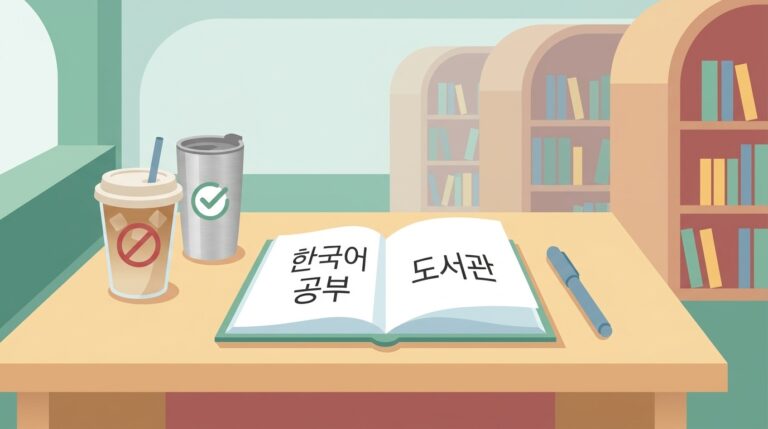
- K-Culture Moment: Korea is highly eco-conscious! In many quiet study libraries, open plastic cups with straws are strictly banned to prevent spills on precious books, but closed tumblers are often gladly welcomed.
- Editor’s Insight: This is a fantastic survival tip! If they say no to your plastic cup, immediately follow up with this question if you have a personal flask. It shows you care about their rules and the books.
- Situation Spectrum:
- Friends/Casual: ✅
- Library Staff/Polite: ✅
- Elders/Superiors: ✅
Phase 3: Textbook Korean vs. Real Korean
When you study with standard textbooks, the language can sometimes sound like a robotic instruction manual. Let’s look at how textbooks teach this versus how real Koreans actually say it in public spaces!
Situation 1: Asking if you can bring a cup of coffee inside
- 📖 Textbook Korean: “음식물 반입은 불가능합니까?” (Eum-sik-mul ban-ip-eun bul-ga-neung-hap-ni-ka? – “Is it impossible to bring in food items?”)
- 🗣️ Real Korean: “여기 커피 들고 들어가면 안 돼요?” (Yeo-gi keo-pi deul-go deul-eo-ga-myeon an dwae-yo? – “Can I not carry coffee inside here?”)
- 💡 Why is it different? Textbooks use heavy grammatical endings. In real life, Koreans prefer to point out the specific object (“coffee”) and use the friendly, softer ending -면 안 돼요? (-myeon an dwae-yo? – Is it not allowed to…?).
Situation 2: Confirming if water is allowed
- 📖 Textbook Korean: “식수를 소지하고 입장해도 되겠습니까?” (Sik-su-reul so-ji-ha-go ip-jang-hae-do doe-get-seup-ni-ka? – “May I enter possessing drinking water?”)
- 🗣️ Real Korean: “물은 괜찮죠?” (Mul-eun gwaen-chan-chyo? – “Water is fine, right?”)
- 💡 Why is it different? Koreans love efficiency. Adding the ending -죠 (-chyo) implies you assume water is naturally allowed (which it almost always is), keeping the conversation fast and friendly.
Phase 4: K-Culture Deep Dive & Non-verbal Manners
4-1. The Art of 눈치 (Nunchi) and Library Manners
In Korea, 눈치 (Nunchi – situational quick-wittedness) is everything. If you walk into a library with a drink, before you even open your mouth, take a quick look around.
* The Visual Check: Are there other people with plastic cups on their desks? Or does everyone have closed metal tumblers?
* The Gentle Bow: When asking the librarian, tilt your head slightly (about 15 degrees) while holding your cup with both hands. Holding your coffee with both hands shows respect and signals that you care about not spilling it.
4-2. The Korean Study Culture Code: 독서실 (Dok-seo-sil) vs. 북카페 (Book Cafe)
Korea has a unique, intense study culture. You might hear of a 독서실 (dok-seo-sil), which is an ultra-quiet, cubicle-style study room where even turning a book page too loudly might get you some stares. On the other hand, Korea is the birthplace of gorgeous 북카페 (book cafes) where you can drink delicious hand-drip coffee while reading brand-new novels. Public libraries sit right in the middle: silent study zones are strictly “No Food/Drink,” while lobby areas often have relaxing lounge spaces where you can drink your sweet potato latte!
Phase 5: Interactive Roleplay Scenario
The Setting: It is a peaceful, rainy afternoon in Seoul. You’ve walked into a beautiful public library near a university. You are holding a freshly made green tea latte from a cute local cafe. A kind-looking librarian named Min-jun (민준) is sitting behind the information desk.
Cast:
* You (The Learner)
* Min-jun (The Friendly Librarian)
- You: (🎭 Holding your latte with both hands, stepping up to the desk) 저기요, 실례합니다.
(Jeo-gi-yo, sil-rye-hap-ni-da. / Excuse me.) - Min-jun: (🎭 Looks up and smiles warmly) 네, 안녕하세요! 무엇을 도와드릴까요?
(Ne, an-nyeong-ha-se-yo! Mu-eot-eul do-wa-deu-ril-ka-yo? / Yes, hello! How can I help you?) - You: (🎭 Pointing slightly to your drink) 혹시… 여기 음료수 가지고 들어가도 돼요?
(Hok-si… yeo-gi eum-ryo-su ga-ji-go deul-eo-ga-do dwae-yo? / By any chance… can I bring a drink in here?) - Min-jun: (🎭 Making a slightly apologetic face) 아, 죄송합니다. 저희 도서관은 음식물 반입 금지예요. 일반 플라스틱 컵은 들고 들어가실 수 없어요.
(Ah, joe-song-hap-ni-da. Jeo-hui do-seo-gwan-eun eum-sik-mul ban-ip geum-ji-yeo-yo. Il-ban peu-las-tik keob-eun deul-go deul-eo-ga-sil su eob-seo-yo. / Ah, I’m sorry. Our library has a ‘no food or drinks’ policy. You cannot bring in regular plastic cups.) - You: (🎭 Nodding understandingly) 아, 그렇군요. 일반 컵은 안 되는군요.
(Ah, geu-reoh-gun-yo. Il-ban keob-eun an doe-neun-gun-yo. / Ah, I see. Regular cups are not allowed.) - Min-jun: 네, 책에 음료를 쏟을까 봐 걱정돼서 그렇습니다.
(Ne, chaeg-e eum-ryo-reul ssod-eul-ka bwa geok-jeong-dwae-seo geu-reot-seup-ni-da. / Yes, we worry people might spill drinks on the books.)
(🔀 Decision Point! What will you do next? Choose your path!)
- Option A: “그럼 물은 괜찮아요?” (Geu-reom mul-eun gwaen-chan-ha-yo? – Then is water okay?)
- Option B: “텀블러에 담은 음료는 괜찮나요?” (Teom-beol-reo-e dam-eun eum-ryo-neun gwaen-chan-na-yo? – Are drinks in a tumbler okay?)
- Option C: “그럼 밖에서 다 마시고 들어갈게요.” (Geu-reom bakk-ee-seo da ma-si-go deul-eo-gal-ge-yo. – Then I’ll drink it all outside and enter.)
💡 Decision Analysis:
- Best Choice – Option B (Polite & Resourceful): Min-jun will likely smile and say, “네, 텀블러는 괜찮습니다!” (Yes, tumblers are fine!). This is the most common loophole in Korean libraries.
- Safe Choice – Option C (Super Considerate): Min-jun will appreciate your cooperation highly and might say, “감사합니다! 천천히 드시고 들어오세요.” (Thank you! Enjoy your drink slowly and then come inside.)
- Simple Choice – Option A (Good to Know): Very practical! Water in closed plastic bottles is almost always allowed.
Phase 6: 10-Second Emotion Shadowing Drill
Let’s practice speaking with real Korean feelings! Pay attention to the slash / marks—they show you where to take a tiny breath.
- [😊 Polite and Curious]
- 혹시 / 여기 음료수 / 가지고 들어가도 돼요?
- Hok-si / yeo-gi eum-ryo-su / ga-ji-go deul-eo-ga-do dwae-yo?
- [🥺 Apologetic and Polishing your Nunchi]
- 아, 죄송해요. / 텀블러는 / 괜찮을까요?
- Ah, joe-song-hae-yo. / Teom-beol-reo-neun / gwaen-chan-eul-ka-yo?
- [😤 Understanding and Cheerful]
- 아, 네! / 밖에서 / 다 마시고 / 들어갈게요!
- Ah, ne! / Bakk-ee-seo / da ma-si-go / deul-eo-gal-ge-yo!
Phase 7: K-Culture Mini Dictionary
| Word | Hangul + Romanization | Real-World Context & Cultural Meaning |
|---|---|---|
| No Entry for Food | 반입 금지 (Ban-ip geum-ji) | Literally “Entry Prohibited” for objects. You will see this on library doors, cinemas, and museums. |
| Outside Food | 외부 음식 (Oebu eumsik) | Literally “External Food.” Many Korean cafes allow you to study but put up signs saying “외부 음식 반입 금지” (No outside food allowed). |
| Tumbler | 텀블러 (Teombeolleo) | Reusable cups or flasks. Korea has a massive tumbler culture; even cafes give discounts if you bring your own teombeolleo! |
| Cafe Studiers | 카공족 (Kagongjok) | A portmanteau of “Cafe” (카페) + “Gongbu” (공부 – study) + “Jok” (족 – tribe). People who love to study in cafes rather than quiet libraries. |
Phase 8: Traveler’s Survival Kit
Survival Expressions TOP 3 🚨
- “이거 보관해 주실 수 있나요?”
- I-geo bo-gwan-hae ju-sil su in-na-yo?
- Pro Tip: If you have an expensive drink you can’t bring inside, ask the front desk to hold it for you! Many library desks have drink holders just for this.
- “음료 보관대 어디 있어요?”
- Eum-ryo bo-gwan-dae eo-di is-seo-yo?
- Pro Tip: Many modern Korean libraries have a “Drink Storage Shelf” (음료 보관대) outside the study room where you can safely leave your cup.
- “물 마시는 곳 어디예요?”
- Mul ma-si-neun got eo-di-ye-yo?
- Pro Tip: Use this to find the water purifier (정수기 – jeong-su-gi), which is free and present in 99% of Korean libraries!
📌 Editor’s Travel Note: To locate the nearest public library or study cafe, do not rely on Google Maps in Korea. Instead, use the Naver Map App Download Page to find highly detailed locations, opening hours, and real-time reviews from local students!
Phase 9: Deep Thoughts — “한 발 더 깊이” (One Step Deeper)
In some countries, public libraries are places where you can lounge with a giant bag of potato chips and a soda. In Korea, however, public spaces like library study rooms are treated with extreme collective respect. Because study rooms are shared spaces where students prepare for highly competitive exams (like the civil service exams), silence and cleanliness are prioritized. Thus, the ban on food is not just about keeping the carpets clean—it is about showing respect to the absolute concentration of others.
💬 Your Turn: How does library etiquette in your country compare? Do people eat meals inside, or is it strictly water-only? Let us know in the comments below!
Phase 10: FAQ & Avoiding Misunderstandings
Q: Can I bring cold bottled water into the library study hall?
A: Yes! Water in a sealed plastic bottle (with a cap) or a personal tumbler is almost universally accepted inside Korean libraries because it poses a very low risk of major spills or bad smells.
Q: Can I eat small candy or chewing gum quietly?
A: Depends. While small, noiseless candies (like throat lozenges) are generally overlooked, crunchy snacks like chips or loud chewing gum are highly discouraged in silent study zones. If you must have a snack, head to the library’s lobby or lounge.
Q: What if I accidentally bring food inside and get caught?
A: Don’t panic! The library staff will kindly say “음식물 반입 안 됩니다” (No carrying food inside). Simply bow your head slightly, say “아, 죄송합니다!” (Ah, I’m sorry!), and walk outside to finish your food or put it in your bag.
🚨 Common Mistakes Warning Board
- Mistake 1: Hiding an open plastic coffee cup in your backpack. (It will spill and ruin your books! Put it on the outside pouch or use the eum-ryo bo-gwan-dae drink shelf.)
- Mistake 2: Walking in while chewing loudly. (Sound travels fast in silent libraries. Finish chewing before crossing the threshold.)
- Mistake 3: Throwing half-full drink cups in the paper recycling bin. (In Korea, liquid waste must be poured down a sink before disposing of the plastic cup.)
Phase 11: Action Mission!
- 🥉 Bronze (Room Challenge): Record yourself saying “음료수 가지고 들어가도 돼요?” on your phone. Focus on making the ending sound friendly and rising in pitch!
- 🥈 Silver (Network Challenge): Take a photo of your favorite study drink, upload it on social media, and write: “이거 가지고 들어가도 돼요? ☕ #DailyHangul” to practice your Korean spelling!
- 🥇 Gold (Real-world Challenge): Next time you enter a cafe, library, or book exhibition in Korea, ask the staff: “텀블러는 괜찮아요?” and enjoy their warm, eco-friendly smile!
Phase 12: Interactive Quiz Challenge
Test your library survival skills below! Click on the toggle to check your answers.
1. Which phrase is the most natural way to ask if your iced latte can go inside?
- A) 물 마시는 곳 어디예요?
- B) 여기 음료수 가지고 들어가도 돼요?
- C) 외부 음식 반입 금지예요.
🔍 View Answer & Explanation
Correct Answer: B
* Explanation: “여기 음료수 가지고 들어가도 돼요?” means “Can I bring a drink inside here?” which is the perfect and polite way to ask! Option A asks for the water fountain, and Option C is a statement telling you that outside food is banned.
2. True or False: You can always bring an open cup of boba tea (bubble tea) into a silent study room in Korea.
🔍 View Answer & Explanation
Correct Answer: False
* Explanation: Open plastic cups with straws are usually banned in silent library halls because of the high risk of spilling sweet, sticky liquid on books and desk surfaces. Stick to closed tumblers or drink it beforehand!
Great job today! You are now fully equipped to explore the beautiful world of Korean libraries without any anxiety. Happy studying, and see you in the next unit of Daily Hangul! 다음 주에 또 만나요! (Dae-eum ju-e tto man-na-yo! – See you again next week!) 👋







