

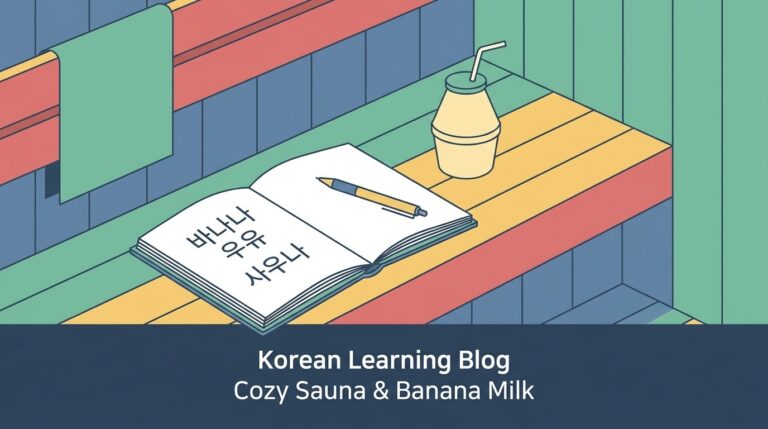
The Ultimate Jjimjilbang Ritual: Why Koreans Drink Banana Milk After a Sauna
안녕하세요! (Annyeonghaseyo!) I am your Senior Editor at Daily Hangul, your trusty guide to navigating the beautiful, steamy, and delicious world of Korean culture.
Have you ever watched a K-drama where the characters, wearing cute towel hats that look like sheep ears, step out of a sizzling hot sauna room and immediately reach for a little, jar-shaped yellow bottle? You might wonder: “Why banana milk? Why not cold water or a sports drink?”
If you have ever felt intimidated about entering a Korean public bath (목욕탕 – mogyoktang) or a 24-hour sauna (찜질방 – jjimjilbang), you are not alone! Many of my B1-level students admit they feel shy or confused about the unspoken social codes inside. Today, we are going to crack the code on Korea’s most comforting post-bath ritual: 사우나 끝나고 바나나 우유 마시기 (sa-u-na kkeut-na-go ba-na-na u-yu ma-si-gi – drinking banana milk after a sauna).
By the end of this guide, you will know exactly what to say, how to act, and why this sweet drink represents the ultimate Korean comfort.
1. Three Core Expressions for the Ultimate Sauna Glow
To sound like a true local while cooling down, you need these three essential expressions in your linguistic toolkit.
① 개운하다 (Gae-un-ha-da)
- Pronunciation: Gae-un-ha-da / [gah-oon-hah-dah]
- Meaning: To feel refreshed, physically relieved, and light.
- K-Culture Moment: This is the exact word Koreans sigh out loud when they step out of a 42°C hot tub or finish a heavy sweat session in a clay dome.
- Editor’s Insight: Do not confuse this with 상쾌하다 (sang-kwae-hada), which is the breezy freshness you feel when brushing your teeth or smelling mint. 개운하다 is a deep, physical release—like your muscles have turned to jelly in the best way possible.
- Situation Spectrum:
- Casual (Friends): ✅ 아, 개운하다! (Ah, gae-un-ha-da!)
- Semi-formal (Colleagues): ✅ 정말 개운하네요. (Jeong-mal gae-un-ha-ne-yo.)
- Formal (Elders/Boss): ⚠️ Use politely: 몸이 아주 개운합니다. (Mom-i a-ju gae-un-ham-ni-da.)
- 🤔 Think About It: In many Western cultures, being hot and sweaty is associated with discomfort. Why do you think Korean culture embraces intense heat as a pathway to feeling “refreshed”? How does your native language express this state of physical relief?
② 목 축이다 (Mok chug-i-da)
- Pronunciation: Mok chug-i-da / [mahk choog-ee-dah]
- Meaning: Literally “to moisten one’s throat.” (To quench your thirst / wet your whistle).
- K-Culture Moment: After sweating out all your water weight in the Hanjeungmak (stone kiln), you grab an icy beverage with your friends.
- Editor’s Insight: While 물 마시다 (mul ma-si-da – drink water) is purely functional, 목 축이다 implies a poetic, satisfying transition from dry throat to pure hydration.
- Situation Spectrum:
- Casual (Friends): ✅ 시원하게 목 좀 축이자! (Si-won-ha-ge mok jom chug-i-ja!)
- Semi-formal (Colleagues): ✅ 시원한 걸로 목 좀 축여요. (Si-won-han geol-lo mok jom chug-yeo-yo.)
- Formal (Elders/Boss): 🚫 Too casual. Use: 음료수 드시겠습니까? (Eum-ryo-su deu-si-get-seum-ni-ka?)
- 🤔 Think About It: Moistening the throat is often a social cue in Korea to take a break together. It is rarely done entirely alone when you are in a group.
③ 살 것 같다 (Sal geot gat-da)
- Pronunciation: Sal geot gat-da / [sahl-geot-gaht-dah]
- Meaning: Literally “I feel like I will live.” (Ah, I feel revived! / This is heaven!)
- K-Culture Moment: Taking that first sweet sip of cold banana milk while resting on the cool polished floor of the Jjimjilbang.
- Editor’s Insight: This is a dramatic but incredibly common hyperbole. You use it whenever a physical discomfort (extreme heat, cold, or hunger) is instantly cured by something wonderful.
- Situation Spectrum:
- Casual (Friends): ✅ 와, 이제야 살 것 같다! (Wa, i-je-ya sal geot gat-da!)
- Semi-formal (Colleagues): ✅ 이제 좀 살 것 같아요. (I-je jom sal geot gat-a-yo.)
- Formal (Elders/Boss): ⚠️ Slightly dramatic, but acceptable with polite endings: 이제야 살 것 같습니다. (I-je-ya sal geot gat-seum-ni-da.)
2. Textbook Korean vs. Real Korean
When we study from textbooks, we learn standard sentences that can sometimes sound a bit robotic in real life. Let’s look at how to sound natural at the Jjimjilbang.
Situation 1: Declaring your post-sauna plan
- 📖 Textbook: “사우나를 마친 후에 음료수를 마실 것입니다.” (Sa-u-na-reul ma-chin hu-e eum-ryo-su-reul ma-sil geot-im-ni-da.)
- Translation: “After finishing the sauna, I will consume a beverage.”
- 🗣️ Real Korean: “사우나 끝났으니까 시원한 바나나 우유 한 잔 때려야지!” (Sa-u-na kkeut-nas-eu-ni-kka si-won-han ba-na-na u-yu han jan ttae-ryeo-ya-ji!)
- Translation: “Now that the sauna is done, I’ve got to smash a cold banana milk!”
- 💡 Why the difference? Real Koreans use the slang verb 때리다 (ttae-ri-da – literally “to hit”) to express craving and eagerly consuming food or drink (e.g., 커피 한 잔 때리자 = let’s grab a coffee).
Situation 2: Reacting to the hot tub bath
- 📖 Textbook: “온탕의 온도가 적당하여 기분이 좋습니다.” (On-tang-ui on-do-ga jeok-dang-ha-yeo gi-bun-i joh-seum-ni-da.)
- Translation: “The temperature of the hot tub is appropriate, so I feel pleasant.”
- 🗣️ Real Korean: “아~ 뜨끈한 게 진짜 좋다…” (Ah~ tteu-keun-han ge jin-jja joh-da…)
- Translation: “Ah, this cozy warmth is truly the best…”
- 💡 Why the difference? 뜨끈하다 (tteu-keun-hada) means a deep, comforting, deeply-penetrating heat (unlike 뜨겁다 which can mean painfully hot). It is the ultimate word for warm comfort foods and baths.
3. K-Culture Deep Dive: The History of the Yellow Bottle
3-1. Body Language & Sauna Manners
When you go to a Korean bathhouse, the first things you will see are people walking around with towel hats shaped like sheep heads (양머리 – yang-meori). To roll your own towel: fold it into thirds lengthwise, then roll both ends outward like sleeves until it fits snugly on your head!
Another non-verbal cue is 눈치 (nunchi – social intuition) regarding shared spaces. When splashing water at your washing station, make sure you do not splash your neighbors. And when you finally sit down to drink your banana milk, it is common to sit cross-legged on the heated floor rather than on chairs, sharing the space peacefully with complete strangers.
3-2. Why Banana Milk? The Nostalgia of 1974
In 1974, Binggrae launched its famous 바나나맛 우유 (Banana Flavored Milk). Back in the 1970s, bananas were an extremely expensive import luxury in South Korea. The government wanted to encourage citizens to drink more milk, so Binggrae created a banana-flavored milk to appeal to the masses.
At the same time, public bathhouses were booming because ordinary homes did not have hot running water. Going to the public bath on the weekend was a massive family event. After hours of scrubbing off dead skin, dehydrated children were rewarded by their parents with a sweet, luxurious bottle of cold banana milk. Today, even though houses have modern showers, that nostalgic flavor association remains unbroken. It is the taste of sweet reward after hard work.
4. Interactive Roleplay: The Post-Sauna Chill
- Setting: You are sitting on the warm, polished wood floor of “Seoul Forest Jjimjilbang.” The air smells lightly of mugwort and charcoal. Your skin is pink and glowing.
- Cast: You and Minjun (your trendy Korean friend, who is currently adjusting his sheep-ear towel hat).
1. Minjun: (🎭 Slapping his cheeks gently to cool down)
   아, 진짜 개운하다! 너는 어땠어?
   (Ah, jin-jja gae-un-ha-da! Neo-neun eo-ttaes-eo?)
   "Ah, I feel so refreshed! How was it for you?"

2. You: (🎭 Wiping a bead of sweat from your forehead)
   처음에는 조금 뜨거웠는데, 지금은 진짜 시원해!
   (Cheo-eum-e-neun jo-geum tteu-geo-wot-neun-de, ji-geum-un jin-jja si-won-hae!)
   "It was a bit hot at first, but now it feels really cool and refreshing!"

3. Minjun: (🎭 Laughing warmly)
   맞아, 그게 찜질방의 매력이지. 이제 땀 많이 흘렸으니까 목 좀 축여야지?
   (Ma-ja, geu-ge jjim-jil-bang-ui mae-ryeok-i-ji. I-je ttam ma-ni heul-lyeot-eu-ni-kka mok jom chug-yeo-ya-ji?)
   "Exactly, that's the charm of the Jjimjilbang. Now that we've sweat a lot, shall we wet our whistles?"

4. You: (🎭 Noding eagerly)
   응! 안 그래도 목말라. 매점에 뭐 팔아?
   (Eung! An geu-rae-do mok-mal-la. Mae-jeom-e mwo pal-a?)
   "Yes! I'm thirsty anyway. What do they sell at the snack bar?"

5. Minjun: (🎭 Pointing toward the brightly lit snack counter)
   식혜도 있고, 구운 계란도 있고, 그리고 대망의 바나나 우유도 있어! 넌 어떤 걸로 할래?
   (Sik-hye-do it-go, gu-un gye-ran-do it-go, geu-ri-go dae-mang-ui ba-na-na u-yu-do it-go! Neon eo-tteon geol-lo hal-rae?)
   "They have Sikhye (sweet rice punch), baked eggs, and... the legendary banana milk! Which one do you want?"
🔀 Your Decision Point!
How do you answer Minjun to show off your B1-level natural Korean?
- Option A: “저는 아무거나 마셔도 괜찮습니다.”
- Option B: “여기서 바나나 우유 안 마시면 불법이잖아! 무조건 바나나 우유!”
- Option C: “식혜가 건강에 좋을 것 같습니다.”
💡 Feedback on Your Choice:
- Best Choice: Option B! (“Here, if you don’t drink banana milk, it’s illegal! Definitely banana milk!”)
Using the humorous hyperbole 불법이잖아 (bul-beob-i-ja-na – “it’s illegal, you know”) shows you understand the cultural weight of this combination. It will instantly crack Minjun up! - Risk Choice: Option A. While polite, saying “anything is fine” (아무거나) kills the fun vibe of picking the ultimate sauna snack.
5. 10-Second Emotional Shadowing Drill
To sound truly natural, you must practice the emotional flow of Korean speech. Try repeating these sentences, paying close attention to the emotion and pauses (/).
- [😊 Relieved and fully relaxed]
아… / 온탕에 들어오니까 / 진짜 / 살 것 같다…
Ah… / on-tang-e deu-reo-o-ni-kka / jin-jja / sal geot gat-da…
(Ah… stepping into the hot tub… I feel truly alive…) - [🤤 Craving with high excitement]
사우나 다 했으니까 / 시원하게 / 바나나 우유 / 한 잔 때려야지!
Sa-u-na da haet-eu-ni-kka / si-won-ha-ge / ba-na-na u-yu / han jan ttae-ryeo-ya-ji!
(Now that the sauna is all done, I’ve gotta smash a cold banana milk!)
6. K-Culture Mini Dictionary
| Word | Romanization | English Meaning | Cultural Context |
|---|---|---|---|
| 찜질방 | Jjim-jil-bang | Korean 24-hour Sauna | A multi-room public bath facility featuring hot saunas, sleeping areas, and snack bars. |
| 양머리 | Yang-meori | Sheep Head Towel | A cute way of folding a bath towel to wear on your head like sheep ears inside the sauna. |
| 식혜 | Sik-hye | Sweet Rice Punch | A traditional sweet dessert drink containing grains of cooked rice, loved for its cooling properties. |
| 세신사 | Se-sin-sa | Professional Body Scrubber | Masters of exfoliation inside bathhouses who scrub off dead skin cells with an intense “italy towel.” |
7. Traveler’s Survival Kit
If you are planning to visit a Jjimjilbang in Korea, keep these three survival phrases handy!
- Card 1: Entering the counter
- 🗣️ “수건 몇 장 주시나요?” (Su-geon myeot jang ju-si-na-yo?)
- 🇺🇸 How many towels do you provide?
- 📌 Pro Tip: Usually, men get unlimited towels inside, while women are given two towels at the counter due to historic usage patterns!
- Card 2: Buying snacks
- 🗣️ “바나나 우유랑 구운 계란 세 개 주세요.” (Ba-na-na u-yu-rang gu-un gye-ran se gae ju-se-yo.)
- 🇺🇸 Please give me a banana milk and three baked eggs.
- 📌 Pro Tip: In modern Jjimjilbangs, you pay by tapping your locker key wristband instead of carrying cash. You pay the total balance when you leave!
- Card 3: Locating facilities
- 🗣️ “아이스방이 어디에 있어요?” (A-i-seu-bang-i eo-di-e is-seo-yo?)
- 🇺🇸 Where is the ice room?
- 📌 Pro Tip: Alternating between hot steam rooms and the cold Ice Room is the secret to a perfect circulation boost.
📌 Editor’s Travel Note: Before you head out, download the Naver Map App Download Page to find the highest-rated local neighborhood jjimjilbangs. Many tourists go to giant luxury ones, but neighborhood bathhouses offer the most authentic local charm!
8. Deep Thought: Naked Intimacy (목욕탕 친밀감)
In many Western cultures, being naked around others can feel intensely awkward. However, in Korea, there is a concept of 목욕탕 친밀감 (mogyoktang chinmilgam – bathhouse intimacy).
Starting from childhood, Koreans go to these bathhouses with parents, grandparents, and close friends. Stripping away clothes, makeup, and fancy brands acts as a social equalizer. It is a space where you cannot hide behind social status. In business culture, sometimes bosses and subordinates will go together to resolve lingering tensions. It teaches us that true emotional bonding sometimes starts by shedding our social armor and just being human together.
💬 Your Turn: Does your culture have a space where people let go of social hierarchies and bond? Share your thoughts in the comments below!
9. FAQ & Avoiding Common Mistakes
Q: Can I wear my swimsuit inside the bathing area?
A: No. Inside the actual gender-segregated bathing and hot tub area, you must enter completely naked. Wearing a swimsuit is actually considered unhygienic in Korea. However, in the shared unisex lounging area (the Jjimjilbang zone), you must wear the t-shirt and shorts uniform provided at the reception.
Q: Why do people call hot soup and hot tubs “시원하다” (cool)?
A: This is a famous linguistic trap! When older Koreans enter a boiling hot tub or eat scorching hot spicy soup, they groan, *







