

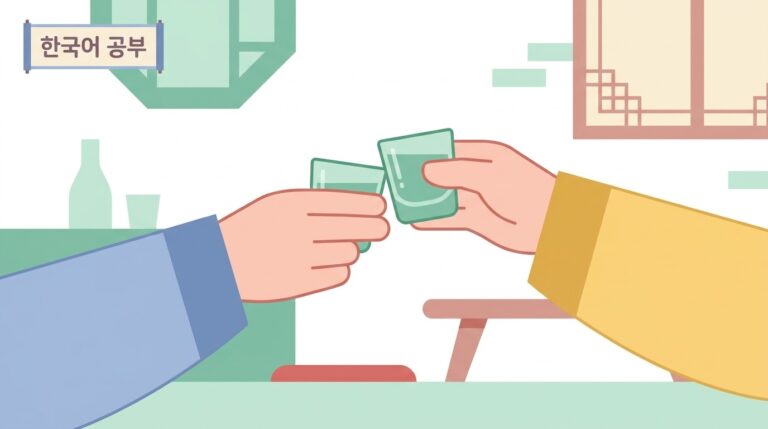
Mastering the Art of the Korean Table: Drinking Etiquette, Toasts, and the Unwritten Rules of Social Bonding
안녕하세요! I’m your head editor at Daily Hangul, your trusty local guide and Korean culture navigator. Have you ever watched a Korean drama where characters sit at a smoky barbecue joint, clinking green bottles of soju (소주), and wondered: “Why did they turn their heads to drink? And why did they use two hands to pour a tiny glass?”
If you have an upcoming business dinner (회식 – hoesik) in Seoul, or if you’ve been invited to drink with Korean friends, navigating these unspoken social mechanics can feel like walking through a minefield of polite gestures. But don’t worry! Today, we are going to dive deep into the cultural psychology behind Korean drinking etiquette and master three essential toasts that will instantly turn you from an awkward bystander into a beloved dinner guest.
This guide is built on real-world feedback from advanced learners who transitioned from textbook Korean to the fast-paced, relationship-driven world of Korean social life. Let’s get pouring!
Phase 2: Deep Dive into 3 Core Expressions
To survive and thrive in a Korean drinking setting, you need more than just a simple “Cheers!”. Here are three expressions that reflect different facets of Korea’s relational hierarchy and bonding culture.
1. 수고하셨습니다 (Su-go-ha-syeot-seumnida)
- Pronunciation: [su-go-ha-syeot-seumnida] / soo-go-ha-shut-sum-nee-da (Sound-alike: “Sue-go” + “ha” + “shut” + “sum-nee-da” without the hard ‘t’ sound at the end)
- Meaning:
- Literal: “You have labored hard.”
- Real-world Nuance: “Cheers to our hard work!” or “Excellent job today, everyone!”
- K-Culture Moment: This is the quintessential post-work toast. Imagine an office team in a drama like Misaeng (미생) collapsing into a plastic-tabled tavern after solving a massive logistics crisis. The team leader raises a glass, and everyone bellows this in unison.
- Editor’s Insight: This phrase carries a deep sense of communal relief. By saying this, you are acknowledging the shared stress and labor of the group, which instantly builds a bridge of empathy.
- Situation Spectrum:
- Friends & Casual: ⚠️ (Can sound slightly too formal for close friends, but acceptable after a grueling group project)
- Coworkers & Semi-formal: ✅
- Bosses & Formal: ✅
- 🤔 Think About It: Unlike English, where “good job” usually flows from a superior to a subordinate, “수고하셨습니다” can be exchanged laterally or even offered to superiors (though with the appropriate honorific ending). Why does Korean culture place such a high premium on verbally validating mutual effort at the end of a day?
2. 밑잔 빼기 금지 (Mit-jan ppae-gi geum-ji)
- Pronunciation: [mit-jan ppae-gi geum-ji] / meet-jahn ppae-ghee geum-jee (Sound-alike: “Meet” + “John” + “pay” + “ghee” + “gum” + “jee”)
- Meaning:
- Literal: “Pulling out the bottom glass is forbidden.”
- Real-world Nuance: “No leaving half-empty glasses!” or “Drink it all, no cheating!”
- K-Culture Moment: This is the ultimate icebreaker in youthful, energetic drinking circles—often seen in college-themed K-Dramas like Work Later, Drink Now (술꾼도시여자들). It’s teased when someone tries to sneakily set down a glass that still has a sip left.
- Editor’s Insight: Korean drinking culture values synchronization. Everyone is expected to share the same state of tipsiness at the same pace. This playful reprimand keeps everyone on the same page.
- Situation Spectrum:
- Friends & Casual: ✅
- Coworkers & Semi-formal: ⚠️ (Use only if the vibe is highly relaxed and energetic)
- Bosses & Formal: 🚫 (Never call out a senior colleague for this!)
- 🤔 Think About It: How does your home culture view individuals who drink slower than the rest of the group? Is it seen as personal autonomy, or does it carry a slight social penalty like it sometimes does in Korea?
3. 원샷 (Won-syat)
- Pronunciation: [won-syat] / one-shot (Sound-alike: Exactly like the English “one shot”, but with a very crisp, short ending on the “t”)
- Meaning:
- Literal: One shot.
- Real-world Nuance: “Bottoms up!” / “Empty the glass in one go!”
- K-Culture Moment: Found in almost every K-Drama celebratory scene. When a group of friends celebrates a promotion, a confession, or simply a weekend, the leader of the toast yells “원샷!”
- Editor’s Insight: While common, be careful. If a senior colleague proposes a “원샷”, you are culturally expected to comply (or at least pretend to drink deeply). However, do not initiate this with a superior unless you want to look overly aggressive.
- Situation Spectrum:
- Friends & Casual: ✅
- Coworkers & Semi-formal: ✅
- Bosses & Formal: ⚠️ (Only if initiated by the superior)
- 🤔 Think About It: “원샷” is a loanword from English, yet its social function in Korea is deeply embedded in local collectivist drinking norms. How do loanwords acquire new, culturally specific weights when they enter a new language?
Phase 3: Textbook Korean vs. Real Korean
When you learn Korean from a standard textbook, the phrases are grammatically flawless but often sound incredibly stiff—sometimes even sterile. Let’s look at how to bridge the gap.
Situation 1: Declining another drink politely
- 📖 Textbook Korean: 저는 더 이상 술을 마실 수 없습니다. (Jeoneun deo isang sureul masil su eopseumnida.)
- Why it’s awkward: It sounds like a medical declaration or a strict legal deposition. It can inadvertently kill the warm atmosphere of the table.
- 🗣️ Real Korean: 아, 제가 술이 좀 약해서요. 오늘은 여기까지 하겠습니다! (Ah, jega suri jom yakhaeseoyo. Oneureun yeogikkaji hagetseumnida!)
- Why it works: It utilizes the “softener” ~해서요 (because…) and gently frames the limit as a personal trait rather than a flat refusal. It politely says, “Ah, my alcohol tolerance is a bit weak, so I’ll wrap it up here today!”
Situation 2: Proposing a casual toast
- 📖 Textbook Korean: 우리 모두의 건강을 위하여 건배합시다. (Uri moduuikr geon-gangeul wihayeo geonbaehapsida.)
- Why it’s awkward: It sounds like a political speech from the 1980s. Unless you are at an official state banquet, it feels incredibly detached.
- 🗣️ Real Korean: 자, 오늘 다들 고생 많으셨으니까, 기분 좋게 한잔 마십시다! (Ja, oneul dadeul gosaeng maneusyeosseumikka, gibun jotge hanjan masipsida!)
- Why it works: It acknowledges the group’s hard work (고생 많으셨으니까) and suggests drinking with good feelings (기분 좋게), which aligns perfectly with modern, warm-hearted Korean social dynamics.
Phase 4: K-Culture Deep Dive & Non-Verbal Manners
4-1. The Physics of Respect: Non-Verbal Etiquette
In Korea, how you drink is often more important than what you drink. If you are drinking with someone older or higher in the company hierarchy, keep these physical rules in mind:
- The Two-Hand Rule: Always pour and receive drinks with both hands. Place your right hand around the bottle/glass, and place your left hand gently under your right forearm or wrist as a sign of respect.
- The Turn-Away: When taking a sip in front of a senior, turn your head and torso slightly away from them. Shield your glass with your hand if possible. Drinking directly facing a senior can be perceived as overly familiar or even defiant.
- Never Pour Your Own Drink: Keeping a glass empty is a social faux pas, but pouring your own drink (자작 – jajak) is traditionally believed to bring bad luck (or at least, it shows that your companions aren’t paying attention to you). Always wait for someone to pour for you, and return the favor!
4-2. The Modern Evolution: Beyond Soju-Bombs
While K-Dramas often highlight chaotic Somaek (소맥 – Soju mixed with Beer) drinking sessions, modern Korean drinking culture is rapidly diversifying. Highball bars, natural wine boutiques, and craft Makgeolli (막걸리) breweries are dominating the trendier districts of Seoul like Seongsu-dong and Hannam-dong. However, even in a sleek natural wine bar, the core values of mutual respect and communal pouring remain deeply intact.
Phase 5: The Interactive Jongno Pub Scenario
Step into the role of a global research analyst in Seoul. It’s 8:30 PM on a rainy Tuesday. You are sitting in a cozy, wooden Hanok-style pub in Jongno with your team. The smell of savory pajeon (green onion pancake) fills the air. Team Leader Kang (강 부장님), a respected veteran of the company, is sitting across from you.
- 강 부장님: (🎭 Smiling warmly, holding a green bottle of soju with both hands) “자, 우리 신입 사원 씨! 오늘 프레젠테이션 아주 훌륭했어요. 내가 한잔 따라 줄게요.”
- (Now, our new team member! Today’s presentation was absolutely excellent. Let me pour you a glass.)
- You: (🎭 Quickly holding your glass with both hands, making sure the left hand supports your right wrist) “아, 부장님! 정말 감사합니다.”
- (Ah, Team Leader! Thank you so much.)
- 강 부장님: (🎭 Pouring the liquid smoothly to about 80% of the glass) “자, 다들 고생했으니까 다 같이 마십시다!”
- (Alright, everyone worked hard, so let’s all drink together!)
- You: (🎭 Holding the glass up respectfully, looking around at the team)
🔀 Decision Point!
What is your next move as Team Leader Kang raises his glass?
- Option A: You clink your glass above the rim of Team Leader Kang’s glass, yell “Cheers!”, and drink while looking him dead in the eye.
- Option B: You lower the rim of your glass slightly below his when clinking, say “수고하셨습니다!”, turn your head slightly to the left, shield your glass with your hand, and drink.
- Option C: You say “저는 오늘 술을 마실 수 없습니다” and put your glass down on the table immediately.
💡 Scenario Analysis:
- Best Choice: Option B! Lowering your glass rim shows humility. Turning your head and shielding the glass demonstrates impeccable Korean manners. Using the toast “수고하셨습니다” perfectly acknowledges the shared work of the day. You will instantly be recognized as a culturally sophisticated “인싸” (insider).
- Bad Choice: Option A! Clinking higher than a senior and drinking while facing them directly is considered quite rude in traditional Korean settings. It signals an assertion of equality or dominance.
- Risk Choice: Option C! While you always have the right to refuse alcohol, rejecting it bluntly without a soft explanation (“제가 술이 좀 약해서요”) can create a freezing tension at the table.
Phase 6: 10-Second Emotion Shadowing Drill
Let’s practice speaking with the exact emotional delivery of a native speaker. Pay attention to the pauses (/) and the emotional cues!
- [😊 Expressing heartfelt relief and gratitude at a work dinner]
- “오늘 / 진짜 / 고생 많으셨습니다! / 적셔!”
- [Oh-neul / jin-jja / go-saeng / ma-neu-syeot-seum-ni-da! / jeok-syeo!]
- (Today / really / you worked so hard! / Let’s get soaked/Cheers!)
- [🥺 Playfully complaining to a close friend who is leaving alcohol in their glass]
- “야, / 밑잔 빼기 / 금지야! / 얼른 다 마셔!”
- [Ya, / mit-jan / ppae-gi / geum-ji-ya! / eol-leun / da / ma-syeo!]
- (Hey, / leaving left-overs / is forbidden! / Drink up quickly!)
Phase 7: K-Culture Mini Dictionary
| Word (Korean + Romanization) | English Translation | Real-world Contextual Usage |
|---|---|---|
| 꺾어 마시다 (Kkeok-eo ma-si-da) | To sip a drink in parts | Used when you split a shot into two or three sips instead of downing it at once. “조금씩 꺾어 마셔도 돼요” (It’s okay to sip it slowly). |
| 흑기사 / 흑장미 (Heuk-gi-sa / Heuk-jang-mi) | Black Knight / Black Rose | A person who drinks a shot on your behalf when you cannot drink anymore. Often used playfully in exchange for a “wish” or favor. |
| 소맥 (Somaek) | Soju-Beer Cocktail | The ultimate casual Korean drink. Finding the perfect ratio of crispy lager to clean soju is considered a highly valued social skill. |
| 주량 (Ju-ryang) | Alcohol tolerance | A very common icebreaker question at dinners. “주량이 어떻게 되세요?” (What is your alcohol tolerance/how much can you drink?). |
Phase 8: Traveler’s Survival Kit
Survival Phrases for the Night Out
- “물 한 컵만 주세요!” [Mul han keop-man ju-se-yo!]
- Tip: “Just a glass of water, please!” Keep this handy when the soju starts catching up to you.
- “대리운전 불러 주실 수 있나요?” [Dae-ri-un-jeon bul-leo ju-sil su in-na-yo?]
- Tip: “Could you call a designated driver for me?” Korea has an incredibly efficient designated driver system (대리) where a driver takes you and your own car home safely.
- “계산서는 나누어서 해주세요.” [Gye-san-seo-neun na-nu-eo-seo hae-ju-se-yo!]
- Tip: “Please split the bill.” Note: While Dutch pay (더치페이) is common among friends, in traditional business settings, the most senior person usually pays the entire bill.
📌 Editor’s Travel Note:
When traveling or navigating Seoul’s nightlife districts like Hongdae, Itaewon, or Gangnam, do not rely on Google Maps—it is often outdated or lacks walking path details in Korea. Instead, make sure to download the Naver Map App Download Page for flawless local navigation and restaurant discovery. Also, note that tipping is absolutely not expected anywhere in Korea; doing so might actually cause confusion!
Phase 9: Deep Thoughts — “Collective Effervescence and Respect”
Korean drinking etiquette is a fascinating dance between vertical hierarchy (Confucian respect for age and status) and horizontal collectivism (the desire to become ‘one’ with the group). Unlike Western drinking cultures, which highly prioritize individual pacing and personal choice, the Korean table seeks a shared rhythm. You drink together, you pour for each other, and you collectively acknowledge work-related stress. While younger generations are pushing for more boundaries and personal autonomy, understanding this deep-rooted desire for communal harmony will help you appreciate why these elaborate manners exist. It is not about restriction; it is about establishing a safe, respectful space for emotional release.
💬 Your Turn: How does your culture handle social drinking etiquette? Is there a concept of showing respect through physical gestures, or is it more relaxed? Let me know in the comments below!
Phase 10: FAQ & Avoiding Common Mistakes
Q: What should I do if my Korean boss keeps offering me drinks, but I really cannot drink alcohol?
A: It is completely fine! You do not have to force yourself to drink. The key is to accept the gesture, not necessarily the chemical. Let them pour a glass of water, soda, or tea into your glass, and participate in the toasts. Simply state respectfully: “제가 건강상의 이유로 술을 못 마셔서, 음료수로 대신해도 되겠습니까?” (Due to health reasons, I cannot drink alcohol. May I substitute it with a soft drink?). Most modern managers will highly appreciate your honesty.
Q: Is it okay to pour a drink into a glass that is still half-full?
A: Generally, no. In Korea, this is called 첨잔 (cheom-jan). It is customary to wait until a glass is completely empty before refilling it. Refilling a half-full glass is sometimes associated with ancestral rites (where food/drink is continuously topped up for spirits), so it is avoided in lively social drinking.
Q: Can I pour a drink for myself if everyone else is busy talking?
A: Avoid self-pouring (자작) if possible. If you notice your glass is empty, the best trick is to find someone else with an empty glass, offer to pour for them first (“제가 한잔 드릴게요!”), and naturally, they will take the bottle and pour one back for you. It’s an elegant, non-verbal social cue!
🚨 The “Oops!” Board: Common Foreigner Mistakes
- The Single-Hand Grab: Grabbing the soju bottle with one hand like you’re in an action movie when pouring for a senior. Fix: Use both hands! Always support the bottle with your right hand and place your left hand on your wrist or under your chest.
- Eye-Contact Overload: Staring directly into your boss’s eyes while drinking down your shot. Fix: Turn your head to the side. It feels unnatural for Westerners who associate eye contact with honesty, but in Korea, direct eye contact during consumption is seen as aggressive.
- Pouring with the Left Hand: Pouring drinks or passing objects solely with your left hand. Fix: In Korean customs, the left hand should never be the active hand when serving others. Always use the right hand, supported by the left.
- Leaving early without saying anything: Slipping away quietly from a hoesik to avoid awkward goodbyes. Fix: While it feels less disruptive, always find the host or senior person, bow respectfully, and say: “오늘 정말 즐거웠습니다. 먼저 들어가 보겠습니다.” (I had a great time today. I will head out first.)
Phase 11: Action Missions
- 🥉 Bronze (The Mirror Challenge): Stand in front of your mirror. Hold a glass with both hands, lower it as if clinking with a virtual senior, turn your head 45 degrees to the left, and practice drinking while covering your glass with your left hand.
- 🥈 Silver (The Social Media Challenge): Post a picture of your favorite drink on Instagram or Twitter, and caption it with one of our toasts: “오늘 하루도 수고하셨습니다!” or “밑잔 빼기 금지!”
- 🥇 Gold (The Real-world Mission): The next time you visit a Korean restaurant or go out with Korean friends/colleagues, actively volunteer to pour the first round using perfect two-hand etiquette. Watch how their eyes light up with surprise and respect!
- 🎮 K-Culture Mission: Watch an episode of a slice-of-life K-Drama (such as My Mister or Hospital Playlist). Identify at least three instances where characters use the physical drinking etiquette we discussed today, and observe who initiates the toasts!
Phase 12: Interactive Quiz Challenge
Try your hand at this quick cultural check!
1. Scenario Question: You are drinking with your Korean team leader. They pour you a drink. How should you receive it?
Answer: You should hold your glass with both hands (right hand wrapping the glass, left hand supporting your right wrist or forearm) and bow your head slightly while thanking them. Receiving a drink with one hand is considered disrespectful to superiors.
2. Fill-in-the-Blank: When everyone at the table wants to make a toast to celebrate finishing a difficult project, they might yell “오늘 정말 ___________!” (You labored hard today!)
Answer: 수고하셨습니다 (su-go-ha-syeot-seumnida).
3. True or False: It is perfectly fine to refill your boss’s glass even if there is still some alcohol left in it.
Answer: False! In Korea, topping up a partially filled glass (첨잔 – cheom-jan) is generally avoided. Wait until the glass is completely empty before offering a refill.







