

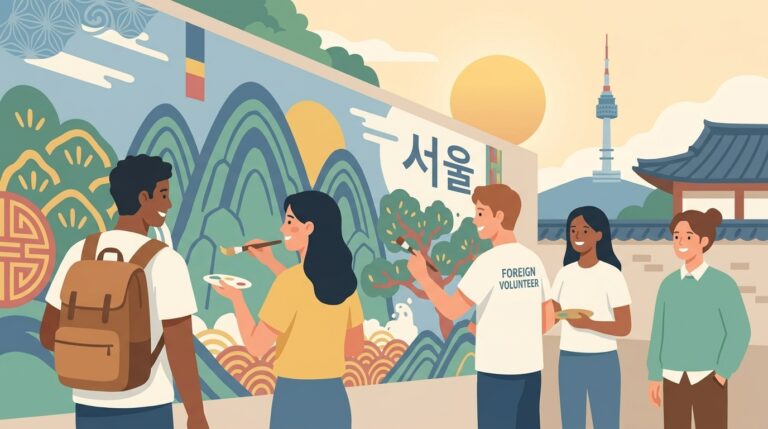
Warm Hearts, Shared Talents: The Ultimate Guide to Volunteering and Talent Donation in Korea
안녕하세요! Welcome back to another cozy session with Daily Hangul. I’m your chief editor, your trusty Korean friend, and your local guide to the heart and soul of Korea.
Have you ever watched a K-Drama where the main characters bundle up in winter to carry charcoal briquettes (연탄 봉사 / yeontan bongsa) to elderly neighbors in cozy, narrow alleys? Or maybe you’ve seen your favorite K-Pop idol donating their voice to record audiobooks for the visually impaired?
In Korea, volunteering isn’t just a checkbox on a resume; it’s a deeply rooted cultural practice driven by 정 (jeong – deep affection and community bond). Today, we are diving into the beautiful world of 재능 기부 (jaeneung gibu – talent donation) and volunteering. By the end of this guide, you won’t just know how to say “I want to volunteer” in textbook Korean—you will know how to offer your unique skills like a warm-hearted local.
Phase 2: Deep Dive into 3 Key Expressions
Let’s unpack three essential expressions you need to sound natural and respectful when offering your time and skills in Korea.
1. 재능 기부 (Jaeneung Gibu)
- Pronunciation: [jae-neung gi-bu] / Sounds like “Jane-ung ghee-boo”
- Meaning: Talent Donation (Literal: Talent Donation)
- K-Culture Moment: Think of K-Drama Hospital Playlist, where doctors perform free band concerts and medical services for those in need, using their professional skills to give back.
- Editor’s Insight: While 기부 (donation) usually refers to giving money or physical goods, 재능 기부 specifically highlights giving your skills—whether that’s teaching English, graphic design, photography, or even playing an instrument.
- Situation Spectrum:
- Friends & Casual: ⚠️ (A bit too formal for casual chat with a single friend, but great when explaining your hobbies)
- Co-workers & Semi-formal: ✅ (Highly respected and frequently used)
- Bosses & Formal: ✅ (Shows high cultural literacy and humility)
- 🤔 Think About It: Why does Korea use the word “donation” (기부) for sharing talents? It shows that time and skill are viewed as highly valuable gifts, equivalent to monetary contributions, fostering a sense of social equality.
2. 봉사 활동 (Bongsa Hwaldoing)
- Pronunciation: [bong-sa hwal-dong] / Sounds like “Bong-sah hwal-dong”
- Meaning: Volunteer Activities (Literal: Service Activities)
- K-Culture Moment: Often seen in warm, slice-of-life dramas where community members gather at the local 복지관 (community welfare center) to make kimchi together for the winter (김장 봉사).
- Editor’s Insight: This is the most standard, widely used term for any kind of volunteer work. If you are doing general volunteer work like cleaning up a park or helping at an animal shelter, this is your go-to phrase.
- Situation Spectrum:
- Friends & Casual: ✅
- Co-workers & Semi-formal: ✅
- Bosses & Formal: ✅
- 🤔 Think About It: Unlike in some Western cultures where volunteering is often individualistic, Korean 봉사 활동 is highly collective. Why do you think Koreans love doing these activities in large, coordinated groups?
3. 일손을 돕다 / 일손을 거들다 (Ilson-eul Dopda / Ilson-eul Geodeulda)
- Pronunciation: [il-son-eul dop-da] / [il-son-eul geo-deul-da]
- Meaning: To lend a helping hand (Literal: To help/assist a worker’s hand)
- K-Culture Moment: You’ll hear this constantly in rural-themed variety shows like Three Meals a Day (삼시세끼), where celebrity guests arrive at a farm and immediately roll up their sleeves to “help with the hands.”
- Editor’s Insight: This expression carries a very warm, humble, and practical nuance. Instead of saying “I will help you” (제가 도울게요), saying you will “add a hand” (일손을 돕다) sounds incredibly cooperative and respectful.
- Situation Spectrum:
- Friends & Casual: ✅
- Co-workers & Semi-formal: ✅
- Bosses & Formal: ✅
- 🤔 Think About It: Using “hand” (손) as a metaphor for labor shows how much Korean culture values physical presence and shared physical effort.
Phase 3: Textbook Korean vs. Real Korean
When you volunteer in Korea, using dry textbook sentences might make you sound detached. Let’s look at how to bridge the gap.
Situation 1: Offering your design/language skills at a local center
- 📖 Textbook Korean: “저는 제 재능을 사용해서 자원봉사를 하고 싶습니다.” (I want to volunteer using my talent.)
- 🗣️ Real Korean: “작은 재능이지만, 좋은 일에 조금이나마 보탬이 되고 싶어요.” (It’s a small talent, but I’d love to be of some help to a good cause.)
- 💡 Why the difference? Humility is key in Korean culture. Directly stating “I want to use my talent” can subtly sound a bit boastful. Saying “It’s a small talent, but…” (작은 재능이지만…) strikes the perfect chord of modesty and warmth.
Situation 2: Arriving at a busy volunteer site and asking what to do
- 📖 Textbook Korean: “제가 무엇을 도와야 합니까?” (What must I help with?)
- 🗣️ Real Korean: “제가 도울 수 있는 일이 있으면 뭐든 말씀해 주세요!” (Please let me know if there’s anything at all I can help with!)
- 💡 Why the difference? The textbook version sounds like an interrogation or a rigid task assignment. The real Korean version shows proactive enthusiasm and open-mindedness, which coordinators absolutely love.
Phase 4: K-Culture Deep Dive & Non-verbal Manners
4-1. Nunchi (눈치) and Body Language at Volunteer Sites
When you volunteer in Korea, actions speak louder than words. Keep these physical manners in mind:
* The Two-Handed Handover: When handing tools, gloves, or materials to elder volunteers or coordinators, always use both hands (두 손으로). It shows deep respect.
* Humility in Attire: Dress practically. Avoid flashy brands or overly revealing clothes. Standard volunteer attire in Korea is comfortable sweatpants, a plain t-shirt, and sneakers you don’t mind getting dirty.
* Read the Room (Nunchi): If you see older volunteers working faster, don’t just stand there waiting for instructions. Step in gently and ask, “제가 이거 옮겨 드릴까요?” (Shall I move this for you?).
4-2. The Romanticized Briquette Sharing (연탄 봉사)
If you visit Korea during winter, you might see groups of young people, celebrities, and foreign students carrying black charcoal briquettes (연탄) up steep hills to older neighborhoods. While K-Dramas make this look cozy and photogenic, it is intense, sweaty physical labor! Yet, the reward at the end—usually sharing a warm bowl of 어묵탕 (fishcake soup) or eating 라면 together with the residents—is an unforgettable taste of raw Korean 정 (Jeong).
Phase 5: Roleplay Scenario: The Mural Painting Day
Setting: A crisp Saturday morning at a neighborhood community center (복지관) in Mapo, Seoul. The walls are being prepped for a colorful community mural.
Cast:
* You (Alex): A foreign designer who signed up to donate mural-painting skills.
* Min-su (민수): The warm and energetic local volunteer coordinator.
- 민수: 어서 오세요, 알렉스 씨! 오늘 벽화 그리기 봉사 활동에 참여해 주셔서 정말 감사합니다.
- [Eoseo oseyo, Alex-ssi! Oneul byeok-hwa geu-ri-gi bongsa hwal-dong-e cham-yeo-hae ju-syeo-seo jeong-mal gam-sa-ham-ni-da.]
- “Welcome, Alex! Thank you so much for participating in today’s mural painting volunteer activity.”
- Alex: (🎭 Bowing politely) 아니에요, 불러 주셔서 제가 더 감사하죠! 제 전공이 디자인이라 조금이나마 일손을 돕고 싶었어요.
- [Anieyo, bul-leo ju-syeo-seo je-ga deo gam-sa-jyo! Je jeon-gong-i di-ja-in-i-ra jo-geum-i-na-ma il-son-eul dop-go sip-eo-sseo-yo.]
- “Not at all, thank you for inviting me! Since my major is design, I wanted to lend a helping hand even if it’s just a little.”
- 민수: (🎭 Eyes widening with excitement) 와, 디자인 전공이시군요! 오늘 정말 든든한 지원군을 만났네요.
- [Wa, di-ja-in jeon-gong-i-si-gun-yo! Oneul jeong-mal deun-deun-han ji-won-gun-eul man-nat-ne-yo.]
- “Wow, a design major! We’ve truly met a reliable supporter today.”
- Alex: (🎭 Smiling modestly) 부족한 실력이지만 열심히 해 볼게요. 제가 어디서부터 시작하면 될까요?
- [Bu-jok-han sil-ryeok-i-ji-man yeol-sim-hi hae bol-ge-yo. Je-ga eo-di-seo-bu-teo si-jak-ha-myeon doel-kka-yo?]
- “My skills are lacking, but I’ll do my best. Where should I start?”
- 민수: 여기 시안이 있는데요, 벽면에 밑그림 그리는 작업을 먼저 도와주실 수 있을까요?
- [Yeo-gi si-an-i-it-neun-de-yo, byeok-myeon-e mit-geu-rim geu-ri-nun ja-geob-eul meon-jeo do-wa-ju-sil su is-seol-kka-yo?]
- “Here is the draft. Could you first help us sketch the outline on the wall?”
- Alex: 네, 기쁜 마음으로 할게요! 연필이랑 브러시는 어디에 있나요?
- [Ne, gi-ppeun ma-eum-eu-ro hal-ge-yo! Yeon-pil-i-rang beu-reo-si-neun eo-di-e it-na-yo?]
- “Yes, I’d be happy to! Where are the pencils and brushes?”
- 민수: 아, 저기 파란색 상자 안에 준비해 두었습니다. 편하게 꺼내 쓰시면 돼요.
- [Ah, jeo-gi pa-ran-saek sang-ja an-e jun-bi-hae du-eot-sam-ni-da. Pyeon-ha-ge kkeo-nae sseu-si-myeon dwae-yo.]
- “Ah, I’ve prepared them in that blue box over there. You can comfortably take and use them.”
- Alex: 확인했습니다! 날씨가 선선해서 봉사 활동 하기 딱 좋은 날이네요.
- [Hwa-gin-haet-sam-ni-da! Nal-ssi-ga seon-seon-hae-seo bongsa hwal-dong ha-gi ttak jo-eun nal-i-ne-yo.]
- “Got it! The weather is cool, so it’s a perfect day for volunteering.”
- 민수: 맞아요. 오늘 함께 땀 흘리며 완성할 벽화가 정말 기대됩니다.
- [Ma-ja-yo. Oneul ham-kke ttam heul-ri-myeo wan-seong-hal byeok-hwa-ga jeong-mal gi-dae-doem-ni-da.]
- “Exactly. I’m really looking forward to the mural we will complete together while sweating today.”
- Alex: 저도요! 오늘 제 작은 재능이 이웃들에게 따뜻한 선물이 되었으면 좋겠어요.
- [Jeo-do-yo! Oneul je ja-geun jae-neung-i i-ut-deul-e-ge tta-tteut-han seon-mul-i doe-eot-seu-myeon jo-get-eo-yo.]
- “Me too! I hope my small talent becomes a warm gift for the neighbors today.”
🔀 Decision Point
Min-su suddenly asks you if you could also translate the English welcome sign for the community center. How do you respond?
- A. “귀찮지만 해 드릴게요.” (It’s a hassle, but I’ll do it for you.)
- 🚫 Risky/Bad: “귀찮다” means annoying/tiresome. Even if said as a joke, it breaks the warm spirit of volunteering!
- B. “제가 영어 번역 정도는 기쁜 마음으로 도와드릴 수 있어요!” (I can gladly help with the English translation!)
- ✅ Best Choice: Positive, humble, and uses “기쁜 마음으로” (with a glad heart) which perfectly matches the spirit of talent donation.
- C. “제 전공은 디자인이라 번역은 못 합니다.” (My major is design, so I cannot translate.)
- ⚠️ Too Blunt: While honest, the phrasing “못 합니다” (cannot do) sounds very cold and rigid in a community setting.
Phase 6: 10-Second Emotion Shadowing Drill
Practice saying these high-impact sentences with the right cultural emotion!
- [😊 Joyful & Enthusiastic]
- “좋은 일에 / 조금이나마 / 보탬이 되고 싶어요!”
- [Jo-eun il-e / jo-geum-i-na-ma / bo-taem-i doe-go sip-eo-yo!]
- (I want to be of help / even if just a little / to a good cause!)
- [🥺 Modest & Humbly Warm]
- “작은 재능이지만 / 기쁜 마음으로 / 참여하겠습니다.”
- [Ja-geun jae-neung-i-ji-man / gi-ppeun ma-eum-eu-ro / cham-yeo-ha-get-seum-ni-da.]
- (Though it’s a small talent / with a glad heart / I will participate.)
Phase 7: K-Culture Mini Dictionary
| Word | Pronunciation | Real-World Context |
|---|---|---|
| 선한 영향력 | Seonhan Yeonghyangnyeok | “Positive Influence.” Used frequently to describe celebrities or ordinary citizens whose charitable acts inspire others to do good. |
| 기부 천사 | Gibu Cheonsa | “Donation Angel.” A heartwarming nickname given to individuals who quietly and consistently donate massive amounts of money or talents. |
| 따뜻한 한 끼 | Tta-tteut-han Han Kki | “A Warm Meal.” Sharing food is the ultimate sign of care in Korea. Volunteering often revolves around providing a warm meal to the vulnerable. |
| 봉사 단체 | Bongsa Danche | “Volunteer Organization.” Local non-profits or community clubs where citizens register to systematically help out. |
Phase 8: Traveler’s Survival Kit
Even as a traveler, you can engage in small acts of service or seek community aid. Keep these 3 phrases in your pocket!
- Card 1: “도움이 필요하시면 말씀해 주세요.” (Please tell me if you need help.)
- Pro Tip: Perfect when you see an elderly person struggling with heavy luggage on the stairs of the Seoul Subway.
- Card 2: “제가 힘을 보탤게요!” (I’ll add my strength!)
- Pro Tip: Use this when helping friends or hosts clean up after a big dinner party.
- Card 3: “혹시 근처에 복지관이 있나요?” (Is there a community welfare center nearby?)
- Pro Tip: Useful if you want to drop off donations or find local community events.
📌 Editor’s Travel Note:
Want to find local volunteer work in Korea? Check out the official 1365 Volunteer Portal or use Naver Maps to search for nearby 종합사회복지관 (General Social Welfare Centers) where you can easily inquire about community work.
Phase 9: Deep Thought — “한 발 더 깊이”
Decades ago, Korea was a country receiving international aid. Today, it has transitioned into a nation that actively sends aid and fosters a robust internal culture of volunteerism. This transition was heavily accelerated by events like the 2007 Taean Oil Spill, where over 1.2 million ordinary Korean citizens voluntarily traveled to the coast to wipe oil off the rocks with their own hands.
When you participate in 재능 기부 in Korea, you are stepping into this deep historical current of collective resilience and mutual aid. It’s not about a foreigner “helping” Koreans; it’s about joining hands as equals to protect the community.
💬 Your Turn: Does your home country have a concept similar to “Talent Donation”? How do you usually offer your unique skills to your local community? Share your thoughts in the comments below!
Phase 10: FAQ & Avoiding Misunderstandings
Q: Can foreigners volunteer in Korea without speaking perfect Korean?
A: Yes! Many animal shelters, mural-painting groups, and English-teaching centers welcome foreign volunteers with open arms. Your willingness to help and basic communication skills are more than enough.
Q: Is there a difference between 기부 (Gibu) and 기증 (Gijeung)?
A: Yes. While both mean “donation,” 기부 is usually for money, talents, or efforts, while 기증 is specifically used for physical goods, artifacts, or organs (e.g., 물품 기증 – product donation).
Q: Can I put volunteer hours on my official Korean visa (D-10, F-2-7) points system?
A: Yes! Official volunteer hours registered through the 1365 Volunteer Portal can actually grant you extra points for certain visa applications under the Social Integration Program (KIIP).
🚨 Common Mistakes Warning Panel
- Confusing “도와주다” with superior tone: Saying “내가 도와줄게” to an elder or coordinator sounds arrogant. Always use “도와드릴게요” or “일손을 돕겠습니다.”
- Expecting rewards: Volunteering in Korea is strictly non-compensatory. Expecting tips or favors goes against the pure concept of “봉사.”
- Overpromising: If you commit to a 재능 기부 schedule, Koreans expect high commitment. Do not sign up unless you can consistently show up!
Phase 11: Action Missions
- 🥉 Bronze (The Mirror Challenge): Record yourself saying “작은 재능이지만 기쁜 마음으로 참여하겠습니다” with a warm, smiling expression.
- 🥈 Silver (The Social Challenge): Post a picture of your hobby or skill on Instagram with the hashtag #재능기부 and write a short Korean caption about wanting to share it.
- 🥇 Gold (The Real-World Challenge): The next time you see an elderly person carrying a heavy cart or struggling at a kiosk, step up and say: “제가 도와드릴게요!”
- 🎮 K-Culture Mission: Watch an episode of a slice-of-life K-Drama (like Our Blues) and spot the scenes where the village residents gather to work together. Write down the expressions they use!
Phase 12: Interactive Quiz Challenge
Test your cultural and linguistic savvy!
1. Which phrase is the most humble and polite way to offer your design talents?
- A) 내 디자인 실력으로 기부할게.
- B) 부족한 실력이지만 좋은 일에 보탬이 되고 싶어요.
- C) 저 디자인 잘하니까 시켜주세요.
Click for the Answer & Explanation
Correct Answer: B
Explanation: Option B uses the humble opener “부족한 실력이지만…” (Though my skills are lacking) and the respectful “보탬이 되고 싶어요” (I want to be of help), making it the perfect choice!
2. True or False: “재능 기부” always involves donating money.
- A) True
- B) False
Click for the Answer & Explanation
Correct Answer: B (False)
Explanation: “재능 기부” specifically refers to “talent donation,” where you donate your skills, knowledge, or time rather than money.







