

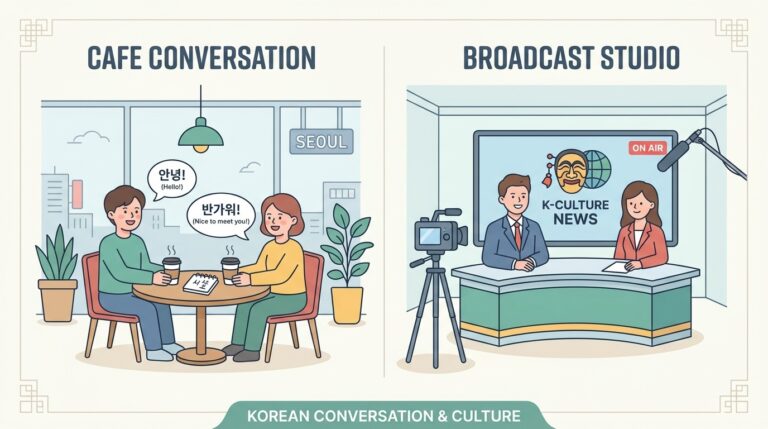
Why You Sound Like a News Anchor: The Truth About TV Korean vs. Real Spoken Korean
Phase 1: Empathy (Your Backstage Pass to Real Korean)
안녕하세요! (An-nyeong-ha-se-yo!) Hello! I’m your lead editor at Daily Hangul, and your friendly Korean companion.
Picture this: You have been studying Korean diligently, binge-watching your favorite K-Dramas like Crash Landing on You, and memorizing every line. You arrive in Seoul, walk into a cozy cafe in Hongdae, and confidently say to the barista:
“안녕하십니까? 아이스 아메리카노 한 잔을 주문하고자 합니다.” (An-nyeong-ha-sim-ni-kka? A-i-seu A-me-ri-ka-no han jan-eul ju-mun-ha-go-ja ham-ni-da.)
The barista pauses, blinks in confusion, and then smiles politely. Why the awkward silence? You just spoke perfect, grammatically flawless Korean!
Here is the secret: You spoke like a 6 o’clock news anchor or a military general. While grammatically correct, using highly formal broadcast Korean in a casual, real-life setting makes you sound like a robot.
In this guide, we are going to break down the barrier between “Broadcast/Textbook Korean” and “Real-Life Conversational Korean.” By the end of this article, you will know exactly when to sound like a polite local and when to drop the formality without being rude. Let’s dive in!
Phase 2: Deep Dive into 3 Core Expressions
To master the shift from TV to reality, let’s dissect the three most common linguistic divides you will encounter.
1. -습니다/습니까? (-seup-ni-da / -seup-ni-kka?)
- Pronunciation: /seum-ni-da/ /seum-ni-kka/ (Sound Analogy: Think of the “sum” in summer + “nee-dah”)
- Meaning: Highly formal sentence endings (Statement / Question).
- K-Culture Moment: You hear this constantly in historical K-dramas (사극 – Sa-geuk) or when K-pop idols stand stiffly on red carpets addressing large crowds: “감사합니다!” (Gam-sa-ham-ni-da! – I am formally grateful!)
- Editor’s Insight: This is the “Broadcaster’s Shield.” It is safe, but highly detached. In real-world cafes, restaurants, and with acquaintances, it creates an invisible wall of distance.
- Situation Spectrum:
- Friends & Casual Settings: 🚫
- Workplace & Business Meetings: ✅
- Real-life Daily Shopping/Dining: ⚠️ (Slightly too stiff)
- 🤔 Think About It: Why does Korean have a tense, formal ending reserved almost exclusively for public speaking? It reflects a deep societal value of public respect vs. private closeness. How does your native language draw the line between public professional speech and everyday polite conversation?
2. 안녕하십니까? (An-nyeong-ha-sim-ni-kka?)
- Pronunciation: /an-nyeong-ha-sim-ni-kka/ (Sound Analogy: “An-young-hah-seem-nee-kah”)
- Meaning: “Are you in peace?” (The most formal greeting possible).
- K-Culture Moment: The standard greeting used by news anchors at the start of a broadcast or by corporate executives entering a boardroom.
- Editor’s Insight: If you say this to a taxi driver or a convenience store clerk, they might look around to see if there is a hidden camera nearby! It is simply too formal for daily encounters.
- Situation Spectrum:
- Friends & Casual Settings: 🚫
- First meetings in corporate offices: ✅
- Local Korean Markets & Taxis: ⚠️ (Change to “안녕하세요”)
- 🤔 Think About It: Imagine greeting a cashier in your hometown with “Greetings, distinguished citizen.” That is exactly how 안녕하십니까? feels in a local convenience store!
3. 반말 (Ban-mal) on Variety Shows vs. Real Life
- Pronunciation: /ban-mal/ (Sound Analogy: “Bahn-mahl”)
- Meaning: Informal, casual language.
- K-Culture Moment: On popular variety shows like Knowing Bros (아는 형님) or Running Man, cast members of widely different ages speak casual Ban-mal to each other to create comedic chemistry and a friendly atmosphere.
- Editor’s Insight: Do not copy this directly! TV shows establish special rules and agreements beforehand. If you speak casual Ban-mal to an older person or a stranger in Korea just because you saw it on TV, it is considered highly offensive.
- Situation Spectrum:
- Same-age friends or younger: ✅
- Strangers/Older acquaintances: 🚫
- On-screen entertainment concepts: ✅ (Only for TV!)
- 🤔 Think About It: TV creates an artificial “safe space” for entertainment. Why do you think Korean audiences find it so exciting to watch celebrities break age-hierarchy rules on variety shows? Because in real life, those boundaries are deeply respected.
Phase 3: Textbook Korean vs. Real Korean Showcase
Let’s compare textbook/broadcast formulas with the phrases real Koreans actually use daily.
Scenario 1: Ordering Food
- 📖 Textbook/TV Korean: “메뉴판을 주십시오.” (Me-nyu-pan-eul ju-sip-si-o.) – “Please bestow the menu upon me.”
- 🗣️ Real Spoken Korean: “저기요, 메뉴판 좀 보여주세요.” (Jeo-gi-yo, me-nyu-pan jom bo-yeo-ju-se-yo.) – “Excuse me, could you show us the menu?”
- 💡 Why is it different? The textbook command “주십시오” sounds like an official decree. Adding “저기요” (Excuse me) and “좀” (a softening word meaning “a little”) makes the request sound polite, natural, and friendly.
Scenario 2: Expressing Excitement
- 📖 Textbook/TV Korean: “정말 즐겁습니다.” (Jeong-mal jeul-geop-seup-ni-da.) – “I am truly experiencing joy.”
- 🗣️ Real Spoken Korean: “대박! 진짜 재밌어요!” (Dae-bak! Jin-jja jae-mit-eo-yo!) – “Awesome! This is so fun!”
- 💡 Why is it different? While “즐겁습니다” is perfect for a written essay, spoken Korean thrives on lively, emotive vocabulary like “진짜” (really/honestly) and modern slang like “대박” (awesome/jackpot).
Phase 4: K-Culture Deep Dive & Non-Verbal Manners
4-1. The Art of Nunchi (눈치) and Body Language
In Korea, language is only 50% of the conversation. The other 50% is non-verbal politeness, driven by 눈치 (Nunchi – situational awareness).
* The Head Bow: When saying 안녕하세요 (An-nyeong-ha-se-yo), a slight 15-to-30-degree nod of the head makes your polite words feel genuine. Never greet an older person or service staff with your hands in your pockets!
* Two-Handed Delivery: Whether you are handing your credit card to a cashier or receiving a drink from a barista, use both hands (or support your right forearm with your left hand). This physical gesture perfectly matches your polite spoken tone.
4-2. The Variety Show Illusion
In K-Pop or variety content, you might see idols playing “Yaja Time” (야자타임), a game where age hierarchy is temporarily reversed, allowing the youngest members (막내 – Maknae) to speak casually to the oldest members.
While hilarious on screen, this is purely a game! In real-life corporate or social settings in Korea, the boundaries of Jondetmal (honorifics) remain an essential sign of respect and mutual comfort.
Phase 5: Interactive Roleplay Scenario
You are a guest visiting a trendy broadcast studio in Sangam-dong, Seoul. You run into PD Min (a television producer) in the hallway while searching for the restroom.
Cast:
- You: A friendly visitor practicing natural, real-life polite Korean.
- PD Min (민 PD): A busy but kind television producer holding a clipboard.
Dialogue:
- You (🎭 Approaching politely with a gentle bow):
“저기요, 실례지만 말씀 좀 여쭤볼게요.”
(Jeo-gi-yo, sil-lye-ji-man mal-sseum jom yeot-jjeo-bol-ge-yo.)
“Excuse me, sorry to bother you, but may I ask a quick question?” -
PD Min (🎭 Stopping, looking up from his clipboard):
“아, 네! 어떤 것 때문에 그러시죠?”
(Ah, ne! Eo-tteon geot ttae-mun-e geu-reo-si-jyo?)
“Ah, yes! What can I help you with?” -
You (🎭 Pointing down the hallway slightly):
“혹시 화장실이 어디에 있어요?”
(Hok-si hwa-jang-sil-i eo-di-e is-seo-yo?)
“By any chance, where is the restroom?” -
PD Min (🎭 Smiling warmly, pointing to the left corridor):
“아, 화장실요? 이쪽 복도로 쭉 가셔서 코너 돌면 바로 보여요.”
(Ah, hwa-jang-sil-yo? I-jjok bok-do-ro jjuk ga-syeo-seo ko-neo dol-myeon ba-ro bo-yeo-yo.)
“Ah, the restroom? Go straight down this hallway, turn the corner, and you’ll see it right away.” -
You (🎭 Bowing your head in appreciation):
“아, 그렇군요! 정말 감사합니다.”
(Ah, geu-reot-gun-yo! Jeong-mal gam-sa-ham-ni-da.)
“Ah, I see! Thank you so much.” -
PD Min (🎭 Noding back):
“네, 좋은 하루 보내세요!”
(Ne, jo-eun ha-ru bo-nae-se-yo!)
“Yes, have a great day!”
🔀 Decision Point
Imagine PD Min notices your cool jacket and says: “와, 옷 스타일이 정말 멋지시네요!” (Wow, your clothing style is really cool!). How do you respond naturally?
- A) “감사합니다! 오다가 주웠습니다.” (Gam-sa-ham-ni-da! O-da-ga ju-wot-seup-ni-da.) – “Thank you! I picked it up on my way here.” (A slightly outdated internet joke, too formal ending).
- B) “고마워! 너도 오늘 멋지네.” (Go-ma-wo! Neo-do o-neul meot-ji-ne.) – “Thanks! You look cool today too.” (Dangerous! Speaking Ban-mal to a stranger you just met is disrespectful).
- C) “아, 정말요? 좋게 봐주셔서 감사합니다!” (Ah, jeong-mal-yo? Jo-ke bwa-ju-syeo-seo gam-sa-ham-ni-da!) – “Oh, really? Thank you for the compliment!” (Polite, natural, and warmly humble).
💡 Feedback:
- Best Choice: C! It maintains the standard polite tone (해요/합니다 style) while showing humility and appreciation.
- Risk Choice: B! Avoid using Ban-mal (casual language) with professionals or strangers, even if they compliment you first.
Phase 6: 10-Second Emotion Shadowing Drill
Let’s practice speaking with real Korean emotion. Pay attention to the pauses (/) and try to mimic the emotional state!
- [😊 Expressing Delight & Surprise]
“진짜요? / 대박! / 너무 / 예뻐요!”
(Jin-jja-yo? / Dae-bak! / Neo-mu / ye-ppeo-yo!)
“Really? / Awesome! / It’s / so pretty!” -
[🥺 Polite, Gentle Asking]
“저기요… / 이것 좀 / 도와주실 수 / 있어요?”
(Jeo-gi-yo… / i-geot jom / do-wa-ju-sil su / is-seo-yo?)
“Excuse me… / could you / help me with this / please?”
Phase 7: K-Culture Mini-Dictionary
| Word (Hangul / Romanization) | Meaning | Real-world Context |
|---|---|---|
| 본캐 (Bon-kae) | Main Character / Real Persona | Originally from gaming, Koreans use this to describe their “real-life self” compared to their broadcast or corporate persona. |
| 예능 (Ye-neung) | Variety Show | Korean entertainment shows like Running Man where casual tone rules are often bent for entertainment. |
| 존댓말 (Jon-daet-mal) | Honorific/Polite Speech | The standard, respectful language used with anyone older, unfamiliar, or in business settings. |
| 반말타임 (Ban-mal Time) | Casual Language Game | A party or television game where participants temporarily drop formal speech to break the ice. |
Phase 8: Traveler’s Survival Kit
Top 3 Real Spoken Phrases for Travelers
- “이거 추천해 주세요.” (I-geo chu-cheon-hae ju-se-yo.)
- Meaning: “Please recommend this (or something) to me.”
- Pro Tip: Use this instead of formal written recommendations when ordering food at local diners!
- “저기요, 계산할게요.” (Jeo-gi-yo, gye-san-hal-ge-yo.)
- Meaning: “Excuse me, I’d like to pay.”
- Pro Tip: Call out gently to the restaurant staff to get their attention politely.
- “괜찮아요, 제가 할게요!” (Gwaen-chan-ha-yo, je-ga hal-ge-yo!)
- Meaning: “It’s okay, I’ll do it!”
- Pro Tip: Perfect when a local seller or host tries to assist you with something and you want to be polite yet independent.
📌 Editor’s Travel Note: To navigate Korea like a local, make sure to download the Naver Map App and Kakao T App before your trip. Google Maps is not fully optimized in Korea, and having these local tools will save you from getting lost in the winding alleyways of Seoul!
Phase 9: Deep Reflection — “One Step Deeper”
Korean speech levels are not just about grammar rules; they are a reflection of relational distance. While English speakers use tone, word choice, and vocal inflections to show politeness, Korean speakers use systematic verb conjugation.
This system allows Koreans to constantly negotiate their relationship with the listener. By choosing the polite 해요 (hae-yo) style over the broadcast 합니다 (ham-ni-da) style, you signals warmth, approachability, and an invitation to connect, while still maintaining high respect. It is a beautiful linguistic dance of social harmony.
💬 Your Turn: How does your native language or culture show respect to strangers without sounding too cold or distant? Let us know in the comments below!
Phase 10: FAQ & Common Mistakes
Q: Can I use “Ban-mal” (casual language) if someone is younger than me?
A: Depends. In modern Korea, even if someone is younger than you, it is polite to use the standard polite form (-요) when meeting them for the first time. Jumping straight into casual Ban-mal simply based on age can feel patronizing unless you are close friends.
Q: Is speaking TV news-style Korean (-습니다) actually wrong?
A: No, it is not grammatically wrong. However, it sounds highly dry, corporate, or military-like. If you want to build a warm connection with locals, standard polite language (-요) is much more effective.
Q: What should I do if a Korean speaker uses casual language with me first?
A: It is safest to keep using polite language (-요) until you both explicitly agree to talk casually (usually initiated with: “말 편하게 하셔도 돼요.” – You can speak casually.)
🚨 Common Mistakes Warning Board
- Mistake 1: Calling a waiter “너” (You) or speaking casually.
- Correct Action: Use “저기요” (Excuse me) and always use polite verb endings.
- Mistake 2: Bowing completely flatly (90 degrees) in a local store.
- Correct Action: A light, friendly head nod (15 degrees) is more than enough for everyday situations.
Phase 11: Action Missions
- 🥉 Bronze (At-Home Challenge): Record yourself saying “안녕하세요” (An-nyeong-ha-se-yo) with a gentle, polite head bow in front of a mirror.
- 🥈 Silver (Network Challenge): Write a polite comment in Korean on your favorite K-Pop idol’s social media page using the natural -요 form instead of the stiff textbook -습니다 style.
- 🥇 Gold (Real-world Challenge): Next time you order at a Korean restaurant or cafe, use: “아이스 아메리카노 한 잔 주세요! 감사합니다.” with a polite nod and a warm smile.
Phase 12: Interactive Quiz Challenge
Test your knowledge of natural spoken Korean with this mini-quiz!
1. Which phrase is best to use when greeting a local barista?
- A) 안녕하십니까?
- B) 안녕하세요!
- C) 안녕!
Click to view the Answer & Explanation
Correct Answer: B!
안녕하세요! is the perfect balance of polite and friendly. 안녕하십니까? (A) is too stiff, and 안녕! (C) is too casual.
2. True or False: You should always copy the casual speech patterns of K-Pop stars on variety shows when talking to everyday Koreans.
Click to view the Answer & Explanation
Correct Answer: False!
Variety shows use special entertainment rules. Always stick to polite Korean (Jondetmal) with real-world strangers and service staff.
Keep practicing your natural Korean tone every day, and soon you’ll sound like a warm, native Seoulite! See you in the next lesson of Daily Hangul! 안녕! 👋







