

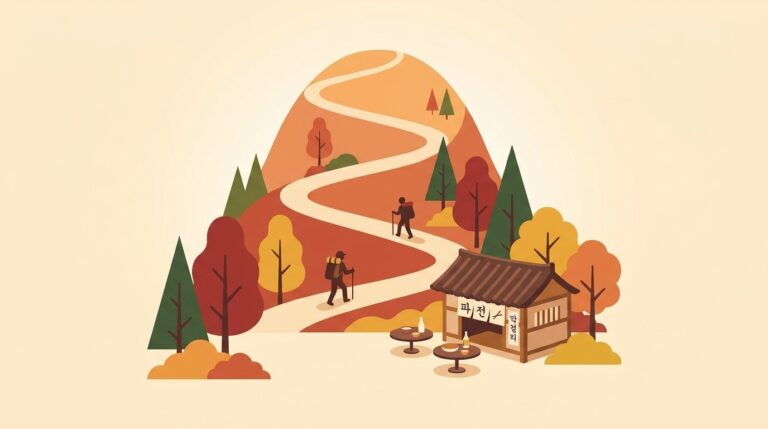
The Ultimate Guide to ‘Hasan’ (하산): Master the Art of Descending Korean Mountains Like a Local
안녕하세요! (Annyeonghaseyo!) Hello, language adventurers! I’m your senior editor at Daily Hangul, your trusty local guide to the heart of Korean language and culture.
Imagine this: You’ve spent the last three hours climbing the majestic rocky trails of Bukhansan (북한산). Your legs are shaking, but the view of Seoul from the top is breathtaking. You feel like a K-Drama hero! But as you look down, a sudden wave of exhaustion hits you. Your knees start to wobble. How do you tell your Korean friends that it’s time to go down—and more importantly, that you are ready for the legendary post-hike feast?
In Korea, hiking (등산 – deungsan) is only half the journey. The real magic happens when you descend the mountain (하산 – hasan). Let’s learn the essential A2-level Korean phrases to make your descent safe, fun, and delicious!
Phase 2: Three Essential Expressions for Descending
1. 이제 하산해요 (Ije hasan-haeyo)
- Pronunciation: [I-je ha-san-hae-yo] / Sound-alike: “Ee-jeh ha-sahn-hay-yo”
- Meaning: “Let’s descend the mountain now.”
- K-Culture Moment: You will hear this in every outdoor K-Drama episode. After the characters take their peak selfies, the leader of the group claps their hands and says this to signal the start of the journey back to civilization (and food!).
- Editor’s Insight: “하산” (hasan) comes from Hanja (Chinese characters): 하 (ha) means “down” and 산 (san) means “mountain”. It sounds much more natural and adventurous than just saying “Let’s go down.”
- Situation Spectrum:
- Friends/Casual: ✅ (이제 하산하자! – Ije hasan-haja!)
- Colleagues/Semi-formal: ✅ (이제 하산해요)
- Bosses/Formal: ✅ (이제 하산하시지요 – Ije hasan-hasijiyo)
- 🤔 Think About It: Why do you think Koreans have a specific, separate word for “descending a mountain” instead of just “going down”? How does your language express this?
2. 무릎이 아파요 (Mureupi apayo)
- Pronunciation: [Mu-reu-bi a-pa-yo] / Sound-alike: “Moo-roo-bee ah-pah-yo”
- Meaning: “My knees hurt.”
- K-Culture Moment: Descending Korean mountains, which are often rocky, can be tough on the joints. You’ll often see friendly Korean hikers walking backward down steep slopes to protect their knees while sighing, “아이구, 무릎이야” (Aigu, mureup-iya!).
- Editor’s Insight: In Korean, we rarely say “내 무릎” (my knee). Because of Korea’s collective culture, we simply say “무릎이 아파요” (the knees hurt). Everyone will know exactly whose knees you mean!
- Situation Spectrum:
- Friends/Casual: ✅ (무릎 아파 – Mureup apa)
- Colleagues/Semi-formal: ✅ (무릎이 아파요)
- Bosses/Formal: ✅ (무릎이 조금 아픕니다 – Mureupi jogeum apeumnida)
3. 막걸리에 파전 먹으러 가요! (Makgeollie pajeon meogeureo gayo!)
- Pronunciation: [Mak-geol-li-e pa-jeon meo-geu-reo ga-yo] / Sound-alike: “Mak-guhl-lee-eh pah-juhn muh-guh-ruh gah-yo”
- Meaning: “Let’s go eat savory green onion pancake (pajeon) and drink rice wine (makgeolli)!”
- K-Culture Moment: This is the ultimate goal of Korean hiking! At the entrance of every Korean mountain, there is a street lined with lively restaurants serving ice-cold Makgeolli (unfiltered rice wine) and hot, crispy Pajeon.
- Editor’s Insight: Saying this phrase will instantly make you the favorite member of any Korean hiking crew. It shows you truly understand the local culture!
- Situation Spectrum:
- Friends/Casual: ✅ (막걸리에 파전 먹으러 가자!)
- Colleagues/Semi-formal: ✅ (막걸리에 파전 먹으러 가요!)
- Bosses/Formal: ⚠️ (Use with caution; invite them politely: “같이 식사하러 가실까요?” – Shall we go eat together?)
Phase 3: Textbook Korean vs. Real Korean
Let’s look at how textbooks teach descending, compared to how Koreans actually speak at the base of the mountain!
Situation 1: Suggesting to go down
- 📖 Textbook: 산에서 내려갑시다. (Let’s descend from the mountain. – Too robotic and formal)
- 🗣️ Real Korean: 이제 슬슬 하산할까요? (Shall we slowly start heading down?)
- 💡 Why the difference? Koreans love using “슬슬” (seul-seul – gently/slowly) to make suggestions sound soft, polite, and natural.
Situation 2: Asking what to eat after hiking
- 📖 Textbook: 등산이 끝난 후에 무엇을 먹을 것입니까? (What will you eat after hiking is finished?)
- 🗣️ Real Korean: 하산 푸드(Food) 뭐 먹을까요? (What should we have for “descend food”?)
- 💡 Why the difference? “하산 푸드” (Hasan Food) is a super popular modern slang term used by young hikers on social media (like Instagram) to describe the delicious meal waiting at the bottom!
Phase 4: K-Culture Deep Dive & Hiking Manners
4-1. Physical Etiquette on the Trail
When descending (하산), the trail can get narrow. Here is the golden rule of Korean hiking etiquette: Uphill hikers have the right of way!
Since climbing up is much harder, those descending should step aside, yield the path, and greet them with a warm, encouraging smile.
4-2. The Reward: “Hasan Food” Culture
Why Makgeolli and Pajeon? Historically, farmers drank Makgeolli during breaks to regain energy. Because hiking is physically demanding, Koreans adopted this tradition. The sweet, fizzy, and cold rice wine perfectly rehydrates your body, while the oil and carbs from the scallion pancake (파전) restore your strength. It is a heavenly culinary match!
Phase 5: Interactive Roleplay Scenario
The Setting: You are walking down Bukhansan with your warm-hearted Korean colleague, Min-su (민수). The sun is beginning to set, casting a beautiful orange glow over the pine trees.
Dialogue
- Min-su: (🎭 Stretching his arms) 아, 오늘 등산 정말 좋았어요!
(Ah, oneul deungsan jeongmal joasseoyo! / Ah, today’s hike was really great!) - You: 맞아요. 그런데 조금 힘드네요.
(Majayo. Georeonde jogeum himdeuneyo. / That’s right. But I’m a little tired.) - Min-su: (🎭 Looking at your shaking legs) 하하, 다리가 떨려요? 이제 슬슬 하산해요!
(Haha, dariga tteollyeoyo? Ije seul-seul hasan-haeyo! / Haha, are your legs shaking? Let’s slowly descend now!) - You: 네, 무릎이 조금 아파요. 천천히 가요.
(Ne, mureupi jogeum apayo. Cheoncheonhi gayo. / Yes, my knees hurt a bit. Let’s go slowly.) - Min-su: (🎭 Slowing down his steps) 그럼요, 안전이 최고예요. 거의 다 내려왔어요.
(Geureomyo, anjeoni choegoyeyo. Geoi da naeryeowasseoyo. / Of course, safety is first. We are almost all the way down.) - You: 다행이에요! 저기 밑에 식당들이 보여요.
(Dahaengieyo! Jeogi mite sikdangdeuri boyeoyo. / Thank goodness! I can see the restaurants down there.) - Min-su: (🎭 Smiling widely) 좋습니다! 하산 푸드 뭐 먹고 싶어요?
(Joseumnida! Hasan pudeu mwo meoggo sipeoyo? / Great! What do you want to eat for your descent food?)
🔀 Decision Point: What is your response?
- A: “그냥 집에 가서 쉴래요.” (I’ll just go home and rest.)
- B: “막걸리에 파전 먹으러 가요!” (Let’s go drink makgeolli and eat pajeon!)
- C: “치즈버거랑 감자튀김 먹어요.” (Let’s eat cheeseburgers and french fries.)
Choice Analysis:
- Best Choice (B): Your friend Min-su’s eyes will light up! You’ve unlocked the ultimate Korean cultural bonding experience. Cheers!
- Risk Choice (A): Oh no! Hiking without “Hasan Food” is like going to Paris and not seeing the Eiffel Tower. Min-su might feel a little disappointed, but he will respect your rest.
- Funny Choice (C): A burger is delicious, but eating Western fast food after climbing a majestic traditional Korean mountain will definitely make Min-su laugh!
Phase 6: 10-Second Emotion Shadowing Drill
Practice saying these out loud with the correct emotion! The slash / means a short pause.
- [🥺 Exhausted but hopeful]
“거의 / 다 왔어요? / 무릎이 / 아파요.”
(Geoi / da wasseoyo? / mureupi / apayo. / Are we almost there? My knees hurt.) -
[😊 Excited and hungry]
“와! / 막걸리에 / 파전 / 진짜 / 맛있겠다!”
(Wa! / makgeollie / pajeon / jinjja / masitgetda! / Wow! Makgeolli and pajeon will be so delicious!)
Phase 7: K-Culture Mini Dictionary
- 하산 (Hasan): Noun. Descending a mountain. Also used metaphorically in dramas when a student finishes their training under a master.
- 막걸리 (Makgeolli): Noun. Traditional Korean raw rice wine, milky and slightly sweet.
- 도토리묵 (Dotorimuk): Noun. Acorn starch jelly, often served as a savory, spicy salad at the base of mountains. Super healthy!
- 등산 크루 (Deungsan Crew): Noun. Modern social groups of young Koreans who hike together and share aesthetic photos on social media.
Phase 8: Traveler’s Survival Kit
Top 3 Phrases for the Trail Base:
- 화장실이 어디에 있어요? (Hwajangsiri eodie isseoyo?) – Where is the restroom? (Crucial after drinking Makgeolli!)
- 여기 계산해 주세요. (Yeogi gyesanhae juseoyo.) – Please check/bill here. (To pay at the restaurant.)
- 물 좀 더 주세요. (Mul jom deo juseoyo.) – Please give me more water. (You will be thirsty!)
📌 Editor’s Travel Note:
To find the best hiking paths and nearby restaurants, do not use Google Maps (it doesn’t work well in Korea). Instead, download the Naver Map App which has highly detailed trail maps and restaurant reviews!
Phase 9:
Frequently Asked Questions (FAQ)
Q: What does "이제 하산해요 (Ije hasan-haeyo)" mean in Korean and how do you pronounce it?
A: In Korean, "이제 하산해요 (Ije hasan-haeyo)" is pronounced [I-je ha-san-hae-yo] and means: "Let’s descend the mountain now."
Q: What does "무릎이 아파요 (Mureupi apayo)" mean in Korean and how do you pronounce it?
A: In Korean, "무릎이 아파요 (Mureupi apayo)" is pronounced [Mu-reu-bi a-pa-yo] and means: "My knees hurt."
Q: What does "막걸리에 파전 먹으러 가요! (Makgeollie pajeon meogeureo gayo!)" mean in Korean and how do you pronounce it?
A: In Korean, "막걸리에 파전 먹으러 가요! (Makgeollie pajeon meogeureo gayo!)" is pronounced [Mak-geol-li-e pa-jeon meo-geu-reo ga-yo] and means: "Let's go eat savory green onion pancake (pajeon) and drink rice wine (makgeolli)!"







