

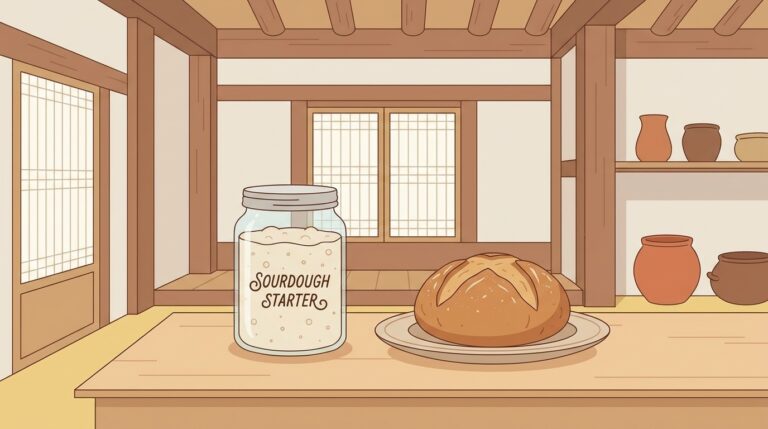
Nurturing Your “Banryo-Hyomo”: The Art of Growing Sourdough Starter in Korean
Phase 1: Empathy – A Slow-Baking Love Story in Seochon
안녕하세요! Hello, dear language learners and bread lovers! It’s your lead editor at Daily Hangul, your trusty companion on this beautiful journey of language and culture.
Imagine walking down the quiet, historic stone-wall alleys of Seochon, Seoul, on a misty morning. You step into a cozy, Hanok-style bakery. Instead of the loud clatter of industrial mixers, you hear the soft, rhythmic crackle of freshly baked wood-fired sourdough. On the wooden counter sits a glass jar bubbling with life—a sourdough starter. In Korea, this slow, mindful baking process has taken the youth culture by storm, mirroring the traditional philosophy of patience found in fermentation like Kimchi and Makgeolli.
For advanced (C1) learners, diving into specialized culinary worlds like 사워도우 발효종 키우기 (sa-wo-do-u bal-hyo-jong ki-u-da – growing sourdough starter) is the ultimate way to master highly nuanced, warm, and idiomatic Korean. Today, we’ll move past rigid textbook terms and learn how to speak about our sourdough with the same affection and precision as Seoul’s top artisan bakers. Mastering these expressions will not only elevate your Korean but also instantly connect you with local culinary artisans and slow-life enthusiasts alike.
This guide was carefully curated based on real experiences of foreign expats attending artisan baking workshops in Mapo-gu, capturing their most common linguistic missteps and moments of cultural enlightenment.
Phase 2: Deep Dive into 3 Core Expressions
1. 발효종을 키우다 (Bal-hyo-jong-eul ki-u-da)
- Pronunciation: [Bal-hyo-jong-eul ki-u-da] / bahl-hyoh-jong-eul kee-oo-dah
- Meaning: Literally “to grow/raise a fermentation starter.”
- K-Culture Moment: You will often see Korean lifestyle vloggers on YouTube cuddling their glass jars, affectionately referring to their starter as their 반려효모 (ban-ryeo-hyo-mo – companion yeast).
- Editor’s Insight: While English speakers say “maintain” or “feed” a starter, Koreans use the verb 키우다 (ki-u-da), which is typically reserved for raising pets, children, or plants. It implies a deep, emotional connection to the living cultures inside the jar.
- Situation Spectrum:
- Friends/Casual: ✅
- Workplace/Semi-formal: ✅
- Formal/Business: ✅
- 🤔 Think About It: Why does Korean culture treat culinary fermentation (like starter, soy sauce, or kimchi) as an act of “raising” rather than mere chemical preparation? How does this reflect the traditional view of humans living in harmony with microscopic nature?
2. 정성을 들이다 (Jeong-seong-eul deu-ri-da)
- Pronunciation: [Jeong-seong-eul deu-ri-da] / jung-sung-eul deu-ree-dah
- Meaning: To devote sincere, heartfelt effort to something.
- K-Culture Moment: In K-documentaries like Master of Living (생활의 달인), old-school master bakers always attribute their perfect bread crusts not to expensive machines, but to “정성을 들이는 시간” (the time spent dedicating heart and soul).
- Editor’s Insight: This goes far beyond “working hard” (열심히 하다). 정성 (jeong-seong) is a mix of love, meticulous care, and spiritual focus. If you skip a starter feeding or ignore the temperature, a Korean baker might say you lacked “정성.”
- Situation Spectrum:
- Friends/Casual: ✅
- Workplace/Semi-formal: ✅
- Formal/Business: ✅
- 🤔 Think About It: Contrast the scientific western method of baking (strict grams and timers) with the Korean ethos of Jeongseong. How can you express “heartfelt care” in your native language without sounding overly dramatic?
3. 숨을 쉬다 (Sum-eul swi-da)
- Pronunciation: [Sum-eul swi-da] / soom-eul swee-dah
- Meaning: To breathe.
- K-Culture Moment: This expression is a beautiful crossover from Korea’s pottery heritage. Traditional clay pots (옹기 – Onggi) are called “숨 쉬는 그릇” (breathing vessels). Bakers use the same metaphor for a active, bubbling starter.
- Editor’s Insight: Saying “기포가 올라온다” (bubbles are rising) is scientifically correct, but saying “발효종이 숨을 쉬고 있어요” (The starter is breathing) instantly marks you as someone who understands the poetic soul of Korean culinary arts.
- Situation Spectrum:
- Friends/Casual: ✅
- Workplace/Semi-formal: ⚠️ (Slightly poetic, but highly appreciated in creative baking circles)
- Formal/Business: ⚠️
- 🤔 Think About It: How does viewing your baking ingredients as “breathing” change the way you interact with food?
Phase 3: Textbook Korean vs. Real Korean
Let’s look at how standard dictionary phrases transform in the living, breathing kitchens of Seoul.
Situation 1: Feeding your sourdough starter
- 📖 Textbook Korean: “발효종에 밀가루와 물을 공급하십시오.”
(Please supply flour and water to the fermentation starter.) - 🗣️ Real Korean: “우리 발효종 밥 줄 시간이에요!”
(It’s time to feed our starter! / Lit: It’s time to give our starter rice!) - 💡 Why the difference? Koreans colloquially refer to the flour-and-water mixture as 밥 (bab – cooked rice/meal). It makes the yeast feel like a beloved family pet. Even elite professional bakers in Hannam-dong use this cute shorthand.
Situation 2: Checking if the starter has fermented sufficiently
- 📖 Textbook Korean: “부피가 두 배로 증가했는지 확인하세요.”
(Verify if the volume has increased twofold.) - 🗣️ Real Korean: “얼마나 예쁘게 부풀었는지 한번 봐 봐요.”
(Take a look at how beautifully it puffed up.) - 💡 Why the difference? Advanced natural Korean relies heavily on adjectives of emotion and organic verbs. 부풀다 (bu-pul-da – to swell/puff up) is much warmer and more sensory than the cold, mechanical “부피 증가” (volume increase).
Phase 4: K-Culture Deep Dive & Non-verbal Etiquette
4-1. Nunchi (눈치) and Non-verbal Yeast Care
Fermenting sourdough starter in a Korean home requires dynamic 눈치 (nunchi – intuitive sensing). Korean apartments alternate between underfloor heating (온돌 – Ondol) in winter and blasting air conditioning in summer. When checking on your starter, do not just read the room thermometer. Physically cup the glass jar with both hands. It is a sign of attentiveness. In front of a master baker, handling your fermentation jar with both hands (양손) demonstrates respect for both the craft and the microscopic culture you are raising.
4-2. The “Slow Life” Healing Trend (힐링)
In a country famous for its 빨리빨리 (ppalli-ppalli – hurry, hurry) lifestyle, the rise of sourdough baking is an act of gentle rebellion. Inspired by the hit Korean slice-of-life movie Little Forest (리틀 포레스트), young Koreans use the slow rhythm of natural fermentation as therapy (힐링 – healing). Sharing starter discards with neighbors has become the modern urban equivalent of sharing Jeong (정 – deep affection).
Phase 5: Interactive Roleplay Scenario
Setting: Inside “온기 (Ongi) Bakery,” a sunlit atelier in the Bukchon Hanok Village. The scent of toasted grain and yeast hangs sweet in the air.
Characters:
* You: An advanced baking apprentice.
* Chef Min-woo (민우): A passionate, warm-hearted artisan baker with flour-dusted hands.
- 민우: (smiling warmly) 어서 오세요! 오늘 사워도우 발효종 상태는 어때요?
(Welcome! How is your sourdough starter doing today?) - You: 안녕하세요, 셰프님! 제 발효종이 어제부터 좀 힘이 없는 것 같아요.
(Hello, Chef! My starter seems to have a bit of a lack of energy since yesterday.) - 민우: (examining the jar closely) 아, 기포가 별로 안 보이네요. 밥은 제때 주셨나요?
(Ah, I don’t see many bubbles. Did you feed it on time?) - You: 네, 매일 아침 같은 시간에 밀가루랑 물을 일 대 일 비율로 줬어요.
(Yes, I gave it flour and water in a 1:1 ratio at the same time every morning.) - 민우: (nodding) 잘하셨어요. 한국은 요즘 장마철이라 습도가 높아서 온도를 잘 맞춰야 해요.
(Good job. It’s the rainy season in Korea now, so the humidity is high, meaning you have to control the temperature carefully.) - You: 아! 실내 온도가 너무 낮았을 수도 있겠네요. 에어컨 때문에요.
(Ah! The indoor temperature might have been too low because of the air conditioning.) - 민우: 맞아요. 발효종도 추위를 타거든요. 조금 더 따뜻한 곳에 두고 정성을 들여 보세요.
(Exactly. Starters get cold too. Put it in a slightly warmer spot and give it some sincere care.) - You: 정말 살아있는 생명체를 키우는 것 같아요. 반려효모네요!
(It really feels like raising a living creature. It’s a companion yeast!) - 민우: (laughs heartily) 맞아요, 반려효모! 아주 좋은 표현이네요. 그럼 지금 한번 먹이를 줘 볼까요?
(Haha, yes, companion yeast! That’s an excellent expression. Shall we feed it right now?) - You: 네! 이번엔 정말 숨을 쉴 수 있게 잘 지켜볼게요.
(Yes! This time, I’ll watch it closely so it can really breathe.)
🔀 Decision Point
Chef Min-woo asks you how you want to revive the sluggish starter. What is your choice?
* Choice A: “그냥 이스트를 좀 넣어서 강제로 키울까요?” (Should we just add some commercial yeast and force it to grow?)
* Choice B: “온도가 따뜻한 온돌방 구석에 두고 지켜볼게요.” (I’ll keep it in a warm corner of the Ondol room and watch it.)
* Choice C: “밀가루를 엄청 많이 부어버릴게요!” (I will dump a massive amount of flour into it!)
Best Choice Analysis:
- Choice B is perfect! It shows you understand the biological nature of natural yeast and utilize Korean traditional domestic environments (Ondol) to nurture your banryo-hyomo with Jeongseong.
- Choice A will make Chef Min-woo cry. Adding commercial yeast defeats the soul of natural sourdough baking!
- Choice C will over-dilute and suffocate your starter. Don’t drown it in flour!
Phase 6: 10-Second Emotion Shadowing Drill
Practice matching your vocal pitch and emotional undertones with these native phrases. Pay attention to the breath pauses marked by /.
- [🥺 Worried and extremely careful]
“우리 발효종이 / 숨을 안 쉬는 것 같아요… 어떡하죠?”
[u-ri bal-hyo-jong-i / sum-eul an swi-neun geot gat-a-yo… eo-tteok-ha-jyo?]
(Our starter… doesn’t seem to be breathing. What should I do?) -
[😊 Filled with pride and excitement]
“우와! / 하룻밤 사이에 / 엄청 예쁘게 부풀었어요!”
[u-wa! / ha-rut-bam sa-i-e / eom-cheong ye-ppeu-ge bu-pul-eot-eo-yo!]
(Wow! Overnight, it puffed up so beautifully!) -
[😤 Determined and passionate]
“밀가루랑 물 비율은 / 정말 정확히 맞춰야 해요!”
[mil-ga-ru-rang mul bi-yul-eun / jeong-mal jeong-hwak-hi mat-chueo-ya hae-yo!]
(You must match the flour and water ratio absolutely precisely!)
Phase 7: K-Culture Mini Dictionary
-
반려효모 (Ban-ryeo-hyo-mo)
- English Translation: Companion Yeast
- Contextual Nuance: Inspired by terms like 반려견 (companion dog) and 반려식물 (companion plant), this trendy term highlights the emotional bond modern urban Koreans form with slow-fermenting sourdough.
- 손맛 (Son-mat)
- English Translation: Hand-taste / The touch of the hand
- Contextual Nuance: The mystical Korean culinary concept that a cook’s unique hands, touch, temperature, and affection pass directly into the taste of food.
- 장마철 (Jang-ma-cheol)
- English Translation: Summer Rainy Season
- Contextual Nuance: Occurring in late June to July, the extreme humidity during this season completely disrupts baking times, requiring bakers to apply maximum “Nunchi” to their sourdough.
- 온돌 (On-dol)
- English Translation: Traditional Korean Floor Heating
- Contextual Nuance: A highly efficient underfloor heating system. Sourdough home-bakers often place their starter jars on the warm floor under blankets during the freezing winter.
Phase 8: Traveler’s Survival Kit for Sourdough Seekers
If you are visiting Seoul and looking to explore its vibrant artisanal baking scene, carry these sentences in your back pocket!
Survival Expressions
- “이 빵, 천연 발효종으로 만드신 건가요?”
[i ppang, cheon-yeon bal-hyo-jong-eu-ro man-deu-sin geon-ga-yo?]
(Is this bread made with a natural wild yeast starter?)- Pro Tip: Ask this at boutique bakeries in Yeonnam-dong to instantly start a deep conversation with the head baker.
- “혹시 발효종 분양을 받을 수 있을까요?”
[hok-si bal-hyo-jong bun-yang-eul ba-deul su is-seul-kka-yo?]
(By any chance, could I adopt a portion of your sourdough starter discard?)- Pro Tip: In Korea, sharing a starter is called “분양” (bun-yang), a term also used for adopting pets or real estate allotment!
📌 Editor’s Travel Note
When looking for authentic natural fermentation bakeries, bypass international search engines which are often outdated. Instead, download the Naver Map Application (네이버 지도 앱) and search for “천연발효종 베이커리” (Natural Fermentation Bakery) or “사워도우 깜빠뉴” (Sourdough Campagne). Credit cards are universally accepted in Seoul, but having a warm smile and asking bakers about their “Son-mat” (손맛) is the best social currency.
(Note: Always check the latest operating hours on Naver Maps as boutique bakeries often close early once their daily sourdough batches sell out.)
Phase 9: Deep Thoughts — “한 발 더 깊이” (Going One Step Deeper)
In Western gastronomy, sourdough is often treated with laboratory-like mathematical precision. Hydration calculators, digital scales, and ph-strips dictate the starter’s life. In Korea, however, sourdough has seamlessly merged with the ancient spirit of traditional fermentation (발효 – bal-hyo).
For centuries, Korean families maintained their own house-yeast (누룩 – nuruk) for brewing alcohol, and passed down soy-sauce starters (씨간장 – ssi-ganjang) through generations. Therefore, when a Korean baker looks at a bubbling jar of sourdough, they do not just see yeast and lactic acid bacteria; they see a lineage of time, temperature, and ancestral affection. It is an active dialogue with nature.
💬 Your Turn: How does your culture view fermentation? Is it a scientific process, or a spiritual connection to nature like in Korea? Let’s talk about it in the comments below!
Phase 10: FAQ & Common Mistakes (FAQ Schema Optimized)
Q: Can I use Korean tap water to feed my sourdough starter?
A: No. While Korean tap water is incredibly clean, it contains trace levels of chlorine used to keep the municipal system sterile. This can stun or kill delicate wild yeast. It is highly recommended to use purified water or bottled spring water (생수).
Q: Why does my Korean friend call my starter a “baby” (애기)?
A: Because in Korean culture, anything you pour immense “정성” (devotion) into is anthropomorphized. It is a sign of affection that shows they respect your hobby as a nurturing act.
Q: I am baking in a tiny studio apartment in Seoul during winter. How do I keep my starter warm?
A: Place your jar near your router, on top of your refrigerator, or near the warm floorboards of your Ondol heating. Just be careful not to place it directly on a boiling hot spot!
🚨 Common Mistakes Warning Board
- Using metal spoons: Traditional Korean bakers believe metal Reacts poorly with organic ferments. Stick to wooden, glass, or plastic utensils.
- Ignoring the monsoon humidity: During







