

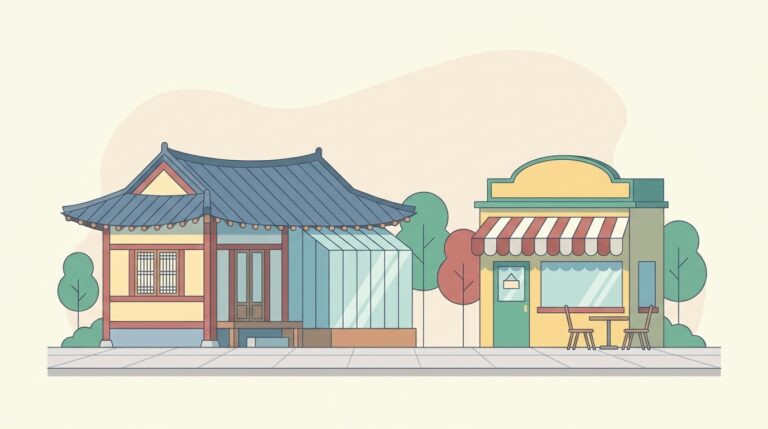
Beyond the Neon Lights: How to Discuss Gentrification and Urban Regeneration in Korean Like a Policy Expert
안녕하세요! (Annyeonghaseyo!) It is your trusted Daily Hangul senior editor and local culture navigator. If you have ever walked through the hip, industrial-chic alleys of Seongsu-dong (성수동), marvelled at the retro-futuristic vibes of Euljiro (을지로), or sipped a flat white in a renovated hanok in Ikseon-dong (익선동), you have witnessed one of Korea\’s most vibrant cultural phenomena: the dramatic transformation of historic urban spaces.
But as a C2-level learner, you are no longer just a tourist admiring the aesthetic facades. You are ready to peer beneath the surface. Behind every trendy cafe is a complex narrative of rapid capital inflow, cultural displacement, and the delicate tightrope walk of urban policy.
Today, we are diving deep into the sophisticated vocabulary and nuanced sociolinguistic structures needed to debate 젠트리피케이션 (Gentrification) and 도시 재생 (Urban Regeneration) in Korean. Whether you are prepping for a TOPIK II writing exam, a university seminar, or a deep-dive discussion with Korean colleagues over craft beers, this guide will elevate your spoken and written register to the highest level of fluency.
Phase 1: The Bittersweet Transformation of Korea\’s Alleyways
Imagine walking down an alleyway in Mullae-dong (문래동). On your left, a decades-old iron foundry sparks with bright blue welding flames; on your right, an ultra-minimalist espresso bar blast indie synth-pop. This surreal juxtaposition is the frontline of Korea\’s modern urban debate.
Many advanced students struggle when transitioning from general vocabulary (like “이 동네가 많이 변했어요” – \’This neighborhood has changed a lot\’) to formal, policy-oriented discussions. They get tongue-tied trying to express systemic displacement or the tension between preserving cultural heritage and economic development.
This guide was compiled using real feedback from advanced exchange researchers and policy students who wanted to sound intellectually persuasive without losing the warmth and natural rhythm of a native speaker. By mastering these expressions, you will not only impress your interlocutors with your command of academic Korean but also show a deep, empathetic understanding of Korean society\’s rapid modernization pains.
Phase 2: Deep Dive into 3 Essential Advanced Expressions
To sound like a native urban planner or cultural critic, you must master Hanja-based academic terms and high-level metaphorical idioms. Let\’s analyze three cornerstones of this debate.
1. 둥지 내몰림 (Dungji Naemollim)
- Pronunciation: [dung-ji nae-mol-lim] / Sound-alike guide: think of “dung” + “jee” (nest) followed by “nae-mol-lim” (being pushed out).
- Meaning: Literally “nest displacement.” It is the elegant, pure-Korean translation of “gentrification-induced displacement.”
- K-Culture Moment: You will hear this term constantly in Korean documentaries and current-affairs podcasts (like Kim Eo-jun\’s News Factory or KBS Docu 3 Days) discussing the plight of small business owners in districts like Hongdae or Daehangno.
- Editor\’s Insight: While Koreans use the English loanword \’젠트리피케이션\’, using 둥지 내몰림 in written essays or academic discussions shows an exceptionally sophisticated, sensitive vocabulary. It evokes the poignant image of a bird being forcibly shoved out of its home.
- Situation Spectrum:
- Casual: ⚠️ (A bit academic for casual beer chat, but fine in serious conversations)
- Semi-formal: ✅ (Excellent for news discussions)
- Formal/Academic: ✅ (Highly recommended for essays and presentations)
- 🤔 Think About It: Why do you think Korean public policy adopted the poetic image of a “nest” (둥지) to represent commercial displacement? How does this metaphor shift the emotional weight of a technical economic discussion?
2. 상생 협약 (Sangsaeng Hyeopyak)
- Pronunciation: [sang-saeng hyeop-yak] / Sound-alike guide: “sahng-saeng” (mutual prosperity) + “hyup-yahk” (agreement/covenant).
- Meaning: Win-win agreement / Mutual coexistence covenant.
- K-Culture Moment: In K-dramas dealing with corporate social responsibility or local community struggles, you will often see neighborhood associations sitting down with landlords and municipal officials to draft a 상생 협약 to freeze rents.
- Editor\’s Insight: The core of this phrase is 상생 (Mutual Coexistence / Living Together), a deeply rooted East Asian philosophical concept. It implies that big business and local merchants are not adversaries, but partners who must survive together.
-
Situation Spectrum:
- Casual: 🚫
- Semi-formal: ✅
- Formal/Academic: ✅
- 🤔 Think About It: How does the term 상생 (Coexistence) differ from western legal concepts of “compromise” or “concession”? Reflect on how corporate-community dynamics are framed in your home country.
3. 구도심의 활성화 (Gudosim-ui Hwalseonghwa)
- Pronunciation: [gu-do-sim-ui hwal-seong-hwa] / Sound-alike guide: “goo-do-shim” (old city center) + “uhee” (of) + “hwal-sung-hwa” (revitalization).
- Meaning: Revitalization of the old/decrepit city center.
- K-Culture Moment: This is the primary term used by municipal offices (like the Seoul Metropolitan Government) to justify urban renewal projects in older areas such as Sewoon Sangga or Changshin-dong.
- Editor\’s Insight: 구도심 (Old city center) stands in direct contrast to 신도심 (New city center / modern downtown). When discussing urban regeneration, always use 활성화 (revitalization/activation) instead of just “development” (개발), as it carries a positive connotation of breathing new life into a historic area rather than demolishing it.
-
Situation Spectrum:
- Casual: ⚠️
- Semi-formal: ✅
- Formal/Academic: ✅
- 🤔 Think About It: Is “revitalization” always a purely positive force? At what point does “활성화” slide into commercial exploitation?
Phase 3: Textbook Korean vs. Real-World Korean Showcase
Let\’s bridge the gap between classroom theory and real-world fluency. Here is how textbook phrases compare to what native speakers actually say when debating urban development.
Situation 1: Expressing concern over the rapid commercialization of an old neighborhood
- 📖 Textbook Korean: “도시 개발로 인해 임대료가 상승하여 원주민들이 다른 곳으로 이주하고 있습니다.”
(Due to urban development, rents have risen, causing original residents to move elsewhere.) - 🗣️ Real-World Korean: “자본이 대거 유입되면서 골목상권의 개성은 사라지고 프랜차이즈만 들어서는 획일화 현상이 심각해지고 있어요.”
(With capital flooding in, the unique character of alleyway commercial districts is vanishing, and the homogenization phenomenon—where only chain stores enter—is getting serious.) - 💡 Why is it different? The real-world sentence uses 자본 유입 (capital influx), 골목상권 (alleyway commercial district), and 획일화 현상 (homogenization phenomenon). These precise, socio-economic terms make your argument sound analytical and mature, moving past simple statements of fact.
Situation 2: Proposing a solution for preserving historic local spots (노포)
- 📖 Textbook Korean: “정부는 오래된 가게들을 보호하기 위한 대책을 세워야 합니다.”
(The government must set up measures to protect old shops.) - 🗣️ Real-World Korean: “단순히 건물을 보존하는 차원을 넘어, 유무형의 역사적 자산으로서 노포(老鋪)들의 가치를 인정하고 제도적 안전망을 구축해야 합니다.”
(Beyond simply preserving physical buildings, we must recognize the value of historic, multi-generational shops (nopo) as tangible and intangible historical assets and build a systemic safety net.) - 💡 Why is it different? C2-level speakers use sophisticated binaries like 유무형의 자산 (tangible and intangible assets) and highly specific cultural terms like 노포 (Nopo – historic local shops). This frames the argument around cultural heritage conservation rather than mere property preservation.
Phase 4: K-Culture Deep Dive & Non-verbal Etiquette
4-1. The Art of “Nunchi” in Intellectual Debates
When discussing sensitive social issues like gentrification with Koreans—especially those who might be landlords, developers, or displaced residents—employing 눈치 (Nunchi – situational awareness) is vital.
- The Soft Interjection: In Korean intellectual discourse, flatly stating “I disagree” (동의하지 않습니다) is considered overly aggressive. Instead, use a physical and verbal softening cue: slightly tilt your head back, emit a soft “음…” (Hmm…), and start with a concession:
> “말씀하신 취지는 충분히 이해합니다만, 다른 한편으로는…”
> (I fully understand the intent of what you\’re saying, but on the other hand…) - Gestures: Keep your palms facing slightly upward or flat on the table when explaining complex policy points. Avoid pointing fingers or chopping the air aggressively, which can read as overly dogmatic.
4-2. Urban Renewal through the Lens of K-Drama & History
To truly understand Korean gentrification, you must understand the speed of Korea\’s development. After the Korean War, Seoul was rebuilt at breakneck speed—a process known as 한강의 기적 (The Miracle on the Han River).
This “compressed development” meant that 500 years of history and ultra-modern skyscrapers collided instantly. In dramas like Itaewon Class (이태원 클라쓰), we see this exact clash: small, passionate local pubs fighting against massive, predatory food conglomerates. Understanding this cultural anxiety about losing small, community-run spaces to cold corporate greed is crucial to discussing urban policy in Korea.
Phase 5: Live Roleplay — The Battle for Euljiro\’s Ironworks Alleys
The Setting: You are an exchange researcher in urban planning at Seoul National University. You are sitting in a dimly lit, renovated retro café in Euljiro with Min-jun (민준), a municipal urban planning officer. Outside, you can hear the faint clanking of ironworks and the chatter of young hipsters queuing for a popular restaurant.
[Cast]
민준 (Min-jun): A pragmatic municipal officer who prioritizes public safety, economic efficiency, and modernization.
유진 (You/Yujin): A passionate C2 researcher advocating for sustainable development and cultural preservation.
- 민준: (커피를 한 모금 마시며 한숨을 쉰다) 유진 씨, 사실 이번 을지로 3가 재개발 사업 때문에 고민이 많아요. 건물이 너무 노후화돼서 붕괴 위험도 있고, 소방차도 못 들어갈 정도로 골목이 좁거든요.
(Sips coffee and sighs. Yujin, to be honest, I have so many worries about this Euljiro 3-ga redevelopment project. The buildings are so old there\’s a collapse risk, and the alleys are so narrow fire trucks can\’t even enter.) -
유진: (고개를 끄덕이며 진지한 눈빛으로) 네, 말씀하신 안전성과 도시의 기능적 효율성 문제도 간과할 수 없죠. 하지만 이곳은 서울의 근현대 산업 역사가 고스란히 숨 쉬는 공간이잖아요.
(Nods with a serious gaze. Yes, we cannot overlook the issues of safety and functional efficiency that you mentioned. However, this is a space where Seoul\’s modern industrial history is fully breathing.) -
민준: (안경을 고쳐 쓰며) 물론 역사도 중요하지만, 이 낡은 철공소들이 도심 한가운데 계속 있는 건 비효율적이에요. 현대적인 비즈니스 허브로 탈바꿈하는 게 장기적으로 서울의 경쟁력을 높이지 않을까요?
(Adjusts glasses. Of course history is important, but having these worn-out ironworks in the middle of the downtown is inefficient. Wouldn\’t transforming this into a modern business hub boost Seoul\’s competitiveness in the long run?) -
유진: (손을 가볍게 내저으며 부드러운 어조로) 하지만 단순한 철거 위주의 개발은 결국 둥지 내몰림 현상을 가속화할 뿐이에요. 수십 년간 이 자리를 지켜온 기술자분들은 어디로 가야 하나요?
(Gently waves hand and speaks in a soft tone. But development focused on simple demolition will ultimately only accelerate nest displacement. Where should the artisans who have kept this place for decades go?) -
민준: (난감한 듯 머리를 긁적이며) 그렇다고 이대로 방치할 수는 없지 않습니까? 대안이 있으신가요?
(Scratching head, seemingly put on the spot. But we can\’t just leave it abandoned like this, can we? Do you have an alternative?)
🔀 Decision Point: What is your next move?
Choose your response to steer the debate ethically and persuasively:
- Choice A (The Radical Preservationist):
“개발을 전면 중단해야 합니다! 자본가들의 배를 불리기 위해 서민들의 삶터와 유산을 파괴하는 것은 절대 용납할 수 없습니다.”
(We must halt development completely! Destroying working-class livelihoods and heritage just to fatten capitalists\’ pockets is absolutely unacceptable.) -
Choice B (The Balanced Policy Expert – BEST CHOICE):
“전면적인 철거 대신 ‘점진적 도시 재생’을 제안하고 싶어요. 기존 철공소의 정체성을 살리면서 청년 예술가들과 협업할 수 있는 상생 협약을 체결하면 어떨까요? 역사성과 안전성을 동시에 잡을 수 있습니다.”
(Instead of full-scale demolition, I want to propose gradual urban regeneration. How about signing a win-win agreement where we keep the identity of the existing ironworks while collaborating with young artists? We can capture both history and safety.) -
Choice C (The Capitulating Realist):
“어쩔 수 없죠. 시대가 변하니까 옛것은 사라져야죠. 건물주들과 대기업들이 원하는 방향으로 빠르게 재개발을 추진하는 게 낫겠네요.”
(It can\’t be helped. As times change, the old must disappear. It might be better to quickly push forward with redevelopment in the direction property owners and conglomerates want.)
🕵️♂️ Choice Analysis:
- Analysis of Choice A: While passionate, this approach is too combative for professional Korean discourse. It uses highly polarized political rhetoric (“자본가들의 배를 불리기”, “절대 용납할 수 없습니다”) which shut down constructive policy negotiation with civil servants.
- Analysis of Choice B (Best): Superb! You acknowledged the practical challenges (safety, efficiency) but offered a highly sophisticated, realistic alternative using key terms like 점진적 도시 재생 (gradual urban regeneration) and 상생 협약 (win-win agreement). This keeps the conversation collaborative and highly intellectual.
- Analysis of Choice C: This forfeits your stance entirely and lacks the critical academic analysis expected of a C2 speaker. It fails to address the socio-cultural loss of the neighborhood.
Phase 6: 10-Second Emotion Shadowing Drill
In policy debates, native speakers use a rhythmic, measured cadence to project authority and intellectual empathy. Practice these sentences, paying close attention to the emotional guides and pause marks (/).
Drill 1: Expressing controlled, intellectual concern
- Emotion: [😤 Calm, firm, and analytical]
- Sentence:
“도시 재생은 / 단순히 건물을 고치는 게 아니라, / 지역 공동체의 삶을 복원하는 / 과정이어야 합니다.” - Romanization:
Doshi jaesaeng-eun / dansunhi geonmul-eul gochineun ge anira, / jiyeok gongdongche-ui sam-eul bogwonhaneun / gwajeong-eoyeoya hamnida. - Translation:
Urban regeneration / is not simply fixing buildings, but / must be a process / of restoring the life of the local community.
Drill 2: Offering a persuasive compromise
- Emotion: [😊 Collaborative, soft, yet confident]
- Sentence:
“개발과 보존의 / 이분법적 구도에서 벗어나, / 상생의 길을 모색해야 할 / 때입니다.” - Romanization:
Gaebal-gwa bojon-ui / ibunbeopjeok gudo-eseo beoseona, / sangsaeng-ui gil-eul mosaekhaeya hal / ttaeimnida. - Translation:
Moving away from the / binary framework of development vs. preservation, / it is time / to seek a path of mutual coexistence.
Phase 7: K-Culture Mini-Dictionary (4 Essential Keywords)
| Word (Korean + Hanja) | Romanization | Real-World Context & Cultural Nuance |
|---|---|---|
| 1. 젠트리피케이션 | Gentrification | The direct phonetic loanword. Used universally in media, academia, and casual conversation to describe commercial displacement. |
| 2. 도시 재생 (都市再生) | Doshi Jaesaeng | Literally “urban rebirth.” Unlike standard development (개발), this emphasizes revitalizing existing structures and preserving local heritage. |
| 3. 핫플레이스 (줄여서 ‘핫플’) | Hat-peul-le-i-seu | “Hot Place.” Refers to ultra-trendy neighborhoods (e.g., Seongsu, Hannam) that drive massive foot traffic but also trigger rapid rent spikes. |
| 4. 노포 (老鋪) | No-po | “Old and historic shop.” Usually family-run restaurants or artisans operating in the same spot for over 30–40 years. Highly protected cultural assets in public sentiment. |
Phase 8: Traveler\’s Survival Kit (For Urban Explorers)
If you are visiting Seoul and exploring historic neighborhoods, these terms will help you read the urban landscape like a local.
Top 3 Survival Signs/Expressions:
- “임대 문의” (Imdae Mun-ui)
- Meaning: “For Lease / Rent Inquiries.”
- Pro Tip: If you see an alleyway where every third shop has this sign on a dusty glass window, you are looking at the aftermath of rapid gentrification (젠트리피케이션 공동화 현상).
- “백년가게” (Baengnyeon Gage)
- Meaning: “100-Year Shop.”
- Pro Tip: This is an official designation by the Korean Ministry of SMEs and Startups awarded to outstanding historic shops that have operated for over 30 years. Seek these out for authentic local food!
- “도시재생 활성화지역” (Doshi-jaesaeng Hwalseonghwa Jiyeok)
- Meaning: “Urban Regeneration Activation Area.”
- Pro Tip: You will spot this on official district maps near historical industrial areas. It indicates a neighborhood undergoing government-backed cultural revitalization.
📌 Editor\’s Travel Note:
To explore the frontlines of urban regeneration firsthand, download the Naver Map Application and search for “창신동 완구거리” (Changshin-dong Toy Market) or “을지로 공구거리” (Euljiro Tool District). Instead of taking standard taxis, use the Seoul Public Bike system, 따릉이 (Ttareungi), to navigate these narrow historic alleys that cars cannot enter.
(Note: Bike availability and municipal rental policies are subject to change, so verify via the official app before traveling.)
Phase 9: Deep Philosophical Reflection — “One Step Deeper”
In the West, gentrification is often analyzed strictly through economic or racial lenses. In South Korea, however, the debate is deeply tied to “정 (Jeong – collective affection)” and the trauma of compressed economic development.
Because Korea modernized so rapidly, entire centuries of architectural history were erased overnight in the 1970s and 80s. Consequently, today\’s generation feels an intense, nostalgic longing for the analogue past—a trend known as 레트로 (Retro) or 뉴트로 (New-tro). Urban regeneration in Korea is not just a policy tool; it is a cultural movement to reclaim the physical spaces of memory before they are lost to corporate glass towers.
💬 Your Turn: How does your home country balance the preservation of historical neighborhoods with the economic demands of modernization? Is gentrification viewed primarily as a financial issue, or is it a cultural loss? Let us know your thoughts in the comments below!
Phase 10: FAQ & Common Mistakes
Q: Can I use “개발” (development) and “재건축” (reconstruction) interchangeably with “도시 재생” (urban regeneration)?
A: No. They have vastly different political and emotional weights. 개발 (development) and 재건축 (reconstruction) imply demolishing the old to build something completely new (often massive high-rise apartments). 도시 재생 (urban regeneration) strictly refers to maintaining the existing framework while improving its quality of life.
Q: How do I politely express that a trendy area has lost its soul?
A: Instead of saying “이 동네 구려졌어요” (This neighborhood became bad), use the elegant C2 phrase:
“상업화가 너무 빨리 진행되면서 동네 고유의 정체성이 희석된 것 같아 아쉬워요.”
(It\’s a pity that as commercialization progressed too quickly, the neighborhood\’s unique identity seems to have been diluted.)
Q: Is “상생” (Sangsaeng) only used in urban planning?
A: No. It is a massive keyword in Korean corporate business, politics, and environmental policy. Anytime two different entities (like conglomerates and small shops, or humans and nature) try to thrive together, use 상생.
🚨 Common Mistakes Warning Board:
- Using “낙후되다” (decrepit/underdeveloped) offensively: Be careful not to call a poor neighborhood “더럽다” (dirty). Use the professional term 낙후된 지역 (underdeveloped/decaying area).
- Confusing “원주민” (original resident) with indigenous people: In Korean urban planning, 원주민 literally means “original inhabitants of a neighborhood” who lived there before redevelopment. It does not carry colonial/indigenous connotations unless specified.
- Overusing slang like “개이득” in academic debates: When arguing about developer profits, do not say “건물주들이 개이득을 봐요.” Instead, use: “지대 상승으로 인한 불로소득이 과도하게 발생합니다.” (Excessive unearned income due to rising land value is generated.)
Phase 11: Your Weekly Action Mission!
To lock in this advanced vocabulary, complete these three challenge levels:
- 🥉 Bronze (Mirror Challenge): Record a 30-second voice memo on your phone using the phrase “둥지 내몰림 현상” and “상생 협약” to describe a changing area in your own city.
- 🥈 Silver (Network Challenge): Find a Korean news article about “도시재생” on Naver, and write a one-sentence comment in Korean expressing your opinion on preservation vs development.
- 🥇 Gold (Real-World Challenge): The next time you visit a renovated cafe in Seoul, ask the staff politely:
“여기 원래 어떤 공간이었는지 혹시 여쭤봐도 될까요?”
(May I ask what kind of space this originally was?)
This is the perfect icebreaker to discover the building\’s historical roots. - 🎮 K-Culture Mission: Watch the classic Korean film Architecture 101 (건축학개론) or the drama My Mister (나의 아저씨). Pay attention to how the old neighborhoods of Seoul are filmed. Note down how the physical environment reflects the characters\’ internal emotional states.
Phase 12: Interactive C2 Quiz Challenge
Test your mastery of Korean urban policy discourse!
1. Situation Judgment
Which of the following responses is the most appropriate and culturally polite way to express disagreement with an aggressive redevelopment proposal during a city council meeting?
- A) “그 의견은 정말 터무니없고 돈만 밝히는 자본주의적 발상입니다.”
- B) “안전과 개발 측면에서의 장점은 분명히 존재하나, 원주민들의 재정착률을 높이고 공동체 붕괴를 막을 제도적 보완책도 함께 병행되어야 한다고 봅니다.”
- C) “저는 개발에 관심이 없으니 알아서들 하세요.”
▶ Reveal Answer & Explanation
Correct Answer: B
- Why: Option B is the epitome of high-level C2 Korean. It acknowledges the counterargument (안전과 개발 측면의 장점), uses precise terms like 재정착률 (resettlement rate) and 제도적 보완책 (systemic complementary measures), and maintains a highly polite, constructive tone. Option A is too aggressive, and Option C is dismissive.
2. Fill in the Blanks
Fill in the blank with the correct term that represents the policy of mutual survival between landlords and tenants.
“임대인과 임차인이 함께 살아가기 위해 체결하는 ( )은/는 상업지역의 급격한 임대료 상승을 방지하는 방패막이가 되어 줍니다.”
▶ Reveal Answer & Explanation
Correct Answer: 상생 협약 (Sangsaeng Hyeopyak / Win-win Agreement)
- Translation of the sentence: “The (win-win agreement) signed by landlords and tenants to live together serves as a shield to prevent sharp rent increases in commercial areas.”
3. True or False?
In Korean public policy, the term “도시 재생” (Urban Regeneration) is identical in meaning to “재개발” (Redevelopment).
- True
- False
▶ Reveal Answer & Explanation
Correct Answer: False
- Why: 재개발 (Redevelopment) generally involves tearing down old residential areas to construct completely new infrastructure. 도시 재생 (Urban Regeneration), on the other hand, focuses on revitalizing and preserving the physical and cultural identity of existing communities.
Congratulations on completing this Masterclass! You are now equipped to navigate one of South Korea\’s most intellectually stimulating social debates. Keep observing, keep questioning, and keep speaking!
다음에 또 만나요! (See you next time!)







