

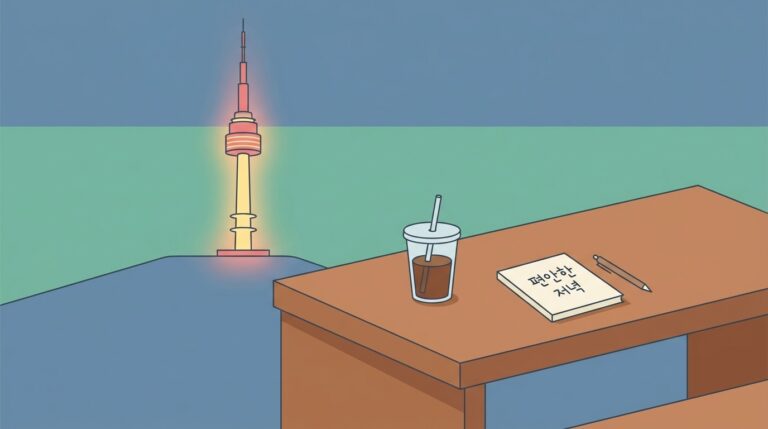
Going to a Rooftop Cafe in Korea: Simple Phrases for the Perfect Sunset View
안녕하세요! (An-nyeong-ha-se-yo!) I’m your lead editor and tutor at Daily Hangul. Have you ever scrolled through Instagram or watched a K-Drama where the main characters are sipping iced coffees on a stunning rooftop, looking over the glittering Seoul skyline?
You land in Korea, find a gorgeous rooftop cafe in Hongdae or Itaewon, walk in… and suddenly freeze. How do I ask if there are seats upstairs? Can I take this mug to the roof?
Don’t worry! Today, we are going to learn simple, natural Korean phrases (A2 Level) that will help you navigate Korean rooftop cafes like an absolute pro. No more awkward staring—just pure sunset vibes and delicious coffee! Let’s get started!
Phase 2: Core Rooftop Expressions for Beginners
Here are three essential phrases you can use the moment you step into a stylish cafe.
1. 루프탑 자리가 있어요? (Is there a seat on the rooftop?)
- Pronunciation: Ru-peu-tap ja-ri-ga isseo-yo?
- Sound-alike: “Roof-top jah-ree-gah eat-suh-yo?”
- Meaning: Is there a seat on the rooftop?
- K-Culture Moment: Think of that iconic scene in Itaewon Class where they look out over Namsan Tower. Before you hike up three flights of stairs, ask this first!
- Editor’s Insight: “자리” (ja-ri) means “seat” or “space.” Koreans use this word constantly. If the cafe is packed, asking this saves you a useless climb.
- Situation Spectrum:
- Friends/Casual: ✅
- Cafe Barista/Semi-formal: ✅
- Formal/Business: ⚠️ (A bit too casual for business, but perfectly fine for customer service)
- 🤔 Think About It: Why do you think Korean cafes use “자리” (seat) instead of “테이블” (table) when asking about availability? (Hint: It feels more cozy and personal!)
2. 위층으로 올라가도 돼요? (Can I go upstairs?)
- Pronunciation: Wi-cheung-eu-ro ol-la-ga-do dwae-yo?
- Sound-alike: “We-chung-ooh-ro oal-lah-gah-do dway-yo?”
- Meaning: Is it okay if I go upstairs?
- K-Culture Moment: Walking into a beautiful Hanok-style cafe in Ikseon-dong and wanting to explore the second-floor terrace.
- Editor’s Insight: The pattern “-도 돼요?” (-do dwae-yo?) is the magic key for asking permission in Korean. It literally means “Is it okay even if I do…?”
- Situation Spectrum:
- Friends/Casual: ✅
- Cafe Staff/Semi-formal: ✅
- Formal: ✅
- 🤔 Think About It: Seoul is famous for multi-story cafes because of limited ground space. Asking to go up is the first step to finding hidden views!
3. 테이크아웃 잔에 주세요. (Please give it to me in a takeout cup.)
- Pronunciation: Te-i-keu-a-ut jan-e ju-se-yo.
- Sound-alike: “Take-out jahn-eh joo-say-yo.”
- Meaning: Please put it in a takeout cup.
- K-Culture Moment: Ordering an iced coffee to enjoy outside on a breezy rooftop deck.
- Editor’s Insight: In Korea, cafes are legally required to serve drinks in reusable glass or plastic mugs inside the shop. However, if you are going to the rooftop terrace, many cafes prefer or require disposable “takeout” cups (테이크아웃 잔) for safety.
- Situation Spectrum:
- Friends/Casual: ⚠️ (Too formal for friends, use with staff!)
- Cafe Staff/Semi-formal: ✅
- Formal: ✅
- 🤔 Think About It: The word “잔” (jan) means cup or glass. It’s a handy counter word to memorize!
Phase 3: Textbook Korean vs. Real Korean
Let’s look at how textbooks teach these situations versus how real Koreans actually talk!
Situation 1: Ordering to go up to the roof
- 📖 Textbook Korean: “아이스 아메리카노를 루프탑에서 마시기 위해 일회용 컵에 주십시오.” (I would like an iced americano in a disposable cup in order to drink it on the rooftop.) – Too long and robotic!
- 🗣️ Real Korean: “루프탑 갈 건데 테이크아웃 잔에 주세요.” (Ru-peu-tap gal geon-de te-i-keu-a-ut jan-e ju-se-yo.)
- 💡 Why the difference? Real Korean values efficiency. The connector “~ㄴ/은데” (-nde) sets the background “I’m going to the rooftop, so…” which naturally explains why you need a takeout cup.
Situation 2: Asking if the roof is open
- 📖 Textbook Korean: “오늘 옥상 테라스가 개방되어 있습니까?” (Is the rooftop terrace open to the public today?) – Sounds like a formal announcement!
- 🗣️ Real Korean: “오늘 루프탑 열었어요?” (O-neul ru-peu-tap yeor-eoss-eo-yo?)
- 💡 Why the difference? Instead of heavy Sino-Korean words like “개방” (gae-bang / opening), locals use the simple conversational verb “열다” (yeol-da / to open).
Phase 4: K-Culture Deep Dive & Non-Verbal Manners
4-1. The Magic of “Seat Claiming” (Nunchi & Safety)
In Korea, it is incredibly safe. You will see people leave their $1,500 MacBooks or iPhones on a table to “claim” their spot before going downstairs to order. This is called “자리 맡기” (ja-ri mat-gi).
* The Rule: If you see a personal item (even a pack of tissues) on a rooftop table, that seat is claimed! Respect the system. Find another spot first, or wait patiently.
* Returning Trays: Do not leave your empty cups on the rooftop tables. Always carry your tray back down to the 반납대 (ban-nap-dae / return station) near the counter.
4-2. The “Eol-Juk-Ah” Phenomenon
Even on a chilly autumn evening on a rooftop, you’ll see Koreans drinking iced coffees. There is a hilarious cultural slang word for this: 얼죽아 (Eol-Juk-Ah), short for “얼어 죽어도 아이스” (Even if I freeze to death, I’ll drink iced beverages!). Try ordering an “아아” (Ah-Ah / Iced Americano) to join the club!
Phase 5: Interactive Roleplay Scenario
Setting: A trendy rooftop cafe in Haebangchon, Seoul at sunset. You can see Namsan Tower glowing in the background.
Characters:
* You (Excited Traveler)
* Minho (Friendly local barista)
- Minho: “어서 오세요! 주문 도와드릴까요?”
(Eo-seo o-se-yo! Ju-mun do-wa-deu-ril-kka-yo?)
“Welcome! Can I help you order?” -
You (🎭 Confidently smiling): “안녕하세요! 혹시 루프탑 자리가 있어요?”
(An-nyeong-ha-se-yo! Hok-si ru-peu-tap ja-ri-ga isseo-yo?)
“Hello! By any chance, are there seats on the rooftop?” -
Minho: “네, 지금 딱 두 자리 남아 있어요!”
(Ne, ji-geum ttak du ja-ri nam-a isseo-yo!)
“Yes, there are exactly two seats left right now!” -
You (🎭 Relieved): “다행이다! 그럼 아이스 아메리카노 한 잔 주세요.”
(Da-haeng-i-da! Geu-reom a-i-seu a-me-ri-ka-no han jan ju-se-yo.)
“Thank goodness! Then, one Iced Americano, please.” -
Minho: “매장에서 드시고 가시나요?”
(Mae-jang-e-seo deu-si-go ga-si-na-yo?)
“Are you drinking here in the cafe?” -
You: “네, 루프탑 갈 건데 테이크아웃 잔에 주세요.”
(Ne, ru-peu-tap gal geon-de te-i-keu-a-ut jan-e ju-se-yo.)
“Yes, I’m going to the rooftop, so please give it to me in a takeout cup.” -
Minho: “알겠습니다. 진동벨 울리면 받으러 오세요.”
(Al-get-seub-ni-da. Jin-dong-bel ul-li-myeon ba-deu-reo o-se-yo.)
“Understood. Please come collect it when the buzzer vibrates.” -
You: “감사합니다!”
(Gam-sa-ham-ni-da!)
“Thank you!”
🔀 Decision Point: The Buzzing Pager!
Your pager (진동벨) starts vibrating. You go pick up your coffee. Minho hands you the tray with a smile. What do you say to him as you head up the stairs?
- Option A: “바이바이!” (Bye-bye!)
- Option B: “수고하세요!” (Su-go-ha-se-yo! – “Keep up the hard work!”)
- Option C: “고맙다.” (Go-map-da – “Thanks” in casual low-form)
The Analysis:
- Best Choice: Option B! Saying “수고하세요” (Su-go-ha-se-yo) is a wonderfully natural way to thank service workers in Korea. It means “keep working hard/thank you for your effort.”
- Risky/Bad Choice: Option C! “고맙다” is informal non-honorific language. Saying this to a barista you don’t know might sound rude, even if you didn’t mean it!
Phase 6: 10-Second Shadowing Drill
Let’s add some Korean “soul” to your pronunciation! Pause at the / marks and match the emotional cues.
- [😊 Excited & Curious]
루프탑 / 자리가 / 있어요?
(Ru-peu-tap / ja-ri-ga / isseo-yo?) -
[🥺 Soft & Polite]
위층으로 / 올라가도 / 돼요?
(Wi-cheung-eu-ro / ol-la-ga-do / dwae-yo?)
Phase 7: K-Culture Mini Dictionary
- 뷰 맛집 (Byu Mat-jip): Literally “View Restaurant.” Used for cafes or eateries that have a mind-blowing scenic view.
- 진동벨 (Jin-dong-bel): The small plastic buzzer/pager given to you after ordering. It vibrates when your drink is ready.
- 인싸 (In-ssa): Insider / Trendsetter. A popular person who knows all the coolest “hot places” (핫플).
- 인생샷 (In-saeng-syat): “Life Shot.” The best photo of your life, usually taken at a gorgeous scenic spot like a rooftop cafe.
Phase 8: Traveler’s Survival Kit
| Expression (Hangul) | Romanization | English & Pro-Tip |
|---|---|---|
| 화장실 어디예요? | Hwa-jang-sil eo-di-yeo-yo? | “Where is the restroom?” (Many rooftop cafes have restrooms only on the 1st floor!) |
| 와이파이 비밀번호 뭐예요? | Wa-i-pa-i bi-mil-beon-ho mwo-yeo-yo? | “What is the Wi-Fi password?” (Usually printed on the receipt or near the pickup counter!) |
| 담요 있어요? | Dam-yo isseo-yo? | “Do you have blankets?” (Rooftops can get chilly at night. Most cafes provide free blankets near the stairs!) |
📌 Editor’s Travel Note: Google Maps is not fully optimized in South Korea. For finding the trendiest rooftop views in Haebangchon or Busan, make sure to download the Naver Map App or KakaoMap App beforehand!
Phase 9: Deep Thought — Cafe as the “Third Place”
In many Western cultures, a cafe is just a place to grab a quick morning coffee before work. In Korea, however, cafes act as social living rooms. Because metropolitan apartments in Seoul can be small and compact, the cafe culture evolved into a massive social ecosystem where people study, date, and take photos for hours. Rooftop cafes represent the ultimate escape from busy city life. It is where locals go to feel a sense of space and freedom.
💬 Your Turn: Does your home country have a big outdoor cafe culture? Where do people go when they want to enjoy the sunset in your city? Let us know in the comments below!
Phase 10: FAQ & Common Mistakes
Q: Can I bring my own snacks to a Korean rooftop cafe?
A: No. Korean cafes are very strict about outside food (외부 음식 반입 금지 – wae-bu eum-sik ban-ip geum-ji). Always buy at least one drink per person!
Q: Is there a time limit for sitting on the rooftop?
A: Generally no, but if it’s a very famous spot with a long line, it is polite to limit your stay to 1.5 to 2 hours.
Q: What should I do if the rooftop is closed due to wind or rain?
A: You can sit inside. The staff will usually post a sign saying “루프탑 미개방” (Rooftop not open) near the entrance.
🚨 Common Mistakes Alert!
- Forgetting to return trays: Leaving dirty cups on the rooftop is a big etiquette mistake. Always bring them down to the return area.
- Speaking too loudly: While rooftops are outdoor spaces, sound travels easily to neighboring residential buildings in Seoul. Keep your voice at a moderate volume.
Phase 11: Daily Hangul Action Missions
- 🥉 Bronze: Record yourself saying “루프탑 자리가 있어요?” on your phone three times.
- 🥈 Silver: Next time you go to a cafe (even in your hometown), try ordering your drink using the sentence structure: “[Drink Name] + 주세요” (ju-se-yo).
- 🥇 Gold: When you travel to Korea, go to a rooftop cafe in Haebangchon, order in Korean, grab a blanket (담요), and post an 인생샷 (Life Shot) on Instagram tagging us!
Phase 12: Interactive Quiz Challenge
1. Which phrase means “Can I go upstairs?”
- A) 루프탑 열었어요?
- B) 위층으로 올라가도 돼요?
- C) 테이크아웃 잔에 주세요.
Reveal Answer & Explanation
Correct Answer: B!
“위층” (wi-cheung) means upstairs, and “올라가도 돼요?” (ol-la-ga-do dwae-yo?) means “may I go up?”
2. True or False: You can leave your phone on a table to save your seat in Korea.
- A) True
- B) False
Reveal Answer & Explanation
Correct Answer: A (True)!
Korea is extremely safe, and “자리 맡기” (claiming seats with personal items) is a standard daily practice.






