

Moving On in Seoul: Healing From a Breakup the Korean Way
Phase 1: Empathy (Our Cozy Corner)
안녕하세요! (Annyeonghaseyo!) Hello, my dear friend. Welcome back to Daily Hangul, your cozy space for learning not just the Korean language, but the heartbeat of Korea. I’m your senior editor and your trusted native guide.
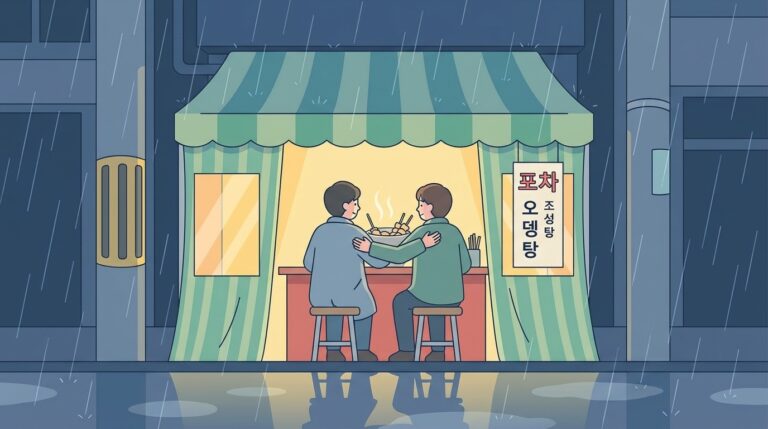
Picture this: It is a chilly, rainy evening in Seoul. You are sitting in a dimly lit, orange-tented street stall called a Pocha (포차). In front of you, a steaming bowl of spicy fish-cake soup (Eomuk-tang / 어묵탕) is warming your hands, but your heart is absolutely frozen. You just broke up with someone you truly cared about.
If you have watched K-Dramas like Our Beloved Summer (그해 우리는) or Yumi’s Cells (유미의 세포들), you know that Koreans take love—and the deep, lingering pain of a breakup—very seriously. There is a legendary Korean song by the artist Hareem that perfectly captures this feeling with a single, comforting truth: “사랑은 다른 사랑으로 잊혀진다” (Sarangeun dareun sarangeuro ichyeojinda), which means “Love is forgotten by another love.”
Today, we are going to dive deep into how Koreans express heartbreak, how they comfort their friends, and how you can use these expressions to connect on a deeply emotional level. By the end of this guide, you will not only understand the bittersweet nuance of moving on, but you will also know exactly what to say when a Korean friend needs a shoulder to cry on. Grab a warm tea, and let’s talk heart-to-heart.
Phase 2: Deep Dive into 3 Core Expressions
1. 사랑은 다른 사랑으로 잊혀진다 (Sarangeun dareun sarangeuro ichyeojinda)
- Pronunciation: [Sarangeun dareun sarangeuro ichyeojinda] / Sound-alike: Sah-rang-eun dah-reun sah-rang-eu-ro ee-chyeo-jin-da
- Meaning: “Love is forgotten/cured by another love.”
- K-Culture Moment: This is the ultimate romantic-realist philosophy in Korea. When someone is desperately trying to erase their ex from their memory, friends will gently pat their back and whisper this phrase to give them hope that a new, brighter love is waiting.
- Editor’s Insight: It sounds a bit sad at first, but it is actually highly optimistic. It acknowledges that trying to force yourself to forget someone using sheer willpower rarely works; instead, you must allow your heart to heal naturally until a new person fills that empty space.
- Situation Spectrum:
- Friends & Casual: ✅
- Co-workers & Semi-formal: ⚠️ (Only if you are very close outside of work)
- Bosses & Formal: 🚫 (Too personal!)
- 🤔 Think About It: In many Western cultures, people say “Take time for yourself before dating again.” Why do you think Korean culture emphasizes finding another love to heal the old wound? How does your culture view this process?
2. 시간이 약이다 (Sigani yagida)
- Pronunciation: [Sigani yagida] / Sound-alike: Shi-gan-ee yahg-ee-da
- Meaning: “Time is medicine” (Equivalent to “Time heals all wounds”).
- K-Culture Moment: You will hear this in almost every single K-Drama hospital or breakup scene. It is the go-to phrase of comfort for any kind of grief or hardship.
- Editor’s Insight: The word 약 (yak) means medicine. Instead of prescribing a physical pill, Koreans prescribe “time.” It is a gentle reminder that pain is temporary, even if it feels permanent right now.
- Situation Spectrum:
- Friends & Casual: ✅
- Co-workers & Semi-formal: ✅
- Bosses & Formal: ✅ (Highly versatile and polite enough for almost any comfort situation)
3. 마음을 정리하다 (Maeumeul jeongrihada)
- Pronunciation: [Maeumeul jeongrihada] / Sound-alike: Mah-eum-eul jung-ree-hah-da
- Meaning: “To organize one’s heart/feelings” (To get closure / to move on).
- K-Culture Moment: When a character in a drama decides to stop crying, packs away all the couple items, and deletes the photos from their phone, they say, “이제 마음 정리하려고요” (Ije maeum jeongriharyeogoyo – I am planning to organize my feelings now).
- Editor’s Insight: Koreans love organization (jeongri / 정리). Applying this to the human heart is a beautiful way of saying that your emotions are messy right now, but you are slowly putting them into the right drawers to find peace.
- Situation Spectrum:
- Friends & Casual: ✅
- Co-workers & Semi-formal: ✅
- Bosses & Formal: ⚠️
Phase 3: Textbook Korean vs. Real-World Korean
When we learn Korean from textbooks, the breakup vocabulary can feel incredibly stiff, like reading a legal document. Let’s look at how native Koreans actually talk about parting ways.
Situation 1: Telling a friend you broke up
- 📖 Textbook Korean: “저는 남자친구와 헤어졌습니다.” (Jeoneun namjachingu-wa heeojyeossseumnida.) – “I parted ways with my boyfriend.”
- 🗣️ Real-World Korean: “우리 깨졌어.” (Uri kkaejyeosseo.) – “We broke/shattered.” OR “나 차였어.” (Na chayeosseo.) – “I got dumped/kicked.”
- 💡 Why the difference? Textbooks use the passive, polite verb heeojida (to separate). Real friends use the visceral verb kkaejida (to break/shatter like glass) or chada (to kick) to show the raw reality of the breakup.
Situation 2: Comforting a crying friend
- 📖 Textbook Korean: “울지 마세요. 더 좋은 사람을 만날 것입니다.” (Ulji maseyo. Deo joeun sarameul mannal geosimnida.) – “Do not cry. You will meet a better person.”
- 🗣️ Real-World Korean: “야, 훌훌 털어버려. 걔가 너 아까워!” (Ya, hulhul teoreobeoryeo. Gyaega neo akkawo!) – “Hey, shake it off completely. They didn’t deserve you anyway!”
- 💡 Why the difference? Hulhul (훌훌) is a beautiful onomatopoeia describing the action of dusting something off lightly. Saying “걔가 너 아까워” literally means “That person was a waste of your value,” which is the ultimate way to boost your heartbroken friend’s self-esteem!
Phase 4: K-Culture Deep Dive & Non-Verbal Manners
4-1. The Art of “Silent Comfort” and Comfort Food
In Korea, comforting a friend who is going through a breakup is less about giving logical advice and more about physical presence and shared pain.
* Body Language Tip: Avoid giving an overly intense, dramatic American-style hug right away if your Korean friend is crying. Instead, sit side-by-side (rather than directly across), gently pat their shoulder or upper back, and pour them a drink.
* The Comfort Food Ritual: Koreans believe that physical pain (like eating incredibly spicy food) can distract from emotional pain. If your friend is heartbroken, take them out for Yeoptteok (엽떡 – super spicy rice cakes) or Maeun-dakbal (매운 닭발 – spicy chicken feet). Let them cry from the spice and the heartbreak simultaneously!
4-2. The Sound of Heartbreak: Hareem’s Masterpiece
The phrase “사랑은 다른 사랑으로 잊혀진다” became an national anthem of comfort because of Hareem’s 2004 ballad. In Korea, going to a Noraebang (노래방 – singing room) alone or with a close friend to scream-sing sad ballads is a crucial step in the healing process. Music in Korea isn’t just entertainment; it is collective therapy.
Phase 5: Interactive Roleplay Scenario
Setting: It is 11:30 PM. You are at a small, cozy retro pub in Hongdae. The background music is playing soft indie tunes. Your close Korean friend, Minjun (민준), is spinning his glass of beer, looking completely devastated after his recent breakup.
- Minjun: (🎭 Sighing deeply, looking at his phone) 하… 진짜 못 믿겠어. 어떻게 한 순간에 남이 되냐?
(Ha… jinjja mot mitgesseo. Eotteoke han sungane nami doenya?)
“Sigh… I really can’t believe it. How do we become strangers in a single moment?” -
You: (🎭 Placing a warm hand on his shoulder) 마음이 많이 아프지? 무슨 말인지 알아.
(Maeumi mani apeuji? Museun marinji ara.)
“Your heart hurts a lot, right? I know exactly what you mean.” -
Minjun: (🎭 Taking a sip of beer) 매일 연락하던 사람이 없어지니까 집이 너무 조용해. 방을 보면 다 그 사람 흔적뿐이야.
(Maeil yeonrakhadeon sarami eopseojinikka jibi neomu joyonghae. Bangeul bomyeon da geu saram heunjeokppuniya.)
“Since the person I messaged every day is gone, my house is so quiet. When I look around my room, it’s just filled with traces of them.” -
You: (🎭 Nodding slowly, listening intently) 물건들 보면 자꾸 생각나서 더 힘들 거야.
(Mulgeondeul bomyeon jakku saenggangnaseo deo himdeul geoya.)
“Looking at those things must make you think of them constantly, making it even harder.” -
Minjun: (🎭 Wiping a stray tear quickly) 나 진짜 평생 그 사람 못 잊을 것 같아. 나 어떡하냐?
(Na jinjja pyeongsaeng geu saram mot ijeol geot gata. Na eotteokanya?)
“I really feel like I can never forget them for the rest of my life. What do I do?”
🔀 Decision Point: What do you say to Minjun?
- Option A: “시간이 약이야, 민준아. 그리고 원래 사랑은 다른 사랑으로 잊혀진대.”
(Sigani yagiya, Minjuna. Geurigo wonrae sarangeun dareun sarangeuro ichyeojindae.) - Option B: “공부나 열심히 해. 바쁘면 다 잊어버려.”
(Gongbuna yeolsimhi hae. Bappeumyeon da ijeobeoryeo.) - Option C: “울지 마. 그 사람은 나쁜 사람이야! 당장 잊어!”
(Ulji ma. Geu sarameun nappeun saramiya! Dangjang ije!)
🏆 The Expert Verdict:
- Best Choice: Option A! This is pure gold. You combined “Time is medicine” with “Love is forgotten by another love” in a natural, warm, and comforting tone. It validates his pain while gently offering hope for the future.
- Risk/Bad Choice: Option B. Telling someone to “just study/work hard” invalidates their deep emotional trauma. It sounds cold, dismissive, and very mechanical.
- Mediocre Choice: Option C. While defensive of your friend, calling the ex a “bad person” can sometimes backfire if your friend still holds beautiful memories of them. It forces an aggressive emotional reaction when they just need to mourn.
Phase 6: 10-Second Emotional Shadowing Drill
Let’s practice saying this with true Korean soul (Jeong). Pay attention to the pauses (/) and the emotional guidance!
- [🥺 With deep empathy and soft tone]
시간이 / 약이야. / 마음 / 천천히 정리해.
(Sigani / yagiya. / Maeum / cheoncheonhi jeongrihae.)
“Time is / medicine. / Organize your heart / slowly.” -
[😊 Comforting, with a warm smile]
사랑은 / 다른 사랑으로 / 잊혀진대. / 힘내자!
(Sarangeun / dareun sarangeuro / ichyeojindae. / Himnaeja!)
“They say love / is forgotten / by another love. / Let’s find strength!”
Phase 7: K-Culture Mini Dictionary
| Word (Korean/Romanization) | English Meaning | Real-world Contextual Nuance |
|---|---|---|
| 이별 (Ibyeol) | Farewell / Breakup | Used in literature, songs, and dramas to describe the beautiful yet tragic process of parting ways. |
| 미련 (Miryeon) | Lingering attachment | The feeling of not being able to let go of an ex. If you still look at their Instagram, you have miryeon. |
| 정 (Jeong) | Deep emotional bond | The sticky, warm, social glue that connects Koreans. It makes breakups extremely hard because you have to tear Jeong apart. |
| 환승연애 (Hwanseung-yeonae) | Transit Love | A popular slang (and TV show title) meaning transferring directly from one relationship to another without staying single. |
Phase 8: Traveler’s Survival Kit
If you ever find yourself heartbroken in Korea, or comforting someone who is, use this survival kit!
Survival Phrases Top 3
- “술 한잔하자.” (Sul hanjanhaja.)
- Tip: “Let’s have a drink.” The absolute universal invitation to listen to a friend’s breakup sorrow.
- “노래방 갈래?” (Noraebang gallae?)
- Tip: “Do you want to go to Noraebang?” Screaming out sad breakup songs is a scientifically unproven but highly effective Korean therapy.
- “맛있는 거 먹으러 가자.” (Masinneun geo meogeureo gaja.)
- Tip: “Let’s go eat something delicious.” Food is love, food is comfort in Korea.
📌 Editor’s Travel Note: If you are in Seoul and need a place to clear your mind, head over to the Banpo Hangang Park (반포한강공원) late at night. The breeze from the river and the glittering city lights are incredibly therapeutic. Use the Naver Map App to find the quickest bus route to get there!
Phase 9: Deep Thoughts — “One Step Deeper”
Have you ever wondered why Korean breakup culture feels so incredibly intense? It all boils down to the concept of 정 (Jeong). Unlike Western love, which often focuses on passion, compatibility, and personal freedom, Korean relationships build a thick layer of Jeong—a shared history, mutual responsibility, and deep attachment.
Because Jeong is like a sticky thread that weaves two lives together, breaking up doesn’t just mean stopping communication; it feels like tearing your own skin. This is why Koreans talk about “organizing the heart” (maeum jeongri) and why finding “another love” is seen as the ultimate cure. It takes a new emotional bond to gently dissolve the old Jeong.
💬 Your Turn: How does your culture handle the process of letting go? Do you believe “love is forgotten by another love,” or do you prefer to heal alone? Let me know your thoughts in the comments below!
Phase 10: FAQ & Common Mistakes
Q: Can I say “사랑은 다른 사랑으로 잊혀진다” to someone who broke up yesterday?
A: Depends. If they are still in the raw, sobbing stage, it might sound a bit too early and dismissive of their current pain. Use “시간이 약이야” (Time is medicine) first. Save the “another love” phrase for when they start showing signs of wanting to move on.
Q: What is the difference between “헤어지다” and “깨지다”?
A: Heeojida is polite and standard. You can say it to anyone. Kkaejida (literally ‘to shatter’) is casual slang used strictly between close friends. Never tell your boss “I shattered with my boyfriend!”
Q: How do I say “I’m over them” in natural Korean?
A: Use “이제 다 정리했어” (Ije da jeongrihaesseo), which means “I have organized everything now.”
🚨 Common Mistakes Alert!
- Calling an ex “전 애인” (Jeon-aein) in casual conversation: While correct, it sounds very clinical and robotic. Instead, just call them “전 남친” (Jeon-namchin / ex-boyfriend) or “전 여친” (Jeon-yeochin / ex-girlfriend).
- Saying “잊으세요” (Ijuseyo) to mean “Get over it”: This sounds like an order. It’s much softer and kinder to say “천천히 잊어버려” (Cheoncheonhi ijeobeoryeo / Forget them slowly).
Phase 11: Action Missions
- 🥉 Bronze (The Mirror Challenge): Look in the mirror and practice saying: “시간이 약이야, 힘내자!” with a warm, comforting expression three times.
- 🥈 Silver (The Social Media Challenge): Go to your favorite K-Drama clip on YouTube, find a breakup scene, and write a comforting comment in Korean using: “마음 천천히 정리해요. 시간이 약이에요.”
- 🥇 Gold (The Real-World Challenge): Next time your friend (or online language partner) is feeling down or stressed, send them a message saying: “맛있는 거 먹으러 가자. 내가 살게!” (Let’s go eat something delicious. My treat!).
- 🎮 K-Culture Mission: Search for the song “사랑은 다른 사랑으로 잊혀지네” by Hareem (하림) on Spotify or YouTube. Listen to it while reading the lyrics. It will instantly upgrade your listening skills and warm your soul!
Phase 12: Interactive Quiz Challenge
Test your knowledge of Korean relationship and healing culture!
1. Which phrase is best to comfort a close friend who is crying over a breakup?
- A) 아주 잘 헤어졌어요. (Aju jal heeojyeosseoyo.)
- B) 훌훌 털어버려! 걔가 너 아까워. (Hulhul teoreobeoryeo! Gyaega neo akkawo.)
- C) 다른 사람을 바로 만나세요. (Dareun sarameul baro mannaseyo.)
🔍 Reveal Answer & Explanation
Correct Answer: B!
“Hulhul teoreobeoryeo! Gyaega neo akkawo” is the most natural, empowering, and affectionate way to comfort a close friend in Korean. Option A is too blunt, and Option C is too clinical/pushy.
2. Fill in the blank: “Time heals all wounds” in Korean is “______이 약이다.”
- A) 사랑 (Sarang)
- B) 마음 (Maeum)
- C) 시간 (Sigan)
🔍 Reveal Answer & Explanation
Correct Answer: C!
“시간” (Sigan) means time. Together, “시간이 약이다” translates to “Time is medicine.”
3. True or False: In Korea, when comforting a heartbroken friend, it is best to immediately give them a tight, long hug in public.
🔍 Reveal Answer & Explanation
Correct Answer: False!
While physical comfort is nice, Koreans often prefer sitting side-by-side, sharing hot food, pouring drinks, and gently patting shoulders over sudden, tight hugs in public spaces. Cultural physical boundaries are slightly different, so subtle presence is highly appreciated!
Remember, whether you are dealing with a tough breakup or just struggling with a difficult grammar point: 시간이 약입니다 (Time is medicine). Keep practicing, keep moving forward, and we at Daily Hangul are always here to walk beside you.
See you in the next unit! 다음에 또 만나요! (Damae tto mannayo!)







