

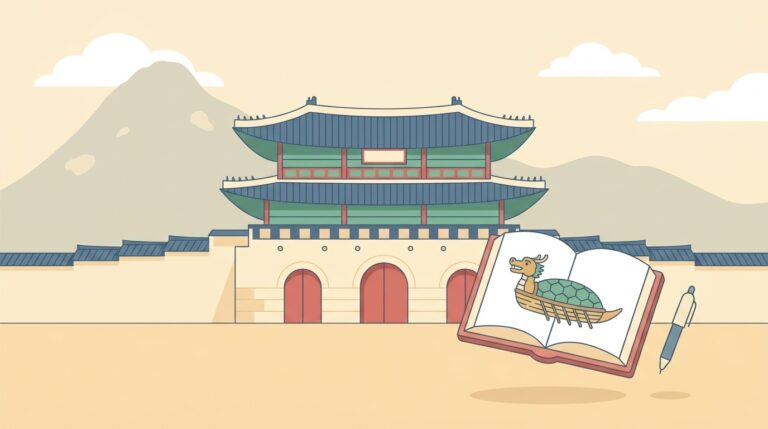
Unlock Korea’s Past: How to Read About Historical Heroes in Easy Korean
안녕하세요! (An-nyeong-ha-se-yo!) Hello there! I’m your friendly senior editor from Daily Hangul.
Have you ever stood in the middle of Gwanghwamun Square in Seoul, looked up at the massive golden statue of King Sejong, and wondered: “Who was this amazing king, and how do Koreans talk about him?”
Perhaps you bought an easy Korean children’s book or a biography (위인전 – wi-in-jeon) to practice your reading, only to get lost in a sea of formal-sounding words and historical terms.
Don’t worry! Reading about Korea’s historical heroes doesn’t have to feel like translating an ancient scroll. Today, we will break down the exact words and phrases you need to talk about Korea’s greatest figures and visit historical sites (역사 유적지 – yeok-sa yu-jeok-ji) with confidence. Grab your favorite drink, and let’s dive into the fascinating stories of Korea!
Phase 2: Core Expressions Deep Dive
Here are three essential expressions you will see in every Korean biography and use at every historical site. Let’s master them together!
1. 위대한 인물 (Wi-dae-han in-mul)
- Pronunciation: [Wee-dae-han een-mool] / Sounds like “We-dae” + “In-mool”
- Meaning: A great historical figure / hero.
- K-Culture Moment: In K-Dramas, whenever characters visit a museum or talk about historical figures like Admiral Yi Sun-sin, they use this term with starry eyes.
- Editor’s Insight: “인물” (in-mul) means “person” or “character,” and “위대하다” (wi-dae-hada) means “to be great.” Together, it’s a highly respectful way to refer to someone who changed history.
- Situation Spectrum:
- Friends/Casual: ✅ (Safe to use when chatting about heroes)
- Coworkers/Semi-formal: ✅
- Bosses/Formal: ✅
- 🤔 Think About It: Who is a “위대한 인물” (great figure) in your country? How do you feel when you stand in front of their statue?
2. 역사적인 장소 (Yeok-sa-jeok-in jang-so)
- Pronunciation: [Yuck-sa-jeok-een jahng-so] / Sounds like “Yuck-sa” + “jeok-in” + “Jang-so”
- Meaning: A historical place / site.
- K-Culture Moment: Think of beautiful K-Dramas like Mr. Sunshine or The King’s Affection. The gorgeous palaces and old walls they film at are all “역사적인 장소.”
- Editor’s Insight: If you visit Gyeongbokgung Palace or the city of Gyeongju, you are standing in a “역사적인 장소.” It sounds much warmer and more natural than just saying “old place.”
- Situation Spectrum:
- Friends/Casual: ✅
- Coworkers/Semi-formal: ✅
- Bosses/Formal: ✅
- 🤔 Think About It: Why do you think preserving these physical locations is so important to Koreans? How does it connect to modern K-Wave?
3. 본받고 싶어요 (Bon-bat-go sip-eo-yo)
- Pronunciation: [Bone-baht-go seep-uh-yo] / Sounds like “Bone-baht” (rolling the t slightly) + “go ship-oh-yo”
- Meaning: I want to follow their example / I want to be like them.
- K-Culture Moment: When K-Pop idols are asked who their role models are, they often say, “I want to follow their path” using this exact grammar structure.
- Editor’s Insight: This comes from the verb “본받다” (to model after / emulate). It shows deep respect and a humble desire to learn from someone else’s great life.
- Situation Spectrum:
- Friends/Casual: ⚠️ (Use “본받고 싶어” without “yo”)
- Coworkers/Semi-formal: ✅
- Bosses/Formal: ✅
- 🤔 Think About It: In Korean culture, showing a desire to learn from the wisdom of ancestors is highly respected. Is this similar or different in your culture?
Phase 3: Textbook Korean vs. Real Korean
When we read textbooks, the language can feel stiff and robotic. Let’s look at how native Koreans actually talk about these historical topics in real life!
Situation 1: Explaining King Sejong’s greatest achievement
- 📖 Textbook Korean: 세종대왕은 한글을 창제하셨습니다. (King Sejong invented Hangeul.) – Very formal and dry.
- 🗣️ Real Korean: 세종대왕 덕분에 우리가 한글을 쓰잖아요! (Thanks to King Sejong, we use Hangeul!) – Warm, conversational, and appreciative.
- 💡 Why the difference? Koreans feel a personal connection to King Sejong. Using “덕분에” (thanks to) shows gratitude for something they use every single day.
Situation 2: Expressing respect for a historical hero
- 📖 Textbook Korean: 저는 이순신 장군을 존경합니다. (I respect Admiral Yi Sun-sin.) – Sounds like a school essay.
- 🗣️ Real Korean: 이순신 장군은 진짜 대단하신 것 같아요. (I think Admiral Yi Sun-sin was truly amazing.) – Natural, conversational, and heartfelt.
- 💡 Why the difference? While “존경합니다” (I respect) is correct, in daily conversation, “진짜 대단하신 것 같아요” (I think they are truly amazing) feels more casual and natural while still keeping the respect honorifics (하-시-다).
⚠️ Bottom Note: Since you are at the A2 level, using “~것 같아요” (I think / it seems like) is a magical way to make any opinion sound polite and natural!
Phase 4: K-Culture Deep Dive & Non-verbal Manners
4-1. The Body Language of Respect
When visiting historical sites like shrines, royal tombs, or giant statues in Korea, you will see Koreans standing quietly or bowing slightly.
* Pro Tip: When taking photos in front of statues of kings or national heroes (like Admiral Yi Sun-sin), avoid making silly faces or peace signs if you want to show respect. A simple, polite posture with a gentle smile is perfect!
4-2. The Sageuk (Historical Drama) Connection
Have you watched K-Dramas like Kingdom or Under the Queen’s Umbrella? Palaces like Gyeongbokgung aren’t just empty museums; they are living backdrops for stories that Koreans grew up with. When you read a biography of a king and then visit Gyeongbokgung Palace, you are walking through the exact rooms where those dramas—and real history—happened!
Phase 5: Gwanghwamun Walk (A Roleplay Scenario)
- Setting: A sunny afternoon at Gwanghwamun Square in Seoul. The giant bronze statue of Admiral Yi Sun-sin stands tall, with fountains splashing around it. You are walking with your Korean friend, Minji.*
-
Cast:
- You: An enthusiastic Korean learner.
- Minji: Your supportive Korean friend.
The Dialogue
- You: 🎭 (Pointing up at the giant statue)
와, 이 동상 진짜 크네요!
(Wa, i dong-sang jin-jja keu-ne-yo!)
“Wow, this statue is really big!” -
Minji: 🎭 (Smiling proudly)
맞아요! 이분이 바로 이순신 장군이에요.
(Ma-ja-yo! I-bun-i ba-ro I-sun-sin jang-gun-i-e-yo.)
“That’s right! This is Admiral Yi Sun-sin.” -
You: 🎭 (Nodding)
아! 책에서 읽었어요. 거북선을 만드신 분이죠?
(Ah! Chaek-e-seo ilg-eoss-eo-yo. Geo-buk-seon-eul man-deu-sin bun-i-jyo?)
“Ah! I read about him in a book. He is the one who made the Turtle Ship, right?” -
Minji: 🎭 (Surprised and impressed)
와, 그걸 어떻게 알았어요? 대단해요!
(Wa, geu-geol eo-tteo-ke a-rass-eo-yo? Dae-dan-hae-yo!)
“Wow, how did you know that? That’s amazing!” -
You: 🎭 (Shyly smiling)
위인전을 조금 읽어봤어요. 진짜 대단하신 분 같아요.
(Wi-in-jeon-eul jo-geum ilg-eo-bwass-eo-yo. Jin-jja dae-dan-ha-sin bun gat-a-yo.)
“I read a little bit of a biography. I think he is a truly amazing person.” -
Minji: 🎭 (Warmly)
한국 사람들이 정말 존경하는 역사적인 인물이에요.
(Han-guk sa-ram-deul-i jeong-mal jon-gyeong-ha-neun yeok-sa-jeok-in in-mul-i-e-yo.)
“He is a historical figure that Korean people deeply respect.” -
You: 🎭 (Looking closely at the sword)
저도 이분의 용기를 본받고 싶어요.
(Jeo-do i-bun-ui yong-gi-lue bon-bat-go sip-eo-yo.)
“I also want to follow his courage.” -
Minji: 🎭 (Clapping gently)
한국어 표현도 정말 잘 쓰네요! 감동이에요.
(Han-guk-eo pyo-hyeon-do jeong-mal jal sseu-ne-yo! Gam-dong-i-e-yo.)
“Your Korean expressions are so good! I’m touched.” -
You: 🎭 (Proudly)
매일한글 덕분이에요!
(Mae-il Han-geul deok-bun-i-e-yo!)
“It’s thanks to Daily Hangul!” -
Minji: 🎭 (Laughing)
그럼 이제 세종대왕 동상 보러 갈까요?
(Geu-reom i-je Se-jong-dae-wang dong-sang bo-reo gal-kka-yo?)
“Then shall we go see the statue of King Sejong now?”
🔀 Decision Point!
Minji asks you: “이순신 장군에 대해 더 알고 싶어요?” (Do you want to know more about Admiral Yi Sun-sin?) How do you reply?
- A) “네, 더 알려주세요!” (Ne, deo al-lyeo-ju-se-yo!)
- 💖 Best Choice! This is incredibly polite and shows enthusiasm. Minji will happily tell you all the exciting historical drama stories!
- B) “귀찮아요.” (Gwi-chan-ha-yo.)
- 🚫 Risky Choice! This means “It’s bothersome/annoying.” It sounds very cold and impolite to a friend who is excited to share their history.
- C) “다 알아요.” (Da al-a-yo.)
- ⚠️ A bit arrogant! This means “I know everything already.” While not directly rude, it stops the friendly conversation.
Phase 6: 10-Second Shadowing Drill
Let’s practice saying this with natural emotion! The slashes (/) show where to take a tiny breath.
Drill 1: [😊 With warm respect and wonder]
진짜 / 대단하신 분 / 같아요!
(Jin-jja / dae-dan-ha-sin bun / gat-a-yo!)
“I think / they are / truly amazing!”
Drill 2: [🥺 Sincerely and full of hope]
저도 / 꼭 / 본받고 싶어요!
(Jeo-do / kkok / bon-bat-go sip-eo-yo!)
“I also / definitely / want to be like them!”
Phase 7: K-Culture Mini Dictionary
| Word | Pronunciation | Real-world Context |
|---|---|---|
| 위인전 (Wi-in-jeon) | [Wee-een-jeon] | Biography of a great person. Often sold in easy-to-read comic book formats for kids and language learners! |
| 유적지 (Yu-jeok-ji) | [Yoo-jeok-jee] | Historical ruins/site. Places like palaces, ancient temples, and traditional villages. |
| 세종대왕 (Se-jong-dae-wang) | [Seh-jong-dae-wahng] | King Sejong the Great. The beloved 4th king of the Joseon Dynasty who created Hangeul. |
| 거북선 (Geo-buk-seon) | [Guh-buk-sun] | Turtle Ship. The famous ironclad warship designed by Admiral Yi Sun-sin. |
Phase 8: Traveler’s Survival Kit
Survival Expressions TOP 3 🎒
- 여기 역사적인 장소예요? (Yeo-gi yeok-sa-jeok-in jang-so-yeo-yo?)
- 👉 “Is this a historical place?” (Use this when walking around old neighborhoods or mountains!)
- 영어 설명서가 있어요? (Yeong-eo seol-myeong-seo-ga is-seo-yo?)
- 👉 “Is there an English pamphlet/guidebook?” (Super useful at museum ticket booths!)
- 사진 찍어도 돼요? (Sa-jin jjig-eo-do dwae-yo?)
- 👉 “May I take a photo?” (Always ask this inside historical temples or shrines!)
📌 Editor’s Travel Note
- Must-Have App: Always use Naver Map App when looking for historical sites. Google Maps can get outdated in Korea, but Naver Map will show you the exact palace gates and even bus routes!
- Pro Tip: Did you know? If you wear a traditional Hanbok (which you can rent nearby), you get free admission to Seoul’s major palaces, including Gyeongbokgung!
Phase 9: Deep Reflection — “One Step Deeper”
In many Western cultures, historical figures are kept in history textbooks or remote statues. But in Korea, historical heroes are part of daily life.
When you buy a banana milk at a convenience store, you pay with coins and bills featuring Yi Sun-sin (100 won coin) or King Sejong (10,000 won bill). They are literally in the hands of modern Koreans every day. This daily connection makes history feel alive, warm, and highly respected.
💬 Your Turn
Who is a historical figure on your country’s currency? How do people talk about them? Let us know in the comments below!
Phase 10: FAQ & Common Mistakes (FAQ Schema)
Q: Can I use “본받고 싶어요” (I want to follow your example) directly to my living boss?
A: Yes, but with caution! While it is polite, saying “본받고 싶어요” sounds extremely emotional and deep. It is best used for historical figures, mentors, or senior teachers. For a direct boss, saying “많이 배우고 싶습니다” (I want to learn a lot from you) is safer and more professional.
Q: What is the difference between “위인” (wi-in) and “영웅” (yeong-ung)?
A: “위인” means a great historical figure who contributed to culture, science, or society (like a king or inventor). “영웅” means a hero, usually in battle or an action movie.
🚨 Common Mistakes Alert!
- Mistake 1: Calling a historical king just by their name (e.g., “세종” or “이순신”).
- Correct Action: Always add their title! Use 세종대왕 (King Sejong the Great) and 이순신 장군 (General/Admiral Yi Sun-sin).
- Mistake 2: Saying “역사 장소” instead of “역사적인 장소.”
- Correct Action: Use “역사적인 장소” to sound like a natural native speaker.
Phase 11: Action Missions
- 🥉 Bronze (At-Home Challenge): Go to Google, look up a photo of Gyeongbokgung Palace, and say out loud: “여기 역사적인 장소예요!”
- 🥈 Silver (Social Challenge): Post a picture of your favorite historical spot or movie hero on Instagram, write “본받고 싶어요” in the caption, and tag us at #DailyHangul!
- 🥇 Gold (Real-Life Challenge): Next time you visit a museum or use a Korean bill, try to identify the hero and explain them to a friend using the phrase: “위대한 인물이에요!”
Phase 12: Interactive Quiz Challenge
1. Situational Question
You are at Gyeongbokgung Palace with a native Korean guide. You want to express how much you admire the ancient architecture. Which phrase is best?
* A) 역사 장소 아주 멋집니다.
* B) 여기 진짜 역사적인 장소네요!
* C) 이 건물 본받고 싶어요.
👉 Click to see the Answer & Explanation
Correct Answer: B
* Explanation: “여기 진짜 역사적인 장소네요!” (This place is truly a historical place!) is natural and uses correct grammar. Option A uses incorrect phrasing (“역사 장소”), and Option C is incorrect because “본받다” is only used for people, not buildings!
2. Fill in the Blanks
Complete the sentence:
세종대왕은 한글을 만드신
__________ 인물입니다. (King Sejong is a great figure who made Hangeul.)
👉 Click to see the Answer & Explanation
Correct Answer: 위대한 (wi-dae-han)
* Explanation: “위대한 인물” means “great historical figure.”
3. True or False?
True or False: You can enter major palaces in Seoul for free if you wear a traditional Hanbok.
👉 Click to see the Answer & Explanation
Correct Answer: True!
* Explanation: Wearing Hanbok grants you free admission to Gyeongbokgung, Changdeokgung, and other major palaces. It is a fantastic cultural experience!
See you in the next lesson! 다음에 또 만나요! (Da-eum-e tto man-na-yo!)






