

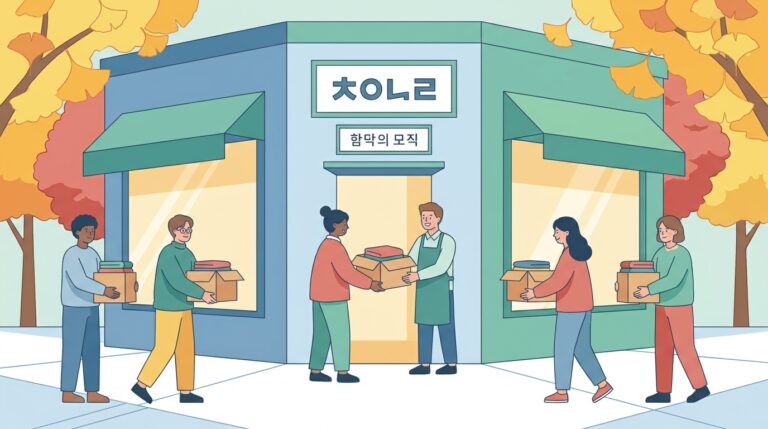
Do Good, Live Local: Mastering the Art of Charity, Flea Markets, and Ethical Living in Korea
안녕하세요! Welcome back to another masterclass with Daily Hangul. I’m your head editor and local culture navigator, and today, we are stepping into a side of Korea that tourists rarely get to experience, but locals hold incredibly dear: the beauty of sharing (나눔 – Na-num).
Have you ever stood in your Seoul officetel, staring at a pile of perfectly good clothes, books, or electronics, wondering what to do with them? Or perhaps you’ve watched a slice-of-life K-Drama like Hometown Cha-Cha-Cha or Run On, where characters spend their weekends volunteering at a cozy neighborhood flea market or donating sentimental belongings, and thought, “I want to do that, but how do I even start without sounding like a tourist reading from a textbook?”
If you have ever felt hesitant to walk into a Beautiful Store (아름다운가게) because you didn’t know the exact linguistic etiquette, or felt lost at a local Sharing Market (나눔 장터), you are in the right place. Today, we’re unlocking the high-level vocabulary, cultural subtexts, and social manners of volunteering and donating in Korea. By the end of this guide, you won’t just know the words—you’ll understand the soul behind them. Let’s dive in!
Phase 2: Deep Dive into 3 Key Expressions
To navigate Korea’s ethical spaces like a C1-level speaker, you need to go beyond the basic word for charity. Let’s look at three high-frequency, nuanced expressions that will immediately earn you the respect of local volunteers.
1. 기증하다 (Gi-jeung-ha-da)
- Pronunciation: [gi-jeung-ha-da] / Sound-alike: “key-jung-ha-da”
- Meaning: To donate (specifically physical items, goods, or talents) vs. 기부하다 (Gi-bu-ha-da) (to donate money or general assets).
- K-Culture Moment: Think of a scene in a drama where an old collector hands over precious books to a local library, or a trendy character packs up their designer clothes to give to Beautiful Store. They don’t just ‘throw it away’—they 기증 it.
- Editor’s Insight: English speakers often default to 기부하다 for everything. However, when you bring physical boxes of clothes to a charity shop, using 기증하다 shows an incredibly sharp command of Korean. It sounds respectful, precise, and highly educated.
- Situation Spectrum:
- Casual (Friends): ⚠️ (Sounds a bit too formal for lending/giving to a friend; use 드림/나눔 instead)
- Semi-formal (Co-workers): ✅
- Formal (Volunteering/Official centers): ✅
- 🤔 Think About It: Why does Korean distinguish physical donations (기증) so sharply from monetary ones (기부)? It stems from a historical appreciation for the tangible history of objects—giving a physical piece of your life to another.
2. 수익금이 좋은 곳에 쓰이다 (Su-ik-geum-i jo-eun go-se sseu-i-da)
- Pronunciation: [su-ik-geum-i jo-eun go-se sseu-i-da] / Sound-alike: “soo-eek-geum-ee jo-eun go-seh ssee-ee-da”
- Meaning: “The proceeds are used for a good cause.”
- K-Culture Moment: You walk into a neighborhood flea market organized by the local district office (구청). A sign at the entrance reads: “수익금은 전액 어려운 이웃을 위해 사용됩니다” (All proceeds will be used for neighbors in need).
- Editor’s Insight: Notice the passive verb 쓰이다 (to be used/spent). In Korean culture, speaking directly about money can sometimes feel crass. By using the passive voice here, the focus shifts beautifully from who is spending the money to the noble destination of the funds.
- Situation Spectrum:
- Casual: ✅
- Semi-formal: ✅
- Formal: ✅
- 🤔 Think About It: How does this passive phrasing reflect the collective modesty of Korean society? Instead of “We donate your money,” it is “The money finds its way to a good place.”
3. 나눔을 실천하다 (Na-num-eul sil-cheon-ha-da)
- Pronunciation: [na-num-eul sil-cheon-ha-da] / Sound-alike: “nah-noom-eul sheel-cheon-ha-da”
- Meaning: To put sharing/generosity into practice (active lifestyle choice).
- K-Culture Moment: This is the ultimate phrase used by socially conscious K-Pop idols during charity campaigns or when fans organize forest-planting projects in their idol’s name.
- Editor’s Insight: The word 실천 (Action/Practice) is the key here. It’s not just about having good intentions; it’s about physically getting your hands dirty, packing boxes, or showing up at the market. Saying you want to 나눔을 실천하다 marks you as someone committed to community action.
- Situation Spectrum:
- Casual: ⚠️ (A bit poetic, but usable when talking about personal philosophies)
- Semi-formal: ✅
- Formal: ✅
Phase 3: Textbook Korean vs. Real Korean
When you study from traditional textbooks, the dialogues can feel stiff and overly clinical. Let’s look at how Koreans actually talk when they are engaging in charity and local trading.
Scenario 1: Offering your items for free at a community market
- 📖 Textbook Korean: “이 물건들을 돈을 받지 않고 드리겠습니다.” (I will give you these items without receiving money.)
- 🗣️ Real Korean: “이거 그냥 나눔할게요. 좋은 분이 가져가셨으면 좋겠어요.” (I’ll just share/give this away for free. I hope it goes to a good home.)
- 💡 Why the difference? Textbooks focus on literal transactions. Real Koreans use the noun-verb 나눔하다 (to share for free) to make the transaction feel warm and community-driven, rather than a cold transaction of ‘zero dollars.’
Scenario 2: Showing enthusiastic support for an ethical business
- 📖 Textbook Korean: “이 가게는 기부를 많이 하니까 제가 물건을 많이 살 것입니다.” (Because this shop donates a lot, I will buy many things.)
- 🗣️ Real Korean: “와, 여기 완전 착한 소비 맛집이네! 우리 오늘 여기서 돈쭐내줘요!” (Wow, this is a total ‘ethical consumption’ hotspot! Let’s ‘punish them with our wallets’ today!)
- 💡 Why the difference? 돈쭐내다 (Don-jjul-nae-da) is a delightful modern slang combining ‘돈’ (money) and ‘혼쭐내다’ (to give a scolding/punishment). It means to obsessively buy from a business that does good deeds so they are flooded with profits. C1 speakers who use this slang will instantly make local volunteers burst into laughter and warmth!
Phase 4: K-Culture Deep Dive & Non-verbal Manners
4-1. The Body Language of Giving (나눔의 비언어적 매너)
In Korea, how you physically hand over your donation items matters just as much as what you say.
* Two-Handed Delivery (두 손으로 전달하기): When handing your donation boxes or items to the store coordinator, always support your right elbow with your left hand, or hold the box with both hands. It shows that you respect the volunteer’s labor.
* Pre-sorting Respect (사전 정리): Never donate dirty or unwashed items. In Korea, donating is seen as passing on a clean piece of your life. Items brought to Beautiful Store should ideally be washed, folded, and organized. Dropping off messy items is seen as treating the charity like a garbage bin, which violates the core cultural code of Nunchi (눈치 – situational awareness).
4-2. The Cultural DNA of “Anabada” (아나바다)
To truly understand Korea’s flea markets, you must know the term 아나바다 (A-na-ba-da). Originating during the 1997 Asian Financial Crisis (IMF crisis), this was a nationwide campaign that stood for:
* 아껴 쓰고 (Save/Conserve)
* 나눠 쓰고 (Share)
* 바꿔 쓰고 (Exchange)
* 다시 쓰자 (Reuse)
What started as a survival mechanism evolved into a beautiful cultural eco-movement. When you visit a local district sharing market (나눔 장터), you are stepping directly into this living history of national solidarity and resourcefulness.
Phase 5: Interactive Roleplay Scenario
Setting: A crisp, golden autumn afternoon at the Beautiful Store (아름다운가게) near Anguk Station, Seoul. Soft acoustic music plays in the background. The smell of second-hand books and clean linen fills the air. You are carrying a box of gently used books and winter coats to donate.
Characters:
* You (민우 / Min-woo): A warm-hearted expat eager to donate.
* Eun-ji (은지): A kind, seasoned Beautiful Store volunteer with a welcoming smile.
- 은지 (Volunteer): (👋 Smiling warmly as she sees you carrying a heavy box) 안녕하세요! 어서 오세요. 오늘 물건 기증하러 오셨나요?
(An-nyeong-ha-se-yo! Eo-seo o-se-yo. O-neul mul-geon gi-jeung-ha-reo o-syeot-na-yo?)
“Hello! Welcome. Are you here to donate physical items today?” -
민우 (You): (🙇♂️ Setting the box down gently on the counter using both hands) 네, 안녕하세요! 그동안 아껴 쓰던 옷이랑 책들을 기증하고 싶어서 가져왔어요.
(Ne, an-nyeong-ha-se-yo! Geu-dong-an a-kyeo sseu-deon ot-i-rang chaek-deul-eul gi-jeung-ha-go sip-eo-seo ga-jyeo-was-eyo.)
“Yes, hello! I brought some clothes and books that I’ve cared for, hoping to donate them.” -
은지 (Volunteer): (✨ Claspping her hands together appreciatively) 와, 정말 감사합니다! 요즘 가을 옷 기증이 많이 필요했는데 딱 맞춰 오셨네요. 기증 신청서 작성은 해 보셨나요?
(Wa, jeong-mal gam-sa-hap-ni-da! Yo-jeum ga-eul ot gi-jeung-i ma-ni pil-yo-haet-neun-de ttak mat-chwo o-syeot-nae-yo. Gi-jeung sin-cheong-seo jak-seong-eun hae bo-syeot-na-yo?)
“Oh, thank you so much! We really needed autumn clothes donations lately, you came at the perfect time. Have you ever filled out a donation application before?” -
민우 (You): (🤔 Looking slightly puzzled but polite) 아, 신청서는 처음이에요. 혹시 연말정산용 기부영수증도 신청할 수 있나요?
(A, sin-cheong-seo-neun cheo-eum-i-e-yo. Hok-si yeon-mal-jeong-san-yong gi-bu-yeong-su-jeung-do sin-cheong-hal su it-na-yo?)
“Ah, it’s my first time filling out the form. By any chance, can I also apply for a donation receipt for year-end tax adjustment?” -
은지 (Volunteer): (👍 Nodding enthusiastically) 물론이죠! 휴대전화 번호랑 인적 사항만 적어 주시면 홈택스에 자동으로 등록해 드려요. 여기 신청서 한 번 봐 주시겠어요?
(Mul-ron-i-jyo! Hyu-dae-jeon-hwa beon-ho-rang in-jeok sa-hang-man jeok-eo ju-si-myeon hom-taek-seu-e ja-dong-eu-ro deung-rok-hae deu-ryeo-yo. Yeo-gi sin-cheong-seo han beon bwa ju-si-get-eo-yo?)
“Of course! Just write your phone number and basic info, and we will automatically register it on Hometax. Could you take a look at this application form?” -
민우 (You): (✍️ Taking the pen with two hands and filling out the form) 네, 다 적었어요. 그런데 여기에 있는 코트 중에 단추가 하나 없는 게 있는데… 이것도 괜찮을까요?
(Ne, da jeok-eot-eo-yo. Geon-de yeo-gi-e in-neun ko-teu jung-e dan-chu-ga ha-na eop-neun ge in-neun-de… i-geot-do gwaen-chan-eul-kka-yo?)
“Yes, I’ve filled it out. But among these coats, there’s one that is missing a single button… Will this be okay?”
🔀 Decision Point!
How should you handle this slightly flawed item? Choose your next response:
- Choice A: “에이, 대충 팔아도 되지 않을까요? 좋은 일에 쓰는 거니까요.”
(Ei, dae-chung pal-a-do doe-ji an-eul-kka-yo? Jo-eun i-re sseu-neun geo-ni-ka-yo.)
“Come on, can’t you just sell it anyway? Since it’s for a good cause.” - Choice B: “혹시 수리가 안 되면 다른 분들께 폐가 될까 봐 걱정되네요. 이 코트는 제가 다시 가져가서 수선해 올게요!”
(Hok-si su-ri-ga an doe-myeon da-ren bun-deul-ke pye-ga doel-kka bwa geok-jeong-doe-ne-yo. I ko-teu-neun je-ga da-si ga-jyeo-ga-seo su-seon-hae ol-ge-yo!)
“I’m worried it might trouble others if it can’t be repaired. I’ll take this coat back and fix it before bringing it again!” - Choice C: “단추가 없어서 그냥 버리려다가 귀찮아서 여기 가져왔어요.”
(Dan-chu-ga eop-seo-seo geu-nyang beo-ri-ryeo-da-ga gwi-chan-as-eo yeo-gi ga-jyeo-was-eo-yo.)
“I was going to throw it away because of the missing button, but I was too lazy, so I brought it here.”
🏆 Best Choice Analysis: Choice B
Choosing Choice B shows the ultimate embodiment of Nunchi (눈치) and respect (배려). In Korea, sending flawed items to charity shops can be seen as “dumping junk” rather than giving. By proactively offering to take it back and repair it, you demonstrate that you respect the potential buyers and the store volunteers. Eun-ji will likely be deeply touched and might even say: “어머, 마음이 너무 예쁘시네요! (Oh, what a beautiful heart you have!)”
- Avoid Choice A & C: Choice A dismisses quality control, and Choice C is outright offensive, implying that the charity is your garbage dump.
Phase 6: 10-Second Shadowing Drill
Let’s put some heart and soul into your spoken Korean! Practice saying this beautiful phrase with the correct emotional inflections.
Phrase:
“수익금이 / 좋은 곳에 쓰인다니 / 정말 마음이 따뜻해지네요.”
- Pronunciation Guide: [Su-ik-geum-i / jo-eun go-se sseu-in-da-ni / jeong-mal ma-um-i tta-tteut-hae-ji-ne-yo.]
- Rhythm & Pauses: Pause briefly at the slashes (
/). Lift your tone slightly at 쓰인다니 and let it settle warmly at 따뜻해지네요. - Emotion Guidepost: [😊 Say this with a warm, genuine smile, feeling soft and appreciative.]
- English Translation: “Hearing that the proceeds will be used for a good cause truly warms my heart.”
Phase 7: K-Culture Mini Dictionary
| Word (한글) | Romanization | English Translation | Real-world Context & Usage |
|---|---|---|---|
| 벼룩시장 | Byeo-ruk-si-jang | Flea Market | Often organized by local neighborhood communities or young creators in artistic districts like Hongdae or Seongsu-dong. |
| 재능기부 | Jae-neung-gi-bu | Talent Donation | Act of donating your professional skills (e.g., teaching English, designing, cutting hair) for free to those in need. |
| 돈쭐 | Don-jjul | “Money-scolding” | Modern slang for buying out an ethical shop’s inventory to reward them for their good deeds. |
| 착한 소비 | Chak-han So-bi | Ethical Consumption | Mindful purchasing behavior, such as buying upcycled bags or fair-trade goods from social enterprises. |
Phase 8: Traveler’s Survival Kit
Even if you are only in Korea for a short stay, visiting these markets can offer some of your most precious memories. Keep these three phrases in your digital pocket!
Survival Phrase Cards
- “혹시 카드 결제도 되나요?”
- RR: [Hok-si ka-deu gyeol-je-do doe-na-yo?]
- Pro Tip: While many traditional markets prefer cash or bank transfers, structured charity shops like Beautiful Store fully support card payments!
- “기부금 영수증 발급해 주세요.”
- RR: [Gi-bu-geum yeong-su-jeung bal-geup-hae ju-se-yo.]
- Pro Tip: If you reside and pay taxes in Korea, say this to get your donation legally registered for tax deduction!
- “이거 직접 만든 업사이클링 제품인가요?”
- RR: [I-geo jik-jeop man-deun eop-sa-i-kleung je-pum-in-ga-yo?]
- Pro Tip: Perfect question to ask local trendy markets in Seongsu-dong when looking at unique, eco-friendly souvenirs.
📌 Editor’s Travel Note:
To find the nearest donation centers or local flea markets, download the Naver Map Application and search for “아름다운가게” or “나눔장터”. Avoid using global search engines as their local business listings in Korea are often outdated!
Phase 9: Deep Thought — “One Step Deeper”
In Western cultures, charity is often viewed through the lens of individual philanthropy—a generous act performed by those who have surplus for those who do not. However, in Korea, the concept of 나눔 (Na-num) is deeply rooted in 공동체 의식 (Gong-dong-che ui-sik – collective consciousness).
From the historical cooperative labor system called 품앗이 (Pum-as-i) to the modern eco-conscious 아나바다 (Anabada), sharing is not seen as a wealthy person’s privilege. It is a mutual responsibility to ensure that no one in the village falls behind. When you buy a ₩3,000 vintage sweater from a Beautiful Store, you aren’t just “buying cheap trash”; you are actively participating in the continuous loop of social warmth that keeps the community alive.
💬 Your Turn: How does your home country view charity and secondhand shopping? Is it seen as a hip eco-trend, a financial necessity, or a community ritual? Let us know in the comments below!
Phase 10: FAQ & Avoiding Misunderstandings
Q: Can anyone donate to a “Beautiful Store” in Korea, even non-citizens?
A: Yes! Absolutely. Anyone can walk in and donate physical items. However, if you wish to receive a tax-deduction receipt (기부영수증), you must have a valid Alien Registration Number (ARC) registered with the National Tax Service.
Q: Are there any items that cannot be donated?
A: Yes, strictly. Items that are heavily stained, outdated textbooks, cosmetics with broken seals, or electronics with missing power cords are rejected. In Korea, the gold standard is: “If you wouldn’t give it to your close friend as a gift, don’t donate it.”
Q: Is bargaining allowed at sharing markets or flea markets?
A: Depends, but proceed with caution. At professional charity shops like Beautiful Store, prices are strictly fixed. At local neighborhood flea markets (나눔 장터), you can ask for a tiny discount (e.g., “조금만 깎아주세요~”), but since the proceeds usually go to local elders or underprivileged children, paying the full, modest price is considered the classiest move.
🚨 Common Mistakes Warning Board
- Mistaking Trash Bins for Donation Bins: The green or blue clothing bins on the streets (의류수거함) are often run by private recyclers, not charities. If you want your items to go directly to the poor, take them to a registered charity like Beautiful Store.
- Using “기증” for Money: Do not say “돈을 기증했어요” (I donated money). Say “기부했어요” (I donated money) or “후원했어요” (I sponsored/supported).
- Dropping off Unwashed Clothes: If you drop off dirty laundry, the staff has to throw it away, incurring disposal costs for the charity. Always wash clothes before donating!
Phase 11: Action Mission
- 🥉 Bronze (At-Home Challenge): Go through your wardrobe today. Pick out 3 items you haven’t worn in a year. Practice saying out loud in front of a mirror: “이거 아름다운가게에 기증해야겠어요!” (I should donate these to Beautiful Store!)
- 🥈 Silver (Social Challenge): Take a photo of an eco-friendly purchase or a donation box, post it on your social media, and caption it with: “오늘도 소소하게 나눔을 실천했습니다! 🌱” (Practicing sharing in a small way today too!)
- 🥇 Gold (Real-world Challenge): Visit your local Beautiful Store or a local weekend flea market. Find one item, purchase it, and warmly say to the cashier: “좋은 일에 써 주세요!” (Please use it for a good cause!)
- 🎮 K-Culture Mission: Watch an episode of a slice-of-life K-Drama (like Reply 1988 or Our Blues) and try to spot a scene where characters participate in a neighborhood market, trade items, or share food over a fence. Note down how they interact!
Phase 12: Interactive Quiz Challenge
Test your cultural and linguistic mastery below! Click on the toggles to check your answers.
1. Situational Etiquette Question
You brought a box of books to donate, but the volunteer politely points out that two of the books are too damaged and cannot be accepted. What is the most culturally polite response?
– A) “아, 그럼 그냥 거기 쓰레기통에 버려주세요.” (Oh, then just throw them in your trash can there.)
– B) “아, 확인해 주셔서 감사합니다! 이건 제가 다시 가져갈게요.” (Oh, thank you for checking! I will take these back with me.)
– C) “제가 좋은 마음으로 가져왔는데 그냥 받아주시면 안 돼요?” (I brought them with good intentions, can’t you just accept them?)
🔍 Click to Reveal the Correct Answer & Explanation
Correct Answer: B
Explanation: Volunteers at charity shops are not waste disposal managers. Taking back rejected items with a pleasant smile shows high Nunchi and social grace. Option A creates unnecessary labor for the volunteer, and Option C guilt-trips them for maintaining quality standards!
2. Fill-in-the-Blank
Complete the sentence to mean: “Since the proceeds are used for a good cause, I want to donate these clothes.”
“수익금이
____________________ (1) 쓰인다니, 이 옷들을
____________________ (2)하고 싶어요.”
🔍 Click to Reveal the Correct Answer & Explanation
Correct Answers:
– (1) 좋은 곳에 (jo-eun go-se – for a good cause/place)
– (2) 기증 (gi-jeung – donate physical goods)
Full Sentence: “수익금이 좋은 곳에 쓰인다니, 이 옷들을 기증하고 싶어요.”
3. True or False?
In Korea, the modern term 돈쭐 (Don-jjul) is a negative word used to criticize businesses that greedily hoard profits.
🔍 Click to Reveal the Correct Answer & Explanation
Answer: False
Explanation: It is actually a highly positive, trendy slang! It means “to punish with money” by flooding an ethical business with purchases so they can thrive. It’s the ultimate linguistic compliment for a ‘착한 가게’ (good/ethical shop)!







