

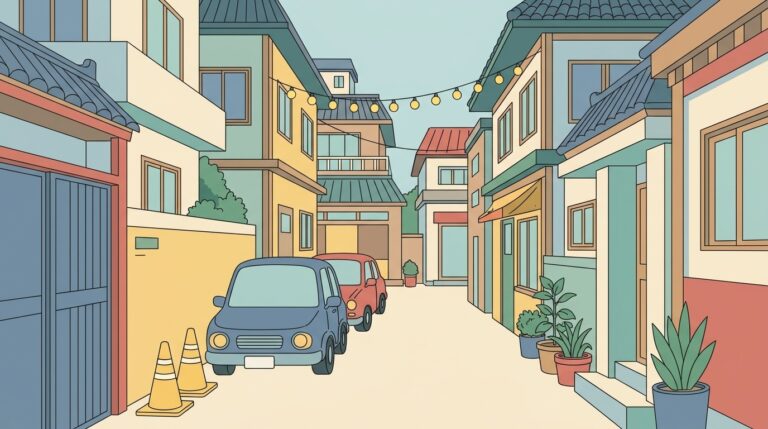
Resolving Korean Parking Disputes: Master the Crucial Phrases for Narrow Seoul Streets
안녕하세요! (Annyeonghaseyo!) Hello there, my dear Korean learner! It’s your favorite premium K-Culture and language mentor from Daily Hangul.
Imagine this: You’ve successfully rented a sleek car to drive down to a trendy café in Yeonnam-dong or a cute pension in Jeju. You find a spot, but when you return, another car is blocking you bumper-to-bumper. Or worse, an angry local neighbor is waving their hands, pointing at your car, and speaking rapid Korean.
In a densely populated country like South Korea—especially in bustling cities like Seoul—parking space is premium gold. Parking disputes (주차 갈등 – jucha galdeung) are a common theme in K-Dramas, from neighbors bickering in Crash Course in Romance to dramatic alleyway confrontations.
Today, we are going to learn how to handle these stressful situations with grace, ultimate politeness, and the linguistic tools of a true Seoul native. No more panic; let’s turn a parking nightmare into a moment of cultural connection!
Phase 2: Deep Dive into 3 Core Expressions
Here are three essential intermediate (B1) expressions you need to confidently resolve parking space issues in Korea.
1. 죄송하지만 차 좀 빼주시겠어요? (Excuse me, but could you please move your car?)
- Pronunciation: Joesong-hajiman cha jom ppae-ju-si-gess-eo-yo? / Sound-alike: “Jway-song-ha-jee-man cha jom ppae-joo-shee-get-uh-yo?”
- Meaning: “I’m sorry, but could you pull your car out?”
- K-Culture Moment: This is the universal, most polite way to ask someone to move their car when they have blocked you in. You will hear this in almost every realistic slice-of-life K-Drama when characters are trying to leave for work in the morning.
- Editor’s Insight: Even though you are the one blocked, starting with “죄송하지만” (I’m sorry, but…) is a magic social lubricant in Korea. It shows you aren’t looking for a fight, immediately lowering the other person’s defenses.
- Situation Spectrum:
- Friends/Casual: ⚠️ Too formal for close friends, but okay if you want to sound dramatic.
- Colleagues/Semi-formal: ✅ Perfect for coworkers blocking you in the office lot.
- Elders/Formal: ✅ Highly recommended for strangers and older individuals.
- 🤔 Think About It: Why does Korean culture value starting a complaint with an apology (“죄송하지만”)? How does this compare to how you would ask someone to move their car in your home country?
2. 여기 주차하면 안 되는 자리인데요. (This is actually a spot where you shouldn’t park.)
- Pronunciation: Yeogi jucha-hamyeon an doeneun jari-indeyo. / Sound-alike: “Yuh-ghee joo-cha-hah-myun an dway-noon jah-ree-een-deh-yo.”
- Meaning: “You are not supposed to park here.”
- K-Culture Moment: In residential alleys (골목길 – golmokgil), residents often place plastic cones or custom signboards to guard “their” parking spots. If someone ignores these and parks anyway, this is the polite warning they receive.
- Editor’s Insight: Notice the ending -인데요 (-indeyo). Instead of a harsh command like “주차하지 마세요!” (Don’t park!), this ending softens the statement, letting the listener complete the implication (“…so please move it”) in their head. It’s polite but firm.
- Situation Spectrum:
- Friends/Casual: ⚠️ Slightly distant; with friends you’d say “여기 대면 안 돼”.
- Colleagues/Semi-formal: ✅ Great for polite, indirect boundary setting.
- Elders/Formal: ✅ Soft enough to avoid offending older drivers while stating the facts.
- 🤔 Think About It: The grammatical structure “-인데요” leaves sentences open-ended. How does this reflect the Korean cultural concept of Nunchi (눈치)—the art of reading the room and completing the speaker’s unsaid thoughts?
3. 이중 주차 때문에 나갈 수가 없어요. (I can’t get out because of the double parking.)
- Pronunciation: Ijung jucha ttaemune nagal suga eopseoyo. / Sound-alike: “Ee-joong joo-cha ttae-moon-eh nah-gal soo-gah up-suh-yo.”
- Meaning: “I can’t leave because of the double parking.”
- K-Culture Moment: South Korea has a unique custom: 이중 주차 (double parking). Because spots are scarce, people park parallel in front of other cars, leave their handbrakes off (gear in Neutral), so those blocked can literally push the car out of the way! However, if the car is locked or too heavy, you have to call them using this phrase.
- Editor’s Insight: Use this phrase over the phone when calling the owner of a double-parked vehicle. It clearly states the physical problem without placing aggressive blame.
- Situation Spectrum:
- Friends/Casual: ✅
- Colleagues/Semi-formal: ✅
- Elders/Formal: ✅
- 🤔 Think About It: Double parking relies on deep social trust—trusting that others won’t damage your car when pushing it. Could this system work in your hometown?
Phase 3: Textbook Korean vs. Real Korean
Let’s compare stiff, textbook sentences with the natural, conversational Korean that will make locals smile and cooperate instantly.
Scenario 1: Getting someone to move their blocking car
- 📖 Textbook Korean: “당신의 차를 이동해 주십시오.” (Dangsin-ui cha-reul idong-hae jusipsio. – “Please move your vehicle.” – Sounds like a police megaphone!)
- 🗣️ Real Korean: “사장님, 차 좀 빼주실 수 있으세요?” (Sajangnim, cha jom ppae-jusil su isseuseyo? – “Boss, could you please move your car for a moment?”)
- 💡 Why it’s different: Addressing a male stranger as 사장님 (Sajangnim – literally “CEO/Boss”) or a female stranger as 어머님 (Eomonim – mother) or 여사님 (Yeosanim) is a respectful social lubricant. Adding the word 좀 (jom – a little) magically softens the request.
Scenario 2: Telling someone they are in your spot
- 📖 Textbook Korean: “여기는 제 사유지이므로 주차를 금지합니다.” (Yeogineun je sayuji-imeuro juchareul geumjihanda. – “Parking is prohibited here as this is my private property.” – Sounds like a legal lawsuit.)
- 🗣️ Real Korean: “죄송한데, 여기 제 지정 주차 구역이라서요…” (Joesonghande, yeogi je jijeong jucha guyeok-iraseoyo… – “I’m sorry, but this is my designated parking spot, so…”)
- 💡 Why it’s different: By ending the sentence with -이라서요… (because it is…), you leave the final command unsaid. This indirectness is considered highly polite and less confrontational in Korean social dynamics.
Phase 4: K-Culture Deep Dive & Non-Verbal Manners
4-1. Nunchi and Body Language
When resolving a parking dispute in Korea, your body language speaks louder than your words.
* The Head Bow: When initiating the conversation, give a slight 15-degree head bow (목인사 – mok-insa). This instantly signals that you are approaching them with respect.
* Soft Eyes and Open Hands: Avoid crossing your arms, which is seen as highly defensive or aggressive. Keep your hands relaxed, pointing to the vehicles rather than pointing fingers at the person.
4-2. The “Dashboard Phone Number” Code
If you drive in Korea, you will notice a small card with a phone number placed on the bottom left corner of almost every windshield. This is the 주차 번호판 (jucha beonhopan).
* The Etiquette: If you must block someone temporarily (double park), leaving your phone number is an absolute requirement. Failing to leave a number is considered incredibly rude.
* Survival Tip: If you are blocked, look at the windshield of the blocking car, find the number, and send a polite text or call using the phrases we learned!
Phase 5: Interactive Roleplay Scenario
The Setting: A rainy Friday evening in a narrow alleyway in Yeonnam-dong. You are parked in a small villa lot, but a black SUV is parked right behind you, blocking your exit. You have a dinner reservation in 20 minutes. You call the number on the dashboard.
Characters:
* You (The stressed driver)
* Mr. Kim (The middle-aged owner of the SUV, currently eating dinner nearby)
The Script
- You: (Politely calling over the phone) “여보세요? 안녕하세요, 혹시 12가 3456 차량 주인분이신가요?”
(Yeoboseyo? Annyeonghaseyo, hoksi sib-i-ga sam-sa-o-yuk charyang juin-bun-isindayo? / Hello? Excuse me, are you by any chance the owner of vehicle 12-Ga-3456?) - Mr. Kim: (Slightly noisy background) “네, 맞는데요. 무슨 일 때문에 그러시죠?”
(Ne, majneundeyo. Museun il ttaemune geureosijyo? / Yes, that is correct. What is this regarding?) - You: “아, 다름이 아니라 제가 지금 차를 빼야 하는데요. 사장님 차가 앞에 주차되어 있어서요.”
(Ah, dareumi anira jega jigeum cha-reul ppaeya haneundeyo. Sajangnim cha-ga ape jucha-doeeo isseoseoyo. / Ah, the thing is, I need to get my car out right now. But your car is parked in front of it, boss.) - Mr. Kim: (Sighing slightly) “아, 그래요? 지금 제가 식당에서 고기를 굽고 있어서 바로 가기는 좀 힘든데…”
(Ah, geuraeyo? Jigeum jega sikdang-eseo gogi-reul gupgo isseoseo baro gagineun jom himdeunde… / Ah, really? I am grilling meat at a restaurant right now, so it’s a bit hard to go over immediately…) - You: (Anxious but keeping your voice soft) “아, 고기 드시는 중이셨군요. 정말 죄송하지만 제가 예약 시간이 다 되어서요. 조금만 빨리 빼주실 수 있으실까요?”
(Ah, gogi deusineun jung-isyeotgunyo. Jeongmal joesong-hajiman jega yeyak sigan-i da doeeoseoyo. Jogeumman ppalli ppae-jusil su isseusilkkayo? / Ah, you were eating meat. I am truly sorry, but my reservation time is almost here. Could you please move it just a little quickly?) - Mr. Kim: “아, 예약 시간요? 골목길이 좁아서 불편하셨겠네. 차 키 어디 뒀더라…”
(Ah, yeyak siganyo? Golmokgil-i jobaseo bulpyeon-hasyeotgenne. Cha ki eodi dweotdeora… / Ah, reservation time? The alley is narrow, so you must have been inconvenienced. Where did I put my car key…) - You: “네, 번거롭게 해드려서 정말 죄송합니다. 앞에 대기하고 있겠습니다!”
(Ne, beongeoropge haedeuryeoseo jeongmal joesong-hamnida. Ape daegihago ikkesseumnida! / Yes, I am truly sorry for inconveniencing you. I will be waiting in front of the car!) - Mr. Kim: “네, 금방 갈게요. 한 5분만 기다려 주세요.”
(Ne, geumbang galgeyo. Han obun-man gidaryeo juseyo. / Yes, I’ll be there shortly. Please wait about 5 minutes.) - You: “감사합니다, 사장님! 천천히 조심히 오세요.”
(Gamsahamnida, sajangnim! Cheoncheonhi josimi oseyo. / Thank you, boss! Take your time and come safely.) - Mr. Kim: (Friendly voice) “네, 지금 나갑니다!”
(Ne, jigeum nagamnida! / Yes, heading out now!)
🔀 Decision Point
Imagine Mr. Kim’s car was double-parked, but he didn’t pick up his phone after three calls. What is your next best move?
- Option A: Push the SUV yourself since it is likely double-parked in Neutral gear.
- Option B: Keep spamming his phone and start honking your horn loudly.
- Option C: Call a local tow truck service immediately.
Best Choice Analysis:
Option A is the most culturally standard action in Korea! Before getting frustrated, check if the car’s gear is in Neutral (N) and if it is parked on flat ground. If so, simply stand behind or in front of the car and gently push it forward to create an exit gap. It is incredibly common and expected!
Risk Choice Analysis:
Option B (honking) is highly discouraged. Honking in residential areas in Korea is considered extremely rude and will bring angry neighbors to their windows. Option C (towing) is difficult because towing private vehicles on private/residential lots without police involvement has complex legal barriers in Korea.
Phase 6: 10-Second Emotion Shadowing Drill
Let’s practice speaking these with emotional conviction! Pay attention to the pause markers (/).
1. [🥺 Desperate & Polite]
“죄송한데 / 차 좀 / 빨리 빼주실 수 / 있으실까요?”
(Joesong-hande / cha jom / ppalli ppae-jusil su / isseusilkkayo?)
“I am so sorry, but / could you / move your car quickly / if possible?”
2. [😤 Firm but Courteous]
“여기 / 제 지정 주차 구역이라서 / 대시면 / 안 돼요.”
(Yeogi / je jijeong jucha guyeok-iraseo / daesimeon / an dwaeyo.)
“This is / my designated parking spot / so you cannot / park here.”
Phase 7: K-Culture Mini Dictionary
| Word (Korean/Romanized) | Meaning | Cultural Insight |
|---|---|---|
| 이중 주차 (Ijung Jucha) | Double Parking | The practice of parking parallel in front of designated spots due to lack of space, leaving the gear in Neutral. |
| 골목길 (Golmokgil) | Narrow Alleyway | The beautiful, labyrinth-like streets of residential Seoul where parking wars routinely take place. |
| 문콕 (Munkok) | Door Ding | A combination of “문” (door) and “콕” (poke). With tight spaces, hitting the adjacent car door is a major dispute trigger! |
| 지정 주차 (Jijeong Jucha) | Designated Parking | Parking spaces legally assigned to specific residents or businesses. Never park here without permission! |
Phase 8: Traveler’s Survival Kit
Top 3 Expressions for Parking & Driving
- “여기 주차해도 돼요?” (Yeogi jucha-haedo dwaeyo?)
- Meaning: “Can I park here?” (Use this with security guards or store owners before leaving your car.)
- “주차 요금이 어떻게 돼요?” (Jucha yogeum-i eotteoke dwaeyo?)
- Meaning: “How much is the parking fee?”
- “무료 주차 시간 지원 되나요?” (Muryo jucha sigan jiwon doenayo?)
- Meaning: “Do you offer free parking hours?” (Essential for malls, cafes, and restaurants.)
📌 Editor’s Travel Note
When driving in Korea, native navigation apps are a must. Google Maps does not work well for driving directions here. Always download and use the Naver Map App on Google Play or Apple App Store. It has real-time parking spot locators and will save you from getting stuck in tight residential alleys!
Phase 9: Deep Thought — “Going One Step Deeper”
In Western countries, personal space and private property boundaries are heavily enforced by law, often leading to immediate towing or fines. In South Korea, however, the dense urban reality has forced the society to adopt a highly communal approach to space.
The phenomenon of leaving cars in neutral gear so strangers can physically push them is a testament to this collective mindset. It requires patience, trust, and a shared understanding of daily struggles. When a parking dispute happens, the goal is not to legally penalize the other person, but to resolve it smoothly with words so everyone can go about their busy days.
💬 Your Turn: How is parking managed in your hometown? Would you ever allow a stranger to push your car to get out of a spot? Let us know in the comments below!
Phase 10: FAQ & Avoiding Misunderstandings
Q: Is it legal to push someone else’s double-parked car?
A: Yes, it is generally accepted and legal! However, if you cause damage (e.g., bumping it into another car or scraping a wall) while pushing, you will be held liable for the repair costs. Always check the path and push carefully!
Q: What should I do if a car has no phone number on the dashboard?
A: Don’t panic. Look around for a building manager (경비아저씨 – gyeongbi-ajeossi). If that fails, you can call the local district office (구청 – gucheong) or the non-emergency police line (112) to report a blocked driveway.
Q: Can I use parking spots of villas or apartments if they look empty?
A: Definitely No. Even if they look empty, these are reserved for residents who pay monthly maintenance fees. You will likely get blocked or receive an angry call within minutes.
🚨 Common Mistakes Warning Board
- Using Banmal (Casual Language) when angry: Even if you are furious, using casual speech (반말) to an older driver will instantly escalate the parking issue into a physical or verbal fight.
- Leaving your gear in Park (P) when double parking: Always shift your gear to Neutral (N) and release the parking brake. Otherwise, you will be called to the scene immediately.
- Ignoring the “No Parking” (주차금지) cones: Cones are placed there for a reason. Moving them to park your car is considered extremely disrespectful.
Phase 11: Action Missions
- 🥉 Bronze (The Mirror Challenge): Stand in front of your mirror, bow slightly, and practice saying, “죄송하지만 차 좀 빼주시겠어요?” until it sounds smooth and natural.
- 🥈 Silver (The K-Drama Hunt): Watch your favorite modern K-Drama and spot a scene where characters talk about parking, double-parking, or driving in alleys. Write down the phrases they use!
- 🥇 Gold (The Dashboard Check): Next time you walk down a street in Korea (or look at photos of Korean alleys), identify three different styles of jucha beonhopan (dashboard phone plates).
Phase 12: Interactive Quiz Challenge
1. Situational Judgment
You blocked someone’s driveway for a quick 10-minute coffee run. What should you do?
* A) Just run and hope they don’t return.
* B) Lock the car, set gear to P, and leave.
* C) Set gear to N, leave handbrake off, and ensure your phone number plate is clearly visible on the dashboard.
2. Fill in the Blanks
“여기 제 지정 주차 _________이라서요.” (This is my designated parking area, so…)
3. True or False?
In Korea, addressing a middle-aged male driver as “사장님” (Sajangnim) is rude because they might not actually be a business owner.
👉 Click here to check the answers & explanations!
- Answer: C. Always leave your number and prepare the car for manual pushing if you are blocking others temporarily.
- Answer: 구역 (guyeok – area/zone) or 자리 (jari – spot).
- Answer: False. Addressing older men as “Sajangnim” (Boss) is a very common and polite way to address strangers in commercial or casual situations!
Was this guide helpful? Bookmark Daily Hangul for more real-world, premium Korean lessons that textbooks will never teach you!







