

Step Inside the K-Drama Library: How to Get Your First Korean Library Card (회원증)
안녕하세요! (Annyeonghaseyo!) Hello there, my dear student! I am your lead editor and tutor at Daily Hangul, your trusty Korean guide and friend in Seoul.
Imagine this: It’s a rainy Tuesday afternoon in Seoul. You walk into a local municipal library, just like the cozy, aesthetic ones you see in K-Dramas like Our Beloved Summer or Romance is a Bonus Book. The scent of old books mixed with warm coffee fills the air. You find a perfect book, but when you go to borrow it, you realize you need a library card. Your heart beats fast. ‘Can I make one? How do I even say this in Korean without sounding like a robot?’
Don’t worry! Today, we are going to unlock the exact phrases, cultural nuances, and insider tips you need to confidently walk up to the counter and say: “회원증 만들러 왔어요!” (I’m here to make a library card!). By the end of this guide, you won’t just know the words—you’ll understand the warm, community-centered heartbeat of Korean public spaces.
1. Three Core Expressions You Must Know (핵심 표현 3선)
Let’s start with the essential building blocks. These three phrases are your magic keys to navigating any Korean library.
① 회원증을 만들고 싶어요. (I want to make a library card.)
- Pronunciation: [hoe-won-jeung-eul man-deul-go sip-eo-yo]
- Sound-alike guide: “Whoa-one-jung-eul man-deul-go ship-oh-yo”
- Meaning: “I would like to make a library membership card.”
- K-Culture Moment: This is the universal phrase you say when you approach the reception desk (안내데스크 – an-nae-de-seu-keu). It is polite, natural, and immediately lets the librarian know what you need.
- Editor’s Insight: “회원” (hoewon) means ‘member’ and “증” (jeung) means ‘certificate’ or ‘card’. Together, they make “회원증” (membership card). You can use this same structure at gyms or museums!
- Situation Spectrum:
- Friends/Casual (친구/사석): 🚫 Too formal for close friends, but you wouldn’t say this to friends anyway!
- Coworkers/Semi-formal (직장 동료/비즈니스): ✅
- Librarians/Seniors (격식/어른): ✅
- 🤔 Think About It: In English, we say “library card” (focused on the object), but in Korean, we say “membership card” (회원증 – focused on joining the community). Why do you think Korean culture emphasizes “membership” or “belonging” even in public libraries?
② 외국인 등록증도 괜찮나요? (Is an Alien Registration Card okay?)
- Pronunciation: [oe-guk-in deung-nok-jeung-do gwaen-chan-na-yo]
- Sound-alike guide: “Way-gook-in deung-nok-jung-do gwen-chan-nah-yo?”
- Meaning: “Is an Alien Registration Card (ARC) okay too?”
- K-Culture Moment: In Korea, to sign up for public services, you need official identification. For foreigners living in Korea, the ARC is your holy grail.
- Editor’s Insight: If you don’t have an ARC yet, some libraries might accept your passport (여권 – yeogwon) along with a proof of residency (like a rental contract). It always helps to ask this politely with a warm smile.
- Situation Spectrum:
- Friends/Casual: ⚠️ Too polite; you can say “외국인 등록증도 돼?” to friends.
- Coworkers/Semi-formal: ✅
- Librarians/Seniors: ✅
③ 어떻게 신청해요? (How do I apply?)
- Pronunciation: [eo-tteok-hae sin-cheong-hae-yo]
- Sound-alike guide: “Uh-ttuk-hae shin-chung-hae-yo?”
- Meaning: “How do I apply / register?”
- K-Culture Moment: You will see this word “신청” (sin-cheong) everywhere in Korea! From applying for a transit card, signing up for K-Pop fan club memberships, to registering for a library card.
- Editor’s Insight: This is a fantastic, short, and highly versatile A2-level phrase. Whenever you are lost in a government office or library, just point and ask this!
- Situation Spectrum:
- Friends/Casual: ⚠️ You would drop the polite “요” (yo) and say “어떻게 신청해?”
- Coworkers/Semi-formal: ✅
- Librarians/Seniors: ✅
2. Textbook Korean vs. Real-World Korean (교과서 vs. 진짜 한국어)
Many textbooks teach you stiff, old-fashioned sentences that Koreans rarely use in real life. Let’s look at the difference so you can sound like a local!
Situation 1: Explaining your purpose at the desk
- 📖 Textbook Korean: “도서관 회원증 발급을 신청하고자 합니다.” (I wish to apply for the issuance of a library membership card.)
- Why it’s awkward: This sounds like you are reading a legal document! It is far too robotic and overly formal.
- 🗣️ Real Korean: “회원증 만들러 왔어요.” (I came to make a library card.)
- Why it’s better: It is simple, friendly, and uses the natural “~러 왔어요” (~reor wasseoyo – “I came here to do X”) pattern which native speakers use daily.
Situation 2: Asking where to write your information
- 📖 Textbook Korean: “인적 사항 기재 양식은 어디에 있습니까?” (Where is the personal details registration form?)
- Why it’s awkward: It sounds like you are entering a high-security military base, not a friendly neighborhood library!
- 🗣️ Real Korean: “신청서 어디에 써요?” (Where do I write on the application form?)
- Why it’s better: It uses everyday words like “신청서” (application form) and “써요” (write), making the conversation flow smoothly.
3. K-Culture Deep Dive & Non-Verbal Manners
To truly connect with Koreans, you need to understand the unwritten rules of respect and culture.
3-1. Physical Manners: The Two-Hand Rule
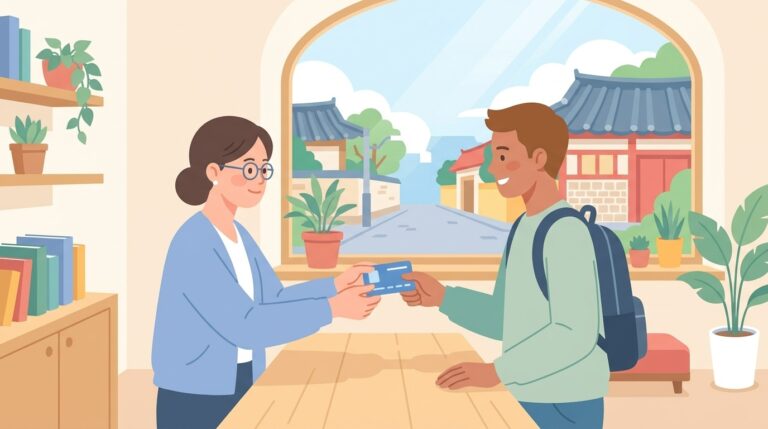
In Korea, your hands speak as loudly as your mouth! When handing over your ID (신분증 – sinbunjeung) or receiving your brand-new library card, always use two hands.
* How to do it: Place your left hand gently under your right wrist or forearm as you present the card with your right hand. Or simply hold the card with both hands. This small gesture shows immense respect and will instantly make the librarian smile!
3-2. The “Book-kangs” (북캉스) Culture
Have you heard of 북캉스 (Book-kangs)? It’s a combination of “Book” and “Vacance” (vacation). In Korea’s fast-paced, high-stress society, municipal libraries have transformed from dusty, quiet study rooms into beautiful, relaxing botanical gardens, cafes, and healing spaces. Koreans love spending their weekends at places like the Seoul Metropolitan Library (서울도서관) or local district libraries (구립도서관) to recharge. Getting a library card is your passport to joining this local self-care culture!
4. Live Roleplay: At the Mapo District Library (실전 롤플레이)
Let’s put your skills to the test! Imagine you are at the cozy Mapo District Library in Seoul. The sun is shining through the window, and a friendly librarian named Min-ji (민지) is waiting at the desk.
- You: (🎭 Approaching the desk with a warm smile) 안녕하세요!
(An-nyeong-ha-se-yo! / Hello!) - Min-ji: 안녕하세요! 무엇을 도와드릴까요?
(An-nyeong-ha-se-yo! Mu-eot-eul do-wa-deu-ril-kka-yo? / Hello! How can I help you?) - You: 저, 도서관 회원증 만들러 왔어요.
(Jeo, do-seo-gwan hoe-won-jeung man-deul-leo wass-eo-yo. / Uh, I came to make a library card.) - Min-ji: 아, 네! 외국인이신가요? 혹시 외국인 등록증 가지고 계세요?
(Ah, ne! Oe-guk-in-i-sin-ga-yo? Hok-si oe-guk-in deung-nok-jeung ga-ji-go gye-se-yo? / Ah, yes! Are you a foreigner? Do you happen to have your Alien Registration Card?) - You: (🎭 Handing over your card with both hands) 네, 여기요. 외국인 등록증 있어요.
(Ne, yeo-gi-yo. Oe-guk-in deung-nok-jeung iss-eo-yo. / Yes, here it is. I have my Alien Registration Card.) - Min-ji: 감사합니다. 서울에 거주하고 계시죠? 여기 신청서에 이름이랑 연락처 적어주세요.
(Gam-sa-ham-ni-da. Seo-ul-e geo-ju-ha-go gye-si-jyo? Yeo-gi sin-cheong-seo-e i-reum-i-rang yeol-lak-cheo jeog-eo-ju-se-yo. / Thank you. You live in Seoul, right? Please write your name and contact info on this application form.) - You: 네, 알겠습니다. (🎭 Fills out the form and hands it back) 다 썼어요.
(Ne, al-get-seom-ni-da. Da sseoss-eo-yo. / Yes, understood. I’m all done writing.) - Min-ji: 확인해 드릴게요… 네, 잘 작성해 주셨어요. 잠시만 기다려 주세요.
(Hwa-gin-hae deu-ril-ge-yo… Ne, jal jak-seong-hae ju-syeoss-eo-yo. Jam-si-man gi-da-ryeo ju-se-yo. / Let me check… Yes, you filled it out well. Please wait just a moment.) - Min-ji: (🎭 Hands over a shiny new library card) 카드 나왔습니다! 오늘부터 바로 빌리실 수 있어요.
(Ka-deu nawass-seom-ni-da! O-neul-bu-teo ba-ro bil-li-sil su iss-eo-yo. / Here is your card! You can borrow books starting today.) - You: 와, 감사합니다! 잘 쓸게요!
(Wa, gam-sa-ham-ni-da! Jal sseul-ge-yo! / Wow, thank you! I will use it well!)
🔀 Decision Point: What if you don’t live in that specific district?
Sometimes, libraries require you to live or work in their specific city (e.g., Seoul) to get a card.
* Best Choice: “서울에 살고 있어요. 여기 고지서도 있어요.” (I live in Seoul. Here is a utility bill too.) -> Proves your residency!
* Risk Choice: “주소는 아직 없는데 그냥 해주시면 안 돼요?” (I don’t have an address yet, can’t you just make it anyway?) -> This might put the librarian in an awkward spot, as they must follow registration laws!
5. 10-Second Emotional Shadowing Drill (10초 감정 섀도잉)
Let’s add some soul and emotion to your Korean! Don’t just read—mimic the feeling. The slashes / represent natural pauses.
- [😊 Friendly & Polite]
회원증 / 만들러 왔어요.
(Hoe-won-jeung / man-deul-leo wass-eo-yo.)
Stop at ‘회원증’ for a split second, then say ‘만들러 왔어요’ with a rising, friendly tone at the end. -
[🥺 Polite & Worried]
외국인 등록증도 / 괜찮나요?
(Oe-guk-in deung-nok-jeung-do / gwaen-chan-na-yo?)
Soften your voice, making ‘괜찮나요?’ sound polite and careful. -
[😤 Determined & Excited]
우와, / 감사합니다! / 잘 쓸게요!
(U-wa, / gam-sa-ham-ni-da! / jal sseul-ge-yo!)
Show pure joy! Koreans love when foreigners express genuine excitement to use their local services.
6. K-Culture Mini Dictionary (K-Culture 미니 사전)
| Word | Pronunciation | Meaning & Local Context |
|---|---|---|
| 도서관 | [do-seo-gwan] | Library. In Korea, local libraries often have fantastic cafes, study zones, and even cultural workshops. |
| 신분증 | [sin-bun-jeung] | ID Card. Any official identification (Passport, ARC, or Korean Driver’s License) used to verify who you are. |
| 대출 | [dae-chul] | Borrowing / Loan. While it also means bank loans, in a library, you’ll see “도서 대출” (book borrowing) everywhere! |
| 반납 | [ban-nap] | Return. Returning books. Most libraries have a 24-hour return box (반납함) outside the main entrance. |
7. Traveler’s Survival Kit (여행자를 위한 생존 키트)
Even if you are just visiting Korea for a short time, you can still enjoy libraries! Here are three survival phrases for travelers:
- 책 그냥 여기서 읽어도 돼요?
- [Chaek geu-nyang yeo-gi-seo ilg-eo-do dwae-yo?]
- “Can I just read books here?” (Perfect for travelers who don’t have a card but want to read inside!)
- 와이파이 비밀번호가 뭐예요?
- [Wa-i-pa-i bi-mil-beon-ho-ga mwo-yeo-yo?]
- “What is the Wi-Fi password?”
- 여기 앉아도 돼요?
- [Yeo-gi an-ja-do dwae-yo?]
- “Can I sit here?”
📌 Editor’s Travel Note: To find the most beautiful neighborhood libraries, skip Google Maps (which isn’t fully optimized for Korea) and search for “도서관” using the Naver Map App or the KakaoMap App. You’ll find hidden architectural masterpieces right in your neighborhood!
8. Deep Thoughts: “Beyond the Silence” (한 발 더 깊이)
Historically, Korean libraries (and private study rooms called 독서실 – dokseosil) were spaces of intense, absolute silence, where students studied for hours to pass national exams. However, today’s modern Korean libraries are shifting toward 소통 (so-tong – communication) and 쉼 (swim – rest). They are designed as open community living rooms. By going to make a library card, you are participating in Korea’s modern cultural transition—where public spaces are designed to cure loneliness and foster warmth.
- 💬 Your Turn: How does library culture in your country compare? Is it a place of absolute silence, or is it a social hub? Let’s chat in the comments below!
9. FAQ & Avoiding Common Mistakes
Q: Can a tourist on a 90-day visa-free entry get a library card?
A: Generally, No. To borrow books and get a physical “회원증,” you almost always need an Alien Registration Card (ARC) or proof of local address. However, anyone can walk into a Korean public library, find a seat, and read books for free inside without a card!
Q: What should I do if I lose my library card?
A: Simply go back to the desk and say, “카드를 잃어버렸어요. 재발급해 주세요” [Ka-deu-reul il-eo-beo-ryeoss-eo-yo. Jae-bal-geup-hae ju-se-yo] (I lost my card. Please reissue it). You might have to pay a tiny fee of around 1,000 to 2,000 KRW.
Q: Are libraries free in Korea?
A: Yes! Accessing the library, reading books, and using the Wi-Fi is 100% free. Borrowing is also free, but make sure to return the books on time to avoid a temporary borrowing ban!
🚨 Common Mistakes Warning!
- Mistake 1: Handing your ID to the librarian with one hand. (Fix: Always use both hands to show respect!)
- Mistake 2: Talking in a loud voice. (Fix: Keep your voice to a gentle, quiet whisper—소곤소곤 – so-gon-so-gon).
- Mistake 3: Calling it “도서관 카드” (doseogwan kadeu). While people understand, the official term “회원증” (hoeweonjeung) sounds much more natural and advanced!
10. Action Missions (액션 미션)
- 🥉 Bronze (At-Home Challenge): Practice saying “회원증 만들러 왔어요” 5 times in front of your mirror using the [😊 Friendly & Polite] shadowing tone.
- 🥈 Silver (Social Challenge): Take a screenshot of your favorite Korean library from a K-Drama and share it on Instagram or Twitter, tagging us
@DailyHangulwith the caption: “도서관에 가고 싶어요!” - 🥇 Gold (Real-World Challenge): If you are currently in Korea, search for your nearest “구립 도서관” (District Library) on Naver Maps, walk inside, find the reception desk, and politely ask the librarian: “외국인도 회원증 만들 수 있어요?” (Can foreigners make a library card too?).
11. Interactive Quiz Challenge (인터랙티브 퀴즈)
1. Culture & Manners Match
What is the most polite way to hand your ID (신분증) to the librarian?
* A) Toss it lightly onto the desk.
* B) Hand it over using only your left hand.
* C) Hand it over using both hands while making polite eye contact.
👉 Click to reveal the Answer & Explanation!
Correct Answer: C
In Korea, using both hands (두 손) to give and receive items is an essential sign of respect. Doing this will make the librarian feel respected and highly willing to help you!
2. Fill in the Blank
Complete the natural Korean sentence: “저, 회원증 ________ 왔어요.” (I came to make a library card.)
* A) 만들러 (man-deul-leo)
* B) 먹으러 (meog-eu-reo)
* C) 자러 (ja-reo)
👉 Click to reveal the Answer & Explanation!
Correct Answer: A
“만들러” comes from “만들다” (to make) + “~(으)러 오다” (to come in order to do). Option B means “came to eat,” and Option C means “came to sleep” (though some people do snooze in libraries, don’t say that at the desk!).
3. True or False
True or False: You must have a physical library card just to enter a Korean public library and read a book.
👉 Click to reveal the Answer & Explanation!
Correct Answer: FALSE
Anyone, including short-term tourists, can enter public libraries in Korea, find a quiet seat, browse books, and enjoy the beautiful architecture completely for free without any card!







