

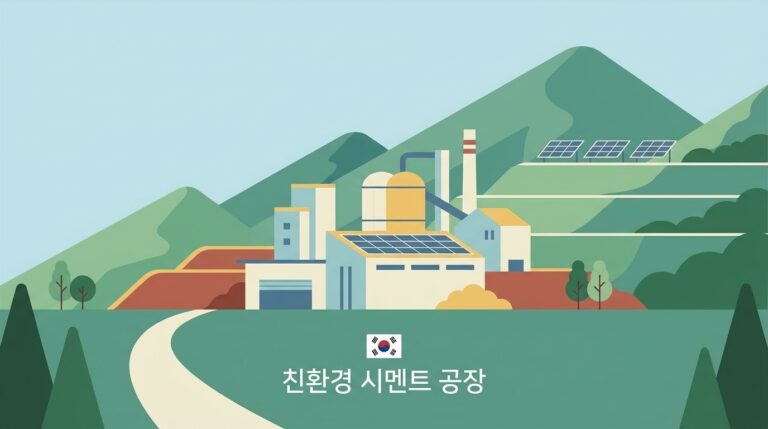
Beyond Greenwashing: Navigating Korea’s Industrial Waste and Environmental Regulation Debates
안녕하세요! Welcome back to Daily Hangul, your premium space for unlocking the deepest, most nuanced layers of the Korean language and culture. I’m your resident chief editor and cultural navigator.
If you have watched the hit K-Drama Vincenzo, you probably remember the intense legal battle against Babel Group over their toxic chemical waste disposal. It wasn’t just dramatic television; it mirrored a highly charged, real-world discourse echoing across Korea’s industrial landscape. Today, we are diving deep into a topic that sits at the volatile intersection of economic progress, community survival, and corporate responsibility: Waste recycling in the cement industry and its environmental fallout (시멘트 산업의 폐기물 재활용과 환경 오염).
As a C2-level learner, you are no longer just ordering coffee or asking for directions. You are ready to engage in high-stakes boardroom meetings, read rigorous editorials, and express sophisticated critiques on ESG (Environmental, Social, and Governance) policies. Let’s master the linguistic precision required to navigate this crucial contemporary Korean debate.
Phase 2: Deep-Dive: Three Pillar Expressions for Sophisticated Debates
To command respect in professional or academic discussions regarding environmental policy, you must move beyond basic vocabulary. Here are three advanced expressions used by policymakers, environmental activists, and industry experts.
1. 자원 순환의 미명 아래 (자원 순환의 미명 아래)
- Pronunciation: jawon sunhwan-ui mimyeong arae / [jah-won soon-hwan-ue me-myeong ah-rae]
- Meaning: Under the guise of resource circulation (Often used to critique pseudo-green initiatives).
- K-Culture Moment: You will hear this phrase used by investigative journalists in documentaries like SBS Unanswered Questions (그것이 알고 싶다) when exposing corporate double standards.
- Editor’s Insight: ‘미명 (mimyeong)’ literally means ‘a beautiful name,’ but in sociopolitical contexts, it almost always implies a pretext or a hypocritical cover-up. Using this phrase immediately signals that you possess a sharp, analytical eye.
- Situation Spectrum:
- Casual/Friends: 🚫
- Workplace/Business: ⚠️ (Use cautiously to avoid sounding overly aggressive)
- Press/Formal Debates: ✅ (Highly effective)
- 🤔 Think About It: Why does Korean society place such heavy emphasis on naming and framing? How does your native language describe the gap between a policy’s beautiful title and its harsh reality?
2. 주객이 전도되다 (주객이 전도되다)
- Pronunciation: jugaegi jeondodoeda / [joo-gaek-ee juhn-doh-doe-dah]
- Meaning: The guest becomes the host (Putting the cart before the horse; when the secondary effect overshadows the primary goal).
- K-Culture Moment: Often cited in economic editorials (사설) discussing how cement factories, meant to build infrastructure, have instead become major processors of hazardous industrial waste, shifting their primary identity from construction to waste management.
- Editor’s Insight: This is a classic four-character idiom (사자성어 – 主客顛倒) representing a structural contradiction. It is highly sophisticated and incredibly satisfying to drop in a formal argument.
- Situation Spectrum:
- Casual/Friends: ⚠️ (Can sound slightly dramatic, but works for humorous exaggeration)
- Workplace/Business: ✅
- Press/Formal Debates: ✅
- 🤔 Think About It: Can you think of another industry in your country where ‘the guest became the host’ due to deregulation or economic pressure?
3. 환경 영향 평가 (환경 영향 평가)
- Pronunciation: hwangyeong yeonghyang pyeongga / [hwan-gyuhng yuhng-hyang pyuhng-gah]
- Meaning: Environmental Impact Assessment (EIA).
- K-Culture Moment: This is the legal battlefield in local community disputes. When a new waste incinerator or cement kiln is proposed, the ‘환경 영향 평가’ is the golden standard that both sides fight over.
- Editor’s Insight: Knowing this technical term is essential for discussing legal frameworks. Korean corporate compliance teams spend millions of dollars annually navigating these assessments.
- Situation Spectrum:
- Casual/Friends: 🚫
- Workplace/Business: ✅
- Press/Formal Debates: ✅
- 🤔 Think About It: In Korea, public hearings (주민 공청회) are legally required during an EIA. How do these community-level negotiations compare to environmental policy implementation in your country?
Phase 3: Textbook Korean vs. Real Korean Showcase
Let’s look at how textbooks teach environmental issues versus how professional, fluent Koreans actually articulate these crises.
Scenario 1: Discussing Corporate Hypocrisy (Greenwashing)
- 📖 Textbook Korean: 이 회사는 환경 보호를 하는 척하면서 실제로는 공해를 유발합니다.
(This company pretends to protect the environment while actually causing pollution.) - 🗣️ Real Korean: 친환경 경영을 표방하고 있지만, 실상은 전형적인 그린워싱에 불과합니다. 눈가리고 아웅 하는 격이죠.
(They claim to practice eco-friendly management, but in reality, it is nothing more than typical greenwashing. It’s like covering one’s eyes and meowing.) - 💡 Why it’s different: ‘눈 가리고 아웅 하다’ is a brilliant idiomatic expression meaning to use a shallow trick to deceive someone who already knows the truth. Combined with ‘표방하다’ (to claim/advocate), it elevates your language to executive level.
Scenario 2: Expressing Community Outrage over Pollution
- 📖 Textbook Korean: 지역 사람들이 쓰레기 태우는 것 때문에 화가 났습니다.
(Local people are angry because of trash burning.) - 🗣️ Real Korean: 대체 연료 사용이라는 명목 하에 유해 물질이 배출되면서, 인근 주민들의 생존권이 심각하게 위협받고 있습니다.
(Under the guise of alternative fuel usage, hazardous substances are being emitted, severely threatening the local residents’ right to survival.) - 💡 Why it’s different: Instead of ‘화가 나다’ (angry), using ‘생존권이 위협받다’ (right to survival is threatened) reflects the actual legal and social rhetoric used in Korean environmental activism and human rights discourse.
Phase 4: K-Culture Deep-Dive & Non-verbal Manners
4-1. Nunchi & Body Language in High-Stakes Negotiations
When negotiating environmental compliance or community compensation in Korea, non-verbal cues carry immense weight. This is where 눈치 (Nunchi – situational quick-wittedness) is tested at its highest level.
- The Head Tilt and Slow Nod: In a tense corporate meeting, directly saying ‘No’ or shaking your head side-to-side is considered confrontational. Instead, Korean executives will tilt their head slightly, let out a soft sigh, and nod slowly while saying ‘네, 무슨 말씀이신지 잘 알겠습니다만…’ (Yes, I understand your point well, but…). This registers respect for the other party’s position before introducing a counterargument.
- The Two-Handed Document Exchange: If you are presenting an Environmental Impact Report, always offer and receive the document with both hands, bowing your head slightly. This shows you treat the data—and the stakeholders—with utmost gravity.
4-2. The Cinematic Reality of Korean Industrial Scandals
From movies like Samjin Company English Class (삼진그룹 영어토익반), which deals with phenol leaks, to dramas like Vincenzo, Korean cinema frequently exposes the dark side of rapid industrialization. Historically, Korea’s miraculous economic rise (The Miracle on the Han River) relied heavily on ‘smokestack industries’ (굴뚝 산업). Today, however, the cultural pendulum has swung. Public consciousness demands environmental justice. Understanding this historic shift is key to understanding why debates around cement factories recycling waste are so incredibly fierce in contemporary Korea.
Phase 5: High-Stakes Boardroom Roleplay Scenario
The Setting: It’s late Friday afternoon. Rain is pouring against the panoramic windows of a major ESG advisory firm in Yeouido, Seoul’s financial district. You are sitting across from Director Min (민 부장), a stressed executive from a major construction conglomerate.
민 부장: (Fingers tapping nervously on the mahogany desk, sighing deeply)
        에스더 씨, 이번 신규 시멘트 소성로 폐기물 대체율 확대 건 말입니다.
        (Esther, regarding our plan to increase the waste substitution rate in the new cement kilns...)

유 (You): (Mainatining calm, professional eye contact, nodding slowly)
         네, 부장님. 주민 공청회에서 반발이 거세다고 들었습니다.
         (Yes, Director. I heard the backlash at the local public hearing was quite fierce.)

민 부장: (Leaning forward, lowering his voice)
        정부에서는 '자원 순환' 가이드라인을 지키라고 압박하고,
        주민들은 대기오염 물질 배출 문제를 걸고넘어지니 아주 진퇴양난입니다.
        (The government is pressuring us to meet "resource circulation" guidelines, while residents are bringing up air pollutant emissions. I'm truly in a double bind.)

유 (You): (Taking a sip of warm tea, leaning in with a serious expression)
         단순히 법적 기준치 충족만 내세워서는 주민들을 설득하기 어렵습니다.
         이제는 친환경 경영이라는 미명 뒤에 숨지 말고,
         실시간 배출 가스 모니터링 데이터를 투명하게 공개해야 합니다.
         (Simply boasting about meeting legal thresholds won't convince the residents. We can no longer hide behind the guise of eco-friendly management; we must transparently disclose real-time emission data.)

민 부장: (Frowning slightly, worried)
        그 데이터를 공개했다가 기준치 근처만 가도 여론이 악화될 텐데요?
        (But if we release that data, and it gets anywhere near the limit, won't public opinion worsen?)

유 (You): (Shaking head gently with a confident smile)
         오히려 선제적으로 대응하셔야 주도권을 잡으실 수 있습니다.
         상생 협력 방안을 구체화하지 않으면, 이번 프로젝트의 착공 자체가 불투명해집니다.
         (On the contrary, responding preemptively is how you seize the initiative. If we don't concretize a win-win cooperation plan, the very groundbreaking of this project becomes highly uncertain.)
🔀 Decision Point: How should you advise Director Min next?
- Option A: “주민들을 설득하기 힘드니, 정부 관계자를 만나 규제 완화를 건의합시다.” (Since it’s hard to convince residents, let’s meet government officials to lobby for deregulation.)
- Option B: “주민 상생 기금을 조성하고, 친환경 기술 설비 투자를 문서로 확약합시다.” (Let’s establish a community win-win fund and formally commit to investing in eco-friendly technology.)
- Option C: “여론이 잠잠해질 때까지 일정을 뒤로 미루고 소나기는 피하고 봅시다.” (Let’s delay the schedule until public opinion cools down; let’s just avoid the storm for now.)
🏆 Best Choice: Option B
- Why: In modern Korea, 상생 (Sangsaeng – mutual prosperity) is not just a buzzword; it is a corporate survival strategy. Committing to concrete, legally binding investments in filtration technology addresses both environmental concerns and localized NIMBYism. Option A risks a massive public relations disaster, and Option C is a passive delay that harms investor confidence.
Phase 6: 10-Second Shadowing Drill
Inject professional urgency and conviction into your voice. Practice pausing at the slashes (/) and channeling the exact emotion suggested.
[😤 Firm and Decisive – Addressing a Board of Directors]
“단순한 / 자원 순환을 넘어 / 주민과의 상생이 / 최우선 과제입니다.”
* Dansunhan / jawon sunhwan-eul neomeo / jumingwaui sangsaengi / choeuseon gwaje-imnida.
* (“Beyond simple / resource circulation, / win-win cooperation with residents / is our absolute priority.”)
Phase 7: K-Culture Mini Dictionary
- 님비 현상 (NIMBY): Not In My Back Yard. Used widely in Korean media to describe local opposition to waste facilities, recycling centers, or cement plants.
- 상생 경영 (Win-Win Management): Corporate strategy focusing on co-prosperity with local communities, subcontractors, and the environment.
- 굴뚝 산업 (Smokestack Industry): Traditional heavy industries (cement, steel, petrochemicals) that powered Korea’s rapid post-war economic growth.
- 환경권 (Environmental Rights): A constitutional right in Korea (Constitution Article 35) guaranteeing citizens the right to live in a healthy and clean environment.
Phase 8: Traveler’s Survival Kit for the Eco-Conscious Mind
Even if you aren’t inspecting cement factories on your holiday, practicing eco-friendly habits in Korea requires knowing the local systems.
Survival Expressions for Green Travelers:
- “종량제 봉투 어디서 사요?” (Jongryangje bongtu eodiseo sayo?)
- Pro Tip: Where do I buy the official volume-rate garbage bag? You must use these municipal bags for general waste in Korea, available at any convenience store.
- “텀블러 할인 되나요?” (Teumbleoreo hal-in doenayo?)
- Pro Tip: Can I get a discount for using my tumbler? Most major Korean cafes offer a 100 to 500 KRW discount to promote zero-waste.
- “이거 분리수거 어떻게 해요?” (Igeo bunrisugeo eotteohge haeyo?)
- Pro Tip: How do I separate and recycle this? Korea has one of the strictest recycling sorting systems in the world (plastic, vinyl, paper, glass, can, and food waste must all be separated).
📌 Editor’s Travel Note: To explore Korea’s ecological transition firsthand, download the Naver Map App and search for ‘Zero Waste Shop’ (제로웨이스트숍) in Seoul. Neighborhoods like Mangwon-dong host beautiful local initiatives that show how grassroot actions tackle the waste problem.
Phase 9: Deep Thought — “Going One Step Deeper”
Korea’s compressed economic development, often called ‘The Miracle on the Han River,’ achieved in thirty years what took other nations over a century. However, this hyper-acceleration left deep ecological scars. The current crisis in the cement industry—where municipal and industrial waste is incinerated as alternative fuel under the name of ‘circular economy’—perfectly illustrates this paradox. It pits the economic efficiency of waste disposal against the health and environmental rights of local communities. As a global citizen, understanding this tension allows you to see Korea not just as a cultural powerhouse of K-Pop and K-Dramas, but as a dynamic, complex society wrestling with the universal challenges of the 21st century.
💬 Your Turn: How does your home country handle the delicate balance between industrial waste management and environmental preservation? Let’s discuss in the comments below! (여러분의 모국에서는 산업 폐기물 문제를 어떻게 해결하고 있나요? 댓글로 여러분의 생각을 공유해주세요!)
Phase 10: FAQ & Common Mistakes
Q: Is waste recycling in cement kilns actually bad for the environment?
A: It depends. Proponents argue it reduces coal usage and safely destroys hazardous organic compounds at ultra-high temperatures (above 1,450°C). Detractors point out that poor monitoring leads to toxic heavy metals and air pollutants being released into neighboring farming valleys.
Q: How do I translate “Greenwashing” in Korean?
A: Use “그린워싱”. While you can say “위장 환경주의” (disguised environmentalism), the English loanword ‘그린워싱’ is universally used in professional Korean boardrooms, media, and academic journals.
Q: What is the difference between ‘재활용’ (recycling) and ‘새활용’ (upcycling)?
A: ‘재활용’ refers to basic chemical or material recovery, while ‘새활용’ is the modern Korean word coined for ‘upcycling’—creating higher-value products from waste materials.
🚨 Common Mistakes Warning Panel
| Common Mistake | What It Sounds Like | Correct Expression | Why It Matters |
|---|---|---|---|
| “환경을 청소해요” | “I am cleaning the environment (literally brushing it).” | “환경을 보전해요” / “환경을 보호해요” | ‘보전’ (preservation) or ‘보호’ (protection) are the correct professional terms for ecological safeguarding. |
| “쓰레기를 다시 써요” | “I reuse garbage.” | “폐기물을 재활용해요” | ‘폐기물’ (waste) and ‘재활용’ (recycle) carry the required scientific and policy-level weight. |
Phase 11: Action Missions
- 🥉 Bronze (The Solo Mirror Challenge): Record yourself saying the Phase 6 Shadowing Drill with correct pacing. Listen to make sure your pauses after the
/marks sound natural and confident. - 🥈 Silver (The Social Network Challenge): Find a Korean news article about ‘시멘트 환경 오염’ or ‘그린워싱’. Write a short, two-sentence opinion in Korean using the phrase “자원 순환의 미명 아래” and share it on your study social media channel.
- 🥇 Gold (The Reality Hunter Challenge): Next time you buy something packaged in Korea, locate the ‘분리배출’ (Separate Discharge) symbol on the packaging. Take a photo and translate the specific material terms (e.g., 페트, 비닐류, 플라스틱) to test your real-world vocabulary.
Phase 12: Interactive Quiz Challenge
Test your mastery of advanced environmental Korean vocabulary!
1. Situational Judgment
Which of the following responses is the most professional when addressing a community protest regarding industrial emissions?
– A) “이것은 국가 경제를 위한 필수적인 과정이니 참아주십시오.”
– B) “주민 여러분의 우려를 깊이 공감하며, 상생 협력 방안과 실시간 환경 데이터를 전면 투명하게 공개하겠습니다.”
– C) “우리는 이미 법적 가이드라인을 통과했기 때문에 법적으로 아무런 문제가 없습니다.”
Reveal Answer & Explanation
Correct Answer: B
Option B demonstrates empathy, transparency, and the core concept of 상생 (Sangsaeng). Option A and C sound highly authoritarian and are recipes for public relations disasters in modern Korea.
2. Fill in the Blank
“정부는 친환경이라는 ( ) 아래 대기업들의 규제를 완화해주었다는 비판을 피할 수 없게 되었다.”
– A) 미명
– B) 이름
– C) 상생
Reveal Answer & Explanation
Correct Answer: A (미명)
‘미명 아래’ (under the guise/pretext of) is the perfect sophisticated phrase to complete this critical sentence pointing out regulatory favoritism.
3. True or False
True or False: In Korea, the term ‘님비 현상’ (NIMBY) is only used in translation and is rarely used by native Korean speakers in actual economic news reports.
Reveal Answer & Explanation
Correct Answer: False
‘님비 현상’ is extremely common in daily Korean journalism and is used as a standard socio-economic term to describe local community resistance to municipal developments.







