

Talk Like a Seoul Bibliophile: Navigating Korean Author Interviews and Literary Criticism at a C1 Level
Phase 1: Reading Between the Lines of the Korean Soul
안녕하세요! Welcome back to Daily Hangul, your premium space for mastering not just the Korean language, but the very pulse of Korean culture. I’m your chief editor and resident cultural navigator.
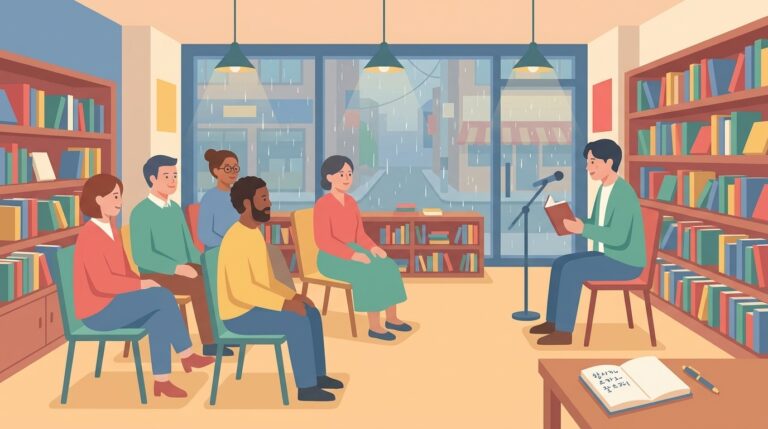
Imagine this: You are sitting in a dimly lit, cozy independent bookstore (독립서점 / dong-nip-seo-jeom) in the heart of Sangsu-dong. Rain is softly pattering against the window, and in front of you sits Han Kang or another of your favorite Korean authors. They are discussing their latest novel. The moderator asks a brilliant question, and the author responds with a deeply poetic, slightly abstract phrase. You look around, and every Korean in the room is nodding slowly, their eyes shining with deep emotional resonance (gong-gam / 공감). You want to join this beautiful intellectual wave, but instead, you find yourself stuck trying to translate the literal words, missing the deep cultural philosophy beneath.
Korean literary critique and author interviews are notoriously high-context. Writers rarely say “I wanted to show X.” Instead, they use evocative metaphors, humble registers, and idioms that reflect Korea’s unique historical trauma, collective memory, and philosophical approach to art.
By mastering these advanced (C1) expressions, you will not only be able to articulate deep literary opinions but also connect with Korean native speakers on a profound intellectual level. Let’s unlock the beautiful world of Korean literary discourse together!
Phase 2: Deep Dive into 3 Core Literary Expressions
1. 행간을 읽다 (Haeng-gan-eul Ik-da)
- Pronunciation: [Haeng-gan-eul ik-da] / Sound-alike: “Heng-gan-ul eek-da” (Think of “Heng” as in hen-g, “gan” as in gone, and “eek” as in squeak).
- Meaning: Lit. “To read between the lines” / Real-world Nuance: To grasp the unwritten intentions, subtext, or emotional landscape that the author deliberately hid between the sentences.
- K-Culture Moment: You will hear this constantly in literary talk shows like “Book DB” or when critics discuss deep K-Drama scripts (like My Liberation Notes or Lost), where what is not said is far more important than what is said.
- Editor’s Insight: Korean is an incredibly context-heavy language. Authors often use silence and sparse prose (yeo-baek-ui mi / 여백의 미 – the beauty of empty space). Saying someone is good at “행간을 읽다” is the ultimate compliment to a reader’s sensitivity.
- Situation Spectrum:
- Casual (Friends): ✅ (Great for discussing deep movies)
- Semi-formal (Work/Colleagues): ✅ (Used when reading between the lines of a subtle business proposal)
- Formal (Book Talks/Essays): ✅ (Perfect for academic writing)
- 🤔 Think About It: Why does Korean literature place so much value on what is left unsaid? How does your native language describe the art of understanding silence?
2. 작가의 손을 떠나다 (Jak-ga-ui Son-eul Tteo-na-da)
- Pronunciation: [Jak-ga-ui so-neul tteo-na-da] / Sound-alike: “Jak-gah-wee so-nul fuh-nah-da”.
- Meaning: Lit. “To leave the author’s hands” / Real-world Nuance: The philosophical idea that once a piece of work is published, it no longer belongs to the writer’s intentions; it belongs entirely to the readers’ interpretations.
- K-Culture Moment: In interviews, when authors are asked, “Is the main character’s death a metaphor for the end of the era?” they often humbly reply, “Now that the book has left my hands, that interpretation is entirely up to the readers.”
- Editor’s Insight: This phrase showcases the classic Korean value of humility (gyeom-yang / 겸양). It shows the artist relinquishing ego and respecting the audience’s agency.
- Situation Spectrum:
- Casual (Friends): ⚠️ (Slightly dramatic for casual chat, but great if you are an artist/creator)
- Semi-formal: ✅
- Formal: ✅
- 🤔 Think About It: In some Western literary theories (like “The Death of the Author”), this concept is highly academic. In Korea, however, it is used as an everyday expression of artistic humility. Why do you think that is?
3. 투영되다 (Tu-yeong-doe-da)
- Pronunciation: [Too-yeong-doe-da] / Sound-alike: “Too-young-dweh-dah”.
- Meaning: Lit. “To be projected/reflected” / Real-world Nuance: How an author’s personal experiences, trauma, or societal viewpoints are unconsciously or consciously reflected in their characters or settings.
- K-Culture Moment: Critics analyzing Bong Joon-ho’s films often say: “한국 사회의 빈부격차가 영화 기생충에 투영되어 있다” (The wealth gap in Korean society is projected onto the movie Parasite).
- Editor’s Insight: This is a fantastic, sophisticated verb to elevate your Korean from intermediate to advanced. Use it instead of the basic “보여주다” (to show) or “나타나다” (to appear).
- Situation Spectrum:
- Casual (Friends): ⚠️ (Slightly academic, but great for deep late-night talks)
- Semi-formal: ✅
- Formal: ✅
- 🤔 Think About It: What aspects of modern Korean history (such as rapid economic development or the division of the peninsula) do you see most frequently projected (투영되다) in K-literature?
Phase 3: Textbook Korean vs. Real-World Korean Showcase
When attending a book talk, if you ask questions straight out of a classic textbook, you might sound like a robotic examiner. Let’s look at how to soften and elevate your expressions to sound natural, warm, and highly intellectual.
Situation 1: Asking what inspired the writer to write this book.
- 📖 Textbook Korean: “이 책을 집필하게 된 동기가 무엇입니까?” (What is your motivation for writing this book?)
- 🗣️ Real Korean: “작가님, 어떤 마음으로 이 첫 페이지를 시작하게 되셨는지 정말 궁금해요.” (Author, I am so curious about what state of mind you were in when you began that very first page.)
- 💡 Why it works: The word “동기” (motivation) sounds like a job interview question. “어떤 마음으로” (with what heart/mind) shifts the focus to emotional resonance, which Korean authors highly appreciate.
Situation 2: Expressing how deeply the book affected you.
- 📖 Textbook Korean: “이 책은 아주 감동적이고 문체가 좋습니다.” (This book is very moving and the writing style is good.)
- 🗣️ Real Korean: “문장 하나하나가 가슴에 깊이 와닿았고, 활자들이 살아서 살아 움직이는 기분이었어요.” (Every single sentence resonated deeply in my chest; it felt as if the letters themselves were alive and moving.)
- 💡 Why it works: Using metaphoric verbs like “와닿다” (to reach and touch the heart) and vivid imagery like “활자가 살아 움직이다” (letters coming alive) shows a profound, poetic mastery of the language.
Phase 4: K-Culture Deep Dive & Non-verbal Etiquette
4-1. The Body Language of Intellectual Respect
In Korea, literary spaces are sacred but intimate. If you attend a book talk (북토크), keep these physical manners in mind:
* The Head Tilt of Deep Thought (고개 끄덕임): When the author speaks, do not just stare. Gently nod your head continuously. It shows gong-gam (공감 / empathy) and indicates you are following their complex train of thought.
* Receiving a Signed Book (두 손으로 받기): When getting your book signed, always hand the book and receive it back with both hands. Lean forward slightly as a sign of respect.
* Avoid Point-Blank Disagreement: In Western literary circles, challenging the author directly is considered healthy debate. In Korea, direct confrontation in public can cause the author to “lose face” (chemyon / 체면). Frame disagreements softly: “혹시 이렇게도 해석할 수 있을지 조심스럽게 여쭤봅니다…” (I would like to ask cautiously if it might also be interpreted this way…).
4-2. The “Book Talk” Culture of Yeonnam-dong
In the West, book tours happen in massive franchise stores. In Seoul, the heart of literature beats in small, independent bookstores tucked away in alleys like Yeonnam-dong, Hapjeong, and Mangwon. These spaces often serve craft beers or hand-dripped coffee while hosting small-scale “Book Talks” (북토크) for just 15 to 20 people. It’s an incredibly intimate, intellectually stimulating environment where the barrier between creator and consumer completely dissolves.
Phase 5: Interactive Roleplay: A Rainy Evening Book Talk in Sangsu-dong
Setting: A tiny, warm-lit indie bookstore in Sangsu-dong. The smell of old paper and rain-drenched soil fills the room. You are sitting just three feet away from Author Han (작가 한지수), whose recent psychological novel has taken the country by storm.
Characters:
* You (민우 / Min-woo): A passionate literary foreign student.
* Author Han (한 작가님): A thoughtful, humble novelist in her late 30s.
Dialogue
- 한 작가님: (🎭 Smiling warmly, looking at you) “오늘 비도 오는데 이렇게 멀리까지 찾아와 주셔서 정말 감사합니다. 제 소설이 조금 어둡고 어려웠을 텐데, 어떻게 읽으셨나요?”
(Thank you so much for coming all this way on a rainy day. My novel must have been a bit dark and difficult; how did you read it?) -
민우: (🎭 Leaning forward, holding a warm cup of tea) “아니에요, 작가님. 오히려 비 오는 날과 너무 잘 어울리는 작품이었어요. 사실 책을 읽으면서 인물들의 슬픔이 저에게 고스란히 전달되는 느낌을 받았습니다.”
(Not at all, Author Han. Actually, it was a work that went perfectly with a rainy day. While reading, I felt that the characters’ sadness was directly transmitted to me entirely.) -
한 작가님: (🎭 Looking touched, nodding slowly) “고스란히 전달되었다니… 작가로서 정말 감사한 말씀이네요. 어떤 장면이 특히 마음에 남으셨나요?”
(Transmitted entirely… As a writer, I am truly grateful to hear that. Which scene in particular remained in your heart?) -
민우: (🎭 Pointing gently to a marked page in the book) “주인공이 어머니의 유품을 정리하면서 아무 말도 하지 않고 창밖을 바라보던 장면이요. 대사는 없었지만, 그 침묵 속에서 많은 감정을 느꼈습니다. 정말 행간을 읽게 만드는 아름다운 연출이었습니다.”
(The scene where the protagonist cleans up her late mother’s belongings and just looks out the window without saying a word. There was no dialogue, but I felt so many emotions in that silence. It was a beautiful direction that truly made me read between the lines.) -
한 작가님: (🎭 Eyes widening slightly with surprise) “와, 민우 씨는 정말 깊이 있는 독자이시네요. 네, 맞아요. 저는 독자들이 그 여백에서 스스로의 아픔을 발견하길 바랐어요. 사실 제 개인적인 유년 시절의 상처가 캐릭터에 많이 투영되었거든요.”
(Wow, Min-woo, you are a truly deep reader. Yes, that’s right. I hoped readers would find their own pain in that empty space. Actually, a lot of my childhood wounds were projected into that character.) -
민우: (🎭 Nodding deeply in empathy) “아… 역시 그랬군요. 작가님의 아픔이 아름다운 활자로 재탄생한 것 같아 감동적입니다. 그런데 결말 부분에서 주인공이 고향을 떠나는 선택은, 열린 결말로 해석해도 될까요?”
(Ah… I see. It’s deeply moving to think your pain was reborn into beautiful print. By the way, regarding the ending where the protagonist decides to leave her hometown—can we interpret this as an open ending?) -
한 작가님: (🎭 Laughing softly, placing her hand over her heart) “하하, 사실 그 질문을 정말 많이 받아요. 하지만 이제 이 책은 제 손을 완전히 떠났는걸요. 작가의 손을 떠난 순간부터 결말의 의미는 민우 씨와 같은 독자분들이 완성하는 것이라고 생각합니다.”
(Haha, honestly, I get that question a lot. But this book has completely left my hands now. From the moment it leaves the author’s hands, I believe the meaning of the ending is completed by readers like you, Min-woo.) -
민우: (🎭 Smiling with pure delight) “그렇게 말씀해 주시니 가슴이 벅차오르네요. 제가 완성한 결말 속에서 주인공은 결국 행복해졌습니다.”
(Hearing you say that makes my heart swell. In the ending I completed, the protagonist eventually found happiness.) -
한 작가님: (🎭 Writing a personal message during the signing) “참 따뜻한 독자분을 만나 제 소설이 드디어 어둠 속에서 나온 기분이 드네요. 오늘 와주셔서 정말 감사합니다.”
(Meeting such a warm reader makes me feel like my novel has finally stepped out of the darkness. Thank you so very much for coming today.) -
민우: (🎭 Bowing politely with both hands receiving the signed book) “제가 더 감사합니다, 작가님. 평생 소중히 간직할게요!”
(I am the one who is grateful, Author Han. I will cherish this forever!)
🔀 Decision Point: What if the author asked you a difficult metaphorical question?
If Author Han suddenly turned the question back to you: “민우 씨는 주인공의 ‘파란색 우산’이 무엇을 상징한다고 생각하시나요?” (What do you think the protagonist’s ‘blue umbrella’ symbolizes?)
- Option A: “잘 모르겠는데요. 그냥 비가 와서 쓴 거 아닌가요?” (I don’t really know. Didn’t she just use it because it was raining?)
- 🚫 Editor’s Verdict: Too literal! While logically true, this shuts down the poetic atmosphere and shows a lack of literary engagement.
- Option B: “제가 아직 한국어가 서툴러서 작가님의 깊은 뜻을 다 이해하기는 어렵습니다.” (My Korean is still clumsy, so it’s hard for me to fully grasp your deep meaning.)
- ⚠️ Editor’s Verdict: Humble, but overly defensive. You miss a great chance to share your unique worldview.
- Option C (Best Choice): “소외된 주인공에게 유일하게 하늘을 가려주던 따뜻한 지붕이자, 세상과의 연결 고리가 아니었을까 조심스럽게 생각해보았습니다.” (I cautiously thought that perhaps it was a warm roof that shaded the alienated protagonist, as well as a connection link to the world.)
- ✅ Editor’s Verdict: Brilliant! Using words like “소외된” (alienated) and framing your opinion with “조심스럽게 생각해보았습니다” (I cautiously thought) shows superb C1-level critical thinking and perfect cultural humility.
Phase 6: 10-Second Emotion Shadowing Drill
Let’s practice speaking like a true literary critic. Pay attention to the emotional markers and natural pauses (/).
Drill 1: Expressing deep empathy during a book talk
- Emotion: [🥺 Deeply moved, sincere, and slow]
- Sentence: “대사는 없었지만, / 그 침묵 속에서 / 작가님의 고민이 / 깊이 와닿았습니다.”
- Pronunciation: [Dae-sa-neun eop-seot-ji-man, / geu chim-muk sok-e-seo / jak-ga-nim-ui go-min-i / gip-i wa-dat-at-seum-ni-da.]
- English: “There was no dialogue, but in that silence, I could deeply feel your agony as a writer.”
Drill 2: Humble response when discussing your own artistic interpretation
- Emotion: [😊 Confident yet respectful, gentle smile]
- Sentence: “작가의 손을 떠난 작품은, / 독자의 마음에 와닿아 / 비로소 완성된다고 생각합니다.”
- Pronunciation: [Jak-ga-ui so-neul tteo-nan jak-pum-eun, / dok-ja-ui mae-um-e wa-dat-a / bi-ro-so wan-seong-daen-da-go saeng-gak-ham-ni-da.]
- English: “I believe that a work, once it has left the author’s hands, is finally completed when it touches the reader’s heart.”
Phase 7: K-Culture Mini-Dictionary
| Word (Korean + Romanization) | Translation | Cultural Context & Usage |
|---|---|---|
| 등단 (Deung-dan) | Literary Debut | In Korea, becoming an official writer usually requires winning a highly competitive literary contest run by major newspapers (신춘문예) or prestigious literary magazines. This official entry is called ‘등단’. |
| 문학청년 (Mun-hak-cheong-nyeon) | Literary Youth / Passionate Bookworm | Traditionally referred to young people who spent sleepless nights debating literature and philosophy. Today, it’s a romantic term for anyone deeply in love with books. |
| 독자 (Dok-ja) | Reader | While “읽는 사람” is literal, “독자” carries an emotional weight of companionship. Authors often refer to their fans as “소중한 독자님” (precious readers). |
| 서사 (Seo-sa) | Narrative / Lore | Originally a literary term for narrative structure. Today, it is used widely in K-Pop to describe the complex universe and storytelling of groups like BTS or aespa (e.g., “이 그룹은 서사가 탄탄하다”). |
Phase 8: Traveler’s Survival Kit for Literary Seoul
Are you planning a trip to Korea? Put these three highly practical sentences in your back pocket for your next visit to a local bookstore.
Survival Phrases
- “이 책 요즘 가장 반응이 좋은가요?”
- Pronunciation: [I chaek yo-jeum ga-jang ban-eung-i jo-eun-ga-yo?]
- Meaning: “Is this book getting the best response/reviews lately?” (Great for asking clerks for trendy recommendations instead of just looking at the bestseller list).
- “작가님 사인회가 몇 시부터 진행되나요?”
- Pronunciation: [Jak-ga-nim sa-in-hoe-ga myeot si-bu-teo jin-haeng-doe-na-yo?]
- Meaning: “From what time does the author’s signing event take place?”
- “혹시 이 책과 결이 비슷한 다른 소설도 추천해 주실 수 있나요?”
- Pronunciation: [Hok-si i chaek-gwa gyeol-i bi-seut-han da-reun so-seol-do chu-cheon-hae ju-sil su in-na-yo?]
- Meaning: “Could you perhaps recommend other novels that have a similar ‘vibe’ (결) to this one?”
📌 Editor’s Travel Note
When you are in Seoul, skip the giant department store outlets for a day and check out the Kyobo Bookstore Gwanghwamun branch to witness the sheer scale of Korean reading culture. Afterwards, take the subway to Hapjeong Station and wander around the alleyways. Look for signs that say 독립서점 (Independent Bookstore) or 북카페 (Book Cafe). Many of these spaces do not accept international credit cards smoothly on older machines, so keeping a Korean banking app or a T-Money card topped up is highly recommended. (Note: Shop operating hours in these indie alleys can change abruptly, so double-check on local maps before visiting).
Phase 9: Deep Thoughts — “The Beautiful Burden of Humility”
If you listen to Western author interviews, you will often hear discussions focused heavily on individual agency, creative rights, and direct social commentary. However, in Korean literary circles, the dominant tone is often 겸양 (Gyeom-yang – Humility). Writers frequently downplay their talent, claiming they are merely “translating the pain of society” or that once their work is published, they have no authority over it.
This reflects Korea’s collective culture, where the artist is not an isolated genius but a medium reflecting the community’s shared wounds—such as the Korean War, rapid industrialization, and intense modern societal pressure. When you enter a Korean literary discussion, adopting this gentle, humble, and deeply empathetic posture is the ultimate way to show your appreciation.
💬 Your Turn:
How does the relationship between authors and readers differ in your country compared to Korea? Is the author’s intention considered absolute, or do you also believe the book “leaves the writer’s hands” once published? Share your thoughts in the comments below!
Phase 10: FAQ & Common Mistakes
Q: Can I use “작가” (Jak-ga) when addressing an author directly during an interview?
A: No, you should never say just “작가”! Addressing someone by their bare title sounds incredibly blunt and rude in Korean. Always add the respectful honorific suffix -님 (nim), making it 작가님 (Jak-ga-nim). This applies to all professions (e.g., 감독님 / Director-nim, 교수님 / Professor-nim).
Q: What is the difference between “소설” (So-seol) and “문학” (Mun-hak)?
A: 소설 (So-seol) specifically means “novel” or “fiction.” 문학 (Mun-hak) is a broader, academic term meaning “literature” as a whole (including poetry, essays, and dramas). When praising an author’s deep themes, using “문학” sounds much more sophisticated.
Q: Can I use “행간을 읽다” when talking about a business text message?
A: Yes, absolutely! While it originates in literature, Koreans constantly use it in everyday business to describe deciphering what a boss or a client actually wants when their email is dangerously short.
🚨 Common Mistakes Alert! Top 3 Slip-ups
- Saying “작가님은 정말 똑똑하십니다” (You are very smart, Author).
- Why it’s bad: Calling someone “똑똑하다” (smart) is usually used by elders praising children. To an author, say “통찰력이 정말 깊으십니다” (Your insight is truly deep).
- Confusing “주제” (Theme) with “소재” (Subject Matter).
- Why it’s bad: “소재” is the physical ingredient of the book (e.g., historical murder), while “주제” is the ultimate philosophical message (e.g., human guilt). Confusing them makes critical analysis sound clumsy.
- Using too much casual slang like “개지린다” (super cool) at a book talk.
- Why it’s bad: While common among Gen-Z on YouTube, using street slang in a literary space ruins the atmospheric respect. Stick to high-level emotional words like “전율이 돋았습니다” (I got goosebumps/chills).
Phase 11: Your Daily Hangul Action Missions!
Ready to put your C1 skills to the test? Complete these three progressive challenges:
- 🥉 Bronze (The Mirror Challenge): Record yourself saying: “작가님의 작품을 통해 한국 사회의 단면이 투영된 모습을 보았습니다.” (Through your work, I saw a cross-section of Korean society projected.) Check your pacing and emotional depth.
- 🥈 Silver (The Social Network Challenge): Find a Korean book you like. Post a photo of it on Instagram or thread, and write a one-sentence review using “행간을 읽다” or “와닿다”. Tag us at
#DailyHangul! - 🥇 Gold (The Real-world Book Talk Challenge): Go to YouTube, search “북토크” (Book Talk) or “작가 인터뷰” (Author Interview). Leave a respectful comment in Korean using at least two terms learned today. You will be amazed by how warmly the creators and other readers reply!
- 🎮 K-Culture Treasure Hunt: Watch the iconic K-Drama Romance is a Bonus Book (로맨스는 별책부록). Find a scene where the characters discuss publishing, and listen carefully to see if they say “작가의 손을 떠나다”!
Phase 12: Interactive Quiz Challenge
Test your literary intuition below!
1. Situational Judgment
You are at an intimate book talk. The author has just finished explaining a deeply personal and tragic inspiration behind their novel. What is the most culturally polite way to respond?
* A) “와, 진짜 대박이네요! 정말 대단해요.”
* B) “작가님의 아픔이 작품에 아름답게 투영되어 읽는 내내 가슴 깊이 와닿았습니다.”
* C) “그런데 왜 슬픈 소설만 쓰시나요? 다음엔 밝은 걸 써주세요.”
🔍 Click to reveal the Answer & Explanation
- Correct Answer: B
- Why: Option B uses high-level, respectful words (투영되다, 와닿다) that perfectly honor the author’s vulnerability. Option A is too casual (borderline street-slang), and Option C is demanding and insensitive to the artistic process.
2. Fill-in-the-Blank
Complete the critic’s sentence:
“이 소설은 친절하게 설명해주지 않는다. 독자가 스스로 문장 속의 ( )을/를 읽어야 비로소 진정한 의미를 깨달을 수 있는 작품이다.”
(This novel does not explain kindly. It is a work where the reader must read the [ ] themselves to finally realize its true meaning.)
🔍 Click to reveal the Answer & Explanation
- Correct Answer: 행간 (Haeng-gan / Subtext/Between the lines)
- Why: The phrase “행간을 읽다” means to read between the lines, which fits the context of a novel that does not explain everything directly.
3. True or False: K-Culture Trivia
True or False: In Korea, when an author says “제 책은 이제 제 손을 완전히 떠났습니다,” it means they have lost their legal copyright and royalties to the publisher.
🔍 Click to reveal the Answer & Explanation
- Correct Answer: FALSE
- Why: It is a philosophical and humble expression meaning “the interpretation now belongs entirely to the readers,” not a legal statement about copyright!
Have any questions about today’s high-level expressions? Let us know in the comments below!
Keep reading, keep thinking, and let’s master the beautiful depths of Korean together. 다음에 또 만나요!







