

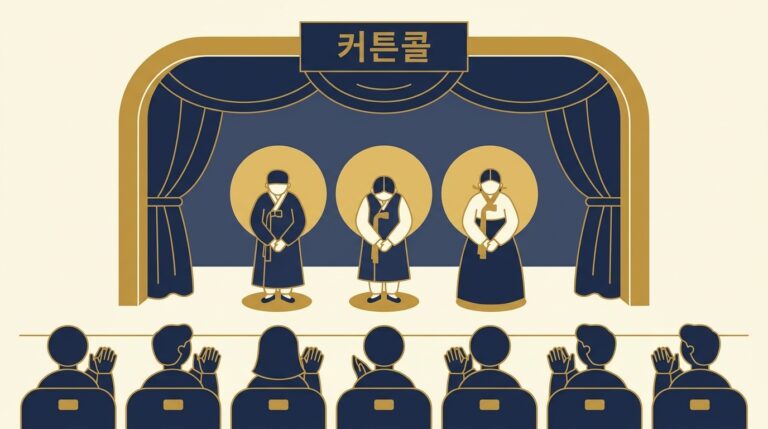
Don’t Get the Laser! Your Ultimate Guide to Korean Theater Etiquette & Curtain Call Rules
Phase 1: Empathy (An Warm Welcome from Your Daily Hangul Editor)
안녕하세요! (An-nyeong-ha-se-yo! – Hello!) It’s your favorite Korean culture navigator and Daily Hangul Editor-in-Chief here!
Imagine this: You’ve finally scored tickets to a blockbuster Korean musical in Blue Square or a charming indie play in Daehak-ro (대학로). The legendary lead actor—maybe an idol you love like Xia Junsu or Onew—delivers a mind-blowing final note. The crowd goes wild. The lights dim, and the glorious curtain call begins. You instantly pull out your phone, aiming to capture this once-in-a-lifetime moment for your Instagram stories.
Suddenly, bam! A green laser beam dancing on your hand or a polite but terrifyingly swift usher (어셔) appears out of the shadows, tapping your shoulder with a hushed “사진 촬영은 금지되어 있습니다” (Sa-jin chwal-yeong-eun geum-ji-doe-eo is-seup-ni-da – Photos are prohibited). Your face flushes red in the dark.
Don’t worry! You aren’t the first person to experience this ‘culture shock.’ Korean performing arts have incredibly unique, unspoken rules—especially when it comes to curtain calls. In this guide, we’ll dive deep into intermediate-level Korean phrases, theater etiquette, and the cultural context behind why Korea’s theater scene is so protective of its stages. By the end of this article, you will be able to navigate any theater in Seoul like an absolute local pro!
Phase 2: Deep Dive into 3 Core Expressions
Here are the most essential expressions you need when checking if you can capture your favorite moments. Let’s master their true nuances!
1. 커튼콜 촬영 가능한가요? (Keo-teun-kol chwal-yeong gang-eung-han-ga-yo?)
- Pronunciation Guide: Kuh-teun-kohl chwahl-yung-gah-neung-hahn-gah-yo? (Think of ‘chwal’ like ‘choo-ahl’ spoken quickly as one syllable)
- Meaning: “Is it okay to shoot/film the curtain call?”
- K-Culture Moment: You are standing in the lobby of a grand theater in Seoul, asking the ticket booth staff before the show starts to make absolutely sure you won’t get caught off guard.
- Editor’s Insight: This is the most polite, natural intermediate-level way to ask. Using ~가능한가요? (Is it possible/allowed?) sounds much more natural and soft to Korean ears than ~해도 돼요? (Can I do~?).
- Situation Spectrum:
- Friends/Casual: 🚫 (Too formal) -> Use “커튼콜 찍어도 돼?”
- Colleagues/Semi-formal: ✅ (Perfect!)
- Staff/Formal: ✅ (Highly recommended)
- 🤔 Think About It: Why does Korean theater use the English word ‘Curtain Call’ as 커튼콜? It shows how Western theater traditions were imported, but localized with highly specific local rules. How does your country handle the term?
2. 지금부터 촬영하실 수 있습니다. (Ji-geum-bu-teo chwal-yeong-ha-sil su is-seup-ni-da)
- Pronunciation Guide: Jee-geum-boo-tuh chwahl-yung-hah-sheel soo eet-seup-nee-dah
- Meaning: “You may film from this moment on.”
- K-Culture Moment: An announcement rings through the speakers just as the curtain call starts, or an usher holds up a small sign that says 촬영 가능 (Filming Allowed).
- Editor’s Insight: Pay attention to ~하실 수 있습니다 (You are able to). It’s a formal honorific form. If you hear this, you have official permission to record. Go ahead and get that camera ready!
- Situation Spectrum:
- Friends/Casual: 🚫
- Semi-formal: ⚠️
- Formal Announcements: ✅ (Standard theater announcement)
- 🤔 Think About It: Notice the respect marker ~시 embedded in 촬영하실. Even in standard announcements, Korean theaters address their audiences with the highest level of respect. How does public signage in your culture show respect to patrons?
3. 빈 무대도 촬영 불가인가요? (Bin mu-dae-do chwal-yeong bul-ga-in-ga-yo?)
- Pronunciation Guide: Been moo-deh-doh chwahl-yung bool-gah-een-gah-yo?
- Meaning: “Is filming/photography prohibited even for an empty stage?”
- K-Culture Moment: You enter the theater early and want to take a aesthetic photo of the stage set/curtain before the show begins to post “I’m here!”
- Editor’s Insight: In Korea, scenic designs (무대 디자인) are often protected by strict copyright laws. In many major productions, you cannot even take a photo of the empty stage before the show. Always ask this beforehand to avoid being corrected by an usher.
- Situation Spectrum:
- Friends/Casual: 🚫
- Semi-formal/Staff: ✅ (Very polite way to check boundaries)
- Formal: ✅
- 🤔 Think About It: In some countries, taking a selfie with the stage behind you is standard practice. Why do you think Korean productions strictly protect scenic designs as intellectual property? Does it elevate the exclusivity of the live experience?
Phase 3: Textbook Korean vs. Real-World Korean
Let’s bridge the gap between classroom Korean and what you will actually hear and say on the streets of Seoul.
Situation 1: Asking the Usher about Camera Policies
- 📖 Textbook Korean: “공연 사진을 찍어도 됩니까?” (Gong-yeon sa-jin-eul jjik-eo-do doep-ni-ka? – May I take photos of the performance?)
- 🗣️ Real-World Korean: “오늘 커튼콜 데이인가요?” (O-neul keo-teun-kol de-i-in-ga-yo? – Is today a ‘Curtain Call Day’?)
- 💡 Why the Difference?: In Korea, most big musicals forbid curtain call filming except during designated promotional weeks called 커튼콜 위크 (Curtain Call Week) or 커튼콜 데이 (Curtain Call Day). Asking if it is a ‘Curtain Call Day’ shows you understand local theater systems and gets you a direct, useful answer.
Situation 2: The Usher giving a gentle warning
- 📖 Textbook Korean: “사진 촬영을 하지 마십시오.” (Sa-jin chwal-yeong-eul ha-ji map-si-o. – Do not take photos.)
- 🗣️ Real-World Korean: “휴대폰은 가방 안에 넣어두셔야 합니다.” (Hyu-dae-pon-eun ga-bang an-e neo-eo-du-syeo-ya hap-ni-da. – You must keep your phone inside your bag.)
- 💡 Why the Difference?: Korean service workers rarely use direct command forms like “하지 마십시오” because it sounds too harsh. Instead, they frame it as a soft necessity (~하셔야 합니다 – you must/should do…) or gently guide your action to keep the peace.
Phase 4: K-Culture Deep Dive & Non-Verbal Manners
4-1. The Art of Nunchi (눈치) in Korean Theaters
To survive a Korean theater, you need high levels of 눈치 (Nunchi – situational wit/reading the room).
Korean theater audiences are famous for being incredibly quiet and focused. In fact, there is a slang word for this: 시체관극 (Siche-gwan-geuk), which literally translates to “corpse-like theater viewing.” It means sitting absolutely still without making a single sound, whispering, or moving your head, out of respect for the actors and fellow audience members.
* Non-Verbal Tip: When the lights dim, turn your phone completely off—not just on silent. In Korea, even the tiny vibration of a phone in a quiet theater can draw irritated looks (눈총 – sharp glares) from your neighbors. If you must check something, keep your phone low in your bag.
4-2. The Daehak-ro Cult Stage & Idol Castings
Daehak-ro (대학로) in Seoul is the Broadway of Korea, packed with over 150 small theaters. Because these venues are so intimate, any movement is highly visible. Additionally, because many K-Pop idols (from groups like SHINee, EXO, or MAMAMOO) regularly star in these musicals, fandoms have established an unspoken pact to preserve the actors’ concentration. Thus, curtain call photography is strictly controlled to prevent professional fansites from bringing massive DSLR cameras (“cannon lenses” or 대포 카메라) that block other people’s views.
Phase 5: Interactive Roleplay Scenario
Scenario: After the Curtain Call at a Musical in Daehak-ro
- Setting: A beautifully lit, cozy 300-seat theater. The musical “Gloomy Day” has just ended. The audience is clapping enthusiastically.
- The Cast:
- You (Alex): An intermediate Korean learner and massive fan of the lead actor.
- Min-ji (민지): Your passionate, theater-loving Korean friend who knows all the ins and outs of Daehak-ro.
- Usher (안내원): A polite but extremely observant theater staff member.
Dialogue
- Alex: 🎭 (Applauding enthusiastically, whispering to Min-ji)
“민지 씨, 오늘 배우님 성량 대박이었어요! 지금 커튼콜인데 사진 찍어도 돼요?”
(Min-ji ssi, o-neul bae-u-nim seong-ryang dae-bak-i-eot-seo-yo! Ji-geum keo-teun-kol-in-de sa-jin jjik-eo-do dwae-yo?)
(“Min-ji, the actor’s vocal volume today was insane! It’s the curtain call now, can I take pictures?”) -
Min-ji: 🎭 (Quickly putting her hand over your phone screen to dim it)
“어머, 알렉스 씨! 잠깐만요! 여기 무대 촬영 금지예요!”
(Eo-meo, Al-rek-seu ssi! Jam-kan-man-yo! Yeo-gi mu-dae chwal-yeong geum-ji-yeo-yo!)
(“Oh my, Alex! Wait a second! Stage photography is prohibited here!”) -
Alex: 🎭 (Surprised, whispering back nervously)
“진짜요? 커튼콜인데도 안 돼요? 다른 사람들은 카메라 꺼내는 것 같은데요?”
(Jin-jja-yo? Keo-teun-kol-in-de-do an dwae-yo? Da-reun sa-ram-deul-eun ka-me-ra kkeo-nae-neun geot gat-eun-de-yo?)
(“Really? Even during curtain call? It looks like other people are taking out cameras?”) -
Min-ji: 🎭 (Pointing discreetly to the front row)
“아, 저분들은 공식 서포터즈이거나 오늘이 특별히 허용된 날이라서 그럴 거예요. 직원분한테 정확히 물어봐요!”
(Ah, jeo-bun-deul-eun gong-sik seo-po-teo-jeu-i-geo-na o-neul-i teuk-byeol-hi heo-yong-doen nal-i-ra-seo geu-reol geo-yeo-yo. Jik-won-bun-han-te jeong-hwak-hi mul-eo-bwa-yo!)
(“Ah, those people might be official supporters or today is a specially permitted day. Let’s ask the staff member precisely!”) -
Alex: 🎭 (Approaching the nearby usher politely)
“저기요, 죄송한데 오늘 커튼콜 촬영 가능한가요?”
(Jeo-gi-yo, joe-song-han-de o-neul keo-teun-kol chwal-yeong gang-eung-han-ga-yo?)
(“Excuse me, sorry, but is curtain call filming allowed today?”) -
Usher: 🎭 (Smiling warmly but shaking her head slightly)
“죄송합니다, 관객님. 저희 공연은 커튼콜을 포함하여 전 회차 촬영이 엄격히 제한되어 있습니다.”
(Joe-song-hap-ni-da, gwan-gaek-nim. Jeo-hui gong-yeon-eun keo-teun-kol-eul po-ham-ha-yeo jeon hoe-cha chwal-yeong-i eom-gyeok-hi je-han-doe-eo is-seup-ni-da.)
(“We apologize, patron. In our production, photography is strictly restricted for all shows, including the curtain call.”) -
Alex: 🎭 (Nodding understandingly)
“아, 전 회차 제한이군요. 알겠습니다. 알려주셔서 감사합니다!”
(Ah, jeon hoe-cha je-han-i-gun-yo. Al-get-seup-ni-da. Al-lyeo-ju-syeo-seo gam-sa-hap-ni-da!)
(“Ah, restricted for all shows. Understood. Thank you for letting me know!”) -
Usher: 🎭 (Bowing politely)
“네, 협조해 주셔서 감사합니다. 즐거운 관람 되십시오.”
(Ne, hyeop-jo-hae ju-syeo-seo gam-sa-hap-ni-da. Jeul-geo-un gwan-ram doe-sip-si-o.)
(“Yes, thank you for your cooperation. Please enjoy the rest of your viewing.”) -
Min-ji: 🎭 (Pulling you back to your seat with a smile)
“거봐요, 물어보길 잘했죠? 대신 눈으로 가득 담고 가요!”
(Geo-bwa-yo, mul-eo-bo-gil jal-haet-jyo? Dae-sin nun-eu-ro ga-deuk dam-go ga-yo!)
(“See, I told you it was good to ask! Let’s fill our eyes with memories instead!”) -
Alex: 🎭 (Clapping hard)
“맞아요! 박수나 크게 쳐야겠어요. 와아아!”
(Ma-ja-yo! Bak-su-na keu-ge chyeo-ya-get-seo-yo. Wa-ah-ah!)
(“Exactly! I should just clap super loud. Woohoo!”)
🔀 Decision Point: What would you do?
If you desperately wanted a souvenir from the show, which action would you take?
- Option A: Stealthily record a 5-second video on your lap, hoping the usher doesn’t see you.
- Option B: Ask the usher politely before the show starts, and if prohibited, buy a program book or take a photo at the official photozone (포토존) in the lobby.
- Option C: Argue with the usher, saying “Other people are doing it, why can’t I?”
💡 The Verdict:
- Best Choice: Option B! Asking politely (커튼콜 촬영 가능한가요?) builds mutual respect. If it’s a no-go, Korean theaters always have amazing Photozones (포토존) or Casting Boards (캐스팅 보드) in the lobby designed specifically for gorgeous social media posts.
- Risk Choice: Option A & C. Sneaking a video (known as 밀캠 – secret camera) can result in you being asked to delete the footage immediately, and in serious cases, being escorted out of the theater without a refund. It also ruins the experience for people sitting behind you!
Phase 6: 10-Second Emotion Shadowing Drill
Practice these lines with the correct emotional rhythm. Pay attention to the pauses (/) to sound like a local!
- [🥺 Realizing you can’t film – Disappointed but polite]
“아… / 오늘 커튼콜은 / 촬영 금지군요. / 아쉽네요.”
(Ah… / o-neul keo-teun-kol-eun / chwal-yeong geum-ji-gun-yo. / A-swip-ne-yo.)
(“Ah… so today’s curtain call is prohibited. What a pity.”) -
[😊 Finding out it IS allowed – Excited and joyful]
“대박! / 지금부터 / 촬영 가능하다고요? / 빨리 찍자!”
(Dae-bak! / Ji-geum-bu-teo / chwal-yeong gang-eung-ha-da-go-yo? / Ppal-li jjik-ja!)
(“Amazing! Filming is allowed starting now? Let’s shoot quickly!”)
Phase 7: K-Culture Mini Dictionary
| Word | Romanization | English Translation | Real-world Context |
|---|---|---|---|
| 관크 | Gwan-keu | Audience interference / Theater nuisance | A blend of 관객 (audience) and ‘Critical’ (from gaming). Used when someone next to you whispers, uses a phone, or blocks your view. |
| 퇴길 (퇴근길) | Toe-gil (Toe-geun-gil) | Stage door / Fan greeting | Literally “way home from work.” Fans gather in designated areas outside the theater after the show to briefly see the actors leave and say thank you. |
| 피켓팅 | Pi-ket-ting | Blood-bath ticketing | A blend of 피 (blood) and ticketing. Refers to the incredibly competitive process of buying theater or concert tickets in Korea. |
| 자첫 / 자막 | Ja-cheot / Ja-mak | First viewing / Last viewing | Short for ‘자체 첫 관람’ (My first viewing) and ‘자체 마지막 관람’ (My last viewing). Korean theater lovers often watch the same musical multiple times to see different cast combinations! |
Note: Ticket and scheduling systems are subject to change depending on theater rules.
Phase 8: Traveler’s Survival Kit
Top 3 Survival Cards for Theater Lovers
Card 1: Ticket Pick-Up
- Korean: “예매 내역서 보여드릴게요.”
- Romanization: Ye-mae nae-yeok-seo bo-yeo-deu-ril-ge-yo.
- Usage Tip: Say this to the ticket booth staff while showing your phone screen with the reservation barcode.
Card 2: Finding Your Seat
- Korean: “제 자리가 어디인지 확인해 주시겠어요?”
- Romanization: Je ja-ri-ga eo-di-in-ji hwag-in-hae ju-si-get-eo-yo.
- Usage Tip: Show your ticket to the usher inside the hall, and they will point you to the correct aisle.
Card 3: Looking for the Cast Board
- Korean: “오늘 캐스팅 보드 어디에 있어요?”
- Romanization: O-neul kae-seu-ting bo-deu eo-di-e is-seo-yo.
- Usage Tip: Use this to locate the display showing the actors performing in today’s specific show.
📌 Editor’s Travel Note
When booking shows in Korea, foreign travelers should use the official English portal of Interpark Global Ticket Services or the Yes24 Ticket Global Page to avoid high reseller markups. To find your way to small theaters hidden in Daehak-ro’s alleyways, download the Naver Map App—Google Maps is not fully optimized for pedestrian walking directions in Korea!
Phase 9: One Step Deeper — Cultural Insight
Why are Korean theaters so strict about silence and photography compared to other countries?
In many Western cultures, theater is a highly interactive, communal space where cheering, drinking, and light moving are accepted. In contrast, Korean theater culture values “배려” (Bae-ryeo – consideration/respect) as the ultimate virtue. Audiences believe that the absolute silence of the room is their active contribution to helping the actors perform at their 100% capacity. It’s a beautiful, collective agreement of respect, though it can sometimes feel intimidating to outsiders.
💬 Your Turn: How does theater etiquette in your home country compare to Korea’s “corpse-like” silent viewing? Do you prefer a quiet, hyper-focused room or a loud, lively environment? Let’s talk in the comments below!
Phase 10: FAQ & Avoiding Common Mistakes
Q: Can I take a selfie inside the theater hall before the show?
A: It depends on the show! While most Broadway-style shows allow you to take a selfie as long as the stage itself isn’t clearly focused in the background, many Korean domestic productions strictly prohibit all photography inside the house. If you see an usher pacing the aisles holding a sign that says “무대 촬영 불가” (No Stage Photography), keep your phone down.
Q: Is there any time I CAN film the curtain call?
A: Yes! Only during ‘Curtain Call Week’. The production company will announce special dates on their official social media accounts. During this week, everyone is encouraged to film and post on Instagram or YouTube using official hashtags.
Q: What should I do if my phone rings during the show?
A: Turn it off instantly and do not pick it up! If it rings, silence it immediately without looking at the screen to read messages. Apologize to your seat neighbors with a polite bow during the intermission.
🚨 The “Oops!” Board: Common Mistakes to Avoid
- Holding your phone at eye-level: Even on allowed filming days, holding your phone high blocks the view of those behind you. Keep it at chest level.
- Whispering during the performance: In Korea, whispering (소곤소곤) is considered just as distracting as talking out loud. Keep all reactions non-verbal until applause time!
- Entering late: If you miss the doors, you will only be let in at designated latecomer entry times, and you will be seated in different, temporary seats until intermission.
Phase 11: Action Mission!
Now it’s your turn to put your knowledge into action with these fun challenges!
- 🥉 Bronze (At-Home Challenge): Practice asking “커튼콜 촬영 가능한가요?” in front of your mirror with a warm, polite smile. Focus on the soft rising intonation at the end of the question!
- 🥈 Silver (Social Media Challenge): Go to Instagram, search the hashtag #뮤지컬 (Musical) or #연극 (Play), and see if you can spot any user-uploaded curtain call videos. Check if they mentioned “커튼콜데이” in their captions!
- 🥇 Gold (Real-World Challenge): The next time you book a show in Korea, walk up to the ticket desk or an usher and confidently ask: “실례지만, 오늘 커튼콜 촬영 가능한가요?”
Phase 12: Interactive Quiz Challenge
Let’s test your Korean theater IQ!
1. Situational Judgment
You are attending a musical, and the curtain call has just started. You see the person next to you pull out their phone and start recording. What should you do?
– A) Immediately pull out your phone too, assuming it’s fine.
– B) Look for an usher or check the ticketing page first to see if it is a designated “Curtain Call Day.”
– C) Loudly tell the person next to you to stop recording.
Click for the Answer & Explanation
Correct Answer: B! Just because someone else is doing it doesn’t mean it’s allowed. They might be breaking the rules, or they might have special press passes. Always check with an usher or look at the official notice boards in the lobby first!
2. Fill in the Blanks
Fill in the missing word: “오늘 공연은 커튼콜을 포함하여 사진
_________ 이(가) 제한되어 있습니다.”
– A) 관람 (Viewing)
– B) 촬영 (Photography/Filming)
– C) 예매 (Booking)
Click for the Answer & Explanation
Correct Answer: B) 촬영 (Chwal-yeong)! The full sentence translates to: “For today’s performance, photography/filming is restricted, including the curtain call.”
3. True or False?
True or False: In Korea, taking photos of an empty stage before the show starts is always allowed because there are no actors on stage yet.
Click for the Answer & Explanation
Correct Answer: False! Many production companies protect the physical scenic design (무대) under copyright laws. You must always check if “빈 무대” (empty stage) photography is allowed before snapping a picture!
Enjoy the breathtaking vocals of Korea’s incredible stage actors, and remember to always keep your 눈치 (Nunchi) sharp! Happy watching!
다음에 또 봐요! (See you next time!)







