

Master the Korean Library Kiosk: How to Book a Study Seat Like a Local
Phase 1: Welcome to the Quiet, High-Tech Haven of Korean Libraries!
안녕하세요! (Annyeonghaseyo!) Hello there, my dear friend! I’m your lead editor and friendly neighborhood K-culture tutor from Daily Hangul. It is so wonderful to have you here today.
Imagine this: You’ve just spent a gorgeous autumn morning walking through the streets of Seoul. You want to escape the afternoon heat, write in your journal, or study some Korean grammar. You spot a beautiful modern building—a Korean public library (도서관, doseogwan). You walk in, excited to experience that peaceful, aesthetic study aesthetic you’ve seen in cozy K-Dramas like Our Beloved Summer or Start-Up.
But as soon as you enter, you face your ultimate nemesis: a sleek, glowing touchscreen kiosk with the words ‘좌석 발권기’ (Seat Ticketing Machine). People are tapping rapidly, scanning barcodes, and grabbing paper slips. You stand there frozen, wondering, “Do I need a special ID? How do I select a seat? Will an alarm go off if I sit in the wrong place?”
Don’t worry! Every single expat and traveler in Korea has felt that exact wave of panic. Today, we are going to demystify the Korean library seat booking system so you can walk up to any kiosk, book your private study cubicle, and enjoy your study session with absolute confidence. You’ll feel like a true Seoulite!
This guide is based on real-life stories from my students who successfully conquered local libraries from Mapo to Gangnam! Let’s get started.
Phase 2: Three Core Expressions to Conquer the Kiosk
Let’s look at the absolute essential vocabulary you need to navigate any library ticketing machine.
1. 좌석 발권 (Jwaseok Balgwon)
- Pronunciation: [jwa-seok bal-gwon] / Sounds like: “Jwah-suck bahl-gwon”
- Meaning: Seat Issuing / Seat Ticketing
- K-Culture Moment: In K-Dramas, university students frantically tap these screens during midterm week to secure a spot next to their crush in the library.
- Editor’s Insight: 좌석 (jwaseok) means “seat,” and 발권 (balgwon) means “issuing a ticket.” When you see this on a screen, it’s your starting point to get a seat!
- Situation Spectrum:
- Friends/Casual: ✅ (Often shortened to “자리 끊다” – jari kkeun-ta)
- Semi-formal: ✅
- Formal: ✅
- 🤔 Think About It: Why does Korea use automated ticketing for library seats? It reflects Korea’s intense study culture and need for high efficiency. How does your local library manage study seats?
2. 이용증 (Iyongjeung)
- Pronunciation: [i-yong-jeung] / Sounds like: “Ee-yong-jung”
- Meaning: Library Card / Membership Pass (literally “User Card”)
- K-Culture Moment: That satisfying moment when an actor taps their card on the library turnstile with a cool beep sound.
- Editor’s Insight: You cannot book a seat without this! Some libraries accept a digital barcode via a mobile app, while others require a physical card.
- Situation Spectrum:
- Friends/Casual: ✅
- Semi-formal: ✅
- Formal: ✅
- 🤔 Think About It: The word suffix -증 (jeung) indicates a certificate or ID (like 학생증 for student ID). Can you think of other certificates you might need in daily life?
3. 반납 (Bannap)
- Pronunciation: [ban-nap] / Sounds like: “Bahn-nahp”
- Meaning: Return / Check-out
- K-Culture Moment: Returning books or leaving a study room at the end of a long, emotional study session in a drama.
- Editor’s Insight: When you leave the library, you must scan your card and return your seat at the kiosk. If you just walk out without doing this, you might get blacklisted from booking seats in the future!
- Situation Spectrum:
- Friends/Casual: ✅
- Semi-formal: ✅
- Formal: ✅
- 🤔 Think About It: 반납 is used both for returning borrowed books and “returning” your seat ticket. It shows the community-minded nature of Korean public facilities.
Phase 3: Textbook Korean vs. Real Korean
Let’s compare what textbooks teach you with how Koreans actually talk in a library setting.
Situation 1: Asking if you can reserve a seat here
- 📖 Textbook Korean: “이곳에서 도서관 좌석을 예약할 수 있습니까?” (Is it possible to reserve a library seat here?)
- Why it’s unnatural: Too formal and stiff. It sounds like a written manual rather than a natural conversation.
- 🗣️ Real Korean: “여기서 자리 끊을 수 있어요?” (Can I get a seat here? / Literally: Can I cut/issue a seat here?)
- Why we use it: The verb “끊다” (kkeun-ta), which literally means “to cut,” is commonly used in daily life to mean “to buy/issue a ticket” (like a movie ticket or a train ticket). It is fast, natural, and efficient.
Situation 2: Reminding a friend to check out before leaving
- 📖 Textbook Korean: “공부가 끝난 후에 좌석을 반납해야 합니다.” (You must return your seat after studying.)
- Why it’s unnatural: It sounds like a strict library rule warning rather than friendly advice.
- 🗣️ Real Korean: “나갈 때 퇴실 처리 꼭 해야 해요.” (Make sure to do the checkout process when you leave.)
- Why we use it: “퇴실 처리” (toesil cheori – check-out process) is the exact term written on the kiosk button. Saying “꼭 해야 해요” (you must do it) adds a helpful, friendly warning.
Phase 4: K-Culture Deep-Dive & Library Manners
4-1. Nunchi (눈치) and Non-Verbal Manners
Korean libraries are incredibly quiet, peaceful sanctuaries. To navigate them smoothly, you need to use your Nunchi (눈치)—the Korean art of reading the room:
* The Soft Step: Avoid wearing squeaky shoes or heavy boots. If your bag has a loud zipper, unzip it slowly before entering the study room.
* The Receipt Secret: When the kiosk prints your seat ticket, keep it on your desk. Sometimes library patrol officers check tickets to ensure no one is “ghosting” (leaving their stuff on a seat without actually being there).
* The Silent Phone: Set your phone to total silence (not even vibration, as the buzzing on wooden desks can be surprisingly loud!).
4-2. Korean Study Culture Code
In Korea, studying is a serious business. You will see high school students, university students, and adults preparing for public exams (공무원 시험) studying side-by-side for 10-12 hours a day.
Because of this, many public libraries have a 매점 (maejeom – cafeteria/snack bar) in the basement. Taking a break to eat a cheap, delicious bowl of instant ramen (라면) with kimbap (김밥) in the library basement is a classic Korean student experience! If you want to experience the authentic lifestyle, definitely check out the basement cafeteria during lunchtime.
Phase 5: Interactive Roleplay — The Mapo Library Adventure
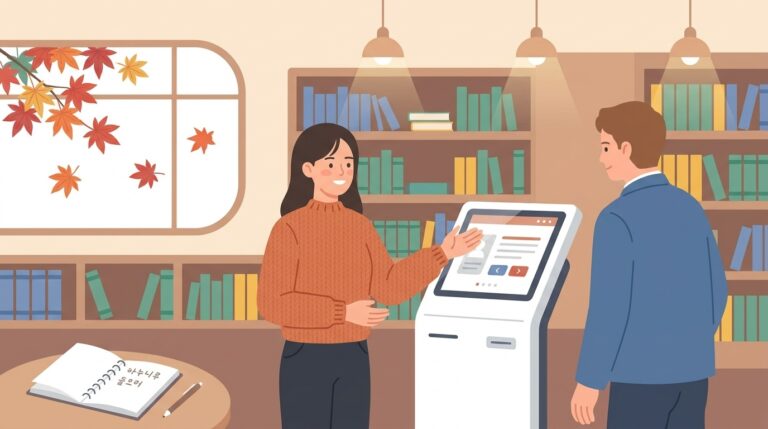
Setting: A crisp autumn afternoon at Mapo Public Library. You are standing in front of a digital kiosk. You have your library card ready, but the buttons look confusing. A friendly-looking Korean student, Min-ji, is standing nearby.
Cast:
* You: A curious foreign student.
* Min-ji: A warm-hearted local university student wearing a cozy knit sweater.
- You: (🎭 Looking around hesitantly, pointing gently at the kiosk screen)
저기요, 혹시 자리 어떻게 끊는지 아세요?
(Jeogiyo, hoksi jari eotteoke kkeunneunji aseyo? / Excuse me, do you happen to know how to book a seat?) -
Min-ji: (🎭 Smiling warmly, stepping closer)
아, 처음이세요? 카드 있으시면 여기 아래에 먼저 바코드 찍으셔야 해요.
(Ah, cheoeumiseyo? Kadeu isseusimeon yeogi arae-e meonjeo bakodeu jjigeuseoyahae-yo. / Oh, is it your first time? If you have a card, you need to scan the barcode down here first.) -
You: (🎭 Scanning your digital barcode on your phone)
아, 이렇게요? 찍었어요!
(Ah, ireotkeyo? Jjigeosseoyo! / Ah, like this? Scanned it!) -
Min-ji: (🎭 Nodding)
네, 잘 됐어요! 이제 화면에서 비어 있는 초록색 자리 중에 마음에 드는 데 누르세요.
(Ne, jal dwaesseoyo! Ije hwamyeoneseo bieo inneun choroksaek jari jung-e maeume deuneun de nureuseyo. / Yes, nice job! Now, tap a seat you like among the empty green spots on the screen.) -
You: (🎭 Pointing to seat number 42)
여기가 좋겠어요. 42번이요!
(Yeogiga joket-seoyo. Sasip-i-beon-iyo! / This place looks good. Number 42!) -
Min-ji: (🎭 Tapping the screen for you)
좋아요. 누르시면 밑에서 영수증이 나올 거예요. 거기에 비밀번호랑 시간 나와요.
(Johayo. Nureusimeon miteseyo yeongsujeungi naol geoyeyo. Geogi-e bimilbeonhorang sigan nawayo. / Great. If you press it, a receipt will come out from the bottom. Your password and time limit will be printed on it.) -
You: (🎭 Grabbing the printed paper)
우와, 나왔어요! 혹시 이용 시간 제한이 있나요?
(Uwa, nawasseoyo! Hoksi iyong sigan jehani innayo? / Wow, it came out! By the way, is there a usage time limit?) -
Min-ji: (🎭 Gesturing gently)
기본 4시간이고요, 시간 다 되기 전에 여기서 ‘연장’ 버튼 누르면 더 쓸 수 있어요.
(Gibon ne-sigan-igoyo, sigan da doegi jeone yeogiseo ‘yeonjang’ beoteun nureumyeon deo sseul su isseoyo. / It’s basically 4 hours, and you can extend it by pressing the ‘Extend’ button here before your time is up.) -
You: (🎭 Bowing slightly with appreciation)
정말 감사해요! 덕분에 쉽게 했어요.
(Jeongmal gamsahaeyo! Deokbune swipge haesseoyo. / Thank you so much! Thanks to you, it was so easy.) -
Min-ji: (🎭 Giving a friendly wave)
아니에요, 열공하세요!
(Aniyeyo, yeolgonghaseyo! / No problem, study hard!)
🔀 Decision Point!
Min-ji wishes you “열공하세요!” (Study hard!). How do you respond?
- A) “네, 감사합니다! 그쪽도 공부 열심히 하세요!”
- B) “고마워요! 화이팅!”
- C) “아뇨, 저는 공부 안 해요.”
Best Choice: A or B!
- A is super polite and acknowledges her efforts too (“그쪽도” means “You too”).
- B is friendly and uses the famous Korean cheer “화이팅!” (Fighting/Go for it!). Both will put a lovely smile on her face!
Bad/Risk Choice: C
- C means “No, I don’t study.” Even if you are just writing a postcard, saying this makes the atmosphere super awkward after she went out of her way to help you book a study seat!
Phase 6: 10-Second Emotional Shadowing Drill
Let’s practice saying these lines with the correct Korean emotion and rhythm. The slash / represents a natural pause.
1. [😊 Polite and Seeking Help]
- Expression: 저기요, / 혹시 자리 어떻게 끊는지 / 아세요?
- Pronunciation: Jeogiyo, / hoksi jari eotteoke kkeunneunji / aseyo?
- Rhythm Tip: Raise the tone slightly at “혹시” and end “아세요?” with a gentle rising intonation like a friendly song.
2. [🥺 Expressing Heartfelt Gratitude]
- Expression: 정말 감사해요! / 덕분에 쉽게 했어요.
- Pronunciation: Jeongmal gamsahaeyo! / Deokbune swipge haesseoyo.
- Rhythm Tip: Emphasize “정말” (really) by holding the “정~” slightly longer to show true sincerity.
Phase 7: K-Culture Mini Dictionary
| Word | Pronunciation | English Meaning | Cultural Insight |
|---|---|---|---|
| 열공 | yeol-gong | Studying Hard | Short for 열심히 공부하다. You say this to wish students good luck on exams! |
| 카공족 | ka-gong-jok | Cafe Study Tribe | People who study at cafes instead of libraries. It’s a massive cultural phenomenon in Korea. |
| 독서실 | dok-seo-sil | Private Study Room | Premium private study rooms, often featuring quiet booths, popular among exam-takers. |
| 사물함 | sa-mul-ham | Locker | Many libraries offer lockers so regular visitors don’t have to carry heavy study materials every day. |
Phase 8: Traveler’s Survival Kit
Here are three lifesaver sentences to keep in your pocket when visiting any library in Korea:
Survival Cards
- “와이파이 비밀번호가 어디에 있나요?”
- Pronunciation: Wa-i-pa-i bimilbeonhoga eodie innayo?
- Meaning: Where is the Wi-Fi password?
- Pro Tip: Usually, it’s posted on the walls of the study room or printed at the bottom of your seat ticket!
- “콘센트 있는 자리로 예약할 수 있을까요?”
- Pronunciation: Konsenteu inneun jari-ro yeyakhal su isseulkayo?
- Meaning: Can I reserve a seat with a power outlet?
- Pro Tip: Look closely at the kiosk seat map—seats with small plug icons have power outlets for your laptop!
- “이용증을 잃어버렸는데 어떻게 해야 하나요?”
- Pronunciation: Iyongjeungeul ireobeoryeonneunde eotteoke haeyahannayo?
- Meaning: I lost my library card, what should I do?
- Pro Tip: Head to the main help desk (안내데스크) on the 1st floor with your passport or residence card to reissue it.
📌 Editor’s Travel Note:
To find local libraries near your Airbnb, use Naver Maps instead of Google Maps, which doesn’t update transit routes as efficiently in Korea. Type “도서관” (library) in the search bar to see beautiful municipal and local options with gorgeous architecture!
Phase 9: A Deeper Thought — The
Frequently Asked Questions (FAQ)
Q: What does "좌석 발권 (Jwaseok Balgwon)" mean in Korean and how do you pronounce it?
A: In Korean, "좌석 발권 (Jwaseok Balgwon)" is pronounced [jwa-seok bal-gwon] and means: Seat Issuing / Seat Ticketing
Q: What does "이용증 (Iyongjeung)" mean in Korean and how do you pronounce it?
A: In Korean, "이용증 (Iyongjeung)" is pronounced [i-yong-jeung] and means: Library Card / Membership Pass (literally "User Card")
Q: What does "반납 (Bannap)" mean in Korean and how do you pronounce it?
A: In Korean, "반납 (Bannap)" is pronounced [ban-nap] and means: Return / Check-out
Q: What does "[😊 Polite and Seeking Help]" mean in Korean and how do you pronounce it?
A: In Korean, "[😊 Polite and Seeking Help]" is pronounced [Jeogiyo, / hoksi jari eotteoke kkeunneunji / aseyo?] and means: a key conversational Korean expression covered in this lesson.







