

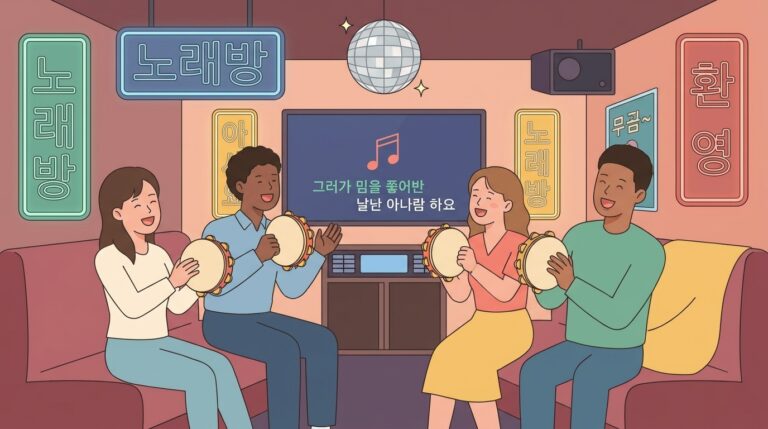
Master the Noraebang: How to Rule the Korean Karaoke Room with a Tambourine
안녕하세요! (Annyeonghaseyo! – Hello!) I’m your Daily Hangul editor and your personal cultural guide.
Have you ever watched a K-Drama where coworkers head to a neon-lit 노래방 (Noraebang – Korean karaoke room) after work? Everyone is laughing, singing, and suddenly, someone grabs a metallic tambourine and starts shaking it like a rockstar.
If you’re an A2 learner planning to visit Korea or hang out with Korean friends, going to a Noraebang is inevitable. But what if you are too shy to sing, or don’t know many Korean songs yet? Don’t panic! You can become the absolute star of the night without singing a single note. All you need is a 탬버린 (tambaerin – tambourine) and three magic phrases. Let’s learn how to shake up the room!
Phase 2: Three Core Expressions to Rule the Noraebang
Here are the three essential phrases you need to conquer any karaoke room. Let’s look at how they are pronounced, what they mean, and how to use them.
1. 탬버린 좀 주세요 (Tambaerin jom juseyo)
- Pronunciation: Tam-baeo-rin jom ju-se-yo / [Sound-alike: “Tahm-buh-rin johm joo-seh-yo”]
- Meaning: Please give me the tambourine.
- K-Culture Moment: This is the ultimate icebreaker. While everyone is busy searching for songs on the remote control, you confidently ask for the tambourine. It shows you are ready to participate and support whoever is singing!
- Editor’s Insight: Adding “좀 (jom – please/a little)” before “주세요 (juseyo – give me)” makes your request sound soft, natural, and polite.
| Situation Spectrum | Level of Appropriateness |
|---|---|
| Friends / Casual | ✅ Highly Recommended |
| Coworkers / Semi-formal | ✅ Perfect for breaking the ice |
| Boss / Formal | ⚠️ Safe, but let them sing first |
- 🤔 Think About It: In many Western cultures, karaoke is about solo performance. Why do you think Korean Noraebang culture places so much emphasis on group percussion instruments like the tambourine?
2. 분위기 살리고! (Bunwigi salligo!)
- Pronunciation: Bun-wi-gi sal-li-go! / [Sound-alike: “Boon-wee-ghee sahl-lee-goh!”]
- Meaning: Liven up the mood! (Literal: “Save the atmosphere!”)
- K-Culture Moment: When a fast, exciting dance song starts playing, you shake the tambourine high in the air and yell this phrase to pump up the energy.
- Editor’s Insight: This phrase is often used as a chant. If you say “분위기 살리고!”, your friends might respond with “템포 올리고! (Tempo olligo! – Speed up the tempo!)”.
| Situation Spectrum | Level of Appropriateness |
|---|---|
| Friends / Casual | ✅ Extremely fun and natural |
| Coworkers / Semi-formal | ✅ Shows you have great social energy |
| Boss / Formal | ⚠️ Only use this during upbeat songs |
3. 텐션 올려! (Tensyeon ollyeo!)
- Pronunciation: Ten-syeon ol-lyeo! / [Sound-alike: “Ten-shun ohl-lyuh!”]
- Meaning: Raise the energy! (Literal: “Raise the tension!”)
- K-Culture Moment: In Korean, the English word “tension” is used to mean “hype” or “vibe.” If the room feels a bit quiet, shake the tambourine and chant this to get everyone dancing.
- Editor’s Insight: This is highly casual slang. Use it with friends of a similar age to instantly sound like a cool local.
| Situation Spectrum | Level of Appropriateness |
|---|---|
| Friends / Casual | ✅ Super trendy and fun |
| Coworkers / Semi-formal | ⚠️ A bit too casual; use with caution |
| Boss / Formal | 🚫 Avoid. It might sound too informal |
Phase 3: Textbook Korean vs. Real Korean
Let’s compare what textbooks teach you with how Koreans actually talk in a real Noraebang.
Situation 1: Offering to cheer for someone else
- 📖 Textbook Korean: 제가 노래를 응원하겠습니다. (Je-ga no-rae-reul eung-won-ha-get-seup-ni-da.)
- “I will cheer for your song.” (Way too formal and stiff!)
- 🗣️ Real Korean: 제가 탬버린 흔들게요! (Je-ga tam-baeo-rin heun-deul-ge-yo!)
- “I’ll shake the tambourine!”
- 💡 Why is it different? Koreans prefer active, visual verbs like 흔들다 (heun-deul-da – to shake) over abstract verbs like “cheer.” It sounds energetic and ready for action.
Situation 2: Complimenting a friend’s singing
- 📖 Textbook Korean: 당신은 노래를 아주 잘 부릅니다. (Dang-sin-eun no-rae-reul a-ju jal bu-reup-ni-da.)
- “You sing songs very well.” (Sounds like a robot reading a report.)
- 🗣️ Real Korean: 와, 대박! 노래 진짜 잘한다! (Wa, dae-bak! No-rae jin-짜 jal-han-da!)
- “Wow, amazing! You’re so good at singing!”
- 💡 Why is it different? 대박 (daebak) is the ultimate expression of admiration in casual Korean. Dropping the formal ending in a casual setting makes your compliment feel warm and genuine.
Phase 4: K-Culture Deep Dive & Non-Verbal Manners
4-1. Nunchi (눈치) and Tambourine Etiquette
In Korea, 눈치 (Nunchi – situational quick-wittedness) is everything. Shaking a tambourine is a great way to show you are participating, but there are physical boundaries:
1. Don’t Block the Screen: Never shake the tambourine right in front of the TV monitor. People need to read the lyrics!
2. Match the Tempo: If someone is singing a beautiful, sad ballad (발라드), put the tambourine down. Shaking it during a emotional love song is a major mood-killer.
4-2. The Noraebang Culture Code
In K-Dramas, the character who plays the tambourine with passion is always the most popular person in the office. This is because Korean social gatherings value 흥 (Heung – shared joy/excitement). By actively shaking the tambourine, you show that you care about everyone else having a good time, making you a beloved guest.
Phase 5: Live Roleplay Scenario – Hongdae Noraebang Night!
The Setting: You are at a trendy Noraebang in Hongdae with your Korean classmates, Minji and Yuri. The neon lights are flashing, and an upbeat K-Pop song starts playing.
- Minji: (🎭 Typing a song into the remote controller) 아, 이 노래 신난다! 우리 같이 놀자!
(Ah, i no-rae sin-nan-da! U-ri gat-i nol-ja!)
“Oh, this song is so exciting! Let’s party together!” - Yuri: (🎭 Grabbing a microphone and smiling) 나 이 노래 진짜 좋아해!
(Na i no-rae jin-jja jo-a-hae!)
“I really love this song!” - You: (🎭 Reaching for the table) 탬버린 좀 주세요!
(Tam-baeo-rin jom ju-se-yo!)
“Please give me the tambourine!” - Minji: (🎭 Passing you the shiny plastic tambourine) 여기 있어! 신나게 흔들어줘!
(Yeo-gi is-seo! Sin-na-ge heun-deul-eo-jwo!)
“Here it is! Shake it excitingly!” - Yuri: (🎭 Singing the high note of the song) ~♪
- You: (🎭 Shaking the tambourine high in the air to the beat) 분위기 살리고!
(Bun-wi-gi sal-li-go!)
“Liven up the mood!” - Minji: (🎭 Laughing and clapping) 와! 진짜 잘 흔든다! 짱이다!
(Wa! Jin-jja jal heun-deun-da! Jjang-i-da!)
“Wow! You shake it so well! You’re the best!” - You: (🎭 Winking at the group) 텐션 올려!
(Ten-syeon ol-lyeo!)
“Raise the energy!”
🔀 Decision Point: The Next Song is a Slow Ballad
Yuri selects a very sad, quiet ballad song. What do you do with your tambourine?
- A) Keep shaking it loudly to keep the ‘tension’ high.
- Editor’s Feedback: Oh no! Shaking a tambourine during a sad song ruins the emotional vibe. Your friends might look at you with bad Nunchi!
- B) Put the tambourine quietly on the table and gently sway your phone flashlight to the music.
- Editor’s Feedback: Excellent Choice! This shows incredible Nunchi. You respect the quiet mood and support the singer gently.
- C) Hide the tambourine under your coat so no one can play it.
- Editor’s Feedback: A bit dramatic! No need to hide it—just let it rest on the table.
Phase 6: 10-Second Shadowing Drill
Let’s practice saying these with real Korean emotion! Pause briefly at the / marks.
- [😊 Energetic & Bright]
탬버린 / 좀 / 주세요!
(Tam-baeo-rin / jom / ju-se-yo!) -
[🔥 Super Hyped Up]
분위기 / 살리고! / 텐션 / 올려!
(Bun-wi-gi / sal-li-go! / Ten-syeon / ol-lyeo!)
Phase 7: K-Culture Mini Dictionary
- 서비스 (Seobiseu – Service): In a Korean Noraebang, the owner often gives you free extra minutes (usually 10 to 30 minutes) at the end of your session. When the timer suddenly goes back up, yell “서비스 감사합니다!” (Service gam-sa-ham-ni-da!).
- 탬버린 여신/남신 (Tambaerin Yeosin/Namsin): “Tambourine Goddess / God.” A nickname for someone who plays the tambourine with incredible skill and choreography.
- 칼군무 (Kalgunmu): Knife-like synchronized dancing. In a Noraebang, shaking tambourines in perfect sync with your friends is called “탬버린 칼군무.”
- 코인 노래방 (Koin Noraebang): Often called “Ko-No.” A smaller, budget-friendly karaoke room where you pay per song (using coins or cards) instead of renting the room by the hour.
Phase 8: Traveler’s Survival Kit
If you are traveling in Korea, keep these three survival phrases ready when visiting a Noraebang:
- 몇 명이에요? (Myeot myeong-i-e-yo?) – “How many people?” (The staff will ask you this first).
- 한 시간 해볼게요. (Han si-gan hae-bol-ge-yo.) – “We will do one hour, please.”
- 물 한 병 주세요. (Mul han byeong ju-se-yo.) – “Please give me a bottle of water.” (Crucial for saving your throat after singing!).
📌 Editor’s Travel Tip: To find the cleanest and most popular karaoke spots near you, avoid using global maps which are often outdated in Korea. Instead, search for “코인 노래방” directly on the Naver Map App Download Page for the most accurate local results.
Phase 9: Think Deeper — “The Power of Heung (흥)”
In Western cultures, karaoke is often about showcasing individual vocal talents. However, the Korean Noraebang is a deeply collective experience. It is a playground of 흥 (Heung)—a unique Korean emotional state of collective joy, energy, and release. By shaking the tambourine, you are active in making sure others feel good. It is a beautiful way of connecting with friends without the pressure of being a perfect singer.
💬 Your Turn: Does your country have a similar concept of collective joy or a specific way of cheering for others during music? Let me know in the comments below!
Phase 10: FAQ & Common Mistakes
Q: Can I play the tambourine during every song?
A: No! Avoid playing the tambourine during slow ballads, R&B, or sad songs. Keep it strictly for dance, K-Pop, and upbeat rock songs.
Q: Do I need to pay extra for using the tambourine?
A: No, tambourines are always provided for free inside the room. They are usually sitting on the table or hanging near the remote control.
Q: What should I do if I don’t know any Korean songs?
A: Don’t worry! You can easily search for English pop songs by changing the language setting on the remote controller. But shaking the tambourine for your Korean friends is the absolute best way to participate!
🚨 Common Mistakes to Avoid:
- Hitting the tambourine on people’s heads: It hurts! Keep the shaking to your hands and knees.
- Holding the microphone and the tambourine in the same hand: This creates loud, screeching feedback noise on the speakers.
- Taking the tambourine home: It belongs to the Noraebang! Always leave it on the table when you depart.
Phase 11: Action Missions
- 🥉 Bronze Mission (Solo): Stand in front of a mirror with a makeshift tambourine (like a set of keys or a water bottle) and practice saying “분위기 살리고!” with high energy.
- 🥈 Silver Mission (Social): Next time you watch a K-Drama featuring a karaoke scene, leave a comment on social media using the phrase: “진짜 텐션 올려!”
- 🥇 Gold Mission (Real Life): Visit a local coin karaoke (코인 노래방) in Korea or your local Koreatown, grab the tambourine, and use the phrase “탬버린 흔들게요!” with your friends!
Phase 12: Interactive Quiz Challenge
1. Which phrase should you say to instantly raise the energy in the room?
a) 노래방 가세요 (Noraebang gaseyo)
b) 텐션 올려 (Tensyeon ollyeo)
c) 물 주세요 (Mul juseyo)
👉 Click to reveal the answer!
Correct Answer: b) 텐션 올려 (Tensyeon ollyeo)
Explanation: This means ‘Raise the energy/tension!’ and is perfect for upbeat moments.
2. True or False: You should shake the tambourine as loudly as possible during a quiet, romantic ballad.
👉 Click to reveal the answer!
Correct Answer: False!
Explanation: Doing this shows poor ‘Nunchi’ (social wit). Put the tambourine down during slow songs.







