

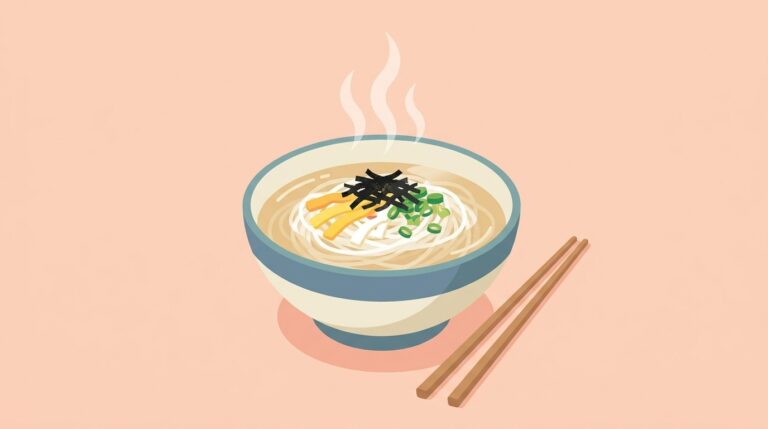
Slurp Your Way to Longevity: The Secret of Korean Janchiguksu and Its Clean Anchovy Broth
안녕하세요! Welcome back to another delicious lesson from Daily Hangul. I’m your resident chief editor and local cultural navigator.
If you’ve spent any time watching K-Dramas, you’ve probably noticed a scene where characters sit in a humble street-side tent (Pojangmacha) or a cozy neighborhood diner, pouring their hearts out over a steaming, simple bowl of noodles. One character might sigh, take a sip of the clear broth, and exclaim, “Ah, gaeunhada!” (Oh, that’s refreshing!).
Have you ever wondered what makes that simple bowl of 잔치국수 (Janchiguksu / Feast Noodles) so deeply comforting? The secret lies in its soul: 깔끔한 멸치 육수 (Kkalgeumhan myeolchi yuksu / clean anchovy broth).
Today, we’re diving into the linguistic and cultural depth of Korean noodle culture. By the end of this guide, you won’t just know how to order like a local; you’ll understand the deep-rooted Korean philosophy behind food that is “warm yet refreshing.”
Phase 2: Core Expressions Deep Dive
Let’s master the three essential expressions you need when eating Korean noodle dishes.
1. 국물이 끝내줘요! (Gungmuri kkeutnae jwoyo!)
- Pronunciation: [Gung-mool-ee kkeut-nae-jwo-yo] / Sound-alike: “Goong-mool-ee coot-nae-jwo-yo”
- Meaning: The broth is out of this world! (Literal: “The soup finishes it!”)
- K-Culture Moment: This is a legendary phrase from a famous late-90s Korean noodle commercial that became an national catchphrase. You say this when the first spoonful of broth hits your throat and instantly relieves all your stress.
- Editor’s Insight: 끝내주다 means “to finish” or “to wrap up,” but colloquially it means “to be fantastic.” Use this to compliment the chef in any soup-based restaurant!
- Situation Spectrum:
- Casual (Friends): ✅ 국물이 끝내준다!
- Semi-formal (Co-workers): ✅ 국물이 끝내줘요!
- Formal (Boss/Elders): ⚠️ 국물이 아주 훌륭합니다. (Better to use a more formal word like 훌륭합니다 / hullyunghamnida)
- 🤔 Think About It: Why does Korean culinary culture focus so heavily on the 국물 (broth/soup)? How does soup culture reflect the communal dining style of Korea compared to your home country?
2. 깔끔하고 개운해요. (Kkalgeumhago gaeunhaeyo.)
- Pronunciation: [Kkal-ggeum-ha-go gae-oon-hae-yo] / Sound-alike: “Kal-geum-ha-go gay-oon-hay-yo”
- Meaning: It is clean and refreshing.
- K-Culture Moment: In K-Dramas, you often see characters eating Janchiguksu the morning after drinking. They aren’t looking for greasy comfort food; they want something 깔끔 (clean/non-greasy) and 개운 (refreshing/restorative) to soothe their stomach.
- Editor’s Insight: 개운하다 is a unique Korean sensory word. It describes a physical feeling of clarity, relief, and freshness—like stepping out of a hot bath or eating a non-oily, clean anchovy broth.
- Situation Spectrum:
- Casual: ✅ 깔끔하고 개운해.
- Semi-formal: ✅ 깔끔하고 개운해요.
- Formal: ✅ 깔끔하고 개운합니다.
- 🤔 Think About It: “Refreshing” in English usually refers to cold things (like iced tea). Why do you think Koreans describe hot, steaming broth as “refreshing” (개운하다/시원하다)?
3. 곱빼기로 주세요! (Goppaegiro juseyo!)
- Pronunciation: [Gop-ppae-gi-ro ju-se-yo] / Sound-alike: “Go-pegg-ee-ro joo-say-yo”
- Meaning: Double portion, please!
- K-Culture Moment: You are starving after walking around Bukchon Hanok Village. You step into a traditional noodle house and want a massive bowl of noodles without ordering two separate dishes. Just shout this out!
- Editor’s Insight: 곱 means double or multiple. 곱빼기 is the noun for a double serving. Most noodle joints will charge just 1,000 to 2,000 KRW extra for a massive mountain of noodles.
- Situation Spectrum:
- Casual: ✅ 곱빼기로 고! (Let’s go double!)
- Semi-formal: ✅ 곱빼기로 주세요!
- Formal: ✅ 곱빼기로 부탁드립니다. (Slightly more polite)
- 🤔 Think About It: In many traditional Korean noodle houses, asking for extra noodles (사리 추가 / sari chuga) is sometimes free of charge. This stems from 정 (Jeong), the Korean concept of warm-hearted generosity. How does your culture show hospitality through food?
Phase 3: Textbook Korean vs. Real Korean
Let’s compare what you learn in classroom textbooks with what native Koreans actually say at a noodle shop.
Situation 1: Expressing that the soup is delicious
- 📖 Textbook: “이 국수는 맛이 좋습니다.” (This noodle taste is good.)
- 🗣️ Real Korean: “와, 국물이 진짜 시원해요!” (Wow, the broth is so “cool”/refreshing!)
- 💡 Why the difference?: Textbooks teach literal descriptions. Real-world Koreans evaluate noodle dishes based on the depth of the broth (국물), using “시원하다” (cool/refreshing) even when the soup is boiling hot.
Situation 2: Asking for a noodle refill
- 📖 Textbook: “국수를 더 많이 주십시오.” (Please give me more noodles.)
- 🗣️ Real Korean: “여기 사리 좀 추가해 주세요~” (Could you add a noodle refill here, please?)
- 💡 Why the difference?: “사리” (sari) is the specific term for a bundled portion of noodles or ingredients added to a soup. Using “사리 추가” makes you sound like an experienced foodie!
Phase 4: K-Culture Deep Dive & Non-Verbal Manners
4-1. Nunchi & Table Manners: Slurping and Lifting the Bowl
In many Western cultures, slurping noodles is considered bad manners. However, in Korea, moderate slurping is perfectly acceptable and even seen as a sign of enjoying the meal!
- The Lift: When you get to the bottom of your Janchiguksu bowl, it is highly customary to lift the heavy ceramic bowl with both hands and drink the clean anchovy broth directly from the rim. Doing this while letting out an appreciative “Ah~” shows the cook that their 멸치 육수 (anchovy broth) was absolutely flawless.
4-2. The Cultural Symbolism of “Janchiguksu”
Did you know 잔치 (Janchi) means “feast” or “party”? Historically, wheat was a rare, precious ingredient in Korea. Therefore, long wheat noodles were reserved for special occasions like weddings, 60th birthday parties (Hwangap), and first birthdays. The long, continuous shape of the noodle strands symbolizes 장수 (Jangsu / longevity) and a long, happy marriage.
Even today, when asking a couple when they plan to get married, older Koreans might playfully ask:
“언제 국수 먹여 줄 거야?”
(When are you going to feed us noodles?)
Phase 5: Interactive Roleplay Scenario
The Setting: A rainy Tuesday evening in a small, cozy noodle shop near Euljiro 3-ga, Seoul. Steam fogs up the windows. An elderly woman (할머니 / Halmeoni) is boiling noodles in a giant pot.
Your Role: A hungry traveler seeking comfort food after a long day of sightseeing.
1. 할머니: (Wiping the table with a warm smile) 어서 와요! 비도 오는데 얼른 앉아요.
   Halmeoni: (Eoseo wayo! Bi-do oneunde eolleon anjayo.)
   [Welcome! It's raining, take a seat quickly.]

2. 나: (Shaking off your umbrella) 감사합니다! 여기 뭐가 제일 맛있어요?
   Me: (Gamsahamnida! Yeogi mwoga jeil masisseoyo?)
   [Thank you! What is the most delicious thing here?]

3. 할머니: (Pointing to the wooden menu) 우리 집은 잔치국수가 최고지! 멸치 육수를 매일 아침 직접 우려내거든.
   Halmeoni: (Uri jibeun Janchiguksu-ga choegoji! Myeolchi yuksu-reul maeil achim jikjeop uryonaegeodeun.)
   [Our house is famous for Janchiguksu! We boil our own anchovy broth fresh every morning.]

4. 나: (Eyes sparkling) 우와, 그럼 잔치국수 하나 주세요!
   Me: (Uwa, geureom Janchiguksu hana juseyo!)
   [Wow, then one Janchiguksu, please!]

5. 할머니: (Looking at your tall frame) 양은 보통으로 줄까, 곱빼기로 줄까? 배 많이 고파?
   Halmeoni: (Yangeun botong-euro julkka, goppaegi-ro julkka? Bae mani gopa?)
   [Should I give you a regular portion or a double portion? Are you very hungry?]
🔀 Decision Point!
How will you answer Halmeoni’s question to get the best portion with the warmest interaction?
- Option A: “곱빼기로 주세요! 배고파요.” (Give me a double portion! I’m hungry.)
- Option B: “많이 주시면 감사하겠습니다.” (I would appreciate it if you gave me a lot.)
- Option C: “할머니, 저 진짜 배고파요! 곱빼기로 엄청 맛있게 해 주세요!” (Halmeoni, I’m really hungry! Please make me a delicious double portion!)
Best Choice: Option C
- Why: Calling the owner “할머니” (Grandma) affectionately (if she is an elderly lady in a traditional diner) instantly melts her heart. Adding “엄청 맛있게 해 주세요” (make it super delicious) shows you are genuinely excited about her cooking. She might even give you extra dumplings for free!
Bad/Risk Choice: Option B
- Why: While grammatically polite, it sounds a bit too robotic and distant for a cozy, local noodle shop where warmth and interpersonal connection (정 / Jeong) are key.
Phase 6: 10-Second Emotion Shadowing Drill
To speak natural Korean, you need to master the emotional flow. Practice these lines by mimicking the emotional cues and pauses (/ indicates a short pause).
- [🤤 Craving & Excited]
“와~ / 국물 냄새가 / 진짜 예술이네요!”
Wa~ / gung-mool naem-sae-ga / jin-jja ye-sul-i-ne-yo!
(Wow, the smell of the broth is truly art!) -
[😌 Satisfied & Healed]
“크으~ / 역시 / 국물이 진짜 개운해요!”
Kuuu~ / yeok-si / gung-mool-ee jin-jja gae-oon-hae-yo!
(Ahhh, as expected, the broth is truly refreshing!)
Phase 7: K-Culture Mini Dictionary
| Word (Hangeul + Romanization) | English Meaning | Cultural Context & Usage |
|---|---|---|
| 잔치 (Janchi) | Feast / Banquet | Historically denoted community celebrations. Today, it represents joyful, shared abundance. |
| 육수 (Yuksu) | Broth / Stock | The foundation of Korean soups. Unlike heavy meat broths, 멸치 육수 (anchovy broth) is highly prized for its light, clean profile. |
| 사리 (Sari) | Noodle Refill Portion | A serving of plain noodles added to an existing soup or stew. You can ask for “사리 추가” (sari chuga) at most noodle joints. |
| 다대기 (Dadaegi) | Spicy Seasoning Paste | A red pepper-based paste. If you want your clear Janchiguksu to have a spicy kick, add a spoonful of 다대기! |
Phase 8: Traveler’s Survival Kit
Survival Phrases for Noodle Lovers
- “양념장 따로 주세요.” (Yang-nyeom-jang tta-ro ju-se-yo.)
- Tip: “Please give me the seasoning sauce on the side.” Use this if you want to control the saltiness or spiciness of your broth.
- “가위 좀 빌려주실 수 있나요?” (Ga-wi jom bil-lyeo-ju-sil su in-na-yo?)
- Tip: “Could I borrow some scissors?” Korean noodles can be incredibly long and chewy. Locals often cut them once or twice crosswise before eating.
- “국물 좀 더 주실 수 있어요?” (Gung-mool jom deo ju-sil su it-seo-yo?)
- Tip: “Could I get a bit more broth?” If you slurp up all your soup too quickly because it’s so good, ask politely for a refill of the warm broth!
📌 Editor’s Travel Note:
To find the most authentic Janchiguksu places in Seoul, avoid search engines meant for tourists. Instead, download the Naver Map App Download Page and search for “잔치국수 맛집” (Janchiguksu gourmet spots). Look for places with lots of reviews from older locals—that’s where the real 멸치 육수 magic happens!
Phase 9: One Step Deeper
In Western linguistics, temperature and emotion are often linked (e.g., “a cold shoulder” or “warm feelings”). In Korea, however, there is a fascinating linguistic paradox centered around the word 시원하다 (siwonhada).
Traditionally, 시원하다 means “cool” or “windy.” Yet, you will constantly hear Korean grandfathers eating boiling hot, spicy stews or hot anchovy noodle soups, sweating profusely, and letting out a deep sigh of relief: “Ah, siwonhada!”
This is because, in Korean cultural psychology, 시원하다 has evolved to mean the sensory relief of internal congestion. It is the feeling of heavy, clogged-up energy (or a hangover!) being washed away by warm, clean liquid. It represents a state of somatic liberation. Next time you drink hot soup in Korea, don’t say “Hot!”—say “Siwonhada!” and watch the restaurant owner beam with pride.
💬 Your Turn: Does your native language have sensory words that carry double meanings like this? Let us know in the comments below!
Phase 10: FAQ & Common Mistakes
Q: Is Janchiguksu broth vegetarian-friendly?
A: Generally, NO. While the soup looks crystal clear and vegetable-based, the authentic base is always made from dried anchovies (멸치) and kelp (다시마). If you are strictly vegetarian, you should ask the owner if they use animal products, though vegetarian noodle houses are rare in traditional markets.
Q: Can I request my noodles to be cold?
A: No, Janchiguksu is traditionally served warm. If you want cold noodles with similar thin wheat noodles, you should order 잔치국수‘s summer cousin: 김치말이국수 (Kimchimal-i-guksu) or 비빔국수 (Bibimguksu).
Q: How do I tell them I don’t want green onions?
A: Say “파 빼주세요” (Pa ppae-juseyo). Janchiguksu is typically garnished with chopped green onions, egg strips, and seaweed.
🚨 Common Mistakes Alert!
- Mistake 1: Calling all noodles 라면 (Ramyun). Ramyun refers specifically to instant curly ramen noodles. Traditional wheat dishes like Janchiguksu are referred to as 국수 (Guksu) or 면 요리 (Myeon yori).
- Mistake 2: Adding too much 다대기 (spicy paste) before tasting the broth. Always taste the clean 멸치 육수 first to appreciate its natural umami, then add seasoning gradually.
Phase 11: Action Mission
- 🥉 Bronze (At-Home Challenge): Record yourself saying “국물이 끝내줘요!” with dramatic hand gestures. Focus on the emotional delivery of the 끝내줘요 part!
- 🥈 Silver (Social Challenge): Take a photo of your next noodle meal, upload it to Instagram, and caption it with: “깔끔하고 개운해요! #DailyHangul”
- 🥇 Gold (Real-World Challenge): Visit a local Korean noodle restaurant, order a bowl of Janchiguksu, and successfully ask the owner: “여기 사리 좀 추가해 주세요!”
Phase 12: Interactive Quiz Challenge
1. Which expression would you use to describe a clean, non-greasy, and refreshing broth?
- A) 기름져요 (Gireum-jyeoyo)
- B) 깔끔하고 개운해요 (Kkalgeumhago gaeunhaeyo)
- C) 매콤해요 (Maekom-haeyo)
2. What does “사리 추가” (sari chuga) mean?
- A) Asking for the bill
- B) Requesting a noodle portion refill
- C) Changing to a larger table
3. True or False: Janchiguksu is historically eaten at weddings to symbolize a short and fast relationship.
- A) True
- B) False
🔍 Click here to reveal the Answers & Explanations!
- Answer: B. 깔끔하고 개운해요 describes a clean and refreshing flavor profile.
- Answer: B. 사리 refers to the extra noodle bundle, and 추가 means addition/refill.
- Answer: B (False). It symbolizes longevity and a long, happy marriage due to the long shape of the noodle strands!







