

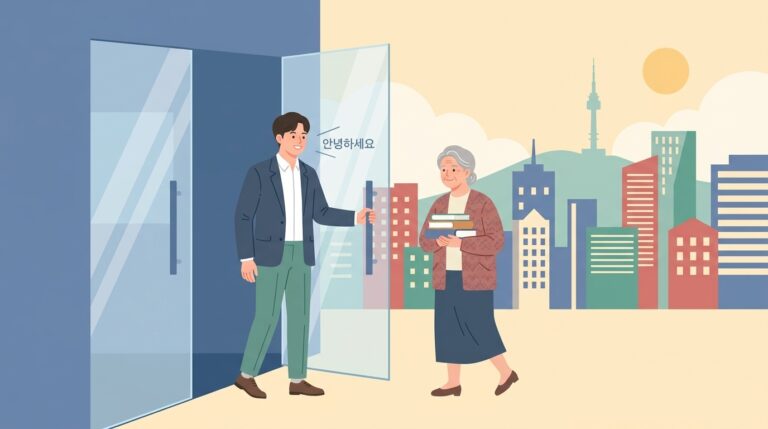
Do Koreans Hold the Door? The Unspoken Etiquette of Chivalry, Respect, and Nunchi
안녕하세요! (Annyeonghaseyo!) Welcome back to Daily Hangul, your premium guide to mastering not just the Korean language, but the intricate, beautiful pulse of Korean society. I’m your head editor and local culture navigator.
Have you ever stood before the heavy glass doors of a trendy cafe in Seongsu-dong, or a bustling office tower in Yeouido, and hesitated? You see someone walking a few paces behind you. In London or New York, you would naturally hold the door, perhaps exchanging a warm smile or a cheerful “After you.” But in Seoul, you might notice something different: sometimes doors are held with a subtle nod, sometimes they sweep shut right in front of you, and other times, a senior colleague insists on letting you pass first regardless of gender.
If you have found yourself perplexed by these daily interactions, you are not alone. Many of my advanced C2 students—seasoned expats and global professionals—express confusion about how Western notions of “Lady First” and chivalry translate into the fast-paced, Confucian-inflected social matrix of modern Korea.
Understanding these subtle physical and verbal dances is what elevates you from a fluent speaker to a culturally empathetic insider. Today, we will unpack the real etiquette of door-holding, gender dynamics, and space in Korea, giving you the linguistic tools and cultural intuition to navigate any entrance with grace.
Phase 2: Deep Dive into 3 Core Expressions
To navigate these physical transitions smoothly, you need more than physical manners—you need the precise verbal keys that signal your intent without creating social awkwardness.
1. 먼저 가세요 (Meonjeo gaseyo)
- Pronunciation: [meon-jeo ga-se-yo] / Sound-alike: “Mun-juh gah-seh-yo” (Say it with a gentle, downward intonation at the end).
- Meaning: “Please go first” (Literal) vs. “After you / Please, after you” (Real-world Nuance).
- K-Culture Moment: This is the quintessential phrase you hear in K-Dramas when two characters reach an elevator or a narrow revolving door simultaneously. Think of a polite male lead stepping aside, gesturing with an open palm toward the entrance.
- Editor’s Insight: This phrase is incredibly versatile. It bypasses gender and age, serving as an egalitarian lubricant for public spaces. By saying this, you are actively choosing to defer your physical progress to show respect for the other person’s time and space.
- Situation Spectrum:
- Friends/Casual: ⚠️ (A bit too formal; use “먼저 가” [meonjeo ga] instead)
- Business/Semi-formal: ✅
- Formal/Elders: ✅
- 🤔 Think About It: Why does Korean prioritize spatial and temporal order (“먼저” – first/ahead) over personal pronouns (“you”) in polite deferral? It reflects a linguistic preference for minimizing direct reference to the interlocutor, thereby maintaining a respectful distance.
2. 문 잡아드릴게요 (Mun jaba-deurilgeyo)
- Pronunciation: [mun ja-ba-deu-ril-gye-yo] / Sound-alike: “Moon jah-bah-deu-ril-geh-yo” (Flow the ‘ba’ into ‘deu’ smoothly).
- Meaning: “I will hold the door for you” (Literal & Real-world Nuance).
- K-Culture Moment: Picture a busy modern office setting. A junior colleague or a thoughtful peer sees you approaching with hands full of iced Americanos from the local coffee shop. They quickly step ahead to keep the heavy security door open.
- Editor’s Insight: The auxiliary verb “-드릴게요” (-deurilgeyo) expresses the speaker’s proactive intention to perform an action as a favor or service for someone else. It is polite, helpful, and shows high situational awareness (눈치 – Nunchi).
- Situation Spectrum:
- Friends/Casual: ⚠️ (Too polite; use “문 잡아줄게” [mun jaba-julge])
- Business/Semi-formal: ✅
- Formal/Elders: ✅
- 🤔 Think About It: How does your native language express the offer of physical assistance? Is it as grammatically encoded with respect and humility as the Korean “-드리다” (-deurida, humble form of give)?
3. 제가 잡고 있을게요 (Jega japgo isseulgeyo)
- Pronunciation: [je-ga jap-go i-sseul-gye-yo] / Sound-alike: “Jeh-gah jahp-go ee-seul-geh-yo”.
- Meaning: “I will keep holding it” (Literal) vs. “Don’t worry, I’ve got the door” (Real-world Nuance).
- K-Culture Moment: When a group of colleagues is entering an elevator or a building vestibule, one person stands guard at the door controls or holds the physical door pane while the entire team files through.
- Editor’s Insight: This is the ultimate “team player” phrase. In Korea’s collectivist culture, taking physical responsibility for a group’s smooth transit is highly appreciated and rarely goes unnoticed.
- Situation Spectrum:
- Friends/Casual: ⚠️ (Use “내가 잡고 있을게” [naega japgo isseulge])
- Business/Semi-formal: ✅
- Formal/Elders: ✅
- 🤔 Think About It: This phrase shifts the focus entirely onto the speaker’s action (“제가” – I), offering reassurance so that others do not feel rushed or burdened by keeping you waiting.
Phase 3: Textbook Korean vs. Real Korean
In textbooks, you might find stiff, imperative sentences that sound like safety manuals. In reality, Koreans use softer, indirect expressions to make transitions seamless.
Situation 1: Holding an elevator door for an approaching stranger
- 📖 Textbook Korean: 엘리베이터 문을 열어 두십시오. (Elribeiteo mun-eul yeoreodhusoipsio. – “Keep the elevator door open.”)
- 🗣️ Real Korean: 타세요! 잡아드릴게요. (Taseyo! Jaba-deurilgeyo. – “Hop in! I’ll hold it for you.”)
- 💡 Why the difference? The textbook version is a cold instruction. The real-world expression uses the energetic, reassuring command “타세요” (Get on) combined with an immediate offer of help, conveying warmth and community spirit.
Situation 2: Deferring to a senior or lady at a narrow cafe entrance
- 📖 Textbook Korean: 여성이나 연장자가 먼저 들어가야 합니다. (Yeoseong-ina yeonjangjaga meonjeo deureogaya hamnida. – “Women or elders must enter first.”)
- 🗣️ Real Korean: 아, 먼저 들어가세요! (A, meonjeo deureogaseyo! – “Oh, please, go right ahead!”)
- 💡 Why the difference? Sociological descriptions are useless in real life. A simple “아” (an involuntary exclamation showing situational realization) followed by a polite invitation is natural, spontaneous, and charming.
⚠️ Bottom Note: As a C2 learner, avoid sounding like a translated textbook. Use conversational softeners like “아” (Ah) or “괜찮습니다” (It’s alright) to cushion your actions.
Phase 4: K-Culture Deep-Dive & Non-verbal Manners
4-1. Nunchi (눈치) and Body Language at the Threshold
In Korea, non-verbal communication speaks volumes. When holding a door, eye contact should be brief but respectful.
- The Subtle Head Nod (목례 – Mokrye): Unlike in Western countries where you might hold a door while facing the person fully and exchanging a wide grin, in Korea, a brief, slight tilt of the head (about 15 degrees) while holding the door is the gold standard of politeness. It acknowledges the other person’s presence without imposing a social obligation to start a conversation.
- The “Half-Turn” Hold: If you are walking through a door first and someone is behind you, do not spin around fully. Instead, pass through, keep your hand extended backward to catch the door pane, and turn your upper body slightly to ensure they have caught it. This keeps the physical flow natural and respects personal space.
4-2. The Evolution of “Lady First” in Korea
To understand modern Korean etiquette, we must look at how Western “chivalry” has integrated with traditional Korean values.
Traditional Confucian Hierarchy                  Western Chivalry
(Respect based on Age & Status)   <---------->   (Deference based on Gender)
                     \                         /
                      \                       /
                       Modern Korean "Baeryeo" (배려)
                       (Context-based consideration for all)
Historically, Korean social hierarchy was governed by Confucian principles, prioritizing age, social status, and professional rank over gender. When Western “Lady First” culture was introduced, it was adopted enthusiastically by younger generations, particularly influenced by K-Dramas where male leads perform highly romanticized chivalrous acts (like shielding someone from rain or opening car doors).
However, in contemporary daily life, the concept of 배려 (Baeryeo – consideration/thoughtfulness) has evolved into something more practical and gender-neutral. Today, holding a door is not strictly a gendered expectation; rather, it is a gesture of courtesy extended to:
1. Anyone carrying heavy loads.
2. Parents with strollers or the elderly.
3. Colleagues, regardless of gender, as a sign of workplace solidarity.
If you are a man, acting with “Lady First” manners is certainly appreciated, but be aware that in professional settings, showing respect to a senior colleague (선배 – seonbae or 상사 – sangsa) regardless of gender takes precedence over Western chivalric norms.
Phase 5: Interactive Roleplay Scenario
The Setting
A rainy Tuesday afternoon in a chic office building in Yeouido. The glass entry doors are heavy, and the lobby is bustling with professionals rushing back from lunch. You are walking back with your team leader, Manager Kim, who is carrying a stack of files.
Cast
- You (Alex): A senior global consultant at the firm.
- Manager Kim (김 과장님): Your polite, slightly traditional Korean team leader.
[Scene Start: Near the heavy glass entrance doors of the Yeouido office tower]
- Manager Kim: (🎭 Balancing a folder under her arm while holding an umbrella) 아, 비가 갑자기 너무 많이 오네요, 알렉스 씨.
(A, biga gapjagi neomu mani oneyeo, Alex-ssi.)
“Ah, it’s suddenly raining so hard, Alex.” -
Alex: (🎭 Stepping forward to reach the door handle first) 정말요. 제가 문 열어드릴게요.
(Jeongmaryo. Jega mun yeoreodeurilgeyo.)
“Indeed. Let me get the door for you.” -
Manager Kim: (🎭 Smiling warmly as you pull the heavy door open) 아휴, 고마워요, 알렉스 씨. 센스 있네요!
(Ahyu, gomawoyo, Alex-ssi. Sense inneyo!)
“Oh, thank you, Alex. You’re so quick-witted!” -
Alex: (🎭 Holding the door firmly with one hand while gesturing inside) 아닙니다, 과장님. 먼저 들어가세요!
(Animnida, gwajangnim. Meonjeo deureogaseyo!)
“Not at all, Manager. Please, go on in!” -
Manager Kim: (🎭 Entering the dry lobby, then turning back to take the door from you) 제가 여기 잡고 있을 테니까 얼른 들어와요. 우산 터시고요.
(Jega yeogi japgo isseul tenikka eolleon deureowayo. Usan teosigoyo.)
“I’ll hold it from this side, so hurry inside. Shake off your umbrella.” -
Alex: (🎭 Quickly shaking the water off the umbrella outside) 감사합니다, 과장님.
(Gamsahamnida, gwajangnim.)
“Thank you, Manager.” -
Manager Kim: (🎭 Heading toward the elevator bank) 엘리베이터에 사람이 많네요. 저기 먼저 타요!
(Elribeiteoe sarami manneyo. Jeogi meonjeo tayo!)
“The elevator is crowded. Go ahead and get on first!” -
Alex: (🎭 Recognizing she is carrying heavy files) 아닙니다. 제가 버튼 잡고 있을게요, 먼저 타세요.
(Animnida. Jega beoteon japgo isseulgeyo, meonjeo taseyo.)
“No, after you. I will hold the door button, please get on first.” -
Manager Kim: (🎭 Stepping into the elevator gratefully) 고마워요. 매너가 정말 좋으시네요.
(Gomawoyo. Maeneoga jeongmal joeusineyeo.)
“Thank you. Your manners are truly wonderful.” -
Alex: (🎭 Nodding slightly as you enter behind her) 과장님 무거우신데 제가 들고 갈까요?
(Gwajangnim mugeousingde jega deulgo galkkayo?)
“Manager, those look heavy, shall I carry them for you?”
🔀 Decision Point
Imagine a senior executive from another department approaches the elevator just as the doors are closing. What is your move?
- A) Press the door close button (닫힘) quickly because you are already late.
- Feedback: 🚫 Oh dear! This is a social landmine in Korean corporate culture. Doing this is seen as highly impatient and disrespectful, especially if senior staff are nearby.
- B) Hold the door open button (열림) and say “먼저 타세요!” (Meonjeo taseyo! – “Please get on first!”) with a warm nod.
- Feedback: ✅ Best Choice! This displays perfect Nunchi and active respect, marking you as a highly professional and socially competent team member.
- C) Step out of the elevator entirely to let them have your spot.
- Feedback: ⚠️ A bit dramatic! Unless the elevator is strictly over capacity and sounding an alarm, stepping out entirely might make the executive feel awkward and overly self-conscious about taking your space.
Phase 6: 10-Second Shadowing Drill
Let’s practice speaking with the right emotional cadence. Korean politeness relies heavily on pitch contour and natural pauses.
- Drill 1: Reassuring and Active
[😊 Warm and helpful]- 아, / 문 잡아드릴게요! / 천천히 오세요!
- (Ah, / mun jaba-deurilgeyo! / Cheoncheonhi oseyeo!)
- “Oh, I’ll hold the door! Take your time!”
- Drill 2: Polite and Deferential
[🥺 Respectful and humble]- 아, 아닙니다! / 먼저 가세요! / 괜찮습니다!
- (A, animnida! / Meonjeo gaseyo! / Gwenchanhseumnida!)
- “Oh, no! Please go first! It’s perfectly fine!”
Phase 7: K-Culture Mini-Dictionary
| Word (Hangul / Romanization) | Meaning | Real-world Context & Usage |
|---|---|---|
| 배려 (Baeryeo) | Consideration / Thoughtfulness | The core of all Korean manners. It means anticipating others’ discomfort and acting quietly to prevent it. |
| 눈치 (Nunchi) | Situational/Social Intelligence | The ability to read the room. Knowing when to hold a door, when to step back, or when to walk faster. |
| 매너 (Maeneo) | Manners / Social Etiquette | Derived from the English word, but specifically refers to interpersonal social graces (e.g., table manners, door etiquette). |
| 양보 (Yangbo) | Yielding / Giving way | Commonly seen on signs near public transit seats or driving situations. Yielding physical space to others. |
Phase 8: Traveler’s Survival Kit
Survival Expressions for Public Spaces
- 잠시만요! (Jamsimanyo!)
- Usage Tip: “Excuse me!” or “Just a moment!” Use this when you need to squeeze through a door or exit a crowded subway car where someone might be inadvertently blocking the way.
- 먼저 내릴게요. (Meonjeo naerilgeyo.)
- Usage Tip: “I will get off first.” Crucial for crowded elevators or subways before you make physical moves to push past.
- 도와드릴까요? (Dowadeurilkkayo?)
- Usage Tip: “Shall I help you?” Excellent for when you see someone struggling with a heavy suitcase at a subway station staircase.
📌 Editor’s Travel Note: When navigating Seoul, download the Naver Map App Download Page to find accessible exits with elevators or escalators, which is incredibly helpful if you are traveling with heavy luggage or strollers.
Phase 9: Deep Thoughts — “Going Deeper”
In Western cultures, door-holding and “Lady First” protocols are often rooted in historical codes of chivalry. In Korea, however, physical spatial deference is an extension of interpersonal harmony and linguistic hierarchy.
Because Korean is an honorific-heavy language where sentences change structure depending on who you are speaking to, physical actions must mirror this linguistic architecture. Holding a door for an elder or a boss is not merely a nice gesture; it is the physical equivalent of using the highest honorific verb endings (-하옵소서 or -시지요).
As Korea continues to globalize, we see a fascinating hybrid emerge: young Koreans seamlessly blending traditional respect for elders with Western-style gender egalitarianism. It is a beautiful dance of past and present.
💬 Your Turn: How is door-holding or “Lady First” etiquette viewed in your country? Is it based on gender, age, or is it completely casual? Let me know in the comments below!
Phase 10: FAQ & Avoiding Misunderstandings
Q: Why do some Koreans let go of the door immediately without looking behind them?
A: It is rarely intended as rudeness! In high-density cities like Seoul, people are often operating in a state of “focused inattention” to preserve personal privacy in packed spaces. Additionally, fast-paced environments mean people are simply moving quickly. Use your own Nunchi to catch doors ahead of time.
Q: Should I hold the door for a male boss if I am a female junior employee?
A: Yes. In Korean corporate spaces, hierarchical status (직급 – jikgeup) almost always trumps gender etiquette. Holding the door for your team leader or executive, regardless of gender, is viewed as professional deference, not subservience.
Q: Do I need to bow while holding a door?
A: No. A full bow while holding a door is physically awkward and unnecessary. A micro-nod of the head (목례) with a soft smile is the perfect, modern compromise.
🚨 Common Mistakes Warning Board
- Mistake 1: Holding a door from too far away.
- Why: If you hold a door for someone who is 20 meters away, you force them into an awkward, apologetic jog. Only hold it if they are within 3-4 paces.
- Mistake 2: Insisting on “After you” repeatedly with an elder.
- Why: If an elder politely insists you go first, accept it with a “감사합니다” and proceed. Repeatedly refusing can feel like you are rejecting their goodwill.
- Mistake 3: Forgetting to watch out for children or delivery riders.
- Why: Delivery personnel carrying heavy boxes are the lifeblood of Seoul. Always prioritize holding doors for them; it is a sign of high social empathy.
Phase 11: Action Missions
- 🥉 Bronze (At-Home Challenge): Practice saying “먼저 가세요” (Meonjeo gaseyo) in front of the mirror with a polite, 15-degree head nod. Master the natural speed!
- 🥈 Silver (Social Challenge): Next time you are in a Korean restaurant or store, hold the door for the person behind you and practice your subtle micro-nod. See if they nod back!
- 🥇 Gold (Real-Life Mastery): Hold an elevator door for a colleague or stranger, make brief eye contact, and say “타세요, 잡아드릴게요!” with a warm, natural smile.
- 🎮 K-Culture Mission: Watch your favorite K-Drama today and spot at least one scene where a character holds a door or elevator. Observe their body language: Did they use a head nod, or did they use an open-palm gesture?
Phase 12: Interactive Quiz Challenge
1. Which phrase is best suited for inviting a senior colleague to enter an elevator first?
- A) 먼저 가 (Meonjeo ga)
- B) 먼저 들어가세요 (Meonjeo deureogaseyo)
- C) 문 열어라 (Mun yeoreora)
🔍 Reveal Answer & Explanation
- Correct Answer: B
- Explanation: “먼저 들어가세요” is polite and utilizes the honorific suffix “-시-” making it perfect for seniors. Option A is too casual (반말), and Option C is an impolite command.
2. True or False: In a Korean company, a male manager should always let a female junior entry-level employee enter a door first due to “Lady First” rules.
🔍 Reveal Answer & Explanation
- Correct Answer: False
- Explanation: While personal kindness exists, in formal Korean business settings, professional rank and age hierarchy take precedence over gender-based chivalry. The junior employee should ideally hold the door for the manager.






