

How to Receive Packages in Korea: Master “Taekbae Wasseumnida” like a Local
안녕하세요! (Annyeonghaseyo!) Hello! It is your senior editor and friendly Korean tutor from Daily Hangul. If you are living in Korea, staying at an Airbnb, or watching your favorite K-Dramas, you have definitely seen the magic of Korean delivery.
Imagine this: You are relaxing in your room after a long day of sightseeing in Seoul. Suddenly, the doorbell rings: Ding-dong! A friendly voice shouts from the hallway, or you get a text message that says: “택배 왔습니다!”
Do you panic and hide? Or do you open the door and freeze? Don’t worry! Today, we will learn how to handle this exact moment with confidence. By the end of this guide, you will sound like a natural Korean resident!
Phase 2: 3 Essential Korean Delivery Expressions
1. 택배 왔습니다 (Taekbae wasseumnida)
- Pronunciation: [Taek-bae-wat-seum-ni-da] / Sound-alike: “Tack-bae wat-sum-nee-da”
- Meaning: “Your delivery is here!” or “The package has arrived!”
- K-Culture Moment: In K-Dramas, this phrase brings instant joy! Characters drop their food or run to the door. It is the modern-day sound of happiness.
- Editor’s Insight: This is a very polite and standard way delivery drivers let you know they are outside.
- Situation Spectrum:
- Friends/Casual: ⚠️ (Too formal for friends, but perfect for delivery situations)
- Co-workers/Semi-formal: ✅
- Bosses/Formal: ✅
- 🤔 Think About It: In Korean, we focus on the object arriving (“The package came”) rather than the person bringing it (“I brought your package”). How does your native language describe a delivery?
2. 문 앞에 두고 가세요 (Mun appe dugo gaseyo)
- Pronunciation: [Mun-ap-e-du-go-ga-se-yo] / Sound-alike: “Moon ah-peh doo-go gah-seh-yo”
- Meaning: “Please leave it in front of the door and go.”
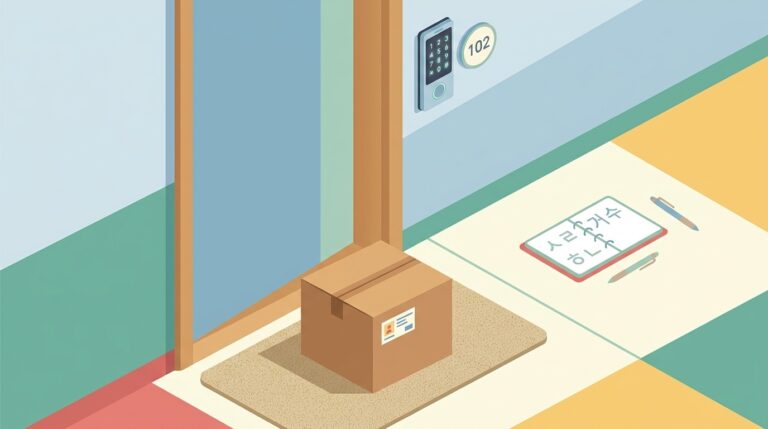
- K-Culture Moment: Korea is incredibly safe. Leaving packages in the hallway is the standard norm! Nobody will take your box.
- Editor’s Insight: Use this when you are working from home, in your pajamas, or resting.
- Situation Spectrum:
- Friends/Casual: ⚠️
- Co-workers/Semi-formal: ✅
- Bosses/Formal: ✅
- 🤔 Think About It: Trust is a huge part of Korean daily life. Leaving valuable packages outside doors reflects this high-trust culture. How would this work in your home country?
3. 감사합니다 (Gamsahamnida)
- Pronunciation: [Gam-sa-ham-ni-da] / Sound-alike: “Gahm-sah-hahm-nee-da”
- Meaning: “Thank you.”
- K-Culture Moment: Shouted politely through the closed door as the driver walks away. It shows respect to the hardworking “delivery heroes” (택배 기사님 – Taekbae Gisanim).
- Editor’s Insight: Always use the polite form! Delivery drivers work very hard, and a warm “Gamsahamnida” makes their day.
- Situation Spectrum:
- Friends/Casual: 🚫 (Too formal for close friends, but mandatory for delivery drivers!)
- Co-workers/Semi-formal: ✅
- Bosses/Formal: ✅
Phase 3: Textbook Korean vs. Real Korean
Situation 1: Telling the driver where to leave the box
- 📖 Textbook Korean: 택배를 현관문 앞에 놓아 주십시오. (Please place the parcel in front of the front door.)
- 🗣️ Real Korean: 문 앞에 놔주세요! (Please leave it at the door!)
- 💡 Why is it different? The textbook version is too stiff and long. Real Koreans shorten “놓아주세요” (noha-juseyo) to “놔주세요” (nwa-juseyo) for faster, friendlier communication.
Situation 2: Shouting to let them know you are inside
- 📖 Textbook Korean: 예, 제가 지금 나가겠습니다. (Yes, I am going out now.)
- 🗣️ Real Korean: 네! 문 앞에 두고 가세요! (Yes! Please leave it at the door and go!)
- 💡 Why is it different? Delivery drivers are very busy. They don’t want you to open the door slowly. Shouting “leave it at the door!” saves everyone’s time!
Phase 4: K-Culture Deep Dive & Non-verbal Manners
4-1. Nunchi (눈치) and Body Language
In Korea, you rarely need to open the door for a delivery. Opening the door physically can sometimes make the busy driver feel rushed! Instead, use your voice. Shout “네, 문 앞에 두고 가세요! 감사합니다!” through the door. If you do meet the driver face-to-face, a polite head nod (a mini bow) with both hands ready to receive the package is the perfect polite gesture.
4-2. The Magic of Rocket Delivery (로켓배송)
Korea’s delivery system, especially Coupang’s “Rocket Delivery,” is legendary. You can order a fresh water bottle or a new keyboard at 11 PM and find it outside your door at 7 AM the next morning. This rapid speed is why knowing these delivery terms is so helpful for daily survival!
Phase 5: Interactive Delivery Roleplay
The Setting: You are in your cozy Airbnb in Mapo, Seoul. You ordered a delicious box of Korean snacks online. Suddenly, the intercom screen blinks.
Cast: You (The Excited Buyer) and the Delivery Driver (택배 기사님 – Taekbae Gisanim).
- Intercom: Ding-dong!
- You: (🎭 Pressing the talk button nervously) 네? (Ne? / Yes?)
- Driver: 택배 왔습니다! (Taekbae wasseumnida! / Delivery is here!)
- You: (🎭 Thinking quickly) 아! 네! (Ah! Ne! / Oh! Yes!)
- Driver: 문 열어주세요. (Mun yeoreo-juseyo. / Please open the building door.)
- You: (🎭 Buzzing them in) 네, 열어드렸어요! (Ne, yeoreo-deuryeosseoyo! / Yes, I opened it for you!)
- Driver: (🎭 Shouting near your door a minute later) 택배 어디에 둘까요? (Taekbae eodie dulkkayo? / Where should I leave the package?)
🔀 Decision Point! How do you reply?
- A) “문 앞에 두고 가세요!” (Mun appe dugo gaseyo!)
- B) “여기 주세요.” (Yeogi juseyo! / Give it here.)
- C) “저기요!” (Jeogiyo! / Hey over there!)
Best Choice Analysis:
- A is the Best Choice! It is polite, clear, and perfectly matches the fast-paced Korean apartment culture.
- B is okay, but it means you have to open the door immediately and take it physically.
- C is too rude and informal to use with a delivery driver!
Phase 6: 10-Second Emotion Shadowing Drill
Let’s practice speaking with real Korean emotion! Use the slashes / to pause.
- [😊 Excited & Happy]
택배 / 왔습니다! (Taek-bae / wat-seum-ni-da!) -
[🥺 Soft & Polite]
문 앞에 / 두고 / 가세요. (Mun-ap-e / du-go / ga-se-yo.) -
[😊 Warm & Appreciative]
감사 / 합니다! (Gam-sa / ham-ni-da!)
Phase 7: K-Culture Mini Dictionary
- 택배 (Taekbae): Package / Delivery. The lifeline of Korean convenience.
- 기사님 (Gisanim): Driver / Technician. A respectful title used for professional workers.
- 문 앞 (Mun-ap): Doorstep / In front of the door.
- 공동현관 (Gongdong-hyeongwan): The shared main lobby entrance of an apartment building, usually requiring a passcode.
Phase 8: Traveler’s Survival Kit
Survival Expressions for Your Pocket:
- 경비실에 맡겨주세요 (Gyeongbisire matgyeojuseyo)
- Meaning: “Please leave it at the security office.” (Useful for high-rise apartments!)
- 택배 보관함에 넣어주세요 (Taekbae bogwanhame neoeojuseyo)
- Meaning: “Please put it in the delivery locker.”
- 전화 주세요 (Jeonhwa juseyo)
- Meaning: “Please call me.”
📌 Editor’s Travel Note: When ordering deliveries to an accommodation, always download the Naver Map App Download Page to check your exact Korean address and postal code!
Phase 9: Deep Thoughts — Trust in Korea
In many countries, leaving a package unattended outside your door invites theft. In Korea, however, hundreds of boxes sit in hallways safely every day. This high-trust environment relies heavily on community respect and the widespread presence of security cameras (CCTV). It is a beautiful example of how society works together to make life convenient.
💬 Your Turn: Would you feel safe leaving packages outside your door in your hometown? Let us know in the comments below!
Phase 10: FAQ & Avoiding Mistakes
Q: Can I use “고마워” (Gomawo) to the driver?
A: No! “고마워” is casual language (반말) for close friends or children. Always use “감사합니다” (Gamsahamnida) to show respect.
Q: What if the driver asks for a password?
A: They are asking for the “공동현관 비밀번호” (gongdong-hyeongwan bimilbeonho – lobby password) to enter your building. You can text it to them.
🚨 Common Mistake Board:
- Mistake 1: Forgetting to say “감사합니다” when receiving a box. (Always be polite!)
- Mistake 2: Opening the door with zero warning. (Always shout “네!” first so they know you are inside!)
Phase 11: Action Missions
- 🥉 Bronze: Record yourself saying “문 앞에 두고 가세요!” three times in a loud, clear voice.
- 🥈 Silver: The next time you watch a K-Drama, listen closely for the word “택배” (Taekbae)!
- 🥇 Gold: If you are staying in Korea, successfully receive a package without opening your door by shouting “문 앞에 두고 가세요, 감사합니다!”
Phase 12: Interactive Quiz Challenge
1. What does “택배 왔습니다” mean?
Click to reveal Answer
Answer: “Your delivery/package is here!”
2. Fill in the blank: “문
______ 두고 가세요.”
Click to reveal Answer
Answer: 앞에 (appe – meaning “in front of”). Full sentence: 문 앞에 두고 가세요.
3. True or False: It is rude to ask the driver to leave the package outside your door.
Click to reveal Answer
Answer: False! It is the standard, preferred way in Korea because it is fast and safe!
“, 200:






