

Shaking Off the Dust: The Korean Art of Resilience (회복 탄력성) and Emotional Recovery
안녕하세요! (Annyeonghaseyo!) I’m your lead editor at Daily Hangul. Have you ever felt like your world was temporarily collapsing? Maybe a dream slipped through your fingers, a deep relationship fractured, or you experienced a trauma that made even waking up feel heavy.
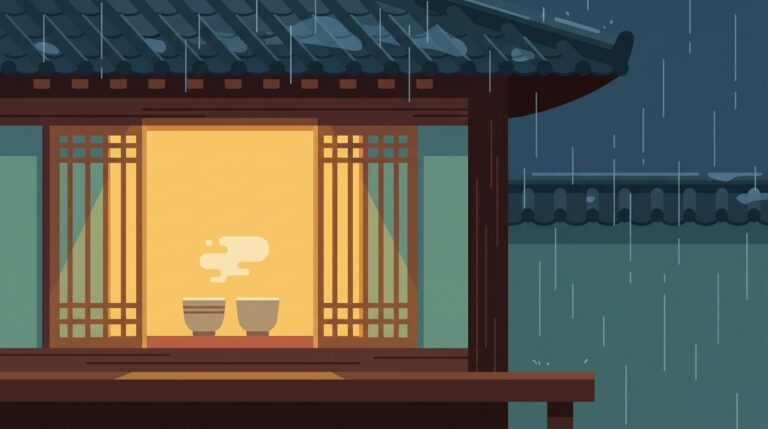
Imagine sitting in a dimly lit, cozy Hanok cafe in Samcheong-dong on a rainy evening. The steam from a hot cup of Ssanghwa-cha (traditional herbal tea) warms your face while you sit opposite a close Korean friend. You finally open up about your struggles. In English, we might talk about “bouncing back.” But in Korean, emotional healing and psychological resilience—known as 회복 탄력성 (hoebok tarlyeokseong)—are woven into deep, beautifully metaphorical expressions that reflect both collective warmth (Jeong) and personal strength.
Today, let’s explore how to express trauma recovery and emotional resilience in natural, native Korean, elevating your language from sterile textbook phrases to deep, soul-stirring conversations that will make your Korean friends say, “You truly understand our heart.”
Phase 2: 3 Key Expressions Deep Dive
1. 훌훌 털어버리다 (Hul-hul teol-eo-beo-ri-da)
- Pronunciation: [hool-hool teol-eo-beo-ri-da] / Sound-alike: Imagine sweeping dust off your shoulders while saying ‘hool-hool’ with a light, rhythmic puff of air.
- Meaning: Literally, “to dust/shake off completely.” Metaphorically, it means to gracefully let go of worries, trauma, or past failures and move forward.
- K-Culture Moment: This expression is a staple in comforting K-Drama scenes. Think of My Mister (나의 아저씨) or Our Blues (우리들의 블루스), where characters who have hit absolute rock bottom sit by the sea or in a local pub, and an older mentor tells them to let go of their heavy burdens.
- Editor’s Insight: The mimic word 훌훌 (hul-hul) mimics the action of shaking off dust or wings fluttering away. It carries a sense of weightlessness. It suggests that your trauma doesn’t define you; you can simply shake it off like dust on a coat.
- Situation Spectrum:
- Friends/Casual: ✅ (Perfect for reassuring a friend)
- Co-workers/Semi-formal: ✅
- Superior/Formal: ⚠️ (Use the honorific form: 훌훌 털어버리세요)
- 🤔 Think About It: Why does Korean use physical actions (dusting off) to describe psychological recovery? It highlights a cultural mindset that views mental burdens as external elements you can physically detach from, rather than permanent internal flaws.
2. 마음이 단단해지다 (Ma-eum-i dan-dan-hae-ji-da)
- Pronunciation: [ma-eum-i dan-dan-hae-ji-da] / Sound-alike: ‘Ma-eum’ (mind/heart) + ‘Dan-dan’ (like a solid, unbreakable stone) + ‘hae-ji-da’ (to become).
- Meaning: “One’s heart/mind becomes solid and resilient.”
- K-Culture Moment: Often heard in coming-of-age dramas like Twenty-Five Twenty-One (스물다섯 스물하나), where young characters face crushing societal and personal setbacks, only to find their inner core strengthened.
- Editor’s Insight: Be careful! Do not confuse 단단하다 (dan-dan-hada: solid, firm, resilient) with 딱딱하다 (ttak-ttak-hada: rigid, stiff, cold). A resilient heart in Korea is 단단하다—it is strong, mature, and unbreakable, yet still warm and empathetic. A 딱딱한 마음 is a cold, closed-off, and defensive heart.
- Situation Spectrum:
- Friends/Casual: ✅
- Co-workers/Semi-formal: ✅
- Superior/Formal: ✅
- 🤔 Think About It: How does your native language distinguish between being “tough” (rigid/defensive) and being “resilient” (flexible yet strong)?
3. 전화위복 (Jeon-hwa-wi-bok)
- Pronunciation: [jeon-hwa-wi-bok] / Sound-alike: ‘Jun-hwa’ (sounds like phone, but means turning point) + ‘we-bok’ (misfortune into blessing).
- Meaning: “Turning a misfortune into a blessing” (A classic four-character idiom / 사자성어).
- K-Culture Moment: This is the ultimate corporate and personal recovery phrase. When business plans fall through or someone suffers a devastating setback, mentors use this to reframe the tragedy as an inevitable setup for a spectacular comeback.
- Editor’s Insight: Using Saja-seong-eo (사자성어) like this instantly signals high intellectual fluency (C1 level). It brings an air of timeless, philosophical wisdom to your words.
- Situation Spectrum:
- Friends/Casual: ✅
- Co-workers/Semi-formal: ✅
- Superior/Formal: ✅ (Highly appreciated by older Koreans and bosses!)
- 🤔 Think About It: This concept stems from Yin-Yang philosophy—the idea that extremes naturally generate their opposites. Do you believe that major setbacks are always hidden opportunities in disguise?
Phase 3: Textbook Korean vs. Real Korean
When dealing with delicate matters like psychological trauma, using robotic textbook Korean can make you sound cold, or worse, unsympathetic. Let’s look at the differences.
Situation 1: Comforting someone who just went through a painful life crisis
- 📖 Textbook Korean: “슬픔을 극복하십시오.” (Seul-peum-eul geuk-bok-ha-sip-si-o.)
- Why it’s awkward: Literally “Please overcome your sadness.” It sounds like an official military command or a cold clinical directive. It lacks empathy.
- 🗣️ Real Korean: “마음 잘 추스르고 천천히 나아가요.” (Ma-eum jal chu-seu-reu-go cheon-cheon-hi na-a-ga-yo.)
- Nuance & Why: “Gather your scattered heart/mind gently, and let’s move forward step by step.” The verb 추스르다 (chu-seu-reu-go) beautifully depicts gathering a spilled or disorganized pile and holding it close, perfectly capturing the delicate act of collecting one’s broken emotions.
Situation 2: Encouraging someone who feels they have hit rock bottom
- 📖 Textbook Korean: “당신은 다시 회복할 수 있습니다.” (Dang-sin-eun da-si hoebok-hal su ist-seumnida.)
- Why it’s awkward: “You are capable of recovering again.” It reads like a self-help book’s generic slogan. It doesn’t sound like a true, close friend speaking.
- 🗣️ Real Korean: “원래 바닥을 쳐야 올라갈 일만 남는 법이에요.” (Won-rae ba-dak-eul cheo-ya ol-ra-gal il-man nam-neun beop-i-e-yo.)
- Nuance & Why: “They say only when you hit rock bottom is there nothing left but to rise.” It normalizes the pain of hitting ‘the floor’ (바닥) and uses natural, colloquial phrasing to offer hope.
Phase 4: K-Culture Deep Dive & Non-Verbal Manners
4-1. The Body Language of Comfort: Eyes, Hands, and Silent Spaces
In Western cultures, deep emotional comfort often involves intense eye contact to show sincerity, or immediate verbal affirmation. In Korea, when someone is sharing trauma or crying, direct, unbroken eye contact can feel confrontational or pressure-inducing.
* The Soft Gaze: Keep your gaze soft and slightly cast down or directed toward their hands. It gives them the physical privacy to cry or show vulnerability without feeling exposed.
* The Gentle Touch: A soft pat on the shoulder or back of the hand—accompanied by a rhythmic, gentle nodding—is worth a thousand words. It communicates the ultimate Korean concept of 정 (Jeong): shared emotional space.
* Accepting Silence: In Korean communication, silence isn’t awkward; it is an active form of listening. Don’t rush to fill the silence with cliches. Simply sitting together and breathing through the heavy air is highly valued.
4-2. The Healing Ritual: Spicy Food & “Soju-therapy”
Have you noticed how K-Drama characters always run to a street-food tent (포장마차) or a hot pot restaurant after a psychological shock?
* 이열치열 (I-yeol-chi-yeol – Fighting fire with fire): Koreans believe that sweating out internal stress with extremely spicy food (like Tteokbokki or Maeuntang) releases trapped, stagnant energy.
* 소주 한 잔 (A Glass of Soju): Drinking together is not about getting drunk; it is a ritual of mutual unburdening. Pouring a drink for your friend while saying nothing but “수고했다” (You’ve suffered/worked hard) is a sacred cultural method of processing trauma.
Phase 5: The Healing Rooftop Bar – Interactive Roleplay Scenario
The Setting
It’s a breezy Autumn night on a rooftop bar overlooking the twinkling lights of Seoul. You are sitting with your close Korean friend, Ji-woo (지우). Ji-woo has been struggling immensely after suddenly losing her dream job due to a company restructuring. She looks weary, holding her glass with both hands.
Cast
- Ji-woo (지우): Your resilient yet exhausted Korean friend.
- You: A supportive, deeply empathetic C1-level foreign friend.
Dialogue
- 지우: (sighing deeply, looking at the city lights) “가끔은 그냥 제 인생이 여기서 끝난 것 같다는 생각이 들어요. 모든 게 무너진 느낌이에요…”
(Gakkeumeun geunyang je insaeng-i yeogi-seo kkeut-nan geot gat-da-neun saeng-gak-i deor-eo-yo. Modeun ge muneojin neukkim-i-e-yo…)
(Sometimes I just feel like my life ended here. It feels like everything collapsed…) -
You: 🎭 (Softly placing your hand near hers, speaking gently) “지우야, 네가 얼마나 오랫동안 이 일을 위해 노력했는지 내가 다 알잖아. 마음이 얼마나 아플지 상상조차 안 돼.”
(Ji-woo-ya, ne-ga ol-mana o-rae-dong-an i il-eul wi-hae no-ryeok-haet-neun-ji na-ga da al-jan-a. Ma-eum-i ol-mana a-peul-ji sang-sang-jo-cha an dway.)
(Ji-woo, I know exactly how long you worked for this. I can’t even imagine how much your heart must hurt.) -
지우: (Tears welling up slightly, nodding) “그냥 제 자신이 너무 바보 같고 쓸모없게 느껴져요. 왜 나한테만 이런 일이 생길까…”
(Geunyang je ja-sin-i neo-mu ba-bo gat-go sseul-mo-eob-ge neuk-kyeo-jyeo-yo. Wae na-han-te-man i-reon il-i saeng-gil-kka…)
(I just feel so foolish and useless. Why do these things only happen to me…) -
You: 🎭 (Looking into her eyes with deep warmth) [Decision Point! What will you say?]
🔀 Decision Point: How do you respond to Ji-woo?
- Option A: “슬퍼하지 마세요. 괜찮아질 거예요. 힘내세요!” (Seul-peo-ha-ji ma-se-yo. Gwaen-chan-ah-jil geo-ye-yo. Him-nae-se-yo!)
- Option B: “지우야, 원래 바닥을 치면 이제 올라갈 일만 남은 거야. 이번 아픔이 오히려 너의 마음을 더 단단하게 만들어 줄 거야.” (Ji-woo-ya, won-rae ba-dak-eul chi-myeon i-je ol-ra-gal il-man nam-eun geo-ya. I-beon a-peum-i o-hi-ryeo neo-ui ma-eum-eul deo dan-dan-ha-ge man-deor-eo jul geo-ya.)
- Option C: “인생은 원래 힘든 법입니다. 그냥 훌훌 털어버리십시오.” (In-saeng-eun won-rae him-deun beop-im-ni-da. Geunyang hul-hul teol-eo-beo-ri-sip-si-o.)
Option Analysis & Feedback
- Best Choice: Option B
- Why: You used the warm, casual address (지우야), validated her pain by normalizing “hitting rock bottom” (바닥을 치면), and reframed her struggle with the beautiful concept of her heart becoming resilient (마음이 더 단단하게). It strikes the perfect balance between raw empathy and empowering optimism.
- Risk Choice: Option A
- Why: It’s too generic. Using formal speech (~세요) to a close friend in a highly emotional moment creates physical distance. Asking someone not to be sad (슬퍼하지 마세요) can sometimes feel invalidating.
- Bad Choice: Option C
- Why: This sounds incredibly dismissive and cold. Telling someone in a formal, dry tone to “just shake it off because life is hard” (훌훌 털어버리십시오) sounds like a heartless lecture rather than friendly support.
Phase 6: 10-Second Emotion Shadowing Drill
Let’s inject genuine emotion into your speech. Practice saying these sentences aloud, paying attention to the emotional punctuation (/ represents a slight pause for breath and emotional resonance).
1. [🥺 Deeply comforting, whispering with warm eyes]
- Sentence: “마음이 많이 아프지… / 내가 네 옆에 있을게.”
- Romaji: [Ma-eum-i / ma-ni a-peu-ji… / nae-ga ne yeob-e / i-seul-ge.]
- Meaning: “Your heart must hurt so much… I will stay by your side.”
2. [😤 Confident, strong, and highly encouraging]
- Sentence: “이것도 다 지나갈 거야. / 우리 힘내서 / 훌훌 털어버리자!”
- Romaji: [I-geot-do da / ji-na-gal geo-ya. / U-ri him-nae-seo / hool-hool teol-eo-beo-ri-ja!]
- Meaning: “This too shall pass. Let’s gather our strength and shake it all off!”
Phase 7: K-Culture Mini Dictionary
| Keyword | Romaji | Real-World Context & Cultural Meaning |
|---|---|---|
| 마음 추스르다 | Ma-eum chu-seu-reu-da | To gather up one’s scattered, broken emotions. Often used after a funeral, break-up, or massive shock when you try to pull yourself back together. |
| 회복 탄력성 | Hoe-bok tar-lyeok-seong | Resilience. Literally, “recovery elasticity.” The psychological capacity to absorb impact and spring back even stronger. |
| 전화위복 | Jeon-hwa-wi-bok | Turning a crisis into a golden opportunity. A highly philosophical idiom used in times of economic or personal disaster. |
| 훌훌 | Hul-hul | An onomatopoeia for dusting off, fluttering wings, or casting away burdens without looking back. |
Phase 8: Traveler’s Survival Kit for the Soul
If you are traveling in Korea and find yourself mentally exhausted, or you want to experience a true mental reboot, try these three survival strategies:
Healing Phrases to Use:
- “조용하고 치유되는 곳을 찾고 있어요.”
- Romaji: [Jo-yong-ha-go chi-yu-doe-neun got-eul chat-go i-seo-yo.]
- Pro Tip: Use this when asking locals for quiet, nature-rich spots to meditate or recover from sensory overload.
- “마음이 편안해지네요.”
- Romaji: [Ma-eum-i pyeon-an-hae-ji-ne-yo.]
- Pro Tip: Tell this to a host at a traditional tea house or temple stay. It means, “My heart is finally finding peace here.”
📌 Editor’s Travel Note:
If you feel overwhelmed in Seoul, immediately search for a Temple Stay Reservation Page to experience overnight mountain meditation, or download the Naver Map App Download Page to find hidden “Forest Healing Parks” (치유의 숲) tucked away in nearby mountain crevices.
Phase 9: Deep Reflection — “One Step Deeper”
In Korea, resilience is rarely seen as a purely solitary endeavor. Historically, Korea has faced immense collective hardships—wars, colonial eras, and economic collapses. Out of these struggles grew a unique cultural dynamic: collective recovery. When a Korean person is going through trauma, the community doesn’t just say “stay strong”; they physically show up with food, clean their house, or drag them out to eat a hot meal. To recover is to heal together in the warmth of shared relationships.
💬 Your Turn: How does your culture view recovery? Is it a private journey of individual grit, or is it a communal effort where people actively step in to help you rebuild? Let me know in the comments below!
Phase 10: FAQ & Common Mistakes (FAQ Schema Optimized)
Q: Can I use “훌훌 털어버리세요” to my boss who is stressed out about company profits?
A: Depends. While grammatically correct, telling a superior to “just shake it off” can sometimes sound a bit too casual or even dismissive of their serious responsibilities. Instead, use a more deferential phrase: “모든 일이 전화위복이 되기를 진심으로 바랍니다.” (I sincerely hope this situation turns into a blessing in disguise.)
Q: What is the difference between “극복하다” (geuk-bok-hada) and “이겨내다” (i-gyeon-aeda)?
A: Both mean “to overcome.” However, 극복하다 is a more academic, formal Chinese-character word (Hanja), perfect for news articles or exams. 이겨내다 is a pure Korean verb that carries a stronger active, human warmth—literally, “to fight through and win.” When talking to friends, always choose 이겨내다!
🚨 Common Mistakes Warning Board
- Saying “마음이 딱딱해요” to mean resilient.
- Correct Action: Say “마음이 단단해요”. 딱딱하다 means cold, unyielding, and stubborn. 단단하다 means firm, healthy, and emotionally resilient.
- Telling a crying person “울지 마세요” (Don’t cry) too quickly.
- Correct Action: In Korea, suppressing tears is considered bad for mental health. Say “울어도 괜찮아요” (It’s okay to cry) and offer a tissue silently.
Phase 11: Action Missions
- 🥉 Bronze (At-Home Challenge): Record yourself saying “마음 추스르고 천천히 나아가자” (Let’s gather our heart and move forward slowly) in a gentle, reassuring tone. Listen to your own voice.
- 🥈 Silver (Network Challenge): Write a supportive comment under a K-Pop idol’s or a friend’s Instagram post who is going through a hard time, using: “힘든 시기지만 잘 이겨낼 거라고 믿어요!” (It’s a tough time, but I believe you will overcome it beautifully!)
- 🥇 Gold (Real-Life Challenge): The next time a Korean friend shares a worry with you, do not give immediate advice. Instead, gently tap their shoulder, offer a warm drink, and say: “네 옆에 항상 내가 있는 거 알지?” (You know I’m always by your side, right?)
Phase 12: Interactive Quiz Challenge
1. Scenario Judgment
Your friend failed their final bar exam after studying for three years. Which response is most culturally empathetic and appropriate in Korean?
* A) “빨리 극복하십시오. 다음 기회가 있습니다.”
* B) “마음 잘 추스르고 맛있는 거 먹으러 가자. 내가 살게.”
* C) “시험은 원래 어려운 것입니다. 잊어버리세요.”
2. Fill in the Blanks
Complete the sentence to mean: “I hope this crisis turns into a blessing in disguise.”
* “이번 위기가 꼭 ( _ _ _ _ )이 되었으면 좋겠어요.”
3. True or False?
- In Korea, calling someone’s heart “딱딱하다” (ttak-ttak-hada) is a high compliment meaning they have great mental resilience. (T/F)
🔍 Click here to check the answers and explanations!
Answers:
1. B (It validates their grief, offers direct support, and initiates the healing ritual of eating together.)
2. 전화위복 (Jeon-hwa-wi-bok: Turning misfortune into blessing.)
3. False (Calling someone 딱딱하다 means they are rigid, stiff, and cold. You should use 단단하다 to praise their healthy resilience!)
“,







