

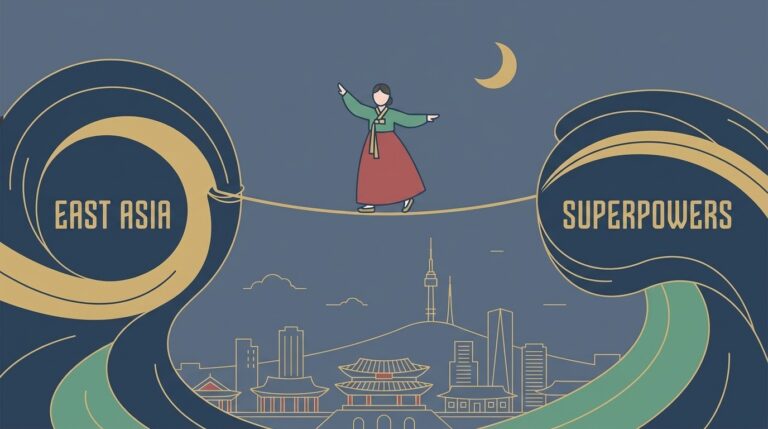
Geopolitical Tightrope: Master the Art of Talking South Korean Foreign Policy Like a Seoul Diplomat
Phase 1: Empathy (An Immersive Entry into Korea’s Diplomatic Arena)
Picture this: You are sitting in a dimly lit, high-end makgeolli (막걸리) bar in Yeouido, the political heart of Seoul. Across from you sits a veteran political analyst. The television overhead murmurs with breaking news about microchip supply chains, trilateral summits, and security pacts in East Asia. The analyst turns to you and asks, “How do you think Korea should handle its position between the global superpowers?”
If your go-to response is a dry, textbook sentence like “한국은 미국과 중국 사이에서 중립을 지킵니다” (Korea maintains neutrality between the US and China), the conversation might politely drift away. While grammatically correct, it lacks the cultural weight, strategic nuance, and historical gravity that native Koreans instantly feel when discussing their country’s geopolitical destiny.
For a C2-level learner, discussing Korea’s Balance of Power (세력 균형) is the ultimate test of linguistic and cultural fluency. In Korea, foreign policy isn’t just a section in the daily newspaper; it is a deeply felt national narrative of survival, resilience, and strategic genius. Today, we will unlock the precise, high-level vocabulary and idiomatic frameworks used by real diplomats, political scientists, and savvy citizens. By the end of this guide, you will not just speak about geopolitics—you will feel the delicate tension of the tightrope Korea walks every single day.
Phase 2: Core Expressions Deep Dive
To speak authoritatively on Korean foreign policy, you need more than raw vocabulary. You need cultural metaphors that instantly signal you understand the Korean historical psyche. Here are the three most crucial expressions.
1. 고래 싸움에 새우 등 터진다 (Gorae ssa-ume saewu deung teojinda)
- Pronunciation: [gorae ssa-u-me sae-u deung teo-jin-da] / Sound-alike: “Go-rae sah-oom-eh seh-woo deung tuh-jin-da”
- Meaning: “A shrimp’s back gets crushed in a fight between whales.”
- K-Culture Moment: You will hear this phrase echoed in historical dramas (Sageuk, 사극) like Mr. Sunshine, where Joseon is caught between the empires of Japan, Russia, and the West. In modern news, it is frequently used to describe South Korea’s economic vulnerability during US-China trade disputes.
- Editor’s Insight: This is perhaps the most famous geopolitical proverb in Korea. It encapsulates the historical trauma of a peninsula that has suffered dozens of invasions due to its geographical location. Using this phrase shows you empathize with Korea’s existential anxieties.
- Situation Spectrum:
- Casual: ✅ (Perfect for casual political debates over drinks)
- Semi-formal: ✅ (Commonly used by columnists and commentators)
- Formal: ✅ (Even politicians use it to emphasize economic urgency)
- 🤔 Think About It: Why does Korea compare itself to a “shrimp” when it is currently the world’s 10th largest economy? It reveals how deeply ingrained the historical memory of vulnerability remains, regardless of modern prosperity. How does your native language describe being caught between two warring giants?
2. 줄타기 외교 (Jultagi Oegyo)
- Pronunciation: [jul-ta-gi oe-gyo] / Sound-alike: “Jool-tah-gee weh-gyoh”
- Meaning: Tightrope Diplomacy (Balancing Act Foreign Policy)
- K-Culture Moment: Think of the classic Korean folk performance Jultagi (tightrope walking), where the performer must balance perfectly on a single rope high above the ground while keeping the audience entertained. In modern politics, it refers to Korea’s delicate act of maintaining its military alliance with the US while preserving its economic partnership with China.
- Editor’s Insight: This is not a derogatory term; it is a recognition of pragmatic survival. To call a country’s strategy jultagi oegyo acknowledges that a single misstep in either direction could lead to a catastrophic fall.
-
Situation Spectrum:
- Casual: ✅
- Semi-formal: ✅
- Formal: ✅
- 🤔 Think About It: Tightrope walking requires constant micro-adjustments rather than standing perfectly still. How does this metaphor change your view of “neutrality” as an active, exhausting effort rather than passive inaction?
3. 동북아의 균형자 (Dongbugaui Gyunhyeongja)
- Pronunciation: [dong-bug-a-ui gyun-hyeong-ja] / Sound-alike: “Dong-buk-ah-eui gyoon-hyung-jah”
- Meaning: The Balancer of Northeast Asia
- K-Culture Moment: This term rose to prominence during the Roh Moo-hyun administration in the early 2000s. It represents a shift from being a passive victim of geopolitics (the “shrimp”) to becoming an active mediator and stabilizer in the region.
- Editor’s Insight: This is a highly sophisticated, academic term. Use this when you want to discuss Korea’s proactive diplomatic strategies, showcasing that you view Korea as a major global power rather than a mere pawn.
- Situation Spectrum:
- Casual: ⚠️ (Slightly too academic for a casual pub conversation, but great for deep debates)
- Semi-formal: ✅
- Formal: ✅
Phase 3: Textbook Korean vs. Real Korean
To reach C2 level, you must shed the dry, flat phrasing of textbooks and adopt the vivid, idiomatic language used by native policy analysts and politically literate citizens.
Situation 1: Describing a delicate diplomatic stance
- 📖 Textbook Korean: 한국은 미국과 중국 사이에서 중립을 지킵니다.
(Han-gug-eun mi-gug-gwa jung-gug sa-i-e-seo jung-rib-eul ji-kim-ni-da.)
“Korea maintains neutrality between the United States and China.” - 🗣️ Real Korean: 한국은 미·중 패권 경쟁 속에서 고도의 줄타기 외교를 펼칠 수밖에 없는 숙명을 안고 있어요.
(Han-gug-eun mi-jung pae-gwon gyeong-jaeng sog-e-seo go-do-ui jul-ta-gi oe-gyo-reul pyeol-chil su-bak-e eob-neun sung-myeong-eul an-go isseo-yo.)
“Korea bears the destiny of having to conduct a highly sophisticated tightrope diplomacy amidst the US-China hegemony rivalry.” - 💡 Why is it different? The textbook version is passive and ignores the intense power struggle (패권 경쟁). The real version uses the active verb 펼치다 (to unfold/conduct) and acknowledges Korea’s historical destiny (숙명), adding a layer of deep literary gravitas.
Situation 2: Warning about geopolitical collateral damage
- 📖 Textbook Korean: 강대국들의 갈등 때문에 한국이 피해를 볼 수 있습니다.
(Gang-dae-gug-deul-ui gal-deung ttae-mun-e han-gug-i pi-hae-reul bol su is-seum-ni-da.)
“Korea may suffer damage due to conflicts between great powers.” - 🗣️ Real Korean: 자칫 방심하다가는 강대국들의 갈등 속에서 고래 싸움에 새우 등 터지는 꼴이 되기 십상입니다.
(Ja-chit bang-sim-ha-da-ga-neun gang-dae-gug-deul-ui gal-deung sog-e-seo gorae ssa-ume saewu deung teo-ji-neun kkol-i doe-gi sip-sang-im-ni-da.)
“If we let our guard down even for a moment, we are highly likely to end up as the shrimp whose back gets crushed in a whale fight.” - 💡 Why is it different? The phrase 자칫 방심하다가는 (if we let our guard down) and the ending ~기 십상이다 (highly prone to/easy to end up as) are high-level native collocations that express urgency and imminent risk far better than a simple ~수 있습니다.
Phase 4: K-Culture Deep Dive & Non-verbal Manners
4-1. Soft Power (K-Culture) as a Shield: Nunchi on the Global Stage
In Korean diplomacy, 눈치 (Nunchi – situational quick-wittedness) is not just a personal social skill; it is a national survival strategy. Because South Korea cannot rely solely on raw military size, it utilizes its massive cultural capital—K-Pop, K-Dramas, and K-Food—as strategic leverage.
When discussing politics with Koreans, note how they view culture as an asymmetric diplomatic asset. This is often called 소프트 파워 (Soft Power). When presenting a counter-argument in a discussion, always start with a subtle nod, maintaining soft eye contact, and use hedging expressions like “그 말씀도 일리가 있습니다만…” (That point also has merit, but…) to demonstrate high-level intellectual nunchi.
4-2. The Cinematic Reflection of Geopolitics
To truly understand the Korean mindset on the balance of power, watch the political thriller movie Steel Rain (강철비, 2017) or the historical drama Mr. Sunshine (미스터 션샤인, 2018). These works do not shy away from showing Korea’s harsh geopolitical reality. They illustrate how the domestic fate of Koreans has historically been negotiated by foreign powers behind closed doors. Understanding this tension will allow you to discuss Korean history and foreign policy with genuine emotional resonance.
Phase 5: The Yeouido Diplomatic Salon (Interactive Roleplay)
The Setting
You are at an exclusive lounge overlooking the National Assembly Building in Seoul. Rain taps gently against the glass. You are sharing a bottle of premium Soju with Ji-won (이지원), a brilliant foreign policy advisor to the Ministry of Foreign Affairs.
Ji-won: (🎭 Swirling her glass thoughtfully)
요즘 한반도를 둘러싼 정세가 정말 심상치 않아요. 미·중 갈등이 심해질수록 우리의 선택지는 좁아지니까요.
[Yo-jeum han-ban-do-reul dul-reo-san jeong-se-ga jeong-mal sim-sang-chi ana-yo. Mi-jung gal-deung-i sim-hae-jil-su-rog u-ri-ui seon-taek-ji-neun job-a-ji-ni-kka-yo.]
"The situation surrounding the Korean Peninsula these days is truly unusual. As the US-China conflict intensifies, our options are narrowing."

You: (🎭 Nodding slowly, showing deep empathy)
맞아요. 한국의 지정학적 위치를 고려하면, 언제나 최악의 시나리오를 대비해야 하죠.
[Ma-ja-yo. Han-gug-ui ji-jeong-hak-jeok wi-chi-reul go-ryeo-ha-myeon, eon-je-na choe-ag-ui si-na-ri-o-reul dae-bi-hae-ya ha-jyo.]
"Indeed. Considering Korea's geopolitical location, we must always prepare for the worst-case scenario."

Ji-won: (🎭 Leaning in slightly)
그렇죠. 일각에서는 우리가 어느 한쪽에 완전히 서야 한다고 하지만, 그게 말처럼 쉽나요?
[Geu-reo-chyo. Il-gag-e-seo-neun u-ri-ga eo-neu han-jjeog-e wan-jeon-hi seo-ya han-da-go ha-ji-man, geu-ge mal-cheo-reom sip-na-yo?]
"Exactly. Some say we should align completely with one side, but is it as easy as it sounds?"
🔀 Decision Point: How do you respond to Ji-won?
- Option A:
“그냥 미국이랑 동맹이니까 미국 편만 들면 되는 것 아닌가요?”
(Why think so hard? Since we are allies with the US, shouldn’t we just side with the US?) -
Option B:
“결국 역사적으로 봐도 고래 싸움에 새우 등 터지지 않으려면, 우리만의 독자적인 외교적 카드를 쥐고 있어야 해요. 줄타기 외교도 힘이 있어야 하는 법이니까요.”
(Looking at history, to avoid getting our back crushed in a whale fight, we must hold our own diplomatic cards. Even tightrope diplomacy requires systemic power.) -
Option C:
“중국과의 경제적 관계가 중요하니까 무조건 친중 정책을 펼쳐야 합니다.”
(Since economic relations with China are important, we must pursue an unconditionally pro-China policy.)
Decision Analysis:
- Best Choice: Option B (Sophisticated, empathetic, and highly analytical. It uses the idioms naturally and acknowledges that diplomatic maneuverability (줄타기) requires national strength rather than passive waiting.)
- Risky Choice: Option A or C (Too black-and-white. In Korean high-level political discourse, taking a simplistic binary side without acknowledging the complex nuances of security vs. economy can sound naive.)
Phase 6: 10-Second Emotional Shadowing Drill
To sound like a true political insider, practice delivering these lines with the exact emotional weight they deserve. Pay close attention to the pauses (/).
Drill 1: [🥺 Resolute yet melancholic – Expressing historical realism]
“줄타기 외교를 / 할 수밖에 없는 게 / 현재 한반도의 / 가혹한 현실이죠.”
* Pronunciation: [Jul-ta-gi oe-gyo-reul / hal su-bak-e eob-neun ge / hyeon-jae han-ban-do-ui / ga-hog-han hyeon-sil-i-jyo.]
* Meaning: “Having to perform tightrope diplomacy… is the harsh reality of the Korean Peninsula today.”
Drill 2: [😤 Firm, confident, and visionary]
“고래 싸움에 / 새우 등 터지지 않으려면, / 우리만의 확실한 / 카드가 필요합니다!”
* Pronunciation: [Gorae ssa-ume / saewu deung teo-ji-ji aneuryeomyeon, / u-ri-man-ui hwag-sil-han / ka-deu-ga pyo-ryo-ham-ni-da!]
* Meaning: “If we want to avoid getting our back crushed in a fight between whales, we need our own definitive strategic card!”
Phase 7: K-Culture Mini Dictionary
| Word (Hangul) | Romanization | English Translation | Cultural & Political Context |
|---|---|---|---|
| 사대주의 | Sadaejuui | Flunkeyism / Serving the Great | Historically referring to subservience to larger empires. Today, it is used as a critical term to warn against relying too heavily on foreign powers without retaining national sovereignty. |
| 한반도 운전자론 | Hanbando Unjeonjaron | “Korean Peninsula Driver” Initiative | The strategic concept that South Korea must sit in the driver’s seat of its own geopolitical destiny, actively leading peace talks rather than letting neighboring powers take the wheel. |
| 지정학적 리스크 | Jijeonghakjeok Riseukeu | Geopolitical Risk | A term ubiquitous in Korean financial and political news, referencing how military tensions on the peninsula directly impact stock markets and international investment. |
| 연미경중 | Yeonmigyeongjung | Ally with US, Cooperate with China | A clever four-character idiom-style abbreviation summarizing the strategy of maintaining a strong military alliance with the US (연미) while deeply cooperating economically with China (경중). |
Phase 8: Traveler’s Survival Kit (For Policy Enthusiasts)
If you are visiting Seoul and want to experience the physical spaces where these geopolitical realities are shaped, here is your essential kit.
Essential Expressions for the Intellectual Traveler
- “여기 시사/정치 코너는 어디에 있나요?”
- [Yeo-gi si-sa/jeong-chi ko-neo-neun eo-di-e in-na-yo?]
- Pro Tip: Use this at the massive Kyobo Book Centre in Gwanghwamun to find the latest foreign policy bestsellers.
- “DMZ 투어 예약은 어디서 하나요?”
- [DMZ tu-eo ye-yag-eun eo-di-seo ha-na-yo?]
- Pro Tip: To understand the physical manifestation of the balance of power, a trip to the Demilitarized Zone is highly recommended.
- “외교부 청사는 어떻게 가나요?”
- [Oe-gyo-bu cheong-sa-neun eo-ttech-ge ga-na-yo?]
- Pro Tip: Located near Gwanghwamun, this area is the epicentre of Korean diplomatic history.
📌 Editor’s Travel Note
When navigating Seoul’s political landmarks (like the War Memorial of Korea or the Gwanghwamun Plaza), do not rely on Google Maps, as national security regulations restrict its mapping details in Korea. Instead, download the Naver Map App or the KakaoMap App for real-time routing and precise building details.
Note: DMZ tours often require passport verification in advance due to strict military protocols. Always double-check booking requirements at least a week before your planned trip.
Phase 9: Deep Thought — “Going One Step Deeper”
For decades, South Korea was viewed by international observers as a passive subject of geopolitical forces—a “shrimp” caught in the tides of empires. However, the modern Korean perspective is undergoing a radical shift. Today, Korea is increasingly defined as a 글로벌 중추 국가 (Global Pivotal State). With its world-class high-tech industries (semiconductors, electric vehicle batteries) and global cultural power, Korea is transforming its geographical vulnerability into strategic leverage.
This raises an intriguing philosophical question about language and power: Can a nation truly escape its historical trauma simply by changing its economic stature, or does the linguistic ghost of being a “shrimp” still quietly dictate its diplomatic caution?
💬 Your Turn: How does your home country manage its relationship with neighboring superpowers? Is your country a “whale,” a “shrimp,” or something else entirely? Let us know your thoughts in the comments below!
Phase 10: FAQ & Avoiding Misunderstandings
Q: Can I use the phrase “고래 싸움에 새우 등 터진다” in a formal business meeting?
A: Yes, but with care. While it is highly expressive, in an ultra-formal corporate briefing, it is better to pair it with analytical terms. For example: “강대국들의 통상 갈등으로 인해, 당사가 고래 싸움에 새우 등 터지는 상황을 피하려면 공급망 다변화가 시급합니다.” (To avoid our company getting caught in the crossfire of superpower trade conflicts, diversifying our supply chain is urgent.)
Q: Is “줄타기 외교” (Tightrope Diplomacy) considered a negative or opportunistic term?
A: It depends on the context. Opponents of a sitting administration might use it to criticize a lack of clear principles. However, foreign policy pragmatists view it as an absolutely necessary, highly sophisticated art of survival. To remain neutral in tone, you can use the more academic term 균형 외교 (Balanced Diplomacy).
Q: What is the difference between “북한 문제” (The North Korea Problem) and “지정학적 리스크” (Geopolitical Risk)?
A: 북한 문제 focuses specifically on inter-Korean relations and denuclearization. 지정학적 리스크 is a broader macroeconomic and diplomatic term that includes the US-China rivalry, global supply chains, and how these forces intersect on the Korean Peninsula.
🚨 Common Geopolitical Language Mistakes
- Calling Korea “중립국” (Neutral State): Korea is not Switzerland; it has an active mutual defense treaty with the United States. Use 동맹국 (Ally) for the US relationship and 전략적 동반자 (Strategic Partner) for China.
- Confusing “사대주의” with Respect: Do not use 사대주의 to mean “showing respect to a larger country.” It is a heavily loaded, critical term implying a lack of national self-respect.
- Mispronouncing “외교” (Oegyo) as “애교” (Aegyo): Pronouncing 외교 (diplomacy) incorrectly can accidentally sound like 애교 (cute behavior). Make sure to round your lips for the “oe” (외) sound to avoid telling someone you are studying “cute tactics between nations”!
Phase 11: Action Missions
Let’s put your advanced knowledge into action with these four challenges!
- 🥉 Bronze (The Mirror Challenge): Record yourself saying the two emotional shadowing drills from Phase 6. Listen to your intonation. Do you sound like a concerned yet brilliant diplomat?
- 🥈 Silver (The Media Challenge): Search for a recent Korean news article with the keyword “줄타기 외교” or “고래 싸움”. Write down two sentences describing how the media uses these terms to discuss current semiconductor policies.
- 🥇 Gold (The Discussion Challenge): The next time you speak with a native Korean friend, ask them: “요즘 미·중 패권 경쟁 속에서 한국의 외교 전략은 어떻게 나아가야 할까요?” Use at least one of our core expressions in your follow-up response.
- 🎮 K-Culture Mission: Watch a political scene from Steel Rain or Designated Survivor: 60 Days and spot the non-verbal Nunchi cues used during high-stakes diplomatic meetings.
Phase 12: Interactive Quiz Challenge
Test your diplomatic wits! Click on the boxes below to check your answers.
1. Situational Judgment
Which of the following responses is the most sophisticated and culturally appropriate way to describe Korea’s strategic positioning in East Asia during a high-level academic discussion?
* A) “한국은 힘이 없기 때문에 그냥 미국이 하자는 대로 따라야 합니다.”
* B) “지정학적 리스크를 극복하기 위해, 한국은 미·중 사이에서 정교한 균형 외교를 취하며 독자적인 레버리지를 확보해야 합니다.”
* C) “고래 싸움에 새우 등 터지기 전에 두 국가 모두와 관계를 끊어야 합니다.”
View Answer & Explanation
Correct Answer: B
Option B uses professional academic terms like 지정학적 리스크 (geopolitical risk), 정교한 균형 외교 (sophisticated balanced diplomacy), and 독자적인 레버리지 (independent leverage). Option A is too submissive, and Option C is geopolitically impossible and highly unrealistic.
2. Fill-in-the-Blank
Fill in the blank with the correct foreign policy term:
“과거 한반도는 주변 강대국들의 이해관계에 휘둘렸지만, 이제는 스스로 한반도 정세를 주도해 나가는 [ ]의 역할을 지향하고 있습니다.”
View Answer & Explanation
Correct Answer: 한반도 운전자론 (or 동북아의 균형자)
Both terms fit beautifully, emphasizing South Korea’s transition from a passive actor to an active driver/balancer of its own regional destiny.
3. True or False
True or False: The proverb “고래 싸움에 새우 등 터진다” should only be used in historical contexts and has no relevance in modern discussions about economics or technology.
View Answer & Explanation
Answer: False
While historic in origin, this proverb is extremely active in modern Korean media today, especially when discussing international supply chain wars, semiconductor rivalries, and trade tariffs that impact South Korea’s export-reliant economy.






