

The Art of Impatience: Cracking the Code of Korea’s ‘Pali-Pali’ (빨리빨리) Culture
Phase 1: Empathy — Welcome to the Fast Lane!
안녕하세요! (An-nyeong-ha-se-yo!) I’m your senior editor at Daily Hangul, and your go-to Korean cultural navigator.
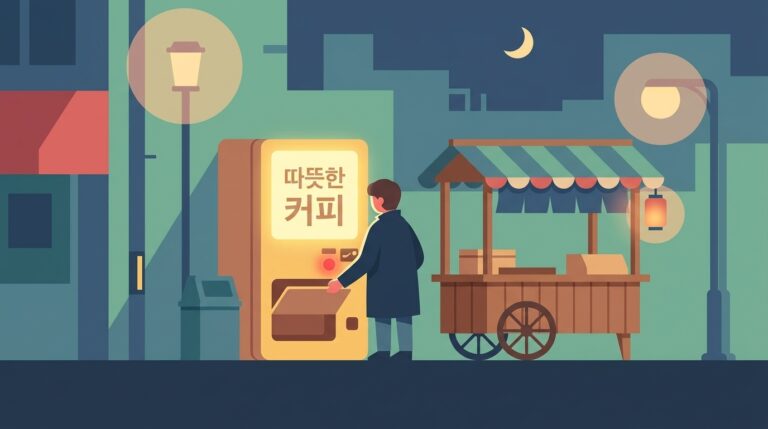
Picture this: You are standing on a crisp autumn evening in a subway station in Seoul. You’ve just inserted a shiny 500-won coin into a vintage paper-cup vending machine (자판기 – ja-pan-gi). The machine whirs. But before the paper cup even drops onto the metallic tray, you see something shocking. A local next to you has already slid their hand inside the dispensing flap, patiently holding the empty space where the cup is about to fall.
No, they aren’t trying to steal the machine. They are practicing a silent, national reflex. In Korea, waiting outside the machine until the beep sounds is like announcing, “I have all the time in the world!”
This is the legendary Pali-Pali (빨리빨리 – Hurry, Hurry) culture in its purest, most visceral form. If you’ve ever felt overwhelmed by the dizzying speed of Seoul—or felt a bit self-conscious about walking too slowly on the sidewalk—you are not alone. Today, we’ll explore how to navigate this lightning-fast social rhythm like an absolute pro, so your Korean friends will look at you and say, “Wow, you are basically Korean now!”
Phase 2: Deep Dive into 3 Core Expressions of Speed
To survive and thrive in the fast lane, you need to master the linguistic shortcuts that Koreans use to grease the wheels of daily life. Let’s look at three essential expressions that capture this high-speed mindset.
1. 빨리빨리 (Pali-pali)
- Pronunciation: [ppal-li-ppal-li] / Sound-alike: Snap your fingers twice and say “pahl-lee pahl-lee” with a sharp, double ‘p’ sound.
- Meaning: Hurry, hurry! / Chop-chop! / On the double!
- K-Culture Moment: You will hear this in almost every office-themed K-Drama when a boss demands a report, or when friends are trying to catch a departing bus.
- Editor’s Insight: While it sounds demanding, “빨리빨리” isn’t always aggressive. Most of the time, it’s a shared, energetic rhythm. It’s the linguistic engine that transformed Korea from a war-torn nation into a global tech powerhouse in just a few decades.
- Situation Spectrum:
- Friends/Casual: ✅ (Very common)
- Co-workers/Semi-formal: ⚠️ (Use with close colleagues only)
- Bosses/Elders/Formal: 🚫 (Can sound rude; use “서둘러 주십시오” [seo-dul-leo ju-sip-si-o] instead)
- 🤔 Think About It: Does your culture value speed as a form of respect for other people’s time, or is taking your time seen as a sign of thoroughness and luxury?
2. 현기증 난단 말이에요 (Hyeongigeung nandan marieyo)
- Pronunciation: [hyeon-gi-jeung nan-dan ma-ri-e-yo] / Sound-alike: “Hyun-gi-jung” (dizziness) + “nan-dan” (is happening) + “ma-ri-e-yo” (I am telling you).
- Meaning: “I’m literally getting dizzy here!” / “I can’t wait any longer (dramatically).”
- K-Culture Moment: This is a famous internet meme originally from a Korean TV show where an impatient boy complained about his food taking too long. Now, Koreans use it playfully when waiting for a highly anticipated K-Pop comeback or a delicious meal.
- Editor’s Insight: Use this when you want to express playful impatience. It immediately signals to Koreans that you understand their internet humor and pop culture.
- Situation Spectrum:
- Friends/Casual: ✅ (Will get a huge laugh)
- Co-workers/Semi-formal: ⚠️ (Only if you are very close)
- Bosses/Elders/Formal: 🚫 (Too dramatic and informal)
- 🤔 Think About It: Why do you think Koreans use physical symptoms (like dizziness or stomach-burning) to describe the psychological state of waiting?
3. 답답해 죽겠어요 (Dapdaphae jukgesseoyo)
- Pronunciation: [dap-dap-hae juk-ges-seo-yo] / Sound-alike: “Dap-dap-hae” (stuffy/suffocated) + “jook-gess-uh-yo” (dying).
- Meaning: “I’m dying of frustration!” / “This is so painfully slow!”
- K-Culture Moment: In K-Dramas, when the main characters take 15 episodes just to hold hands, international fans and Korean viewers alike scream this at their screens.
- Editor’s Insight: “답답하다” (dapdaphada) is a unique Korean emotional concept. It describes a feeling of chest-tightness when things are blocked, slow, or uncommunicative. Adding “죽겠다” (dying) is the ultimate Korean way to dramatize everyday inconveniences.
- Situation Spectrum:
- Friends/Casual: ✅ (Extremely natural)
- Co-workers/Semi-formal: ✅ (To vent about slow systems/software)
- Bosses/Elders/Formal: ⚠️ (Can sound like you are complaining too much)
- 🤔 Think About It: Is there a single word in your native language that captures the physical sensation of being suffocated by someone else’s slowness?
Phase 3: Textbook Korean vs. Real Korean
Let’s look at how native speakers actually express impatience compared to the stiff sentences you find in traditional textbooks.
Situation 1: Nudging someone to finish up quickly
- 📖 Textbook Korean: “천천히 하셔도 괜찮습니다.” (Cheon-cheon-hi ha-syeo-do gwen-chan-seup-ni-da. / It is okay to take your time.)
- 🗣️ Real Korean: “아직 멀었어요?” (A-jik meor-eot-seo-yo? / Are you almost done? / Is it still far?)
- 💡 Why the difference?: While polite textbooks preach patience, in real life, a gentle nudge like “아직 멀었어요?” (delivered with a soft, questioning smile) is highly effective and completely normal among acquaintances.
Situation 2: Reacting to a slow internet connection or lagging app
- 📖 Textbook Korean: “인터넷 속도가 조금 느립니다.” (In-teo-net sok-do-ga jo-geum neu-rip-ni-da. / The internet speed is a bit slow.)
- 🗣️ Real Korean: “아, 속 터져!” (Ah, sok teo-jyeo! / Ah, my stomach is bursting [from frustration]!)
- 💡 Why the difference?: Koreans don’t just state facts; they express how the speed affects their internal organs! “속 터지다” (stomach bursting) is the go-to idiom for anything that moves at a glacial pace.
Phase 4: K-Culture Deep Dive & Non-verbal Manners
4-1. The Body Language of Impatience
To truly pass as a local, you must master the non-verbal dance of the Pali-Pali culture. Next time you are in Korea, observe these micro-behaviors:
* The Cafe Hover: When waiting for a coffee, do not sit down. Stand exactly two steps away from the pickup counter, staring intently at the barista while lightly clutching your wireless buzzer (진동벨 – jin-dong-bel).
* The Elevator Close-Button Assault: The moment you step into an elevator, your finger should automatically find and press the “닫기” (Close) button multiple times. Waiting for the doors to close automatically is considered a minor test of spiritual endurance.
4-2. The Cultural Roots: Why the Rush?
Foreigners often ask: Why is Korea so obsessed with speed?
It traces back to the rapid modernization of the late 20th century. During the Miracle on the Han River, speed was survival. Building roads, bridges, and industries faster than anyone else was the key to national success. Today, this has evolved into a hyper-convenient lifestyle: from Rocket Delivery (로켓배송 – Ro-ket-bae-song) that delivers groceries to your door by 7 AM, to getting your high-speed train tickets booked in three clicks. Speed is Korea’s love language of convenience.
Phase 5: Interactive Roleplay — The Vending Machine Test
Setting: It is 11:30 PM on a chilly Friday night in Mapo, Seoul. You and your warm-hearted but perpetually busy Korean senior colleague, Min-ho (민호), are waiting for a taxi. The wind is freezing. You spot an old paper-cup vending machine glowing yellow in the dark corner of the street.
Min-ho: (Shivering and rubbing his hands together)
아, 오늘 진짜 춥네요! 몸 좀 녹이게 자판기 커피 한잔하실래요?
Ah, o-neul jin-cha chup-ne-yo! Mom jom nog-i-ge ja-pan-gi keo-pi han-jan-ha-sil-lae-yo?
(Wow, it's freezing today! Shall we grab a cup of vending machine coffee to warm up?)

You: (Nodding eagerly)
좋아요! 제가 살게요. 동전 있어요.
Jo-ha-yo! Je-ga sal-ge-yo. Dong-jeon is-seo-yo.
(Sounds great! I'll pay. I have coins.)

Min-ho: (Pointing at the menu)
저는 무조건 '밀크커피'요! 달달한 게 최고예요.
Jeo-neun mu-jo-geon 'mil-keu-keo-pi'-yo! Dal-dal-han ge choe-go-ye-yo.
(For me, definitely 'Milk Coffee'! Sweet is the best.)

You: (Inserting the coins and pressing the button for Milk Coffee. A whirring noise begins inside the machine.)
이제 조금 기다리면 되죠?
I-je jo-geum gi-da-ri-myeon doe-jyo?
(Now we just wait a bit, right?)

Min-ho: (Gasps dramatically, pointing at your hands which are politely folded in front of you)
어라? 동우 씨, 손이 왜 거기 있어요? 벌써 컵이 내려오는 중인데!
Eo-ra? Dong-u ssi, son-i wae geo-gi is-seo-yo? Beol-sseo keob-i nae-ryeo-o-neun jung-in-de!
(Huh? Dong-woo, why are your hands all the way over there? The cup is already coming down!)
🔀 Decision Point: What do you do?
- Option A: “Safety first! I must wait until the beep sound finishes before touching anything.”
- Option B: (Sliding your hand quickly through the plastic flap, holding the bottom of the empty paper cup before the coffee pours) “Like this, Sunbae?”
- Option C: “Why hurry? Let’s take a deep breath and enjoy the slow, mindful extraction of our coffee.”
🏆 Best Choice: Option B!
By choosing Option B, you show Min-ho that you understand the true soul of Korean street culture. Sticking your hand in early is a playful badge of honor. It proves you’ve shed your tourist skin and are embracing the local rhythm.
- Risk Choice Analysis (Option C): While philosophical, Option C will make Min-ho chuckle and tease you for being “too relaxed.” In the freezing cold of Mapo, slow mindfulness is a luxury no one wants!
Phase 6: 10-Second Emotional Shadowing Drill
Let’s practice speaking with the exact emotional frequency of a native speaker. Pay attention to the pauses (/) and the emotional cues!
Drill 1: [😤 Expressing passionate, playful impatience]
- Korean: 빨리요! / 현기증 난단 말이에요!
- Romanization: Ppal-li-yo! / Hyeon-gi-jeung nan-dan ma-ri-e-yo!
- Rhythm Guide: PPAL-LI-YO! (Fast and high pitch) / (Short pause) / hyeon-gi-jeung / NAN-DAN / ma-ri-e-yo!
Drill 2: [🥺 Sighing dramatically to a friend]
- Korean: 아, 진짜 / 답답해 죽겠네!
- Romanization: Ah, jin-cha / dap-dap-hae juk-get-ne!
- Rhythm Guide: Ah… (drag it out) / jin-cha / (heavy sigh) / DAP-DAP-HAE / jook-get-neh!
Phase 7: K-Culture Mini Dictionary
| Word | Meaning | Contextual Insight |
|---|---|---|
| 진동벨 (Jin-dong-bel) | Cafe Buzzer / Pager | The ultimate physical anchor of the Pali-Pali culture. Holding it and waiting for it to vibrate is a daily ritual. |
| 믹스커피 (Mix-coffee) | 3-in-1 Coffee Stick | Korea’s legendary instant coffee. It represents the efficiency of office life; sweet, fast, and highly addictive. |
| 퀵서비스 (Quick-service) | Motorcycle Courier | Need a document across Seoul in 30 minutes? These riders navigate traffic like action movie stars to keep business moving. |
| 불금 (Bul-geum) | “Burning Friday” | Literally “Fire Friday” (TGIF). It reflects the desire to transition from hard work to hard play at maximum speed. |
Phase 8: Traveler’s Survival Kit
Here are 3 quick-rescue expressions to use when navigating transportation, dining, or shopping in Korea:
1. "먼저 갈게요!" (Meon-jeo gal-ge-yo!)
   - Meaning: I'm leaving first! / Go ahead without me!
   - Pro Tip: Use this when you are in a group and need to run ahead quickly.

2. "음식 언제 나와요?" (Eum-sik eon-je na-wa-yo?)
   - Meaning: When is the food coming out?
   - Pro Tip: If your food is taking more than 15 minutes in a busy restaurant, it is completely acceptable to ask this politely.

3. "바로 준비해 드릴게요." (Ba-ro jun-bi-hae deul-il-ge-yo.)
   - Meaning: I will prepare it for you immediately.
   - Pro Tip: This is what you want to hear from service staff. It means your request is top priority.
📌 Editor’s Travel Note: To navigate Korea with peak efficiency, do not rely on Google Maps (which has limited functionality in Korea due to security laws). Instead, download the Naver Map Application for real-time transit and walking routes, and use Kakao T Taxi App to summon rides instantly.
(Note: App features and interfaces are subject to updates by developers.)
Phase 9: Deep Thoughts — “One Step Deeper”
Is “Pali-Pali” always a good thing?
While the relentless pursuit of speed has made South Korea one of the most convenient and technologically advanced societies on earth, it also comes with a cost. Modern Koreans are beginning to reflect on the stress and burnout associated with this constant rush. Recently, trends like “Bul-mong” (불멍 – zoning out while watching a campfire) or visiting quiet Hanok cafes in the countryside have gained popularity as a counter-movement to the fast-paced life.
As a language learner, balancing the efficiency of “Pali-Pali” with the warmth of slow connection is the ultimate mastery.
💬 Your Turn: How does your home country view waiting? Do you have an equivalent of “Pali-Pali” in your culture, or do you prefer to take things slow? Let us know in the comments below!
Phase 10: FAQ & Avoiding Mistakes
Q: Is it considered rude to stick my hand in the vending machine cup dispenser early?
A: Not at all! It is a lighthearted, culturally accepted behavior that shows you are in tune with the local pacing. However, make sure you don’t burn yourself on hot steam!
Q: Can I say “빨리빨리” (Pali-pali) to restaurant staff or taxi drivers?
A: No, avoid this. Saying “빨리빨리” directly to service workers can sound demanding, impatient, and elitist. Instead, use polite alternatives like “조금만 서둘러 주실 수 있나요?” (Jo-geum-man seo-dul-ler ju-sil su it-na-yo? / Could you hurry just a little bit, please?).
Q: Is it okay to use “답답해 죽겠어요” in professional settings?
A: It is fine when talking with a close colleague about a system or a external slow process, but never say it to your boss about a task they gave you, as it sounds highly emotional.
🚨 Common Mistakes Warning Board
- Saying “빨리!” (Pali!) to an elder: This is a major social faux pas. Always add the polite ending particle “요” (yo) -> “빨리요!” if you absolutely must nudge them, though patience is preferred with elders.
- Tapping your credit card on the reader aggressively: Korean card readers are fast, but slamming your card or phone multiple times can freeze the system. One firm tap is enough!
Phase 11: Action Missions
To lock in your learning, try these three missions this week:
- 🥉 Bronze Mission (The Mirror Challenge): Stand in front of your mirror and practice saying “아, 속 터져!” with the most dramatic, hand-on-chest expression you can muster. Record your voice to match the rhythm.
- 🥈 Silver Mission (Social Sharing): Share this post or write a sentence using “답답해 죽겠어요” on your social media, explaining a slow situation you faced today (like a slow transit or long line).
- 🥇 Gold Mission (The Ultimate Vending Machine Test): The next time you find a paper-cup coffee machine (in Korea or at a local Korean supermarket abroad), try the “hand-in-first” method. Feel the warmth of the cup dropping into your palm. Congratulations, you are now a local!
Phase 12: Interactive Quiz
Test your cultural and linguistic IQ below!
1. Which expression would you use to express playful, dramatic impatience while waiting for a delicious food delivery?
- A) 서둘러 주세요
- B) 현기증 난단 말이에요
- C) 시간이 아주 오래 걸립니다
👉 Click to reveal Answer & Explanation
Correct Answer: B
- Why: “현기증 난단 말이에요” is the perfect, dramatic internet-meme style phrase to show you are “dizzy with anticipation.” Option A is too formal, and Option C is too dry and textbook-like!
2. True or False: Sticking your hand in a vending machine before the cup drops is considered extremely disrespectful in Korea.
👉 Click to reveal Answer & Explanation
Correct Answer: False
- Why: While it’s not a formal etiquette rule, it is a very common, humorous, and socially accepted manifestation of Korea’s “Pali-Pali” culture. It’s done with a sense of playful urgency!







