

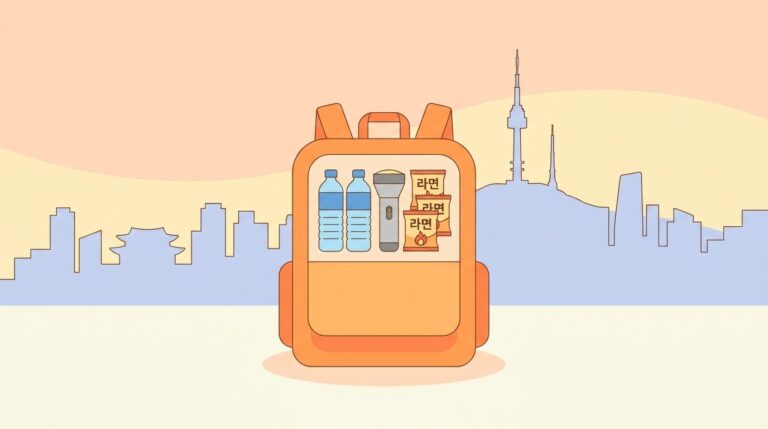
Disaster Preparedness: Packing a Survival Backpack (생존 배낭) in Korea
Phase 1: Empathy (An Immersive Opening)
안녕하세요! Welcome back to Daily Hangul, your premium guide to navigating the linguistic and cultural currents of South Korea. I’m your head editor, and today we’re tackling a topic that is often overlooked until the moment it becomes absolutely critical: emergency preparedness and packing a survival backpack (생존 배낭 – saengjon baenang).
Imagine this scene, straight out of a gripping K-thriller like Exit (엑시트) or the post-apocalyptic neighborhood of Concrete Utopia (콘크리트 유토피아): You are sitting in a trendy cafe in Hapjeong when suddenly, every smartphone in the room blares in unison with a piercing, high-pitched alert. It’s a emergency disaster text (재난문자 – jaenan munja). Your heart races. You look around—locals are swiftly checking their phones, translating the Korean script in their heads, and making calculated decisions. Would you know what to do? Or more importantly, if you had to evacuate your apartment, would you have a pre-packed emergency kit ready to go, and could you communicate your needs in Korean?
Many expats and advanced learners focus heavily on restaurant dining or business etiquette, but mastering the vocabulary of survival and emergency preparedness is the ultimate mark of local fluency. Knowing how to discuss safety, read official warnings, and coordinate emergency supplies not only ensures your physical safety but also builds immense trust with your Korean friends and neighbors. This guide is built upon real-life feedback from expats who survived the heavy Seoul floods of 2022 and localized seismic alerts, designed to elevate your C1-level command of Korean under pressure.
Phase 2: Core Expressions Deep Dive
Let’s analyze three sophisticated Korean expressions that are central to emergency preparedness. Since you are performing at a C1 level, we will bypass simple terms and focus on formal, idiomatic, and culturally rich vocabulary.
1. 생존 배낭을 싸다 (saeng-jon bae-nang-eul ssa-da)
- Pronunciation: [sʰɛŋdzon bɛnaŋɯl s͈ada] / Sounds like “saeng-john bae-nang-eul sah-da”
- Meaning: Literally “To pack a survival backpack,” referring to a bug-out bag or disaster go-bag.
- K-Culture Moment: In survival K-dramas like Sweet Home (스위트홈), you often see characters frantically throwing essentials into a sturdily built backpack before abandoning their rooms. In Korea, where high-density apartment living is the norm, having a compact, lightweight saengjon baenang ready by the front door is highly recommended.
- Editor’s Insight: The verb 싸다 (to pack/wrap) is highly versatile. In an emergency context, it implies efficiency—packing only the absolute essentials (생존 필수품 – saengjon pilsu-pum) rather than leisurely packing for a vacation (짐을 싸다).
- Situation Spectrum:
- Casual (Friends): ✅ “지진 날까 봐 무서워서 어제 생존 배낭 쌌잖아.” (I was scared of earthquakes, so I packed a survival bag yesterday.)
- Semi-formal (Colleagues): ✅ “회사에서도 만약의 사태를 대비해 생존 배낭을 구비해야 할까요?” (Should we equip a survival backpack at the office just in case?)
- Formal (Official/Adults): ✅ “정부 가이드라인에 맞춰 생존 배낭을 구성하는 것이 안전합니다.” (It is safe to configure your survival backpack according to government guidelines.)
- 🤔 Think About It: Contrast “생존 배낭을 싸다” with “피난 보따리를 싸다” (to pack a refugee bundle). The latter carries historical weight, reminiscent of the Korean War era. Why do you think modern Koreans prefer the systematic, militaristic term saengjon baenang over historical survival terms?
2. 비상식량을 구비하다 (bi-sang-sik-ryang-eul gu-bi-ha-da)
- Pronunciation: [pisaŋɕʰiŋnyaŋɯl gubihada] / Sounds like “bee-sahng-shing-nyang-eul goo-bee-hah-dah”
- Meaning: To stock up on or equip emergency rations / survival food.
- K-Culture Moment: If you visit a Korean household during a typhoon or heavy snow warning, you’ll find pantries stocked with instant cup ramen (컵라면), canned tuna (참치캔), and microwaveable instant rice (햇반). These are the pillars of Korean comfort food, which double as high-calorie emergency fuel.
- Editor’s Insight: While the casual verb 챙기다 (to pack/take care of) is common, the C1-level verb 구비하다 (具備 – to equip/have something thoroughly prepared) elevates your speech. It signals a systematic, responsible approach to safety.
- Situation Spectrum:
- Casual (Friends): ⚠️ “비상식량 구비했어?” (Slightly formal for casual chat, unless joking. Better: “참치캔이랑 라면 좀 쟁여뒀어?” – Have you hoarded some tuna and ramen?)
- Semi-formal (Colleagues): ✅ “저희 비상식량으로 햇반이랑 생수 좀 구비해 두는 게 좋을 것 같아요.” (I think it would be good to have some Hetbahn and bottled water equipped as emergency rations.)
- Formal (Official): ✅ “각 가구는 최소 3일 치의 비상식량을 구비해야 합니다.” (Each household must equip emergency rations for at least three days.)
- 🤔 Think About It: How does the ubiquity of instant food (즉석식품) in Korea change the way locals approach emergency food storage compared to your home country?
3. 대피소 위치를 확인하다 (dae-pi-so wi-chi-reul hwa-gin-ha-da)
- Pronunciation: [tɛpʰisʰo witɕʰilɯl ɦwaɡinhada] / Sounds like “dae-pee-so wee-chee-reul hwah-gin-hah-dah”
- Meaning: To locate/verify the evacuation shelter.
- K-Culture Moment: Did you know that most subway stations, basement parking lots, and major building basements in Seoul are officially designated as Civil Defense Evacuation Shelters (민방위 대피소)? You’ve likely walked past the yellow and black “대피소 (Shelter)” signs hundreds of times without noticing them.
- Editor’s Insight: 대피소 (Evacuation/Refuge Shelter) comes from 대피 (evacuation) + 소 (place). Confusing this with 피난소 (refugee camp) or 대피처 is a common mistake; daepiso is the official government-designated term you will see on emergency apps like Emergency Ready (안전디딤돌).
- Situation Spectrum:
- Casual (Friends): ✅ “우리 동네 대피소 위치 확인해 봤어?” (Have you checked the location of our neighborhood shelter?)
- Semi-formal (Colleagues): ✅ “지진 대피소 위치를 미리 확인해 두는 편이 좋겠습니다.” (It would be wise to verify the location of the earthquake shelter in advance.)
- Formal (Official): ✅ “재난 발생 시 가장 가까운 대피소 위치를 확인하시기 바랍니다.” (In the event of a disaster, please verify the location of the nearest shelter.)
- 🤔 Think About It: Why does Korea’s urban infrastructure rely so heavily on underground subway networks as temporary shelters? Think about the geographical and geopolitical context of the Korean Peninsula.
Phase 3: Textbook Korean vs. Real-World Korean
Let’s compare the sterile sentences found in formal textbooks with the pragmatic, high-velocity language used by native speakers during tense moments.
Situation 1: Asking where the nearest shelter is during an emergency
- 📖 Textbook Korean: “가장 가까운 비상 대피소는 어디에 위치하고 있습니까?” (Gajang gakkaun bisang daepisoneun eodie wichihago isseumnikka? – Where is the nearest emergency evacuation shelter located?)
- 🗣️ Real Korean: “근처에 대피소 어디 있어요?” (Geuncheoe daepiso eodi isseoyo? – Where’s a shelter nearby?) or “여기 민방위 대피소가 어디죠?” (Yeogi minbangwi daepisoga eodijyo? – Where is the civil defense shelter here?)
- 💡 Why is it different?: In a true emergency, overly complex passive constructions like “위치하고 있습니까” waste breath. Native speakers shorten the inquiry to its absolute bare essentials, utilizing “근처” (nearby) instead of “가장 가까운” (the nearest) and dropping unnecessary particles to speed up communication.
Situation 2: Stockpiling supplies before a major storm
- 📖 Textbook Korean: “태풍에 대비하여 마트에 가서 생필품을 구매하여 저장해 두어야 합니다.” (Taepunge daebihayeo mateue gaseo saengpilpumeul gumaehayeo jeojanghae dueoya hamnida. – To prepare for the typhoon, we must go to the mart, purchase daily necessities, and store them.)
- 🗣️ Real Korean: “태풍 온다는데 마트 가서 생수랑 라면 좀 쟁여놔야겠어요.” (Taepung ondaneunde mateu gaseo saengsurang ramyeon jom jaengyeonwayagetseoyo. – They say a typhoon is coming, I should go to the mart and hoard some bottled water and ramyeon.)
- 💡 Why is it different?: Textbook Korean relies on formal Sino-Korean verbs like “구매” (purchase) and “저장” (store). In spoken reality, C1 speakers use the highly idiomatic colloquial verb 쟁여두다 / 쟁여놓다 (to hoard/stockpile items, stacking them tightly). It perfectly captures the psychological urge to stock up before a crisis.
Phase 4: K-Culture Deep Dive & Non-Verbal Manners
4-1. “Nunchi” (눈치) and Orderliness in Emergency Situations
During a crisis, Korea’s collective social dynamics shift rapidly. The concept of 정 (Jeong – collective affection and community bond) and 눈치 (Nunchi – situational awareness) play a vital role in survival scenarios. If an evacuation warning is issued, pushing, shouting, or cutting lines is heavily frowned upon and can cause dangerous bottlenecks. Koreans value collective order highly; you will notice that even in heavy rain or sudden subway delays, queues remain remarkably self-regulated.
* Non-Verbal Tip: When entering an emergency shelter, always take off your shoes if others have done so (even in a gymnasium setup), and keep your personal belongings strictly within your designated space. Maintain a quiet voice—loud outbursts can trigger panic in shared shelters.
4-2. The Reality of the “Disaster Alert” (재난문자)
In Korea, your phone will frequently vibrate with emergency alerts. These alerts range from missing persons reports in your district to extreme weather warnings and civil defense drills. Expats often make the mistake of disabling these notifications because they cannot read them quickly. Do not do this! If you receive an alert labeled 위급재난 (Extreme Emergency) or 긴급재난 (Emergency Alert), pay immediate attention. Familiarize yourself with the warning sounds and icons so you can react with high nunchi alongside the locals.
Phase 5: The Emergency Roleplay Scenario
Setting: A sudden, unusually strong ground tremor shakes a high-rise office building in Yeouido, Seoul. The emergency sirens inside the building begin to sound. You are at your desk, and your calm but serious senior colleague, Team Leader Kang (강 팀장), turns to you.
Cast:
* You (C1 Expat): Prepared, observant, and capable of articulate safety checks.
* Kang Team Leader (강 팀장): A seasoned, pragmatic office veteran who values safety and speed.
[The office lights flicker. A loud emergency buzzer rings.]

강 팀장: (침착하지만 신속하게 서류를 챙기며) 방금 진동 꽤 컸죠? 단순 여진이 아닌 것 같은데요.
Kang Team Leader: (Calmly but swiftly packing papers) That tremor was quite big, wasn't it? Doesn't feel like a simple aftershock.

You: 네, 건물이 흔들리는 게 느껴질 정도였어요. 팀장님, 일단 테이블 밑으로 대피할까요?
You: Yes, it was strong enough to feel the building swaying. Team Leader, should we take cover under the table first?

강 팀장: (천장을 올려다보며) 아뇨, 일단 진동이 멈춘 것 같으니 신속하게 계단으로 대피합시다. 엘리베이터는 절대 타면 안 돼요!
Kang Team Leader: (Looking up at the ceiling) No, the shaking seems to have stopped for now, so let's evacuate quickly via the stairs. Absolutely do not take the elevator!

You: 알겠습니다. 혹시 모르니 사무실 비상용 생존 배낭도 챙겨 가겠습니다. 제가 메고 갈게요.
You: Understood. Just in case, I'll bring the office emergency survival backpack. I will carry it.

강 팀장: (기특하다는 듯 쳐다보며) 오, 역시 준비성이 철저하시네요. 손전등이랑 비상약 들어있는 거 맞죠?
Kang Team Leader: (Looking at you appreciatively) Oh, as expected, your preparation is thorough. Flashlight and emergency medicine are inside, right?

You: 네, 지난달에 제가 유통기한이랑 구급약품 상태를 전부 확인하고 구비해 두었습니다.
You: Yes, last month I verified all the expiration dates and the condition of the medical supplies and equipped them.

강 팀장: 아주 훌륭해요. 스마트폰으로 가장 가까운 대피소 위치 한번 조회해 줄 수 있어요? 제 폰은 지금 먹통이네요.
Kang Team Leader: Excellent. Can you look up the nearest shelter location on your smartphone? My phone is unresponsive right now.

You: (안전디딤돌 앱을 신속하게 켜며) 네, 여기 근처 영등포구청 지정 민방위 대피소가 도보 5분 거리에 있네요. 지하철역 출입구 근처입니다.
You: (Quickly opening the Emergency Ready app) Yes, there's a designated Yeongdeungpo-gu Civil Defense shelter a 5-minute walk from here. It's near the subway station entrance.

강 팀장: 완벽하네요. 자, 다들 당황하지 말고 제 뒤를 따라 계단으로 조심히 내려가세요!
Kang Team Leader: Perfect. Alright, everyone, don't panic, follow me, and carefully head down the stairs!
🔀 Decision Point
While evacuating the building, you notice an elderly lady struggling to carry a heavy bag down the stairs. What do you do?
- Option A: Ignore her and rush ahead to secure a spot in the shelter. (“제 안전이 우선이니 그냥 빨리 내려간다.”)
- Option B: Tell her to drop the bag and offer to support her arm while guiding her down. (“할머니, 가방은 두고 제 팔을 잡으세요! 제가 도와드릴게요.”)
- Option C: Stand on the stairs and shout for building security to help her. (“경비 아저씨! 여기 도와주세요! 하고 소리친다.”)
🏆 Best Choice: Option B
Helping vulnerable citizens in a calm, polite manner aligns perfectly with Korean collective civic virtue. By telling her to leave heavy items (“가방은 두고”) and offering physical support, you maximize both speed and safety, earning high respect from onlookers and your team leader.
⚠️ Risk Choice: Option A
In Korea’s collectivist society, displaying extreme individualism during a crisis (like pushing past an elder) will heavily damage your social standing and trigger severe community disapproval (눈총 – sharp glares of criticism).
Phase 6: 10-Second Emotion Shadowing Drill
To speak authentic Korean in high-stress moments, you must master the intonation and pauses. Practice these sentences out loud, emphasizing the emotional cues.
1. [😤 Urgent but Calm]
“엘리베이터 타지 말고 / 계단으로 대피해요! / 생존 배낭은 제가 챙길게요!”
El-ri-be-i-teo ta-ji mal-go / gye-dan-eu-ro dae-pi-hae-yo! / Saeng-jon bae-nang-eun je-ga chaeng-gil-gae-yo!
(Don’t take the elevator, evacuate via the stairs! I’ll grab the survival backpack!)
* Pause Tips: Pause briefly at the slashes/. Keep your tone firm and direct without sounding hysterical.
2. [🥺 Reassuring and Helpful]
“괜찮으세요? / 제 손잡고 / 천천히 내려가요. / 대피소가 바로 근처에 있어요.”
Gwaen-chan-eu-se-yo? / Je son-jap-go / cheon-cheon-hi nae-ryeo-ga-yo. / Dae-pi-so-ga ba-ro geun-cheo-e is-seo-yo.
(Are you okay? Take my hand and let’s go down slowly. The shelter is right nearby.)
* Tone Tips: Lower your pitch, breathe smoothly, and project warmth to calm the other person down.
Phase 7: K-Culture Mini Dictionary
Here are four crucial terms related to daily life and disaster prep in Korea:
| Word (한글) | Romanization | Real-World Context & Usage |
|---|---|---|
| 안전디딤돌 | An-jeon-di-dim-dol | Emergency Ready App: The official disaster safety app provided by the Ministry of the Interior and Safety. Vital for expats to find nearby evacuation shelters and safety guides. |
| 민방위 | Min-bang-wi | Civil Defense: Refers to the national civil defense system. You will see yellow-uniformed officers during national defense drills (민방위 훈련), practicing evacuation procedures. |
| 쟁여두다 | Jaeng-yeo-du-da | To Stockpile/Hoard: Colloquial but essential verb used when hoarding items (like snacks, water, or ramyeon) before a heavy storm or crisis. |
| 구호물품 | Gu-ho-mul-pum | Relief Supplies: Kits distributed by the government or Red Cross containing blankets, toiletries, instant food, and first-aid kits during disaster situations. |
Phase 8: Traveler’s Survival Kit
Top 3 Emergency Phrases
- “도와주세요! 사람이 다쳤어요!”
- Do-wa-ju-se-yo! Sa-ram-i da-chyeot-seo-yo!
- Pro Tip: Use this absolute direct call for help when someone is injured. It immediately alerts bystanders.
- “여기 주소 좀 알려주실 수 있나요?”
- Yeo-gi ju-so jom al-ryeo-ju-sil su in-na-yo?
- Pro Tip: In an emergency, calling 119 or 112 requires your exact location. Ask a nearby local for the street name address (도로명 주소).
- “대피소로 가는 길이 어디예요?”
- Dae-pi-so-ro ga-neun gil-i eo-di-yeo-yo?
- Pro Tip: If GPS maps fail due to cellular overload, use this phrase to get instant walking directions from locals.
📌 Editor’s Travel Note
When traveling or living in South Korea, please download the official Emergency Ready App (안전디딤돌) immediately. It offers English translation settings and provides real-time alerts. Additionally, bookmark the Naver Map Application to find local emergency clinics (응급실 – eunggeupsil) and pharmacies (약국 – yakguk) open 24/7 during holidays.
Phase 9: Deep Thoughts — “One Step Deeper”
The Dynamics of Collective Resilience in Korea
South Korea has faced rapid modernization alongside various natural and geopolitical challenges. This unique history has shaped a society that acts with incredible collective speed—what locals call 빨리빨리 (Palli-Palli) culture—even in crises. When a disaster strikes, public infrastructure, telecommunications, and neighborly networks mobilize within minutes.
However, this reliance on high-speed technology creates a unique vulnerability: what happens when the digital network goes dark? Packing a physical saengjon baenang with non-digital survival items (analog maps, physical radios, cash) is a practice that bridges the gap between digital reliance and raw survival.
- 💬 Your Turn: How does emergency preparedness differ in your home country compared to Korea’s highly digitized urban setup? Do you have an emergency kit ready at home? Share your thoughts and stories in the comments below!
Phase 10: FAQ & Common Mistakes
Q: Can I use tap water as my primary survival water source in Korea?
A: No, with caveats. While Korean tap water (아리수 – Arisu in Seoul) is highly treated and technically safe to drink, disaster situations can damage water pipes and introduce contaminants. Always stock commercially bottled water (생수) in your emergency backpack. Aim for 2 liters per person per day.
Q: Are subway stations safe to use during an earthquake?
A: Yes, generally. Most modern Korean subway stations are built with robust seismic designs and serve as designated civil defense shelters. However, if the shaking is severe, seek immediate cover under sturdy desks or interior pillars first, and only move to the station once the primary shaking stops to avoid falling debris on the streets.
Q: Do I need a physical passport in my survival backpack if I have a digital copy?
A: Yes, absolutely. During a severe disaster, international departures, identity checks, and consular assistance will require your physical passport (여권) and Alien Registration Card (외국인등록증). Keep them in a waterproof ziplock bag inside your saengjon baenang.
🚨 Common Mistakes Alert!
- Mistake 1: Relying entirely on card payments. During blackouts, card networks collapse. Keep at least 50,000 to 100,000 KRW in cash (현금) in small bills inside your bag.
- Mistake 2: Storing standard white rice instead of instant rice (햇반). Standard rice requires a lot of water and boiling time. Hetbahn is pre-gelatinized and can even be eaten cold in extreme survival situations.
- Mistake 3: Ignoring evacuation drills. Civil defense drills are held regularly in Korea. Participating actively helps you memorize the physical paths to safety.
Phase 11: Action Missions
Complete these three challenges to transition from passive learner to active survivor!
- 🥉 Bronze (At-Home Challenge): Locate your apartment’s emergency fire extinguisher (소화기) and check its pressure gauge. Say aloud: “소화기 위치 확인 완료!” (Extinguisher location verified!)
- 🥈 Silver (Network Challenge): Open Naver Maps, find your nearest civil defense shelter (민방위 대피소), take a screenshot, and share it with an expat friend, stating: “여기 우리 비상 대피소야. 기억해 둬!” (Here is our emergency shelter. Keep it in mind!)
- 🥇 Gold (Real-World Challenge): Pack your own saengjon baenang this weekend. Include a flashlight, bottled water, high-calorie snacks, and a small pouch of cash, and take a photo of your bag sitting proudly by your front door!
-
🎮 K-Culture Mission: Watch the Korean disaster-comedy movie Exit (엑시트). Pay attention to how the characters use basic items like chalk, trash bags, and gym chalk for survival, and note down three safety words you hear in the movie!
Phase 12: Interactive Quiz Challenge
Test your emergency preparedness Korean!
1. Situational Judgment
Which is the most appropriate action when a heavy earthquake warning is received?
* A) 엘리베이터를 타고 지하 주차장으로 신속하게 대피한다.
* B) 가방으로 머리를 보호하고 낙하물이 없는 안전한 터 아래나 테이블 밑으로 피한다.
* C) 아파트 발코니로 나가서 상황을 촬영하여 인스타그램에 공유한다.
2. Fill in the Blank
“재난 상황을 대비해서 집 안에 최소 3일 치의 ________을(를) 구비해 두어야 합니다.”
(To prepare for disasters, we must equip at least 3 days of ________ in our homes.)
3. True or False
- Q: Standard subway stations marked with the yellow and black “대피소” sign are only open to Korean citizens during an emergency. (T/F)
🔍 Click here to check the answers and explanations!
- Answer: B
- Explanation: Never use elevators during earthquakes as power outages can trap you inside. Protecting your head under a sturdy structure is the universal safety protocol.
- Answer: 비상식량 (Emergency Rations)
- Explanation: Bisangsiklyang is the proper formal term for emergency food stores.
- Answer: False
- Explanation: Evacuation shelters are open to absolutely everyone, including foreign tourists, expats, and residents. Safety knows no borders!
- Explanation: Evacuation shelters are open to absolutely everyone, including foreign tourists, expats, and residents. Safety knows no borders!
“,






