

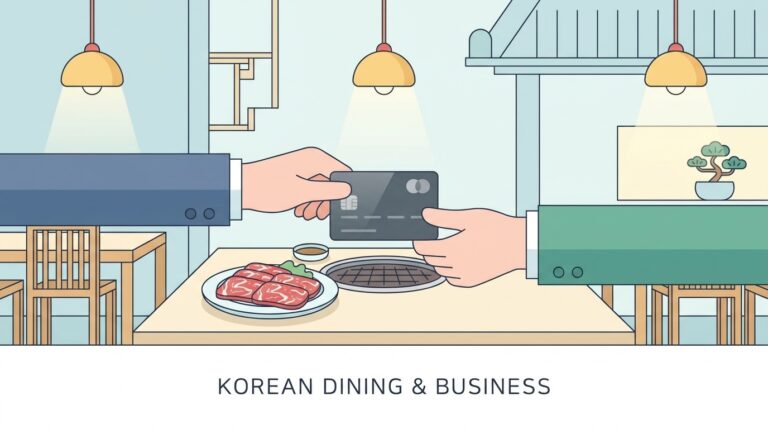
Mastering the Art of Beobka: Navigating Korea’s Corporate Card Culture and Dinner Etiquette
Phase 1: Empathy (An Invitation to the Korean Corporate Table)
안녕하세요! (An-nyeong-ha-se-yo!) I’m your Senior Editor at Daily Hangul, your trusted companion for navigating the beautiful, sometimes complex world of Korean language and culture.
If you have ever watched a workplace K-Drama like Misaeng (미생) or What’s Wrong with Secretary Kim (김비서가 왜 그럴까), you have definitely seen the iconic “Hoesik” (회식 – company dinner) scene. The grill is sizzling with high-grade Hanwoo beef (한우), glasses of somaek (소맥 – beer and soju mix) are clinking, and the atmosphere is electric. Then, the magical moment arrives: the team leader dramatically pulls out a sleek plastic card to pay the massive bill.
This is the legendary 법인카드 (Beob-in-kadeu – corporate card), affectionately shortened to 법카 (Beob-ka).
But here is the catch: behind the glossy drama scenes lies a world of strict corporate guidelines, tax regulations, and unwritten cultural rules. I once tutored a foreign marketing manager, Mark, who wanted to impress his Korean team by ordering premium dessert rounds on the corporate card, only to find out later that he had violated the company’s daily tax-deductible limit per person. The awkward conversation with the finance department (재무팀) the next morning was something he wished he could have avoided.
Understanding how to talk about and manage corporate card regulations isn’t just about administrative compliance—it is a vital showcase of your 눈치 (nunchi – situational awareness) and respect for the team’s collective boundaries. Let’s master this intermediate skill so you can swipe that card with absolute confidence and zero awkwardness!
Phase 2: Key Expressions Deep Dive
1. 법카로 계산해 주세요 (Beob-ka-ro gye-san-hae ju-se-yo)
- Pronunciation: [beob-ka-ro gye-san-hae ju-se-yo] / Sound-alike: “Bup-kah-roh gyeh-sahn-heh-joo-seh-yo”
- Meaning: “Please charge it to the corporate card.”
- K-Culture Moment: This is the go-to line when the team leader hands you the card at the end of a dinner, prompting you as the junior team member to handle the payment transaction at the counter.
- Editor’s Insight: Even though you are using a corporate card, adding “주세요” (ju-se-yo) keeps the request polite and professional for the restaurant staff.
- Situation Spectrum:
- Casual/Friends: 🚫 (Using “법카” implies official business)
- Co-workers/Semi-formal: ✅
- Boss/Formal: ✅
- 🤔 Think About It: Why do Koreans shorten “법인카드” to “법카”? It reflects the rapid, efficiency-focused communication style of Korean offices (빨리빨리 문화 – Pali-pali culture).
2. 한도가 얼마나 남았죠? (Han-do-ga eol-ma-na nam-at-jyo?)
- Pronunciation: [han-do-ga eol-ma-na nam-at-jyo?] / Sound-alike: “Hahn-doh-gah-uhl-mah-nah-nah-maht-jyo?”
- Meaning: “How much is left on the limit?”
- K-Culture Moment: You whisper this to a close colleague before deciding whether to order that expensive second round of seasoned pork ribs (양념갈비).
- Editor’s Insight: Asking about the limit (한도) shows you are responsible and care about the company’s budget, preventing an embarrassing card rejection at the register.
- Situation Spectrum:
- Casual/Friends: 🚫
- Co-workers/Semi-formal: ✅
- Boss/Formal: ⚠️ (Use a softer tone with bosses, like “혹시 예산이 괜찮을까요?” – Is the budget okay?)
- 🤔 Think About It: In many Western corporate settings, individual budgets are managed via online portals. In Korea, why is checking the remaining limit often done through collective verbal double-checking during the event?
3. 결재 올려야 해요 (Gyeol-jae ol-lyeo-ya hae-yo)
- Pronunciation: [gyeol-jae ol-lyeo-ya hae-yo] / Sound-alike: “Gyuhl-jeh-ohl-lyuh-yah-heh-yo”
- Meaning: “I have to submit this for approval.”
- K-Culture Moment: Said when returning to the office the next morning, sorting through receipt papers to upload to the electronic approval system.
- Editor’s Insight: Note the spelling: 결재 (gyeol-jae) means corporate approval, while 결제 (gyeol-je) means financial payment. This is a very common spelling mistake even native speakers make!
- Situation Spectrum:
- Casual/Friends: 🚫
- Co-workers/Semi-formal: ✅
- Boss/Formal: ✅
- 🤔 Think About It: The verb 올리다 (ol-li-da) means “to lift up.” Why do you think Korean corporate language uses “lifting up” to describe submitting a document to a manager?
Phase 3: Textbook Korean vs. Real Korean
Situation 1: Confirming if a business accepts corporate cards
- 📖 Textbook Korean: 이곳에서 법인 카드를 사용할 수 있습니까? (Is it possible to use a corporate card at this establishment?)
- 🗣️ Real Korean: 이거 법카 되나요? (Does this take corporate cards? / Can I use this corporate card?)
- 💡 Why the difference? The textbook phrase is grammatically correct but incredibly stiff. In real life, especially at a busy restaurant or cafe, Korean cashiers prefer short, functional questions. Using “되나요?” (doe-na-yo) is natural, polite, and efficient.
Situation 2: Asking a cashier to split the bill to match the spending limit
- 📖 Textbook Korean: 규정에 맞추어 금액을 분할하여 결제해 주십시오. (Please split the amount and pay in accordance with the regulations.)
- 🗣️ Real Korean: 금액 나눠서 긁어 주실 수 있나요? (Could you split the amount and swipe it separately?)
- 💡 Why the difference? The verb 긁다 (geulg-da) literally means “to scratch.” Historically, this came from swiping credit cards through old physical machines. Today, “긁다” is the universal slang for charging a card. Saying “나눠서 긁어 주세요” sounds like a seasoned local who knows how corporate finances work.
Phase 4: K-Culture Deep Dive & Non-verbal Manners
4-1. Nunchi (눈치) & Body Language at the Register
When using the company card, physical actions speak louder than words.
1. The Two-Handed Hand-off (두 손 사용): When presenting the corporate card to the cashier, or when receiving it from your boss, always use two hands. This shows respect for the money and the person trusting you with it.
2. The Receipt Sweep: Always ask for the physical receipt (영수증 – yeong-su-jeung), even if your company uses digital tracking. Handing the receipt back to your boss along with the card is the ultimate sign of professional responsibility.
4-2. The Evolution of “Hoesik” Culture
In the past, company dinners were mandatory, alcohol-heavy marathons. Today, thanks to the “52-Hour Workweek” law (주 52시간 근무제) and changing generational attitudes, Hoesik has transformed.
Many companies now opt for “Culture Hoesik” (문화 회식), utilizing the Beobka for movie afternoons, escape rooms, or lunch outings. Because tax authorities closely monitor corporate card usage—often flagging transactions made after 11:00 PM or near residential areas on weekends—managing the Beobka has become a highly coordinated administrative ballet.
Phase 5: Live Roleplay Scenario (The Yeouido Beef Crisis)
Setting: 8:15 PM. A lively, smoke-filled premium barbecue joint in Yeouido (Seoul’s financial district). The table is covered with empty side dishes and sizzling premium ribeye.
Cast:
* You: An intermediate marketer at a Korean tech firm.
* Team Leader Kim (김 팀장님): Generous but strictly bound by company policy.
* Assistant Manager Lee (이 대리님): Your friendly mentor who always keeps an eye on the budget.
1. 김 팀장님: (Satisfied, patting his stomach) 오늘 고기 정말 맛있네! 유진 씨 많이 먹었어요?
   [Today, the meat is incredibly delicious! Yujin, did you eat well?]

2. You: (Smiling broadly) 네, 팀장님! 정말 맛있게 먹었습니다. 감사합니다!
   [Yes, Team Leader! I really enjoyed it. Thank you!]

3. 이 대리님: (Whispering quietly to you) 유진 씨, 우리 벌써 추가 주문을 너무 많이 해서 예산이 아슬아슬해요.
   [Yujin, we have ordered so many extras that our budget is cutting it close.]

4. You: (Surprised) 아, 정말요? 오늘 법카 한도가 어떻게 되는데요?
   [Ah, really? What is our corporate card limit today?]

5. 이 대리님: (Tapping her calculator app) 인당 3만 원인데, 우리 지금 벌써 넘은 것 같아요.
   [It is 30,000 KRW per person, and I think we have already exceeded it.]

6. 김 팀장님: (Laughs, raising a glass) 어이, 두 사람 무슨 비밀 얘기를 그렇게 해? 고기 더 시킬까?
   [Hey, you two, what secrets are you sharing? Shall we order more beef?]

7. You: (Gently waving hands) 아, 팀장님! 저희 오늘 이미 배가 너무 불러요! 고기는 충분합니다!
   [Ah, Team Leader! We are already so full! The beef is plenty!]

8. 김 팀장님: 그래? 그럼 이쯤에서 마무리하고 계산할까? 유진 씨가 가서 법카로 긁고 와요.
   [Is that so? Then shall we wrap it up and pay? Yujin, go swipe the corporate card.]

9. You: (Taking the card with two hands) 네, 제가 다녀오겠습니다!
   [Yes, I will go handle it!]

10. 이 대리님: (Nudging you) 계산대 직원분께 금액 맞춰서 쪼개 달라고 말씀드려 봐요.
    [Ask the cashier to split the payment to match our limit.]
🔀 Decision Point: What do you say to the cashier?
- Option A: “한도 넘었으니까 깎아 주세요.” (We went over our limit, so please give us a discount.)
- Option B: “죄송하지만, 한도 금액까지만 이 카드로 긁어 주시고, 나머지는 개인 카드로 따로 결제해 주세요.” (I’m sorry, but could you please charge up to our limit on this card, and pay the rest separately with my personal card?)
- Option C: “돈이 모자라니까 그냥 신고하지 말아 주세요.” (Since we don’t have enough money, please just don’t report this transaction.)
💡 Analysis:
- Best Choice: Option B. This is a highly practical, professional solution. Many Korean establishments are used to corporate clients splitting bills across multiple cards to fit strict tax compliance limits.
- Bad Choice: Option A. Expecting a discount because you mismanaged your company budget is considered highly unprofessional and rude to the business owner.
- Risk Choice: Option C. Asking a business to hide or alter transactions is illegal and can lead to severe audits for both the restaurant and your company.
Phase 6: 10-Second Shadowing Drill
Let’s train your tongue to speak with the exact right tone and pause patterns. Pay attention to the emotion flags!
- [🥺 Polite and tentative – asking if corporate cards are accepted]
“저기… / 혹시 / 이거 / 법카로 / 결제 / 되나요?”
(Jeo-gi… / hok-si / i-geo / beob-ka-ro / gyeol-je / doe-na-yo?) -
[😊 Friendly and natural – negotiating a split bill at the register]
“죄송한데 / 금액을 / 나눠서 / 긁어 주실 수 / 있을까요?”
(Joe-song-han-de / geum-aek-eul / na-nweo-seo / geulg-eo ju-sil su / is-seul-kka-yo?)
Phase 7: K-Culture Mini-Dictionary
| Word (Hangul + Romanization) | English Meaning | Cultural/Business Context |
|---|---|---|
| 법카 (Beob-ka) | Corporate Card | Short for 법인카드. It symbolizes company-sponsored dining but comes with high administrative accountability. |
| 품의서 (Pum-ui-seo) | Approval Proposal Draft | A formal document written by an employee to justify why a specific budget was spent. |
| 영수증 (Yeong-su-jeung) | Receipt | The ultimate paper trail. Losing this can lead to personal out-of-pocket expenses. |
| 2차 (I-cha) | Second Round | Continuing the gathering at a different location (e.g., a cafe or Hof). Frequently paid with personal funds if the corporate card limit is exhausted. |
Phase 8: Traveler’s Survival Kit
Even if you are not working in a Korean office, knowing how transactions work in Korea will save your trip! Here are three emergency expressions for dining:
- Card 1: “영수증 따로 끊어 주세요” (Yeong-su-jeung tta-ro kkeun-eo ju-se-yo)
- Pro Tip: Use this if you are traveling with friends and need separate receipts to claim business expenses back home.
- Card 2: “이거 한 번에 결제해 주세요” (I-geo han beon-e gyeol-je-hae ju-se-yo)
- Pro Tip: Use this to pay for everything at once to keep your group dynamic smooth.
- Card 3: “카드 두 개로 나눠서 긁어 주세요” (Ka-deu du gae-ro na-nweo-seo geulg-eo ju-se-yo)
- Pro Tip: Perfect for sharing costs on expensive meals.
📌 Editor’s Travel Note:
Korea is almost entirely cashless. Even the smallest street food vendors often accept card payments or bank transfers. If you are navigating Seoul’s busy corporate hubs, download the Naver Map App Download Page to find restaurants that explicitly offer corporate catering, individual group invoicing, and tax receipt services.
Phase 9: Deep Thoughts — “One Step Deeper”
In many Western cultures, a corporate expense card is managed with individual trust; you swipe it, log your expenses, and move on. In Korea, however, Beobka regulation is deeply collective. The budget is often distributed per department or per project team, rather than per individual.
This means that if you spend over the limit, you are not just impacting your personal allowance; you are dipping into the collective pool of your team’s social budget. This system reinforces the communal responsibility that is the bedrock of Korean society. The strict guidelines set by the National Tax Service are not just numbers—they shape how teams socialize, drink, and bond.
💬 Your Turn:
How does corporate expense tracking work in your home country? Is it an individual process, or is there a collective spirit like in Korea? Let us know in the comments below!
Phase 10: FAQ & Common Mistakes
Q: Can I use the corporate card to buy a personal meal if I work overtime?
A: Depends. Most companies allow a “night meal allowance” (야근 식대) if you work past 8:00 PM. However, you must submit proof of overtime hours alongside the receipt.
Q: What happens if I lose my physical receipt?
A: Yes/No. Most card transactions are registered digitally, so you can print a copy from the company card portal. However, some traditional finance teams strictly require physical tax receipts, so always keep them!
Q: Can we use the corporate card on weekends?
A: No. Unless you have pre-approved business travel or client entertainment scheduled, weekend transactions are highly monitored by tax authorities and are generally blocked by default.
🚨 Common Mistakes Warning Board
- Paying past midnight: Card transactions made after 12:00 AM are major red flags for corporate audits. Always try to settle the bill before midnight!
- Incorrect Spelling of Gyeol-jae: Writing “결제 완료 부탁드립니다” when asking your boss for approval instead of “결재 완료” shows a lack of professional vocabulary.
- Using the card near your home: Swiping the corporate card within a 1km radius of your registered home address during weekends or holidays can lead to disciplinary reviews.
Phase 11: Action Missions
- 🥉 Bronze (The Mirror Challenge): Practice asking “이거 법카 되나요?” in front of the mirror three times using the correct polite, upward intonation.
- 🥈 Silver (The Social Share): Take a screenshot of your favorite K-Workplace drama scene and post a comment naming the characters’ hierarchy using Korean corporate titles (팀장님, 대리님, 사원).
- 🥇 Gold (The Real-World Quest): The next time you pay for a meal in Korea with a credit card, confidently ask the cashier: “영수증 챙겨 주세요” (Please give me the receipt).
- 🎮 K-Culture Mission: Watch an episode of the drama Misaeng and find a scene where the team is discussing budgets or corporate dinner cards. Write down how many times they mention the word “결재” (approval).
Phase 12: Interactive Quiz Challenge
1. Situation Analysis
You are at a coffee shop buying drinks for your team. The total comes to 32,000 KRW, but your daily team card limit is 30,000 KRW. What is the most culturally appropriate action?
▶ Click to reveal the correct answer and explanation
Correct Answer: Ask the barista to pay 30,000 KRW on the corporate card, and pay the remaining 2,000 KRW with your personal card. Saying: “3만 원은 법카로 하시고, 남은 2천 원은 이 카드로 긁어 주세요” is the perfect balance of professional responsibility and nunchi!
2. Fill in the Blank
Complete the following sentence naturally used in a Korean office:
“팀장님, 어제 회식 영수증 나왔는데 어디에 ________ 올릴까요?” (Team Leader, the receipt from yesterday’s company dinner is out, where should I upload it for approval?)
▶ Click to reveal the correct answer
Correct Answer: 결재 (Gyeol-jae – corporate approval)
Remember: “결제” with ‘ㅓ’ is financial payment (swiping the card), and “결재” with ‘ㅐ’ is corporate approval (manager signing off).
3. True or False?
In modern Korea, using a corporate card to pay for a second-round team gathering at a karaoke room (노래방) after midnight is highly encouraged by tax authorities.
▶ Click to reveal the correct answer
Correct Answer: False.
Late-night entertainment venues and post-midnight charges are highly monitored and discouraged to maintain healthy workplace balances and meet tax compliance laws.







