

Why I Love Winter More Than Summer: Mastering Comparisons in Korean
안녕하세요! (An-nyeong-ha-se-yo!) I am your senior editor and veteran tutor at Daily Hangul. Over the years, I’ve walked along the cozy streets of Seoul with hundreds of students, observing where they stumble and what makes them fall in love with Korea. Today, we are diving deep into the art of comparison through a highly debated topic among Koreans: 여름보다 겨울이 더 좋다 (I prefer winter to summer).
Phase 1: The Warmth of Winter (An Empathic Opening)
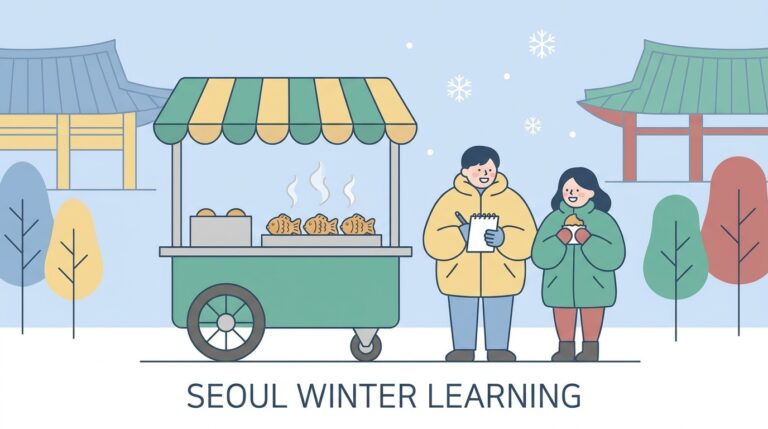
Picture this: It’s July in Seoul. The humidity is so thick you feel like you are breathing through a warm, wet towel. You step outside, and within three seconds, you are sweating. Now, flash-forward to January. The air is crisp, snow is gently dusting the rooftops of Hanok houses in Bukchon, and you are holding a paper bag of piping-hot bungeoppang (fish-shaped pastry) that warms your frozen fingers.
When my student Sarah first tried to explain why she preferred winter to summer, she said: “여름은 나쁩니다. 겨울은 좋습니다.” (Summer is bad. Winter is good.) While grammatically correct, it sounded a bit like a robot writing a report! When she learned how to naturally compare the two, she was able to banter with her Korean coworkers during lunch, instantly earning the title of a “Korean culture insider.”
Learning to express preferences and contrast situations doesn’t just improve your grammar; it unlocks deep, soulful conversations over hot street food. Let’s make sure you never sound like a textbook again!
Phase 2: Three Core Expressions for Flawless Comparisons
1. [Noun A]보다 [Noun B]이/가 더 [Adjective]
- Pronunciation: [Noun A]-bo-da [Noun B]-i/ga deo [Adjective]
- Meaning: B is more [Adjective] than A / I prefer B to A.
- K-Culture Moment: You are standing in front of a convenience store heater with a friend, arguing over whether to drink hot canned coffee or iced coffee. You point at the snow and say: “여름보다 겨울이 더 좋아!”
- Editor’s Insight: This is the absolute gold standard of comparison. Remember, the noun attached to 보다 (bo-da) is always the one being compared against (the baseline).
- Situation Spectrum:
- Casual (Friends): ✅
- Semi-formal (Coworkers): ✅
- Formal (Bosses/Elders): ✅ (Just change “좋아” to “좋습니다” or “좋아요”)
- 🤔 Think About It: Why does Korean put the baseline comparison first (A-보다) rather than the preferred item? How does this reflect the context-heavy nature of Korean thinking?
2. [Noun A]에 비해서 [Noun B]은/는…
- Pronunciation: [Noun A]-e bi-hae-seo [Noun B]-eun/neun…
- Meaning: Compared to A, B is…
- K-Culture Moment: Chatting about Korean apartments. “원룸에 비해서 아파트는 진짜 비싸요.” (Compared to a studio, apartments are really expensive.)
- Editor’s Insight: This is slightly more analytical and sophisticated than 보다. It’s perfect for B1 learners who want to sound objective and polished.
- Situation Spectrum:
- Casual (Friends): ✅
- Semi-formal (Coworkers): ✅
- Formal (Bosses/Elders): ✅
- 🤔 Think About It: In English, we often say “relative to…” or “in comparison to.” Notice how “비하다” (to compare) becomes an active description of relative state.
3. [Noun A/Verb-기]라기보다는 [Noun B/Verb-기]
- Pronunciation: [Noun A]-ra-gi-bo-da-neun [Noun B]
- Meaning: Rather than A, it’s more like B.
- K-Culture Moment: Someone asks if you are dating a classmate. You blush and say: “남자친구라기보다는 그냥 친구예요.” (Rather than a boyfriend, he’s just a friend.)
- Editor’s Insight: Use this when you want to make soft, nuanced distinctions. It avoids sounding too blunt or confrontational.
- Situation Spectrum:
- Casual (Friends): ✅
- Semi-formal (Coworkers): ✅
- Formal (Bosses/Elders): ✅
- 🤔 Think About It: How does utilizing a soft correction like “라기보다는” help maintain social harmony (인화, Inhwa) in Korean conversations?
Phase 3: Textbook Korean vs. Real-world Korean
Let’s look at how native Koreans actually speak compared to what standard textbooks teach.
Situation 1: Declaring Your Favorite Season
- 📖 Textbook Korean: 저는 여름보다 겨울을 더 선호합니다. (I prefer winter to summer.)
- 🗣️ Real-world Korean: 저는 완전 겨울파예요! 여름은 너무 습해서 싫어요. (I’m totally a winter person! Summer is way too humid, so I hate it.)
- 💡 Why is it different? Koreans love classifying themselves into “파” (factions/teams), such as “겨울파” (Team Winter) or “여름파” (Team Summer). It sounds incredibly natural and conversational.
Situation 2: Emphasizing Low Temperatures
- 📖 Textbook Korean: 겨울은 기온이 낮고 바람이 붑니다. (Winter has low temperatures and wind blows.)
- 🗣️ Real-world Korean: 겨울은 역시 추워야 제맛이죠! (Winter has to be cold to feel like real winter!)
- 💡 Why is it different? “~해야 제맛이다” is a beautiful idiomatic expression meaning “it needs to be [X] to have its true charm/flavor.”
Phase 4: K-Culture Deep Dive & Non-verbal Manners
4-1. Nunchi (눈치) and Winter Body Language
In Korea, comparing things isn’t just about grammar; it’s about physical energy! When declaring your love for winter, cozy up your body language. Slightly hunch your shoulders, rub your hands together, and blow warm air into them. This physical expression of coldness makes your preference for winter feel passionate, cozy, and highly relatable to locals.
4-2. The Cozy Korean Winter Code
Unlike many Western cultures where winter is seen as a bleak downtime, Korean culture celebrates winter with bustling energy. This is the season of 붕세권 (Bung-se-gwon)—a playful term combining bungeoppang and station area (역세권), meaning a neighborhood fortunate enough to have a winter street-food cart. Showing your preference for winter by mentioning winter street food immediately wins hearts.
Phase 5: Interactive Roleplay Scenario
Setting: A cozy, warm cafe in Insadong. Outside, heavy snow is falling. Inside, the smell of roasted grain tea and warm cinnamon fills the air.
Cast: You (The Winter Enthusiast) and Minjun (Your Korean colleague, a die-hard Summer Lover).
- Minjun: (Shaking snow off his coat) 🎭 와, 진짜 춥네요! 전 겨울이 정말 싫어요. 여름이 훨씬 나아요.
(Wa, jin-ja chump-ne-yo! Jeon gyeo-ul-i jeong-mal sil-eo-yo. Yeo-reum-i hwol-ssin na-a-yo.)
(Wow, it’s really cold! I really hate winter. Summer is much better.) - You: 🎭 에이, 여름보다 겨울이 훨씬 더 낭만적이지 않아요?
(Ei, yeo-reum-bo-da gyeo-ul-i hwol-ssin deo nang-man-jeok-i-ji an-a-yo?)
(Come on, isn’t winter way more romantic than summer?) - Minjun: 🎭 낭만요? 추워서 밖에서 데이트도 못 하잖아요!
(Nang-man-yo? Chu-weo-seo bak-es-eo de-i-teu-do mot ha-jan-a-yo!)
(Romantic? It’s so cold you can’t even go on outdoor dates!) - You: 🎭 겨울엔 따뜻한 포장마차나 카페에 가기 딱 좋잖아요.
(Gyeo-ul-en tta-tteut-han po-jang-ma-cha-na ka-pe-e ga-gi ttak jo-chan-a-yo.)
(In winter, it’s just perfect to go to warm street food stalls or cafes.) - Minjun: 🎭 음… 그건 그렇네요. 하지만 아침에 이불 밖으로 나오는 건 정말 고역이에요.
(Eum… geu-geon geu-reom-ne-yo. Ha-ji-man a-chim-e i-bul bak-eu-ro na-o-neun geon jeong-mal go-yeok-i-e-yo.)
(Hmm… that’s true. But getting out of bed in the morning is absolute torture.)
🔀 Decision Point: How do you respond to Minjun?
- Choice A: 여름에 더워서 땀 흘리는 것보다 훨씬 나아요! (Yeo-reum-e deo-weo-seo ttam heul-ri-neun geot-bo-da hwol-ssin na-a-yo!)
- Choice B: 그냥 겨울이 좋으니까 추위는 참으세요! (Geu-nyang gyeo-ul-i jo-eu-ni-kka chu-wi-neun cham-eu-se-yo!)
- Choice C: 맞아요, 그래서 ‘이불 밖은 위험해’라는 말이 있죠! (Ma-ja-yo, geu-rae-seo ‘i-bul bak-keun wi-heom-hae’-ra-neun ma-ri it-jyo!)
Best Choice: Choice C
Using the cultural meme “이불 밖은 위험해” (It’s dangerous outside the blanket) shows high-level cultural fluency and makes Minjun laugh, breaking any tension.
* Bad Choice: Choice B
Too blunt! Telling someone to “just bear with the cold” can sound aggressive in Korean social contexts.
Phase 6: 10-Second Emotional Shadowing Drill
Let’s practice speaking with true Korean emotion! Use the slash (/) for breathing pauses.
- [🥶 Shivering & Cute] “여름보다 / 겨울이 / 훨씬 더 / 제 스타일이에요!”
(Yeo-reum-bo-da / gyeo-ul-i / hwol-ssin deo / je seu-ta-il-i-e-yo!)
Meaning: Rather than summer, winter is way more my style! -
[😊 Pleased & Proud] “겨울엔 역시 / 따뜻한 / 길거리 간식이 / 최고죠!”
(Gyeo-ul-en yeok-si / tta-tteut-han / gil-geo-ri gan-sik-i / choe-go-jyo!)
Meaning: In winter, warm street food snacks are definitely the best!
Phase 7: K-Culture Mini Dictionary
- 얼죽아 (Eol-Juk-Ah)
- English: “Even if I freeze to death, iced Americano.”
- Insight: A hilarious testament to Koreans’ obsessive love for cold coffee even in sub-zero winter temperatures.
- 붕세권 (Bung-Se-Gwon)
- English: A neighborhood blessed with a winter bungeoppang cart.
- Insight: Played on the real estate term “Subway area”, it ranks how cozy and convenient your neighborhood is in winter.
- 이불 밖은 위험해 (Ibul Bak-keun Wi-heom-hae)
- English: It is dangerous outside the blanket.
- Insight: The ultimate winter lazy-day slogan used by everyone from tired students to famous idols.
- 소확행 (So-Hwak-Haeng)
- English: Small but certain happiness.
- Insight: Holding a hot sweet potato on a freezing walk home is the textbook definition of this lifestyle phrase.
Phase 8: Traveler’s Survival Kit
Top 3 Winter Survival Expressions
- 추우니까 안으로 들어갈까요? (Chu-u-ni-kka an-eu-ro deu-reo-gal-kka-yo?)
- Pro Tip: Use this when your fingers are freezing and you want to politely suggest moving the party indoors.
- 이거 엄청 뜨거우니까 조심해서 드세요. (I-geo eom-cheong tteu-geo-u-ni-kka jo-sim-hae-seo deu-se-yo.)
- Pro Tip: Say this when sharing steaming hot street snacks like hotteok with your friends.
- 따뜻한 물 좀 주시겠어요? (Tta-tteut-han mul jom ju-si-get-eo-yo?)
- Pro Tip: Essential in winter restaurants where cold water is often served by default.
📌 Editor’s Travel Note: Make sure to download the Naver Map App to locate temporary winter ice skating rinks and street food spots across Seoul during your winter vacation! (Note: Street food locations can vary seasonally).
Phase 9: Think Deeper — “한 발 더 깊이”
In Western cultures, small talk often revolves around the current weather. In Korea, however, asking whether someone prefers summer or winter is treated like a fun personality test, similar to MBTI. Asking this question shows that you want to understand someone’s lifestyle—are they an active explorer who enjoys the bright sun, or a reflective soul who enjoys cozy indoor aesthetics? Comparing preferences is a bridge to mutual understanding.
💬 Your Turn: Which season do you prefer, and how would you compare them using today’s grammar? Let us know in the comments below!
Phase 10: FAQ & Common Mistakes
Q: Can I use ‘보다’ with verbs?
A: Yes, but you must change the verb into a noun form first using ~기보다. For example: “요리하기보다 사 먹는 것이 더 편해요.” (Rather than cooking, buying food is easier.)
Q: Does ‘더’ (more) always have to be in the sentence?
A: Not strictly, but omitting “더” can make the sentence sound slightly incomplete. Including it makes the comparison clear and natural.
Q: Can I use ‘더’ without ‘보다’?
A: Absolutely! If the context is already known, you can simply say “겨울이 더 좋아요” (I like winter more).
🚨 Common Mistake Warnblock
- Mistake: 여름이 겨울보다 더 좋아 (When you actually prefer summer, but got the word order mixed up).
- Correction: The noun attached to 보다 is the one you are less fond of. Keep the one you love right before 더!
Phase 11: Action Missions
- 🥉 Bronze: Record yourself saying: “여름보다 겨울이 훨씬 더 좋아요!” with lots of cozy emotion.
- 🥈 Silver: Text a Korean friend or post on social media comparing your country’s weather to Korea’s weather using ~에 비해서.
- 🥇 Gold: Go to a local Korean cafe or restaurant and order a warm drink, casually telling the host: “추우니까 따뜻한 게 최고예요!” (Because it’s cold, warm things are the best!)
- 🎮 K-Culture Mission: Watch a winter scene from your favorite K-Drama (like Goblin or Crash Landing on You) and try to spot how the characters physicalize the cold weather!
Phase 12: Interactive Quiz Challenge
1. Match the Best Response
Which of the following means: “Compared to last year, this year is colder”?
* A) 작년보다 올해가 더 추워요.
* B) 올해에 비해서 작년이 더 추워요.
🔍 Click here for the Answer
Answer: A
A translates directly to “Compared to last year, this year is colder.” (Option B says the opposite!)
2. Fill in the Blank
겨울은 추운 것_________ 오히려 낭만적이에요. (Rather than being cold, winter is romantic.)
🔍 Click here for the Answer
Answer: 이라기보다는
“추운 것이라기보다는” fits perfectly to mean “Rather than just being cold…”
3. True or False K-Culture Quiz
True or False: “얼죽아” is a term only used by older generations in Korea.
🔍 Click here for the Answer
Answer: False!
It’s a very popular slang term widely used by younger generations and office workers across Korea!
“,







