

Write Your Own Seoul Story: The Ultimate Guide to Independent Publishing and E-books in Korea
Phase 1: Empathy (공감)
안녕하세요! Welcome back to Daily Hangul, your cozy corner for mastering both the Korean language and its beautiful lifestyle. I’m your senior editor and resident cultural guide.
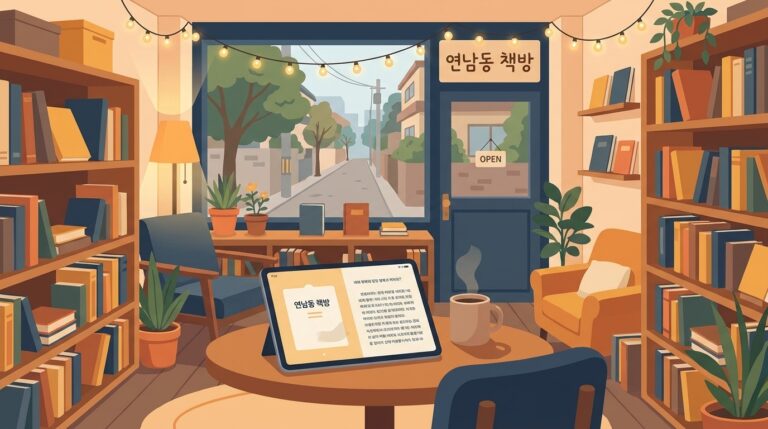
Imagine walking down a narrow, leafy alleyway in Yeonnam-dong (연남동) on a crisp autumn afternoon. You slide open the glass door of a tiny, dimly lit independent bookstore (독립서점). Inside, the scent of fresh paper and warm drip coffee wraps around you. You see unique, hand-stitched booklets, experimental poetry zines, and beautifully designed e-book displays. Suddenly, a wild dream sparks: “What if I published my own story here in Korea?”
Many of our advanced C1 students have asked me: “How do I navigate the Korean indie publishing scene? The vocabulary is so specific, and the cultural etiquette of pitching to small bookstores feels like an unwritten code!”
Indeed, moving from academic Korean to the nuanced world of independent publishing (독립 출판) and e-book creation (전자책 제작) can feel daunting. But don’t worry! This guide is built on real tutoring case studies of expats and international writers who successfully launched their indie projects in Seoul. Today, we will unlock the precise terms, subtle manners, and emotional nuances you need to turn your draft into a published masterpiece in Korea.
Phase 2: Key Expressions Deep Dive (핵심 표현 3선 심층 분석)
Let’s dissect three indispensable terms that will immediately establish your credibility when talking to Korean designers, printers, and bookstore owners.
1. 독립 출판 (Dong-nip Chul-pan)
- Pronunciation: [dong-nip chul-pan] / Sound Analogy: “dong-neep” (like “dong” + “neep” with a short ‘i’) + “chool-pahn”.
- Meaning: Independent Publishing.
- K-Culture Moment: You will hear this word constantly in the trendy hubs of Mapo-gu (마포구). It refers to the entire subculture of self-publishing, where the author bypasses mainstream publishers to handle editing, design, printing, and distribution independently.
- Editor’s Insight: Unlike mainstream commercial publishing (기성 출판), 독립 출판 represents complete creative freedom. In Korea, this isn’t just a business model; it’s an artistic lifestyle statement.
- Situation Spectrum:
- Friends / Casual: ✅
- Business / Professional: ✅
- Formal / Elders: ✅
- 🤔 Think About It: Why do you think Korea has such a vibrant physical indie book culture despite being one of the most digitally advanced societies in the world?
2. 원고를 투고하다 (Won-go-reul Tu-go-hada)
- Pronunciation: [won-go-reul tu-go-hada] / Sound Analogy: “one-go” (manuscript) + “too-go-hah-dah” (to submit).
- Meaning: To submit a manuscript (for consideration/publishing).
- K-Culture Moment: In K-Dramas like Romance is a Bonus Book (로맨스는 별책부록), you often see aspiring writers nervously waiting for a publisher to review their submitted manuscript.
- Editor’s Insight: The word 투고 (投稿) literally means “throwing/submitting a piece of writing.” It carries a highly respectful, formal tone. When emailing an indie bookstore or publisher, you don’t just “send” (보내다) your writing; you 투고 it.
- Situation Spectrum:
- Friends / Casual: ⚠️ (Sounds too formal unless joking about your diary)
- Business / Professional: ✅
- Formal / Elders: ✅
- 🤔 Think About It: How does the word 투고하다 reflect the traditional respect Korean culture places on written literature and academic efforts?
3. 1인 출판사 (Il-in Chul-pan-sa)
- Pronunciation: [il-in chul-pan-sa] / Sound Analogy: “eel-een” (one-person) + “chool-pahn-sah” (publishing house).
- Meaning: One-person publishing house.
- K-Culture Moment: Many successful Korean e-book creators register themselves as a 1인 출판사 to get official ISBNs (International Standard Book Numbers) and distribute their work on major digital platforms like Ridi (리디북스) or Yes24.
- Editor’s Insight: Setting up a 1인 출판사 in Korea is surprisingly simple and highly respected. It signals that you are not just a hobbyist, but a professional entrepreneur managing your own intellectual property.
- Situation Spectrum:
- Friends / Casual: ✅
- Business / Professional: ✅
- Formal / Elders: ✅
- 🤔 Think About It: How does the concept of a “one-person company” challenge the traditional Korean corporate hierarchy?
Phase 3: Textbook Korean vs. Real Korean (교과서 한국어 vs. 진짜 한국어)
To sound like a true publishing insider, you must shed rigid classroom phrases and adopt the organic vocabulary used by Korean designers and creators.
Situation 1: Describing the process of revising and editing your draft
- 📖 Textbook Korean: “원고를 수정하고 고치고 있습니다.” (I am correcting and fixing the manuscript.) – Sounds a bit elementary and mechanical.
- 🗣️ Real Korean: “지금 열심히 퇴고(推敲) 중이에요.” (I am currently in the middle of polishing/revising my draft.)
- 💡 Why the difference? 퇴고 is a Sino-Korean literary term that specifically refers to the artistic process of refining, polishing, and choosing the perfect words. Using 퇴고 중 shows you treat writing as a craft.
Situation 2: Asking if a bookstore will stock your physical book
- 📖 Textbook Korean: “제 책을 이 서점에서 팔아주실 수 있나요?” (Can you sell my book at this bookstore?) – Too direct and transaction-oriented.
- 🗣️ Real Korean: “혹시 제 책을 입고(入庫)할 수 있을지 여쭤보고 싶습니다.” (I would like to ask if it might be possible to stock/consign my book here.)
- 💡 Why the difference? In the indie publishing world, 입고 (stocking/consigning) is the standard professional term. It frames the relationship as a mutual partnership rather than a cold sales pitch.
Phase 4: K-Culture Deep Dive & Non-Verbal Etiquette
4-1. The Art of “Nunchi” (눈치) in Indie Bookstores
When visiting a Korean independent bookstore to pitch your project or build networks, your non-verbal manners (비언어적 매너) speak louder than your words.
* The “One-Book” Rule: Never enter an indie bookstore, take photos of the interior for your Instagram, and leave without buying anything. This is considered highly bad manners (민폐). Always buy at least one book or a small piece of merchandise before attempting to speak with the owner about your own work.
* The Soft Approach: Owners of indie bookstores are often introverted curators who love books deeply. Do not approach them with a loud, aggressive “elevator pitch.” Instead, start with a polite bow, complement their curation, and ask if they have a preferred email channel for 투고 queries.
4-2. The Crowdfunding Revolution: Tumblbug (텀블벅)
In Korea, independent publishing and crowdfunding are inseparable. Tumblbug (텀블벅) is the Korean equivalent of Kickstarter, specifically tailored for creative arts. Many creators fund their printing costs through Tumblbug by offering beautiful physical rewards (굿즈) like custom bookmarks, fabric book covers, or exclusive writer meetups (북토크).
Phase 5: Interactive Roleplay Scenario (실전 롤플레이)
Setting: You are at “Paper & Dream” (종이와 꿈), a cozy, independent bookstore in Mangwon-dong. Rain is pattering against the window. Min-ji (민지), the curator and owner, is organizing books behind a wooden counter.
[Cast]
- You: An aspiring foreign writer who has prepared an indie essay collection.
- Min-ji (민지): The warm, professional bookstore owner with an eye for unique stories.
- Turn 1 (You):
안녕하세요! 사장님, 책방 분위기가 너무 아늑하고 좋네요. 혹시 잠깐 시간 괜찮으실까요?
(An-nyeong-ha-se-yo! Sa-jang-nim, chaek-bang bun-wi-gi-ga neo-mu a-neuk-ha-go joh-nae-yo. Hok-si jam-kkan si-gan gwaen-chanh-eu-sil-kka-yo?)
🎭 (Smiling warmly, holding a small book you just purchased from her counter)
“Hello! Owner, the bookstore atmosphere is so cozy and wonderful. Do you happen to have a brief moment?” -
Turn 2 (Min-ji):
아, 네! 안녕하세요. 저희 책방 찾아주셔서 감사해요. 구매해 주신 책도 정말 좋은 에세이예요. 무슨 일이신가요?
(Ah, ne! An-nyeong-ha-se-yo. Jeo-hui chaek-bang cha-ja-ju-syeo-seo gam-sa-hae-yo. Gu-mae-hae ju-sin chaek-do jeong-mal joh-eun e-se-i-ye-yo. Mu-seun il-i-sin-ga-yo?)
🎭 (Polishing a coffee cup, looking at you with a welcoming smile)
“Ah, yes! Hello. Thank you for visiting our bookstore. The book you just bought is a really wonderful essay collection, too. What can I do for you?” -
Turn 3 (You):
실은 제가 이번에 서울 생활을 주제로 독립 출판을 준비하고 있거든요. 에세이와 사진을 엮은 책이에요.
(Sil-eun je-ga i-beon-e Seo-ul saeng-hwal-eul ju-je-ro dong-nip chul-pan-eul jun-bi-ha-go it-geo-deun-yo. E-se-i-wa sa-jin-eul yeok-eun chaek-i-ye-yo.)
🎭 (Slightly nervous but maintaining steady eye contact)
“Actually, I am currently preparing an independent publication about my life in Seoul. It’s an essay book integrated with photographs.” -
Turn 4 (Min-ji):
와, 재미있겠네요! 안 그래도 외국인 분의 시선으로 본 서울 이야기는 늘 흥미롭다고 생각했어요. 원고는 거의 다 쓰셨나요?
(Wa, jae-mi-it-get-nae-yo! An-geo-rae-do oe-guk-in bun-ui si-seon-eu-ro bon Seo-ul i-ya-gi-neun neul heung-mi-rop-da-go saeng-gak-haess-eo-yo. Won-go-neun geo-ui da sseu-syeoss-na-yo?)
🎭 (Leaning forward with genuine curiosity)
“Wow, that sounds interesting! I’ve always thought that stories about Seoul from a foreigner’s perspective are very fascinating. Have you finished writing most of the manuscript?” -
Turn 5 (You):
네, 열심히 퇴고 중이에요. 혹시 완성이 되면 사장님 책방에 입고 제안을 드려도 될까 해서요.
(Ne, yeol-sim-hi toe-go jung-i-ye-yo. Hok-si wan-seong-i doe-myeon sa-jang-nim chaek-bang-e ip-go je-an-eul deu-ryeo-do doel-kka hae-seo-yo.)
🎭 (Using the polite humble gesture, lowering your head slightly)
“Yes, I am currently polishing it hard. I was wondering if I could pitch a stocking proposal to your bookstore once it’s finished.” -
Turn 6 (Min-ji):
물론이죠! 저희는 기획 의도가 확실하고 개성 있는 원고라면 언제든 환영이에요. 혹시 실물 책으로만 내시나요? 요새는 전자책으로도 많이 투고하시거든요.
(Mul-ron-i-jyo! Jeo-hui-neun gi-hoek ui-do-ga hwak-sil-ha-go gae-seong itt-neun won-go-ra-myeon oon-je-deun hwan-yeong-i-ye-yo. Hok-si sil-mul chaek-eu-ro-man nae-si-na-yo? Yo-sae-neun jeon-ja-chaek-eu-ro-do ma-ni tu-go-ha-si-geo-deun-yo.)
🎭 (Nodding encouragingly)
“Of course! We always welcome manuscripts that have a clear concept and distinct personality. Are you releasing it only as a physical book? These days, many people submit e-books too.”
🔀 Decision Point (선택의 순간)
How should you respond to Min-ji’s question about your publishing format to show both professional preparation and adaptability?
- Option A: “실물 책만 만들 거예요. 전자책은 가짜 책 같아요.” (I will only make physical books. E-books feel like fake books.)
- Option B: “텀블벅에서 실물 책 펀딩을 진행한 후에, 리디북스에 전자책으로도 등록할 계획입니다.” (I plan to run a physical book funding campaign on Tumblbug first, and then register it as an e-book on Ridi.)
- Option C: “사장님이 골라주시는 대로 할게요. 저는 아무거나 상관없어요.” (I will do whatever you choose, owner. I don’t care either way.)
[Best Choice Analysis – Option B]
Option B is outstanding! It demonstrates that you understand the modern Korean publishing ecosystem. Mentioning 텀블벅 (Tumblbug) shows you have a realistic funding strategy, and referencing 리디북스 (Ridi) proves you understand the major Korean e-book channels.
* Risk of Option A: Saying e-books feel “fake” sounds overly stubborn and dismisses a massive sector of the modern Korean literary market.
* Risk of Option C: Passive behavior makes you look unprepared and unprofessional as a prospective publisher.
Phase 6: 10-Second Emotion Shadowing Drill (10초 감정 섀도잉 드릴)
Let’s practice speaking with real soul and emotion! Use the slashes / to pace your breathing, and mimic the emotion guides in the brackets.
- [😊 Proud and Excited]
“드디어 / 제 첫 독립 출판물이 / 나왔어요!”
(Deu-di-eo / je cheot dong-nip chul-pan-mul-i / na-wass-eo-yo!)
“Finally / my first independent publication / is out!” -
[🥺 Anxious but Hopeful]
“부족한 원고지만, / 진심을 담아 / 퇴고했어요.”
(Bu-jok-han won-go-ji-man, / jin-sim-eul dam-a / toe-go-haess-eo-yo.)
“It is an imperfect manuscript, / but I polished it / with all my heart.” -
[😤 Determined and Confident]
“이번 책은 / 꼭 / 텀블벅 펀딩에 / 성공할 겁니다!”
(I-beon chaek-eun / kkok / teom-beol-beok peon-ding-e / seong-gong-hal geom-ni-da!)
“This book / will definitely / succeed / in its Tumblbug funding!”
Phase 7: K-Culture Mini Dictionary (K-Culture 미니 사전)
| Word (한글/Romanization) | Meaning | Real-World Context & Usage |
|---|---|---|
| 소장 욕구 (So-jang Yok-gu) | The desire to collect/own | Koreans love beautiful book covers, unique paper textures, and special merchandise. A book with high 소장 욕구 sells out fast as a physical piece of art. |
| 북토크 (Buk-to-keu) | Book Talk / Author Meetup | A cozy event where indie authors talk about their writing journey in small bookstores. It is highly valued for building intimate relationships with readers. |
| 전자책 (Jeon-ja-chaek) | E-book / Digital Book | Highly popular among busy Korean commuters who read on their iPads or e-readers (such as Crema) during subway rides. |
| 책방지기 (Chaek-bang-ji-gi) | Bookstore Keeper / Curator | A warm, poetic term used to refer to the owner or curator of an independent bookstore instead of the corporate word 사장님 (owner). |
Phase 8: Traveler’s Survival Kit (여행자를 위한 생존 키트)
Even if you aren’t ready to publish yet, visiting these literary pockets of Seoul is an unforgettable experience. Here is your pocket toolkit!
Survival Phrases
- “이 책 / 샘플은 / 어디에 있나요?”
(I chaek / saem-peol-eun / eo-di-e in-na-yo?)
“Where is the sample copy of this book?”
(Pro Tip: In indie shops, only books marked ‘샘플’ or ‘독자용’ can be opened and read. Do not unwrap sealed books!) - “이거 / 독립 출판물 / 맞나요?”
(I-geo / dong-nip chul-pan-mul / man-na-yo?)
“Is this an independent publication?” - “혹시 / 책방지기님이 / 추천해 주시는 / 책이 있을까요?”
(Hok-si / chaek-bang-ji-gi-nim-i / chu-cheon-hae ju-si-neun / chaek-i is-seul-kka-yo?)
“By any chance, is there a book recommended by the bookstore keeper?”
📌 Editor’s Travel Note
- Essential App: Use Naver Map App Download Page and search for “독립서점” (Independent Bookstore) in the Hongdae or Mangwon area.
- Payment & Manners: Indie bookstores operate on very thin margins. Paying with a local debit/credit card or cash rather than international cards is always deeply appreciated by the 책방지기.
Phase 9: One Step Deeper (한 발 더 깊이)
Have you noticed how many Korean indie books deal with highly personal, vulnerable struggles? Books like “I Want to Die but I Want to Eat Tteokbokki” (죽고 싶지만 떡볶이는 먹고 싶어) started as humble independent publications before becoming national bestsellers.
In a highly competitive, fast-paced society where displaying weakness is traditionally discouraged, independent bookstores have become “safe sanctuaries.” Here, authors openly share their burnout, anxiety, and unconventional life choices. By writing in the first-person and self-publishing, they bypass the sterile gatekeeping of big corporations and speak directly, heart-to-heart, to their peers.
💬 Your Turn: Does your home country have a similar subculture of vulnerable, self-published essays? Or is independent publishing mostly focused on fiction and academic zines? Share your thoughts with us in the comments!
Phase 10: FAQ & Common Mistakes
Q: Can a foreigner register a 1인 출판사 (One-person publishing house) in Korea?
A: Yes, but it depends on your visa status. F-series visa holders (F-2, F-5, F-6) can easily register a business. If you are on an E-series or tourist visa, it is much easier to collaborate with an existing Korean indie publisher or publish your e-book through global platforms that distribute directly to Korean markets.
Q: Do I need a physical address to register a publishing business in Korea?
A: Yes, you need an address. However, many indie creators use shared offices or specialized virtual office spaces specifically designed for home-based publishers (비상주 사무실).
Q: How do independent bookstores pay writers for sold books?
A: Usually, they use a consignment contract (위탁 판매). The bookstore takes a 30% to 35% commission, and you receive the remaining 65% to 70% at the end of every month based on actual sales.
🚨 Common Mistakes Alert!
- Sending raw drafts without formatting: Always compile your work into a clean PDF or EPUB before pitching. Sending a raw Word document (hwp or docx) looks unprofessional.
- Ignoring bookstore curation styles: Do not pitch an sci-fi thriller to a bookstore that exclusively curates feminist poetry. Always research the bookstore’s theme first.
- Over-relying on automated translation: If you write in English and translate to Korean, hire a professional bilingual editor for 퇴고 (polishing). Clunky machine translation ruins the emotional resonance of literary prose.
Phase 11: Action Missions (액션 미션)
- 🥉 Bronze (The Mirror Challenge): Record yourself saying the three shadowing sentences in Phase 6 with perfect emotional tone. Listen to your pitch and pace!
- 🥈 Silver (The Social Pitch): Draft a short, 3-sentence book concept proposal in Korean describing a book you would love to write. Share it on your social media with the hashtag
#매일한글 #독립출판. - 🥇 Gold (The Scout Mission): Visit an independent bookstore (physically in Korea or online via their Instagram page) and identify their primary curation theme. Leave a polite comment or ask a question in Korean using the terms learned today.
Phase 12: Interactive Quiz Challenge (인터랙티브 퀴즈)
Test your knowledge of Korean publishing culture!
Question 1: What is the most appropriate word to use when you want to politely propose stocking your book at an indie bookstore?
1) 팝니다 (Pap-ni-da)
2) 투고 (Tu-go)
3) 입고 제안 (Ip-go Je-an)
4) 인쇄 (In-swae)
Reveal Answer & Explanation
Answer: 3) 입고 제안 (Ip-go Je-an)
* Explanation: 입고 제안 means “stocking proposal.” 투고 is submitting the manuscript itself to a publisher, while 입고 is delivering physical books to a storefront. 팝니다 is too blunt (“sell”), and 인쇄 means printing.
Question 2: Fill in the blank.
“오랫동안 준비한 원고의 ________ 작업을 마치고 나니 마음이 개운합니다.”
(After finishing the _______ process of the manuscript I prepared for a long time, I feel relieved.)
Reveal Answer & Explanation
Answer: 퇴고 (Toe-go – polishing/revision)
* Explanation: 퇴고 is the elegant Sino-Korean word for the creative revision and polishing of a literary draft.
Question 3: True or False?
“In Korea, it is considered perfectly polite to take photos of all the book covers inside a private independent bookstore without purchasing any items.”
* True / False
Reveal Answer & Explanation
Answer: False
* Explanation: This is a classic etiquette mistake. Independent bookstores are curated spaces. Taking photos without buying anything or asking permission is considered rude (민폐). Show some love to the 책방지기 by buying a book first!







