

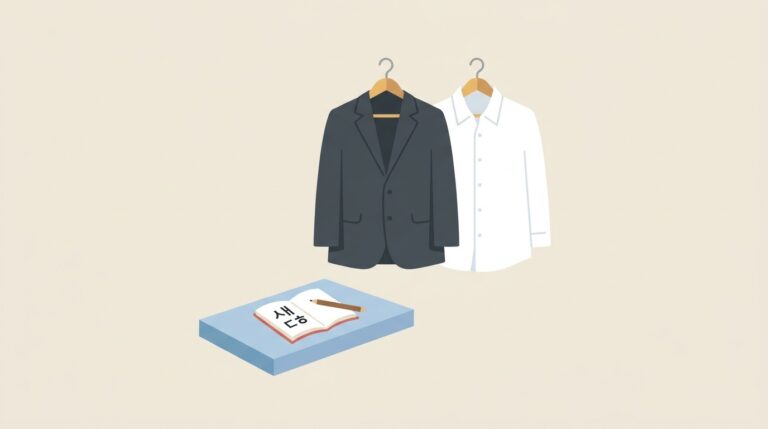
Dress for Success: The Beginner Guide to Korean Interview Outfits
안녕하세요! (An-nyeong-ha-se-yo!) Hello! I am your friendly Korean tutor and local guide from Daily Hangul. Have you ever watched a Korean drama like Start-Up or Misaeng (미생) and noticed how sharp everyone looks when they walk into an office?
If you are preparing for a job interview in Korea, or even if you just want to understand Korean business culture, you might be asking yourself: “What should I wear?” or “How do I say these clothes in Korean?”
Don’t worry! Today, we are going to learn the most essential Korean words for interview outfits (면접 복장 – Myeon-jeop Bok-jang) at a beginner-friendly level (A1). By the end of this guide, you will know exactly what to wear and how to talk about it like a local!
1. Three Essential Korean Expressions to Master
To make a great first impression, let’s learn three simple but powerful words about Korean dress codes.
① 정장 (Jeong-jang)
- Pronunciation: [Jung-jahng] (Sounds like the word ‘Jung’ from jungle + ‘jahng’)
- Meaning: Suit / Formal Business Attire
- K-Culture Moment: Think of K-Dramas where the main character buys their very first dark suit for a big corporate interview. In Korea, wearing a ‘Jeong-jang’ shows deep respect for the company.
- Editor’s Insight: Traditional Korean companies love dark navy or black suits with a clean white shirt. It is the gold standard of job interviews!
- Situation Spectrum:
- Casual: 🚫
- Semi-formal: ⚠️
- Formal: ✅
- 🤔 Think About It: In your home country, do people always wear suits to job interviews? Why do you think clean suits are so highly valued in Korean work culture?
② 단정하게 (Dan-jeong-ha-ge)
- Pronunciation: [Dahn-jung-hah-geh] (Sounds like ‘Dahn’ + ‘jung’ + ‘hah’ + ‘get’ without the ‘t’)
- Meaning: Neatly / Tidily
- K-Culture Moment: K-beauty and styling guides often emphasize ‘Dan-jeong-han’ hair (neatly tied up or neatly brushed) and minimal accessories for interviews.
- Editor’s Insight: It’s not about wearing expensive luxury brands. It is about looking ‘Dan-jeong-ha-ge’—clean, organized, and ready to work.
- Situation Spectrum:
- Casual: ⚠️
- Semi-formal: ✅
- Formal: ✅
- 🤔 Think About It: How does looking ‘neat’ or ‘tidy’ influence how people trust you in a professional setting?
③ 깔끔하게 (Kkal-kkeum-ha-ge)
- Pronunciation: [Kahl-kkeum-hah-geh] (The double ‘K’ is sharp like the ‘k’ in ‘sky’. ‘Kkeum’ has a flat lips sound, like ‘coom’)
- Meaning: Cleanly / Polished
- K-Culture Moment: When you visit a trendy cafe in Seoul, you see many young professionals dressed in clean, simple, and well-ironed shirts. This is the definition of ‘Kkal-kkeum-ha-ge’!
- Editor’s Insight: If someone says “옷이 깔끔하네요” (Ot-i kkal-kkeum-ha-ne-yo / Your clothes are very clean and neat), you have won their heart!
- Situation Spectrum:
- Casual: ✅
- Semi-formal: ✅
- Formal: ✅
- 🤔 Think About It: Why do you think neutral colors like black, white, and grey are considered the most ‘Kkal-kkeum’ (clean) colors in Korea?
2. Textbook Korean vs. Real-World Korean
Sometimes, what you learn in standard textbooks sounds a bit too robotic. Let’s look at how Koreans actually talk about interview outfits in real life!
Asking About the Dress Code
- 📖 Textbook: “면접 복장은 정장입니까?” (Myeon-jeop bok-jang-eun jeong-jang-im-ni-ka? / Is the interview dress code a suit?)
- 🗣️ Real Korean: “정장 입어야 돼요?” (Jeong-jang ib-eo-ya dwae-yo? / Do I have to wear a suit?)
- 💡 Why the difference? Textbook Korean uses very formal endings that sound like a military manual. Real people use the friendly ‘-아/어야 돼요’ (have to / should) pattern in daily business environments.
Explaining Smart Casual
- 📖 Textbook: “비즈니스 캐주얼을 착용하십시오.” (Bi-jeu-ni-seu kae-ju-eol-eul chak-yong-hap-si-o. / Please wear business casual.)
- 🗣️ Real Korean: “깔끔하게 입고 오세요.” (Kkal-kkeum-ha-ge ib-go o-se-yo. / Just dress neatly and come.)
- 💡 Why the difference? Instead of using difficult English loanwords like ‘Business Casual’, Koreans love using the word ‘깔끔하게’ (neatly/cleanly) to mean ‘look professional but comfortable’.
3. K-Culture Deep Dive: The Non-verbal Etiquette
To pass a Korean interview, wearing the right clothes is only half the battle. You also need to understand the cultural codes!
3-1. Eye Contact and Bowing (인사 – Insa)
When you enter the interview room, do not just sit down.
1. Walk in quietly, stand next to your chair.
2. Greet the interviewers with a polite 30-degree bow.
3. Keep your hands neatly placed in front of your waist (this is called ‘Gong-su’ 자세).
3-2. The ‘Startup’ vs. ‘Traditional’ Vibe
Korea has two main business outfit cultures:
* The ‘Kal-Jeong-jang’ (칼정장) Culture: This refers to a sharp, perfectly black-and-white suit. Traditional banks and conglomerate companies (like Samsung or Hyundai) still expect this.
* The ‘Start-up’ Culture: IT and creative fields (like Kakao or Naver) prefer neat denim, simple shirts, and clean sneakers. Wearing a full black suit here might actually make you look too stiff!
4. Interactive Roleplay Scenario
Imagine you are standing in the quiet waiting room of a tech company in Gangnam, Seoul. You are wearing a nice navy blazer. Min-ji, a friendly HR manager, comes over to guide you.
- 민지 (Min-ji): (🎭 smiling warmly) 안녕하세요! 오늘 면접 보러 오셨죠?
(An-nyeong-ha-se-yo! O-neul myeon-jeop bo-reo o-syeot-jyo? / Hello! You are here for the interview today, right?) - You: 네, 안녕하세요! 많이 떨려요.
(Ne, an-nyeong-ha-se-yo! Man-i tteol-ryeo-yo. / Yes, hello! I am very nervous.) - 민지 (Min-ji): (🎭 looking at your outfit) 걱정 마세요. 오늘 옷이 아주 단정하네요!
(Geok-jeong ma-se-yo. O-neul ot-i a-ju dan-jeong-ha-ne-yo! / Don’t worry. Your clothes look very neat today!) - You: 정말요? 감사합니다. 정장 입어야 하는지 고민했어요.
(Jeong-mal-yo? Gam-sa-ham-ni-da. Jeong-jang ib-eo-ya han-eun-ji go-min-haess-eo-yo. / Really? Thank you. I was worried if I should wear a full suit.) - 민지 (Min-ji): 요즘은 깔끔하게만 입으면 괜찮아요. 준비되셨으면 들어갈까요?
(Yo-jeum-eun kkal-kkeum-ha-ge-man ib-eu-myeon gwaen-chan-a-yo. Jun-bi-doe-syeot-eu-myeon deu-reo-gal-kka-yo? / These days, as long as you dress cleanly, it is fine. Shall we go in if you are ready?)
🔀 Decision Point: What do you say to Min-ji?
- A: “네, 가요!” (Ne, ga-yo! / Yes, let’s go!)
- B: “네, 단정하게 하고 가겠습니다!” (Ne, dan-jeong-ha-ge ha-go ga-get-seum-ni-da! / Yes, I will go in a neat manner!)
- C: “아니요, 너무 긴장돼요.” (An-i-yo, neo-mu gin-jang-dwae-yo. / No, I’m too nervous.)
💡 Best Choice: B
Saying B shows you used the word ‘단정하게’ that Min-ji used, which makes you sound very polite, positive, and culturally aware! A is a bit too casual for an interview setting, and C might make you seem unprepared.
5. 10-Second Shadowing Drill
Let’s practice speaking with the right emotion! Read these out loud, pausing at the / marks.
- [😊 Proud & Confident]
- 깔끔하게 / 입었어요!
- Kkal-kkeum-ha-ge / ib-eoss-eo-yo!
- (I dressed very cleanly/neatly!)
- [🥺 Curious & Polite]
- 정장 / 입어야 돼요?
- Jeong-jang / ib-eo-ya dwae-yo?
- (Do I have to wear a suit?)
6. K-Culture Mini Dictionary
| Word | English Meaning | Real-world Context |
|---|---|---|
| 면접 (Myeon-jeop) | Job Interview | Essential word for job seekers in Korea. |
| 칼정장 (Kal-jeong-jang) | Strict Formal Suit | Lit. ‘Knife-sharp suit’. Refers to perfect corporate formal wear. |
| 단정 (Dan-jeong) | Neatness | The most valued keyword in Korean school and office appearance rules. |
| 첫인상 (Cheot-in-sang) | First Impression | Koreans believe your Cheot-in-sang is decided in just 3 seconds! |
7. Survival Kit for Travelers & Interviewees
If you are traveling in Korea and suddenly need to dress up for a formal meeting or an interview, use these tips!
Top 3 Useful Expressions
- “다림질방/세탁소 어디예요?” (Da-rim-jil-bang/Se-tak-so eo-di-ye-yo?)
- Pro Tip: “Where is the laundry/dry cleaners?” Use this to iron out wrinkles on your shirt.
- “정장 대여할 수 있나요?” (Jeong-jang dae-yeo-hal su in-na-yo?)
- Pro Tip: “Can I rent a suit?” Many cities in Korea offer free or cheap suit rental services for young job seekers!
- “이거 단정해요?” (I-geo dan-jeong-hae-yo?)
- Pro Tip: “Is this neat?” Ask your Korean friends before walking into the interview.
📌 Editor’s Note: If you need to find a local dry cleaner (세탁소), do not use Google Maps! It doesn’t work well in Korea. Download Naver Map or Kakao Map for real-time local search results.
8. Deep Thoughts: Why Do We All Wear the Same Suit?
In many Western countries, expressing individuality through colorful clothes or accessories during interviews is seen as creative. However, in Korea, uniform neatness is deeply rooted in the concept of harmony (조화 – Jo-hwa) and respect (존중 – Jon-jung). By wearing a clean, standard suit, you show that you are ready to melt into the company culture without causing friction. While startup cultures are changing this slowly, the spirit of ‘respect through neatness’ remains strong.
💬 Your Turn: How do people dress for interviews in your home country? Do they wear strict black suits, or is it more relaxed? Let me know in the comments below!
9. Frequently Asked Questions (FAQ)
Q: Can I wear bright colored suits to a Korean interview?
A: Generally, No. It is safest to stick to dark navy, charcoal gray, or black. Bright colors can sometimes be distracting to conservative Korean interviewers.
Q: Are clean white sneakers okay for a business casual dress code?
A: Depends. For young startups or IT companies, clean white leather sneakers are perfectly fine. But for government, banking, or traditional corporate jobs, choose black leather shoes (구두 – Gu-du).
Q: Do I need to wear a tie?
A: Yes for traditional companies, No for modern tech companies. If the dress code says ‘Jeong-jang’ (suit), always wear a tie.
🚨 Common Style Mistakes in Korea
- White socks with a black suit: This is considered a major fashion crime! Always wear dark socks that match your trousers.
- Wrinkled shirts (구겨진 셔츠): Shows lack of preparation. Always iron your clothes!
- Heavy perfume (강한 향수): Korean offices are often shared spaces. Keep your perfume light and subtle.
10. Daily Hangul Action Missions!
- 🥉 Bronze Mission: Look in the mirror today and say “단정하게!” (Neatly!) three times with a bright smile.
- 🥈 Silver Mission: Take a photo of your favorite neat shirt or blazer, post it on social media, and write: “Is this 깔끔해요?”
- 🥇 Gold Mission: Walk into a Korean clothing shop (like SPAO or Musinsa) and ask the staff: “이거 면접 정장이에요?” (Is this an interview suit?)
-
🎮 K-Culture Bonus Mission: Watch one episode of the Korean drama Start-Up and write down whether the characters are wearing Kal-jeong-jang (strict suits) or casual clothes!
11. Mini Quiz Challenge
Test what you learned today!
Q1. Which word means ‘neatly’ or ‘tidily’ in Korean? (Click to reveal answer)
Answer: 단정하게 (Dan-jeong-ha-ge)
Example: 옷을 단정하게 입으세요. (Please dress neatly.)
Q2. True or False: You should always wear white athletic socks with a black suit in Korea.
Answer: False!
Always wear dark socks that match your black or navy suit pants.
Q3. Fill in the blank: If you want to say ‘suit’ in Korean, you say: ____.
Answer: 정장 (Jeong-jang)
Great job today! Dressing up for an interview can be stressful, but now you have the words and cultural knowledge to shine. See you in the next lesson! 다음에 또 만나요! (Da-eum-e tto man-na-yo!)







