

The Silent Crisis of Hangeul: Navigating Korea’s Modern Literacy Debate and the Power of Reading
안녕하세요! Welcome back to another masterclass with Daily Hangul. I’m your senior editor and cultural navigator. If you’ve spent any time on Korean social media or watched contemporary Korean news, you might have noticed a fascinating, slightly alarming conversation taking place across the nation. It’s not about economic policies or K-pop charts—it is about 문해력 (Mun-hae-ryeok / Textual Literacy).
Imagine this: A trendy cafe in Yeonnam-dong posts an announcement saying, “금일 휴업합니다” (Geum-il hyu-eob-ham-ni-da / Closed today). Within hours, angry reviews flood in from confused Gen Z customers demanding to know why the cafe is open on Friday (Geum-yo-il) but closed when they arrived on a Tuesday. They mistook 금일 (Geum-il / Today) for 금요일 (Geum-yo-il / Friday) because of a shared syllable.
This is not a singular event. It’s part of a nationwide discourse on “functional literacy” in a hyper-digitalized South Korea. For a C2-level learner, mastering this debate is your ticket to high-level intellectual discussions with native speakers. Today, we’ll explore the nuance of literacy, dive into the culture of reading education, and equip you with the sophisticated language tools needed to navigate this cultural landscape.
Phase 2: Deep Dive into 3 Core Advanced Expressions
To speak like an intellectual in Korea, you must look beyond basic vocabulary. Let’s dissect three high-frequency, sophisticated expressions that capture the current socio-cultural zeitgeist.
1. 문해력 (Mun-hae-ryeok)
- Pronunciation: [Mun-hae-ryeok] / Sound-alike: Moon-hare-yuck
- Meaning: Literacy (specifically functional comprehension rather than just basic decoding of letters).
- K-Culture Moment: This word is the star of countless debate shows on SBS and KBS. In documentaries investigating the “digital-native” generation, educators lament that while Korea boasts a near 99% literal literacy rate (문맹률 0% / zero illiteracy), the deeper comprehension capability—the real 문해력—is slipping.
- Editor’s Insight: Do not confuse 문해력 with 독서력 (reading speed/capacity). 문해력 is about critical analysis; it is the cognitive muscle that allows you to read between the lines.
- Situation Spectrum:
- Casual (Friends): ⚠️ (Slightly formal, but perfectly natural when discussing school, work, or news trends)
- Semi-formal (Colleagues): ✅
- Formal (Academic/Business): ✅
- 🤔 Think About It: Korea eradicated literal illiteracy in record time post-war thanks to the logical design of Hangeul. Yet, why does the transition from decoding sounds to parsing complex socio-contextual meanings remain a global human challenge? How does this compare to your home country?
2. 맥락을 짚다 (Maeng-nageul jip-da)
- Pronunciation: [Maeng-nageul jip-da] / Sound-alike: Maeng-nak-eul jeep-dah
- Meaning: To grasp the context / to pinpoint the core thread of an argument.
- K-Culture Moment: You will hear this constantly in high-end Korean thrillers or legal dramas (like Stranger / 비밀의 숲). When a detective or a prosecutor connects disparate clues to find the underlying motive, they are “맥락을 제대로 짚고 있다” (correctly grasping the context).
- Editor’s Insight: 맥락 means context, and 짚다 means to point out or touch. Combined, it means you aren’t just reading the literal letters on a page; you are reading the social and situational atmosphere.
- Situation Spectrum:
- Casual (Friends): ✅ (Used when correcting a friend who misunderstood a rumor)
- Semi-formal (Colleagues): ✅
- Formal (Academic/Business): ✅
- 🤔 Think About It: Korean is famously a 고맥락 언어 (High-context language), where what is unsaid matters as much as what is said. How does “맥락을 짚다” change from a linguistic tool to an essential survival skill in Korean society?
3. 활자 매체 (Hwal-ja mae-che)
- Pronunciation: [Hwal-ja mae-che] / Sound-alike: Hwal-jah mae-cheh
- Meaning: Print media / written text mediums (books, newspapers, physical magazines).
- K-Culture Moment: In interviews with modern Korean authors like Han Kang (winner of the Nobel Prize in Literature) or Kim Young-ha, they often discuss the survival of 활자 매체 in an era dominated by short-form video platforms like YouTube Shorts and TikTok.
- Editor’s Insight: Utilizing 활자 매체 instead of just saying 책 (book) or 신문 (newspaper) instantly elevates your speech to an academic, professional level.
- Situation Spectrum:
- Casual (Friends): ⚠️ (Sounds quite scholarly, use playfully: “나 요즘 활자 매체랑 멀어졌어” – I’ve drifted from the printed word lately)
- Semi-formal (Colleagues): ✅
- Formal (Academic/Business): ✅
- 🤔 Think About It: Is the shift from 활자 매체 to digital media truly a degradation of human intellect, or is it simply an evolution of how our brains process information?
Phase 3: Textbook Korean vs. Real Korean
When discussing cognitive concepts, textbook phrases can sound stiffly pedantic. Let’s look at how native intellectuals actually frame these ideas in natural conversation.
Situation 1: Expressing that young people don’t read books these days.
- 📖 Textbook Korean: 요즘 젊은이들은 책을 많이 읽지 않아서 지식이 부족합니다. (Young people these days do not read many books, so they lack knowledge.)
- 🗣️ Real Korean: 요즘 디지털 기기 과의존 때문에 젊은 세대의 실질 문해력 저하가 심각한 사회적 화두예요. (Due to over-dependence on digital devices these days, the decline in the functional literacy of the younger generation is a serious social talking point.)
- 💡 Why the difference? The textbook version sounds judgmental and overly simplistic. The real-world C2 version uses sociological terms like 과의존 (over-dependence) and 사회적 화두 (social talking point/topic of public debate) to frame the issue structurally rather than individually.
Situation 2: Noting that a document or text is incredibly hard to digest.
- 📖 Textbook Korean: 이 글은 단어가 어려워서 이해하기가 매우 힘듭니다. (This text is very hard to understand because the words are difficult.)
- 🗣️ Real Korean: 정보량이 너무 압도적이라 가독성이 떨어지고, 텍스트를 읽는데 피로감이 확 몰려오네요. (The volume of information is so overwhelming that the readability is poor, and I feel a sudden wave of fatigue just trying to get through the text.)
- 💡 Why the difference? Advanced speakers rarely just say “it’s hard.” Instead, they evaluate the 가독성 (readability) and express the physical/mental toll of reading dense text as 텍스트 피로감 (text fatigue).
⚠️ Bottom Note: At a C2 level, you want to showcase systemic understanding. Avoid making flat, black-and-white moral statements about literacy, and instead discuss structural causes (e.g., algorithms, short-form media).
Phase 4: K-Culture Deep Dive & Non-Verbal Manners
4-1. 눈치 (Nunchi) and Non-Verbal Manners in Intellectual Discussions
In Korean intellectual circles, debate is rarely combative in the Western adversarial sense. Instead, it is highly collaborative and context-aware.
* The Soft Interruption: If you want to challenge someone’s take on literacy, never start with “I disagree.” Instead, employ the nod-and-tilt gesture: Nod slowly to show you have processed their point, tilt your head slightly to the side to signal a shift in perspective, and soft-launch your counterargument with: “그 말씀도 일리가 있지만, 한편으로는…” (There is truth in what you say, but on the other hand…).
* Eye Contact and Humility: When discussing complex educational topics with older professors or seniors, avoid unblinking, aggressive eye contact. Keep your posture open, look slightly at their brow or chin during intense moments, and demonstrate active listening by taking physical notes if you are in a meeting or seminar. This shows immense respect for their 내공 (inner intellectual depth).
4-2. The Rise of the “Literary Hipster” (텍스트 힙스터) in Korea
While media outlets cry wolf over the decline of literacy, a fascinating counter-trend is blooming in places like Hongdae, Seochon, and Yeonnam-dong: the 텍스트 힙스터 (Text Hipsters).
Young Koreans are intentionally disconnecting from their smartphones to gather at 독립서점 (independent bookstores). They organize 심야 책방 (midnight book clubs), drinking whiskey or highballs while silently reading physical books together. In a hyper-fast society, slow reading has become the ultimate luxury and a rebellion against the digital sensory overload.
Phase 5: Interactive Seochon Book-Cafe Roleplay
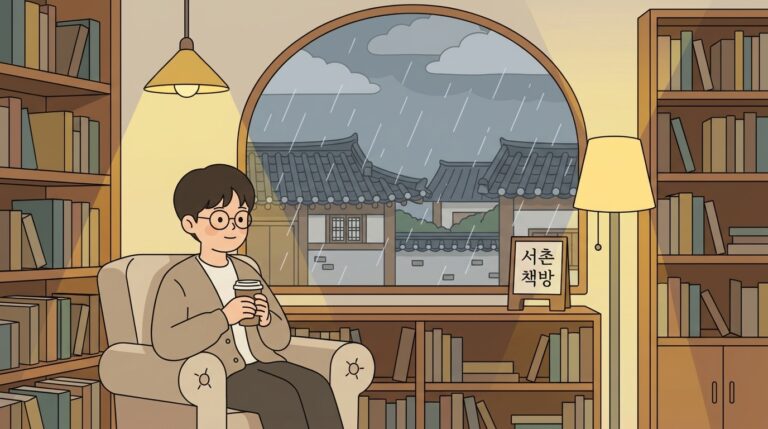
Setting: It is a rainy Thursday afternoon. You are sitting at a massive oak table inside a quiet, dimly lit independent bookstore-cafe in Seochon, Seoul. The smell of rain-soaked stone outside mixes with the aroma of freshly ground drip coffee and old paper. Min-jun, the passionate local curator of the store, approaches your table carrying a beautifully bound collection of Korean essays.
[Cast]
- You (An advanced C2 Korean scholar exploring Seochon)
- Min-jun (민준 - The thoughtful, articulate book curator)
- Min-jun: 🎭 (Approaching with a warm, quiet smile, placing a wooden coaster on your table) “이쪽에 주문하신 따뜻한 필터 커피 나왔습니다. 그나저나… 펼쳐 놓으신 책이 꽤 심오해 보여요.”
(Here is the warm filter coffee you ordered. By the way… the book you have open looks quite profound.) -
You: 🎭 (Closing the book slightly, matching his gentle tone) “아, 감사합니다. 요즘 한국 미디어에서 연일 화두가 되고 있는 실질 문해력 저하에 관련된 칼럼을 읽고 있었어요.”
(Ah, thank you. I was reading a column about the decline in functional literacy, which has been a major talking point in Korean media lately.) -
Min-jun: 🎭 (His eyes lighting up with genuine academic interest, pulling up a nearby stool with a respectful gesture) “오, 정말요? 외국인 입장에서 한국 사회의 이 ‘문해력 논란’을 바라보시는 시각이 정말 궁금하네요. 현장 체감이 어떠신가요?”
(Oh, really? I’m genuinely curious about your perspective as a foreigner looking at this ‘literacy controversy’ in Korean society. How do you perceive it in reality?) -
You: 🎭 (Tracing the rim of your coffee cup thoughtfully) “언어학적으로 굉장히 흥미로워요. 한국은 문맹률이 제로에 가까운데, 한자어 맥락을 놓치면서 발생하는 오해가 많더라고요. 예를 들면 ‘심심한 사과’ 같은 단어요.”
(Linguistically, it’s fascinating. Korea’s illiteracy rate is close to zero, but there are so many misunderstandings arising from missing the context of Sino-Korean words. For example, words like ‘Simsimhan Sagwa’.) -
Min-jun: 🎭 (Nodding vigorously in agreement) “맞아요! ‘지루하다’는 뜻의 ‘심심하다’로 오해해 분통을 터뜨린 네티즌들 사건 말이죠! 한자 교육의 공백이 이런 참사를 낳은 것 같아요.”
(Exactly! The incident where netizens lost their tempers mistaking it for ‘boring’ [Simsimhada]! It feels like the gap in Hanja education brought about this disaster.) -
You: 🎭 (Leaning in slightly to offer a balanced view) “단순한 한자의 문제가 아니라, 활자 매체보다 숏폼 비디오처럼 즉각적인 자극에 익숙해진 디지털 생태계의 한계가 아닐까 싶어요.”
(I wonder if it’s not just a matter of Hanja, but rather the limitation of a digital ecosystem that is more accustomed to immediate stimulation like short-form videos than print media.) -
Min-jun: 🎭 (Exhaling softly, impressed by your depth) “날카로운 지적이십니다. 그래서 저희 서점도 단순 도서 판매를 넘어 문해력을 기르는 독서 토론 공동체를 지향하고 있어요. 혹시 참여해 보실 생각 있으신가요?”
(That’s a sharp observation. That’s why our bookstore aims to be a reading discussion community that builds literacy, rather than just selling books. Would you be interested in participating?)
🔀 Decision Point: How do you respond to Min-jun’s invitation?
- Choice A: “네, 가입하고 싶어요! 가입 신청서는 어디 있나요?” (Simple and direct, but lacks C2 sophistication.)
- Choice B: “관심은 많지만 제가 아직 원어민들의 빠른 토론 흐름과 그 깊은 맥락을 온전히 짚어낼 수 있을지 조금 우려스럽네요. 그래도 도전해 보고 싶습니다.” (Sophisticated, humble, demonstrates advanced vocabulary.)
- Choice C: “독서 모임은 귀찮아요. 그냥 조용히 혼자 책 읽는 게 제 스타일입니다.” (Too blunt, breaks the relational harmony [인화 / Inhwa] of the interaction.)
💡 Choices Analysis:
- Best Choice (Choice B): This is the quintessential C2 response. It beautifully balances humility with intellectual ambition. By using the expression “맥락을 짚다” in a self-reflective manner, you prove that your literacy is already top-tier. Min-jun will be absolutely charmed and will likely offer you a free hand-drip refill!
- Risk Choice (Choice C): While honest, this shuts down the relational connection (정 / Jeong) instantly. In Korean culture, flatly rejecting a communal invitation without a soft buffer is considered socially tone-deaf.
Phase 6: 10-Second Emotional Shadowing Drill
To sound like a native intellectual, your rhythm and pauses must be deliberate. Practice this sentence, paying close attention to the emotional tone and pause indicators (/).
[😤 Firm and Passionate – Defending the necessity of reading education]
“단순한 / 글자 해독을 넘어 / 생각의 깊이를 키우려면 / 독서 교육이 / 반드시 병행되어야 합니다.”
- Romanization: Dan-sun-han / geul-ja hae-dog-eul neo-meo / saeng-gag-ui gip-i-reul ki-u-ryeo-myeon / dog-seo gyo-ug-i / ban-deu-si byeong-haeng-deo-yeo-ya ham-ni-da.
- Meaning: Beyond simple decoding of letters, to grow the depth of one’s thoughts, reading education must absolutely be carried out in parallel.
- Pronunciation Tip: Pause briefly at each
/. Build up the volume on “생각의 깊이” (depth of thoughts) and deliver “반드시” (absolutely) with absolute conviction.
Phase 7: K-Culture Mini Dictionary
| Word (Korean + Romanization) | English Translation | Cultural Context & Usage |
|---|---|---|
| 심심한 사과 (Sim-sim-han Sa-gwa) |
Deep, heartfelt apology | An administrative term using the Hanja ‘심심 (甚深)’ meaning deep/profound. Younger netizens mistook it for the native Korean word ‘심심 (bored)’, causing a massive cultural debate about literacy. |
| 사흘 (Sa-heul) |
Three days | A pure Korean word. Due to the number four being ‘사 (四)’ in Sino-Korean, many modern internet users mistakenly believe ‘사흘’ means four days (which is actually 나흘 / Na-heul). |
| 활자 중독 (Hwal-ja Jung-dok) |
Text addict / Compulsive reader | A term used affectionately for someone who cannot go a day without reading something, even if it’s the ingredients on the back of a cereal box. |
| 문해력 붕괴 (Mun-hae-ryeok Bung-goe) |
Collapse of literacy | A sensational headline term used by Korean media to describe the widening gap in comprehension abilities among the digital generation. |
Phase 8: Traveler’s Survival Kit
Even if you are traveling for leisure, visiting Korea’s literary spaces will show you a gorgeous side of Seoul that tourists rarely see.
Survival Expressions for Booklovers:
- “이 책 요즘 한국 독자들 사이에서 반응이 어떤가요?”
(How is the reaction to this book among Korean readers these days?)
💡 Pro Tip: Use this with independent bookstore owners to start an authentic conversation. - “사유하기 좋은 조용한 자리가 혹시 마련되어 있을까요?”
(Is there perhaps a quiet space suitable for deep contemplation/reading?)
💡 Pro Tip: A highly poetic and elegant way to ask for a quiet reading nook. - “이 독립서점만의 시그니처 추천 도서 큐레이션이 궁금합니다.”
(I’m curious about this independent bookstore’s signature recommended book curation.)
💡 Pro Tip: Showcases that you value the owner’s taste and professional identity.
📌 Editor’s Travel Note:
When in Seoul, skip the crowded malls and head directly to the Seochon Bookstore Alley (서촌 책방골목). Use the Naver Map App Download Page to find hidden gems like Dae-o Bookstore (대오서점), the oldest secondhand bookstore in Seoul, or The Book Society (더북소사이어티) for avant-garde art publications. Note: Store operating hours in Seochon fluctuate frequently; it is wise to double-check their Instagram pages before visiting.
Phase 9: Deep Reflection — “One Step Deeper”
There is a profound historical irony in Korea’s current literacy crisis. In 1443, King Sejong the Great created Hangeul specifically because the complex Chinese characters (한자) prevented common citizens from expressing their thoughts and reading laws. He built a phonetic writing system so simple that “a wise man can learn it in a morning, and a fool in ten days.”
Now, centuries later, the ease of Hangeul has led to a different kind of challenge. Because decoding the letters is so effortless, the educational focus shifted away from rigorous comprehension training. Furthermore, because a massive percentage of Korean vocabulary (nearly 60-70%) is rooted in Sino-Korean Hanja roots, reading modern text without understanding those foundational concepts is like trying to build a house on sand.
Modern Korean society is facing a crossroad: Should we simplify our language to match the speed of the digital age, or should we slow down and preserve the classical depth of our vocabulary through targeted reading education?
💬 Your Turn: How does your native language handle the friction between rapid digital communication and deep textual comprehension? Let’s discuss in the comments below!
Phase 10: FAQ & Avoiding Misunderstandings
Q: Why do young Koreans struggle with Hanja-based vocabulary if they don’t use Hanja characters in daily life anymore?
A: Yes, Korea mostly phased out Chinese characters (한자) from daily newspapers and textbooks in the late 20th century to prioritize pure Hangul. However, the vocabulary itself remains deeply Hanja-derived. Without basic root-character education, young readers can read the phonetic sound of a word but cannot deduce its abstract meaning when encountered in formal documents.
Q: Is this “literacy collapse” a sign that the Korean education system is failing?
A: No, not necessarily. Korean students consistently score near the very top of global OECD PISA rankings in reading. The issue is a modern divergence: while academic reading remains high, “everyday digital functional literacy” (discerning fake news, understanding corporate memos, parsing long-form policy) is dropping due to a media diet dominated by visual platforms.
Q: As a C2 learner, should I start studying Hanja characters?
A: Yes, absolutely. You do not need to learn how to write thousands of complex characters by hand, but learning the sounds and meanings of key Hanja roots (e.g., 독 (Dok – to read/poison/alone), 문 (Mun – letter/door/hear)) will exponentially increase your reading speed and comprehension of academic papers and literature.
🚨 Common Mistakes Alert:
- Confusing ‘금일’ (Geum-il / Today) with ‘금요일’ (Geum-yo-il / Friday): Remember, 금일 is







