

Lost in Seoul? Ask “Does This Bus Go to Seoul Station?” Like a True Local!
Phase 1: Empathy (Welcome, Adventurer!)
안녕하세요! (Annyeong-haseyo!) Welcome back to Daily Hangul, your cozy Korean learning space. I’m your lead editor and local Seoul guide.
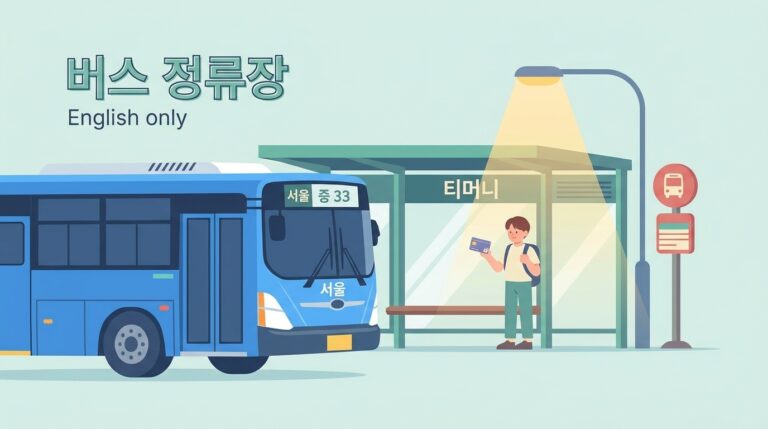
Imagine this: You are standing in the vibrant heart of Myeongdong. Neon signs are glowing, the scent of sizzling street food fills the air, and a giant blue bus pulls up to the curb. Your feet are tired from a long day of exploring, and you need to get back to Seoul Station (서울역 – Seoul-yeok). You see the bus doors open, but the digital sign on the front flashes in Korean. Your heart rate spikes. Is this the right one?
If you’ve watched K-Dramas like Twenty-Five Twenty-One or My Mister, you know how iconic Seoul buses are—they are the veins of this fast-moving city. Knowing how to ask a single, simple question can turn your travel anxiety into a moment of warm connection with a friendly local driver. Today, we’re going to master that exact phrase so you can step onto any bus with total confidence.
Phase 2: Three Essential Phrases to Save Your Day
Let’s break down the three most powerful phrases you need when navigating Seoul’s bus system.
1. 서울역 가나요? (Seoul-yeok gannayo?)
- Pronunciation: [Seoul-yeok gan-nah-yo?] / Sound-alike: “Seoul-yuck gone-nah-yo?”
- Meaning: Does this go to Seoul Station?
- K-Culture Moment: This is the ultimate classic. Picture yourself in a K-Drama, stepping halfway onto the bus, making polite eye contact with the driver, and asking this with a gentle nod.
- Editor’s Insight: The ending “~나요?” (~nayo?) is beautifully soft and polite. It makes you sound curious and friendly rather than demanding.
- Situation Spectrum:
- Casual (Friends): ⚠️ (Slightly too polite for close friends, but okay)
- Semi-formal (Co-workers/Strangers): ✅ (Perfect!)
- Formal (Elderly/Boss): ✅ (Safe and respectful)
- 🤔 Think About It: Notice how there is no word for “you” or “this bus” in this sentence? In Korean, we love dropping the subject when the context is obvious. It’s all about shared space and mutual understanding!
2. 이거 서울역 가요? (Igeo Seoul-yeok gayo?)
- Pronunciation: [Ee-geo Seoul-yeok gah-yo?]
- Meaning: Does this go to Seoul Station?
- K-Culture Moment: You are pointing at a specific bus while asking a nearby local at the bus stop.
- Editor’s Insight: “이거” (Igeo) means “this.” It’s slightly more casual and very fast to say when a bus is about to close its doors.
- Situation Spectrum:
- Casual: ✅
- Semi-formal: ✅
- Formal: ⚠️
3. 서울역 가려면 몇 번 타야 해요? (Seoul-yeok garyeomeon myeot beon taya haeyo?)
- Pronunciation: [Seoul-yeok gah-ryeom-eon myeot beon tah-yah hae-yo?]
- Meaning: To go to Seoul Station, which number should I ride?
- K-Culture Moment: Asking an elder sitting at a bus shelter for directions while waiting under the cherry blossoms.
- Editor’s Insight: This is a bit longer, but extremely useful when you are completely lost and need someone to point out the bus number for you.
- Situation Spectrum:
- Casual: ⚠️
- Semi-formal: ✅
- Formal: ✅
Phase 3: Textbook Korean vs. Real-World Korean
Many textbooks teach you stiff sentences that locals rarely use. Let’s see the difference so you can sound like a natural!
Scenario 1: Asking the Bus Driver
- 📖 Textbook Korean: 실례합니다, 이 버스는 서울역에 정차합니까? (Shillye-hamnida, i beoseu-neun Seoul-yeok-e jeongcha-hamnikka? – Excuse me, does this bus stop at Seoul Station?)
- 🗣️ Real-World Korean: 서울역 가나요? (Seoul-yeok gannayo? – Seoul Station go?)
- 💡 Why the difference? Seoul transit moves fast! Bus drivers don’t have time for long, literary sentences. “Seoul-yeok gannayo?” is highly polite yet incredibly efficient.
Scenario 2: Asking a Person at the Bus Stop
- 📖 Textbook Korean: 서울역으로 가는 버스 노선을 알려주시겠습니까? (Seoul-yeok-euro ganeun beoseu noseon-eul allyeo-jusigessnimkka? – Could you please inform me of the bus route going to Seoul Station?)
- 🗣️ Real-World Korean: 서울역 가는 거 어디서 타요? (Seoul-yeok ganeun geo eodiseo tayo? – Where do I ride the one going to Seoul Station?)
- 💡 Why the difference? Real spoken Korean relies heavily on contractions like “거” (geo) instead of “것” (geot – thing/one) and uses direct, natural verbs.
Phase 4: K-Culture Deep Dive & Non-Verbal Manners
4-1. The “Nunchi” (눈치) of Riding a Seoul Bus
When boarding a bus in Korea, non-verbal etiquette is just as important as speaking.
1. The Slight Bow: When asking the driver, step onto the first step, bow your head slightly, and ask your question. It shows immense respect.
2. The Fast Tag: Have your transportation card ready in your hand before you step on. Korean efficiency (빨리빨리 – Ppalli-ppalli) is real!
4-2. Understanding Seoul’s Colorful Buses
Did you know Seoul buses are color-coded?
* Blue Buses (간선): Run on main lines connecting different districts of Seoul. These are your best friends for long distances.
* Green Buses (지선): Local feeder buses that connect subway stations and neighborhoods.
* Red Buses (광역): Express buses connecting Seoul with surrounding suburban areas (like Gyeonggi-do).
Phase 5: Interactive Roleplay – A Rainy Night in Myeongdong
Let’s put your skills to the test! You are trying to get back to your hotel near Seoul Station. It’s raining, and a big blue bus pulls up.
- Setting: A bustling, rain-slicked bus stop in Myeongdong. The bus headlights cut through the mist.
- Cast: You (an excited traveler) and 기사님 (Gisanim – the friendly bus driver).
기사님: (🎭 opens the door, welcoming you inside with a nod)

You: (🎭 stepping onto the first step, shaking off your umbrella)
     안녕하세요! (Annyeong-haseyo!)
     - Hello!

기사님: (🎭 smiling warmly)
       네, 어서 오세요! (Ne, eoseo oseyo!)
       - Yes, welcome aboard!

You: (🎭 looking slightly worried, pointing towards the route map)
     저기... 이거 서울역 가나요? (Jeogi... igeo Seoul-yeok gannayo?)
     - Um... does this go to Seoul Station?

기사님: (🎭 nodding vigorously)
       네! 서울역 갑니다. 타세요! (Ne! Seoul-yeok gamnida. Taseyo!)
       - Yes! It goes to Seoul Station. Get on!

You: (🎭 letting out a sigh of relief)
     아, 감사합니다! (Ah, gamsa-hamnida!)
     - Oh, thank you!

기사님: (🎭 pointing to the card terminal)
       카드 찍어주세요. (Kadeu jjigeo-juseyo.)
       - Please tag your card.

You: (🎭 tapping your card on the terminal with a cheerful "BEEP!")

기사님: (🎭 gesturing toward the empty seats near the front)
       비 맞았는데 얼른 앉으세요. (Bi majatneunde eolleon anjeuseyo.)
       - You got rained on, please sit down quickly.

You: (🎭 bowing politely as you head to a seat)
     네, 감사합니다! (Ne, gamsa-hamnida!)
     - Yes, thank you!
🔀 Decision Point: How do you react when the driver asks you to tag your card?
- Choice A: Say “I don’t have a card” and try to hand him a 50,000 KRW bill.
- Choice B: Smile, tap your T-money card smoothly on the terminal, and sit down. (Best Choice!)
- Choice C: Panic, run off the bus back into the rain.
-
Best Choice Analysis (B): Seoul buses are almost entirely cashless now! Having your T-money card pre-loaded and ready to tag shows you understand local culture and respects the driver’s time.
- Risk Choice Analysis (A): Most drivers cannot accept large bills or cash at all. Trying to pay with cash might cause a delay for other passengers.
Phase 6: 10-Second Emotion Shadowing Drill
Let’s practice saying our core phrase with real emotion! Follow the slash / marks for natural pauses.
- [🥺 Worriedly & Politely – Asking under pressure]
- “저기… / 서울역 / 가나요?”
- Jeogi… / Seoul-yeok / gannayo?
- [😊 Brightly & Confidently – When you are happy to find the right bus]
- “아! / 서울역 / 가요? / 감사합니다!”
- Ah! / Seoul-yeok / gayo? / Gamsa-hamnida!
Phase 7: K-Culture Mini Dictionary
| Word (Korean + Romanization) | English Meaning | Local Context & Usage |
|---|---|---|
| 기사님 (Gisanim) | Driver / Mr. Driver | The most respectful way to address bus drivers, taxi drivers, or technicians. |
| 환승 (Hwanseung) | Transfer | Free or discounted transfers between buses and subways within 30 minutes! |
| 교통카드 (Gyotong-kadeu) | Transit Card | Your golden ticket (like T-money) to travel seamlessly across South Korea. |
| 정류장 (Jeongryujang) | Bus Stop | The physical bus stop shelter, often equipped with heated benches in winter! |
Phase 8: Traveler’s Survival Kit
Survival Phrases TOP 3
- 내려요! (Naeryeoyo! – Getting off!)
- Pro Tip: Use this if the bus is crowded and you need the driver to hold the door open for you to exit.
- 카드 안 돼요. (Kadeu an dwaeyo. – My card isn’t working.)
- Pro Tip: If the terminal makes an angry beep, say this politely to get the driver’s help.
- 여기 어디예요? (Yeogi eodi-yeyo? – Where is this place?)
- Pro Tip: Show this to a local if you think you missed your stop.
📌 Editor’s Travel Note:
Before you step out of your hotel, download the Naver Map App Store Page or Google Play Store equivalent. Google Maps does not work well for real-time bus tracking in Korea, but Naver Map will tell you exactly when your bus is arriving down to the second!
Phase 9: Deep Thoughts – “The Power of Context”
In Western languages, we are taught to specify everything: “Excuse me, does this bus go to Seoul Station?”
But in Korean, we say: “Seoul Station go?”
This reflects the beautiful, community-oriented nature of Korean society. We share the same physical space and moment, so we don’t need to state the obvious. Over-explaining can actually make you sound distant. By dropping the subject, you are inviting the listener into a shared context. It’s a wonderful way of saying, “We are in this together.”
💬 Your Turn: Does your native language drop subjects like Korean does, or do you have to specify everything? Let’s chat in the comments below!
Phase 10: FAQ & Common Mistakes
Q: Can I pay with a regular foreign credit card on Seoul buses?
A: Generally, no. Only Korean credit cards with integrated “후불교통” (post-paid transit) chips work. It is highly recommended to buy a physical T-money card at any convenience store and load it with cash.
Q: Do I need to tap my card when getting off the bus?
A: Yes, absolutely! Always tag your card on the exit reader. This ensures you get transfer discounts and avoids extra distance-based charges on your next ride.
Q: Are the bus announcements in English?
A: Yes! Major stops in Seoul are announced in both Korean and English. Listen for: “이번 정류소는 서울역입니다.” (This stop is Seoul Station).
🚨 Common Mistakes Warning!
- Mistake 1: Calling the driver “아저씨” (Ajeossi – Mister). While not deeply offensive, it is much more polite and professional to use 기사님 (Gisanim).
- Mistake 2: Standing up and moving while the bus is turning sharply. Seoul bus drivers drive dynamically. Hold onto the handrails until the bus stops!
Phase 11: Action Missions
- 🥉 Bronze Mission (My Room Challenge): Look in the mirror, pretend you are stepping onto a bus, and practice saying “서울역 가나요?” three times with a friendly smile.
- 🥈 Silver Mission (Social Challenge): Share your favorite K-Drama bus scene on Instagram or Twitter, tag #DailyHangul, and write “서울역 가나요?” in the caption!
- 🥇 Gold Mission (Real-World Challenge): The next time you are in Seoul, skip the subway once! Take a local blue bus, look the driver in the eyes, and ask: “서울역 가나요?”
Phase 12: Interactive Quiz Challenge
1. Which phrase is the most natural and polite way to ask a bus driver if the bus goes to Seoul Station?
a) 이거 서울역 가?
b) 서울역 가나요?
c) 서울역 가라!
2. True or False: You should always tag your transit card when getting off the bus in Korea.
- True / False
🎉 Click to see the Answers & Explanations!
- Correct Answer: b) 서울역 가나요?
- Explanation: It uses the polite and soft ending “~나요?” which is perfect for strangers and drivers. (a) is too casual/rude for a driver, and (c) is a command!
- Correct Answer: True
- Explanation: Tagging off is essential to avoid penalty fares and to get free transfer benefits!
- Explanation: Tagging off is essential to avoid penalty fares and to get free transfer benefits!







