

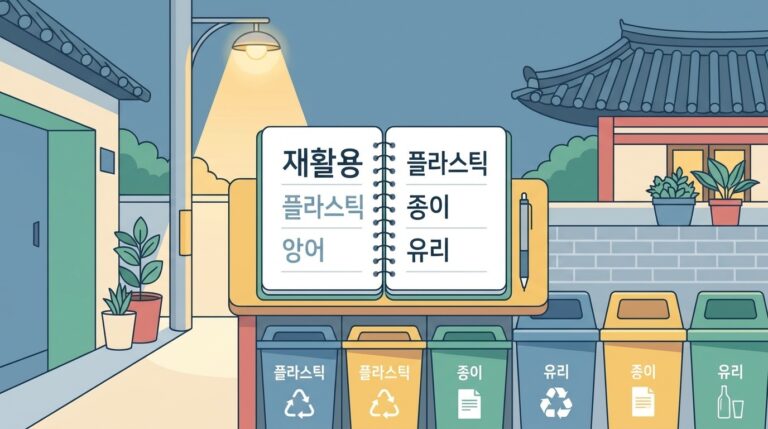
Master Korea’s Trash System: The Ultimate Beginner’s Guide to Jongryangje Bags
Phase 1: Empathy (스토리 몰입형 오프닝)
안녕하세요! (An-nyeong-ha-se-yo!) Hello! It’s your favorite Daily Hangul editor and local lifestyle guide.
Imagine this: You’ve just finished a delicious meal of delivery Korean Fried Chicken (치맥 – chi-maek) in your cozy Seoul studio. You are feeling full, happy, and ready to binge-watch another episode of your favorite K-drama. But then, you look at the grease-stained box, the leftover radish containers, the plastic wrappers, and the bones. A cold sweat breaks out. Where on earth does all of this go?
If you have ever stood in front of a colorful row of recycling bins in Korea feeling completely frozen, you are not alone. In Korea, trash disposal is not just a daily chore—it is an art form, a civic duty, and a major cultural experience. In fact, many foreigners joke that passing the “Korean Trash Sorting Test” is the true initiation into becoming a real Seoulite.
Today, we are going to crack the code of 종량제 봉투 (jong-ryang-je bong-tu)—Korea’s volume-rate garbage bag system. Master this, and you will save yourself from hefty fines, earn the deep respect of your neighborhood 아줌마 (a-jum-ma – neighborhood auntie), and live like a true local. Let’s dive in!
Phase 2: Key Expressions (핵심 표현 3선 심층 분석)
1. 종량제 봉투 (Jong-ryang-je bong-tu)
- Pronunciation: jong-ryang-je bong-tu / Sound-alike: “jong-ryahng-jeh bong-too”
- Meaning: Pay-as-you-go / Volume-rate litter bag.
- K-Culture Moment: In slice-of-life K-dramas, you often see characters buying these plastic bags at the local convenience store alongside ice cups and ramyeon. They are official bags issued by each local district (gu/구).
- Editor’s Insight: You cannot just use any grocery bag for your trash. Each district in Korea (like Mapo-gu, Gangnam-gu, etc.) has its own specific colored bag. If you throw away trash in a Mapo-gu bag while living in Seodaemun-gu, your trash will be left behind with a warning sticker!
- Situation Spectrum:
- Casual (with friends): ✅ “종량제 봉투 있어?” (Do you have a official trash bag?)
- Semi-formal (with landlord): ✅ “종량제 봉투 어디서 사요?” (Where do I buy the official trash bags?)
- Formal: ✅ “종량제 봉투를 사용해야 합니다.” (You must use the volume-rate bags.)
- 🤔 Think About It: Why does Korea use different bags for different districts? It is because trash treatment fees are managed locally. By purchasing a bag, you are actually paying your local trash disposal tax in advance!
2. 분리수거 (Bun-ri-su-geo)
- Pronunciation: boon-ree-soo-guh / Sound-alike: “boon-ree-soo-guh”
- Meaning: Waste sorting / Recycling separation.
- K-Culture Moment: Think of K-dramas where a handsome lead character casually helps the female lead carry heavy cardboard boxes to the apartment’s recycling station on a Sunday morning. It is the ultimate neighborly bonding ritual.
- Editor’s Insight: 분리수거 is taken very seriously. Plastic, cans, glass, paper, and vinyl must all be separated. If you mix them together, your building manager will find you!
- Situation Spectrum:
- Casual: ✅ “오늘 분리수거 하는 날이야.” (Today is recycling day.)
- Semi-formal: ✅ “분리수거 좀 도와줄래요?” (Could you help me with the recycling sorting?)
- Formal: ⚠️ (Usually kept to practical daily contexts.)
- 🤔 Think About It: In many Western countries, sorting is done broadly. Why does Korea separate items down to “vinyl wrap” and “clear PET bottles”? It reflects Korea’s collective effort to protect their beautiful, mountainous peninsula.
3. 음식물 쓰레기 (Eum-sik-mul sseu-re-gi)
- Pronunciation: eum-sik-mul sseu-re-gi / Sound-alike: “oom-sheek-mool ssuh-reh-ghee”
- Meaning: Food waste.
- K-Culture Moment: If you have watched domestic reality shows like I Live Alone, you have probably seen celebrities struggling to throw away food waste. It is a highly relatable struggle!
- Editor’s Insight: The golden rule of Korean food waste is: “Can an animal eat this?” If yes, it is food waste. If no (like chicken bones, eggshells, or peach pits), it is general waste (일반 쓰레기).
- Situation Spectrum:
- Casual: ✅ “음식물 쓰레기 버리고 올게.” (I’ll go throw away the food waste.)
- Semi-formal: ✅ “음식물 쓰레기는 따로 버려주세요.” (Please discard the food waste separately.)
- Formal: ✅ (Used in public notices or official building guidelines.)
- 🤔 Think About It: How does your home country handle leftover food? In Korea, food waste is recycled into animal feed or organic fertilizer, which is why the sorting rules are so amazingly detailed!
Phase 3: Textbook vs. Real Korean (교과서 한국어 vs 진짜 한국어)
Let’s compare stiff textbook phrases with the lively, natural sentences Koreans actually use when dealing with trash.
1. Buying a bag at the convenience store
- 📖 Textbook: “종량제 봉투를 주십시오.” (Jong-ryang-je bong-tu-reul ju-sip-si-o. / Please give me a volume-rate bag.) -> Too formal and clinical.
- 🗣️ Real Korean: “쓰레기 봉투 하나 주세요. 20리터짜리로요!” (Sseu-re-gi bong-tu ha-na ju-se-yo. I-sip-ri-teo-jja-ri-ro-yo! / Can I get a trash bag? The 20-liter one, please!)
- 💡 Why is it different? Locals rarely say the long word “종량제”. They simply say “쓰레기 봉투” (trash bag) or even “쓰봉” (sseu-bong) for short, and specify the size they need (usually 10L or 20L for single households).
2. Asking where to throw away something
- 📖 Textbook: “쓰레기를 어디에 버려야 합니까?” (Sseu-re-gi-reul eo-di-e beo-ryeo-ya hap-ni-ka? / Where must I discard the trash?) -> Sounds like an academic manual.
- 🗣️ Real Korean: “이거 어디다 버려요?” (I-geo eo-di-da beo-ryeo-yo? / Where do I throw this?)
- 💡 Why is it different? Spoken Korean values speed and efficiency. “어디다” (eo-di-da) is a natural contraction of “어디에다가” (eo-di-e-da-ga), which flows off the tongue much faster during busy housework.
Phase 4: K-Culture Deep Dive & Non-verbal Manners
4-1. Nunchi (눈치) & Non-verbal Etiquette
- The Art of the Clean Peel: When recycling plastic water bottles, you must peel off the plastic label entirely. Throw the label in the vinyl recycling, crush the bottle flat to save space, and put the cap back on. Doing this demonstrates high 눈치 (Nunchi – social wit/sensibility). Your neighbors will see your neatly flattened bottles and think, “Wow, this resident is highly civilized!”
- The Sunset Rule: In many residential neighborhoods (especially villa districts), you are only allowed to put out your trash during designated hours, typically between 6:00 PM and midnight. Putting trash out in the scorching morning sun is a major faux pas because it causes odors and attracts street cats.
4-2. K-Culture Code Analysis
In Korean apartment complexes, the recycling yard is the ultimate communal space. In family-oriented K-dramas, you will often find neighborhood busybodies gathering there to exchange gossip while sorting cardboard boxes. It is a symbol of Korea’s transition from a rural, village-sharing society to dense modern apartment living, where community rules must still be collectively maintained.
Phase 5: Interactive Roleplay Scenario
Setting: It is a breezy Tuesday night in a quiet residential alleyway in Mapo-gu, Seoul. You are standing in front of the villa’s shared trash bins with a cardboard box full of plastic containers. An elderly neighborhood lady, the legendary 아줌마 (Ajumma), is quietly watching you with sharp, eagle-like eyes.
Cast:
- You: A friendly foreign resident trying your best to follow the local rules.
- 아줌마 (Ajumma): The passionate volunteer guardian of the neighborhood’s recycling zone.
Dialogue:
- 아줌마: “(🎭 Looking closely at your hands) 학생, 잠깐만요! 그 상자 테이프 뗐어요?”
(Hag-saeng, jam-kkan-man-yo! Geu sang-ja te-i-peu ttet-eo-yo? / Student, wait a second! Did you peel the tape off that box?) -
You: “(🎭 Startled, bowing slightly) 아, 안녕하세요! 테이프요? 아직 안 뗐어요.”
(Ah, an-nyeong-ha-se-yo! Te-i-peu-yo? A-jik an ttet-eo-yo. / Oh, hello! The tape? I haven’t peeled it off yet.) -
아줌마: “(🎭 Shaking her head gently) 에이, 박스는 테이프를 꼭 떼고 버려야 돼. 그래야 재활용이 되지!”
(E-i, bak-seu-neun te-i-peu-reul kkok tte-go beo-ryeo-ya dwae. Geu-rae-ya jae-hwal-yong-i doe-ji! / Oh dear, you must peel the tape off the cardboard box. That’s the only way it can be recycled!) -
You: “(🎭 Realizing) 아, 그렇군요! 몰랐어요. 지금 바로 뗄게요.”
(Ah, geu-reoh-gun-yo! Mol-rat-eo-yo. Ji-geum ba-ro ttel-ge-yo. / Oh, I see! I didn’t know. I’ll peel it off right now.) -
아줌마: “(🎭 Smiling warmly) 그래요, 잘하네. 근데 그 플라스틱 배달 용기는 씻어 왔나?”
(Geu-rae-yo, jal-ha-ne. Geun-de geu peul-ra-seu-tik bae-dal yong-gi-neun ssis-eo wat-na? / Yes, good job. By the way, did you wash those plastic food containers?) -
You: “(🎭 Nodding enthusiastically) 네! 물로 깨끗하게 씻어 왔어요!”
(Ne! Mul-ro kkae-kkeut-ha-ge ssis-eo wat-eo-yo! / Yes! I washed them clean with water!) -
아줌마: “(🎭 Impressed, clapping her hands) 아이고, 예쁘네! 아주 잘했어요. 어떤 사람들은 그냥 버려서 골치 아픈데.”
(A-i-go, ye-bbeu-ne! A-ju jal-ha-ss-eo-yo. Eo-tteon sa-ram-deul-eun geu-nyang beo-ryeo-seo gol-chi a-peun-de. / Oh, lovely! Great job. Some people throw them away dirty and it causes such a headache.) -
You: “(🎭 Smiling proudly) 한국 생활 규칙을 열심히 배우고 있어요. 감사합니다!”
(Han-guk saeng-hwal gyu-chik-eul yeol-sim-hi bae-u-go is-seo-yo. Gam-sa-hap-ni-da! / I am studying Korean living rules hard. Thank you!) -
아줌마: “(🎭 Patting your shoulder) 착하네. 쓰레기 봉투는 매주 화요일이랑 목요일 밤에만 내놓는 것도 알지?”
(Chak-ha-ne. Sseu-re-gi bong-tu-neun mae-ju hwa-yo-il-i-rang mok-yo-il bam-e-man nae-noh-neun geot-do al-ji? / Sweetheart. You know we only put out the trash bags on Tuesday and Thursday nights, right?) -
You: “(🎭 Confidently) 네, 달력에 적어 놨어요!”
(Ne, dal-ryeok-e jeok-eo nwat-eo-yo! / Yes, I wrote it down on my calendar!)
—
🔀 Decision Point!
The Ajumma hands you a small, discarded plastic coffee cup with a tiny bit of sweet iced caramel macchiato leftover at the bottom. She asks you: “그럼 이건 어디에 버려야 할까?” (Then, where should we throw this?)
- A) “그냥 플라스틱 재활용 함에 넣을게요!” (I’ll just throw it in the plastic recycling bin!)
- B) “남은 음료수는 싱크대에 버리고, 컵은 물로 헹궈서 플라스틱으로 버릴게요!” (I’ll pour the leftover drink down the sink, rinse the cup with water, and recycle it as plastic!)
- C) “전체 다 일반 쓰레기 종량제 봉투에 넣어 버릴게요!” (I’ll throw the whole thing into the general waste trash bag!)
🏆 Best Choice: B
Excellent! You nailed it. Liquid or food remnants inside containers ruin the entire batch of recycling. Always pour out liquids, wash the container, and separate the lid if it is made of a different material. The Ajumma will reward you with a big smile and maybe even some fresh fruit!
⚠️ Risky Choices: A & C
- If you chose A, the liquid will spill and contaminate the other clean recyclables, making the Ajumma very upset!
- If you chose C, while safer than A, it is a waste of recyclable plastic and fills up your expensive general waste bag too quickly.
Phase 6: 10-Second Shadowing Drill (감정 섀도잉 드릴)
Let’s practice speaking with real Korean emotion! Use the slashes / for natural pauses.
- [😊 Expressing proud compliance]
- “이거 / 깨끗하게 / 씻어 왔어요!”
- I-geo / kkae-kkeut-ha-ge / ssis-eo wat-eo-yo!
- (I washed this / completely clean / before bringing it!)
- [🥺 Asking for kind help]
- “아줌마, / 이거 / 어디다 / 버려요?”
- A-jum-ma, / i-geo / eo-di-da / beo-ryeo-yo?
- (Auntie, / where / do I throw / this?)
- [😤 Determined to do it right]
- “테이프 / 지금 / 바로 / 뗄게요!”
- Te-i-peu / ji-geum / ba-ro / ttel-ge-yo!
- (I will peel / the tape / right / now!)
Phase 7: K-Culture Mini Dictionary (4개 핵심 키워드)
| Word (한글) | Romanization | English Translation | Real-world Context |
|---|---|---|---|
| 빌라 | Bil-la | Villa / Low-rise building | Refers to multi-unit brick buildings (3-5 floors) common in residential neighborhoods. Trash rules here are usually managed directly by residents, making community rules highly personal! |
| 아줌마 | A-jum-ma | Middle-aged woman | A friendly yet powerful demographic in Korea. Showing them respect and asking for household advice will make your life in Korea 200% easier. |
| 과태료 | Gwa-tae-ryo | Fine / Administrative penalty | If you do not use the correct official trash bag or mix food waste with plastics, you could face a fine of up to 300,000 KRW ($230 USD). |
| 소화제 | So-hwa-je | Digestion aid / “Satisfying” | While physically medicine, Koreans metaphorically use this to describe the deep, stress-relieving satisfaction of solving a complicated task perfectly—like sorting trash cleanly! |
Phase 8: Traveler’s Survival Kit
Top 3 Survival Phrases for Travelers
- “일반 쓰레기 봉투 하나 주세요.”
- Il-ban sseu-re-gi bong-tu ha-na ju-se-yo.
- Tip: Say this at any convenience store cashier to buy a general waste bag. They will ask you “몇 리터짜리요?” (How many liters?). Ask for “십리터” (sip-ri-teo – 10L) if you are traveling light.
- “영수증은 봉투에 넣어주세요.”
- Yeong-su-jeung-eun bong-tu-e neo-eo-ju-se-yo.
- Tip: This means “Please put the receipt inside the bag.” In Korea, paper trash can also go into designated paper recycling piles, but thermal receipts are actually general waste!
- “길거리에 쓰레기통이 없어요.”
- Gil-geo-ri-e sseu-re-gi-tong-i eop-seo-yo.
- Tip: “There are no trash cans on the street.” Street trash cans are extremely rare in Seoul. Carry a small plastic bag in your backpack to store your trash until you return to your accommodation or find a subway station.
📌 Editor’s Travel Note
When navigating your neighborhood, use the Naver Map App or KakaoMap App to locate local community centers (주민센터 – Ju-min sen-teo) where you can pick up English brochures about local recycling schedules if you are staying long-term.
Phase 9: Deep Reflection — “One Step Deeper” (한 발 더 깊이)
Why is Korea so incredibly strict about trash sorting? It comes down to land, population density, and history. In 1995, Korea introduced the volume-rate waste disposal system to reduce waste dramatically in its rapidly growing cities. Because Korea has limited land space, recycling isn’t just a green lifestyle trend—it is a survival strategy.
By participating in 분리수거, you are not just throwing away garbage; you are participating in a historical, collective social contract. It shows how Korean society values collective responsibility and harmonious community living over individual convenience.
💬 Your Turn: How does your home country handle waste? Do you have strict rules or is it a simpler system? Let us know in the comments below!
Phase 10: FAQ & Common Mistakes (FAQ Schema Optimized)
Q: Can I use a Gangnam-gu trash bag if I live in Mapo-gu?
A: No. You must buy and use the trash bags specifically issued by your local district (gu/구). Local convenience stores only sell the bags for the district they are physically located in, so buy them close to home!
Q: Are bones (chicken, pork, beef) considered food waste?
A: No. Animal bones, eggshells, garlic skins, and fruit pits (like peach or cherry pits) are hard and cannot be processed into animal feed. Discard them in the general waste (일반 쓰레기) bag.
Q: Where do I buy the food waste bags?
A: At any local convenience store or supermarket. Just ask the clerk for “음식물 쓰레기 봉투” (eum-sik-mul sseu-re-gi bong-tu). They are usually yellow or orange, while general trash bags are white or light blue.
🚨 Common Mistakes Alert!
- Throwing dirty delivery containers into recycling: If it has red tteokbokki sauce stains that won’t wash off, throw it in general waste!
- Mixing food waste with plastic bags: Never throw food waste directly into the food bin while it is still sealed inside a regular grocery plastic bag. Empty the food waste into the bin or the official yellow food waste bag.
- Ignoring the calendar: Each neighborhood has specific days for recycling. Check the entrance of your building for the schedule!
Phase 11: Action Mission & Participation
Ready to put your knowledge to the test? Complete these three challenges to become a local pro!
- 🥉 Bronze (At-Home Challenge): Go through your trash bin right now. Separate at least three plastic bottles, peel off their labels, crush them flat, and screw the caps back on.
- 🥈 Silver (Social Challenge): Take a photo of your neatly sorted recycling pile and post it on your Instagram Story or favorite online community. Use the hashtag
#DailyHanguland show off your eco-friendly Korean lifestyle! - 🥇 Gold (Real-world Challenge): Go to your nearest Korean convenience store and buy a pack of 10-liter general waste bags in Korean. Say: “쓰레기 봉투 10리터짜리 한 묶음 주세요” (Please give me one bundle of 10-liter trash bags).
-
🎮 K-Culture Treasure Hunt: Next time you watch a K-drama, look closely at the kitchen scenes. See if you can spot the yellow food waste bin or the colored plastic bags hanging on the wall!
Phase 12: Interactive Quiz Challenge
1. Situation Judgment
- Question: You just ate a peach. Where do you throw away the large hard seed in the middle?
- A) Food waste bin
- B) General waste bag
- C) Throw it out the window into the garden
👉 Click to reveal the Answer & Explanation
- Correct Answer: B
- Why? Since a animal cannot digest a hard peach seed, it must go into the general waste bag. (And please don’t choose C!)
2. Fill in the Blank
- “상자 버릴 때는 꼭 ________를 떼고 버려야 해요.”
(When throwing away a box, you must definitely peel off the ________ first.)
👉 Click to reveal the Answer & Explanation
- Correct Answer: 테이프 (te-i-peu / tape)
- Why? Plastic packing tape cannot be recycled with cardboard paper. Always peel it off first!
3. True or False?
- Statement: “Every city and district in Seoul uses the exact same color and design for their trash bags.”
👉 Click to reveal the Answer & Explanation
- Correct Answer: False
- Why? Each district (gu) has its own uniquely colored and labeled bags. You must use the bag that matches the district you currently live in!






