

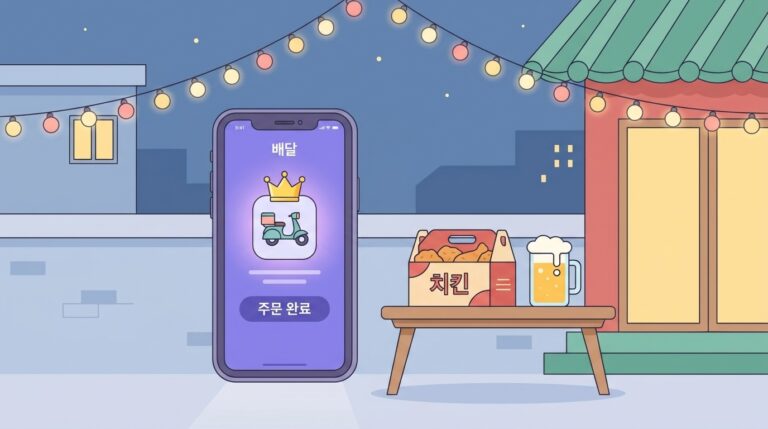
Master the Art of Late-Night Food Bragging: Korean Delivery App Slang
Phase 1: Empathy (공감)
안녕하세요! (Annyeonghaseyo!) I’m your lead editor at Daily Hangul, your cozy Korean language and culture guide. Let’s paint a picture. It’s 11:30 PM in Seoul. You’re sitting in a rooftop apartment with Korean friends after a long day of exploring. The conversation slows down, and then someone’s stomach rumbles.
Instantly, someone asks the golden question: “출출하지 않아? 야식 시킬까?” (Chulchulhaji ana? Yasik sikilkka? / “Aren’t you a bit hungry? Should we order late-night snacks?”).
One of your friends whips out their phone, opens a food delivery app, and lets out a gasp of pure pride. “나 배민 천생연분 등급이야!” (Na Baemin cheonsaeng-yeonbun deung-geub-iya!). Everyone gasps in awe. But you? You’re left staring at your screen, wondering why having a “Match Made in Heaven” (천생연분) status on a food app is a badge of absolute honor, and how on earth you can join this delicious elite club.
Don’t worry! This guide is built from real-world stories of expats who felt like outsiders during late-night food runs. By the end of this article, you’ll not only understand why Koreans are obsessed with delivery app VIP statuses, but you’ll also be able to brag about your own eating habits like a born-and-raised Seoulite!
Phase 2: Core Expressions Deep Dive (핵심 표현 3선 심층 분석)
1. 천생연분 (Cheonsaeng-yeonbun)
- Pronunciation: [cheonsaeng-yeonbun] / Sound-alike: “Chun-sang-yun-boon” (Rhymes with “sun-sang-yoon-boon”)
- Meaning:
- Literal: A match made in heaven / Soulmates.
- Real-world Nuance: The ultimate, highest VIP user tier on Korea’s top delivery app, “Baedalui Minjok” (배달의민족). It means you order delivery food dozens of times a month.
- K-Culture Moment: In K-Dramas, when a character is too lazy to cook and orders delivery every day, they proudly show their purple VIP app screen to prove their dedication to the “delivery lifestyle.”
- Editor’s Insight: Historically, this beautiful poetic word was reserved for couples who were destined to be together. Today, Koreans humorously use it to say, “My destiny is tied to this food app!”
- Situation Spectrum:
- Friends & Casual: ✅ (Perfect for bragging)
- Coworkers & Semi-formal: ⚠️ (Only if you are close and chatting during lunch)
- Bosses & Formal: 🚫 (Might make you look a bit too obsessed with fast food!)
- 🤔 Think About It: Why do you think Korean society embraces such dramatic, romantic words for casual apps? How does your culture gamify daily habits like eating?
2. 돈쭐내다 (Donjjul-naeda)
- Pronunciation: [don-jjul-nae-da] / Sound-alike: “Don-jool-nay-dah” (Rhymes with “con-tool-play-da”)
- Meaning:
- Literal: To punish someone with money.
- Real-world Nuance: To support an incredibly kind, ethical, or delicious restaurant by ordering a massive amount of food to make the owner rich.
- K-Culture Moment: Often seen on social media when netizens discover a restaurant owner who gave free meals to children in need. Everyone rallies to “돈쭐내러 가자!” (Let’s go punish them with our wallets!).
- Editor’s Insight: This is a combination of 돈 (Don / money) and 혼쭐내다 (Honjjul-naeda / to scold severely). It’s wholesome capitalistic justice!
- Situation Spectrum:
- Friends & Casual: ✅
- Coworkers & Semi-formal: ✅
- Bosses & Formal: ⚠️
- 🤔 Think About It: How does consumer activism work in your country? Do you have a slang word for supporting good businesses with massive sales?
3. 배달의 민족 (Baedal-ui Minjok)
- Pronunciation: [baedal-ui minjok] / Sound-alike: “Bae-dahl-ee meen-johk”
- Meaning:
- Literal: The Nation of Delivery / The Descendants of horseback riders.
- Real-world Nuance: The official name of Korea’s most popular food delivery app (commonly shortened to “Baemin” / 배민), and a playful national identity celebrating Korea’s lightning-fast delivery speed.
- K-Culture Moment: Mentioned in almost every lifestyle K-Vlog or variety show where cast members order food to a park near the Han River.
- Editor’s Insight: This is a brilliant pun! “Baedal” (배달) means delivery, but “Baedal” (배달/倍達) is also an ancient, legendary name for the Korean nation. Thus, Koreans are literally “born to deliver.”
- Situation Spectrum:
- Friends & Casual: ✅
- Coworkers & Semi-formal: ✅
- Bosses & Formal: ✅
- 🤔 Think About It: How does your country’s history or mythology connect with modern technology or lifestyle habits?
Phase 3: Textbook Korean vs. Real Korean (교과서 한국어 vs 진짜 한국어)
Let’s compare what you learn in classroom textbooks with how Koreans actually speak when they gather for midnight snacks.
Scenario 1: Asking if they order food often
- 📖 Textbook Korean: “배달 음식을 자주 주문하십니까?” (Do you order delivery food frequently?)
- 🗣️ Real Korean: “배달 어플 등급이 어떻게 돼요?” (What is your delivery app VIP level?)
- 💡 Why the difference? Asking directly about someone’s app tier is a much more conversational, playful way to gauge how much of a foodie (or lazy homebody) they are!
Scenario 2: Expressing your high usage
- 📖 Textbook Korean: “저는 이 배달 어플리케이션을 아주 많이 이용합니다.” (I use this delivery application very much.)
- 🗣️ Real Korean: “저 배민 거의 ‘천생연분’ 급이에요!” (I’m basically at the ‘Match Made in Heaven’ level on Baemin!)
- 💡 Why the difference? Using the actual tier name instantly establishes your “insider” status and shows you are deeply immersed in the local modern lifestyle.
Phase 4: K-Culture Deep Dive & Non-verbal Manners (문화 코드 분석)
4-1. The “Nunchi” of Late-night Delivery (눈치)
When ordering food late at night with Korean friends, there is a subtle, unwritten social etiquette.
* The Payment Dance: One person usually orders and pays first on their app to secure their VIP points (or to use their discount coupons). The polite thing to do is not to fight over the phone, but to immediately say, “정산해 줘!” (Jeongsanhae jwo! / “Send me the split bill!”) and wire your share via banking apps like Toss or KakaoPay.
* The “Review Event” (리뷰 이벤트) Promise: Many Korean restaurants offer free sides (like extra dumplings or cheese sticks) if you write a positive review on the app. If your friend ordered using a “Review Event” option, make sure you take a nice photo of the food so they can write their review and keep their VIP privileges!
4-2. The Romanticization of Yasik (야식 문화)
In K-Dramas, late-night food is never just about hunger; it’s about bonding. Whether it’s the classic Chicken and Beer (치맥 – Chimaek) by the Han River or spicy pig’s trotters (족발 – Jokbal) in a small apartment, yasik acts as a social lubricant. Sharing a delivery box in your pajamas represents a level of comfort and deep friendship (정 – Jeong) that a fancy restaurant dinner simply cannot match.
Phase 5: Interactive Roleplay Scenario (실전 롤플레이 시나리오)
The Setting: A cozy rooftop terrace in Hongdae, Seoul. 11:45 PM. The cool autumn wind is blowing, and you are sitting with Minjun, a self-proclaimed culinary master of late-night snacks.
The Cast:
- You: A hungry expat living in Seoul.
- Minjun (민jun): Your energetic Korean friend and Baemin enthusiast.
Minjun: (🎭 Rubbing his hands together greedily) 아, 오늘 밤 진짜 출출하다. 야식 각인데?
(Ah, oneul bam jinjja chulchulhada. Yasik gak-inde? / Ah, I'm so hungry tonight. It's the perfect time for late-night snacks!)

You: (🎭 Nodding eagerly) 그러니까요! 치킨 어때요? 치맥해요!
(Geureonikkayo! Chikin eottaeyo? Chimaekhaeyo! / Exactly! How about chicken? Let's do chicken and beer!)

Minjun: (🎭 Whipping out his phone with a flourish) 역시 뭘 좀 아네! 내가 배민으로 주문할게. 나 등급 높거든.
(Yeoksi mwol jom ane! Naega Baemin-euro jumunhalge. Na deung-geub nopgeodeun. / As expected, you know your stuff! I'll order on Baemin. My tier is super high.)

You: (🎭 Looking curiously at his screen) 우와, 무슨 등급인데요?
(Uwa, museun deung-geub-indeyo? / Wow, what tier are you?)

Minjun: (🎭 Showing the screen proudly) 나 ‘천생연분’이야! 나보다 많이 시켜 먹는 사람 없을걸?
(Na 'Cheonsaeng-yeonbun'-iya! Na-boda mani sikyeo meok-neun saram eobseolgeol? / I'm 'Match Made in Heaven'! I bet nobody orders more than me!)
🔀 Decision Point!
How will you respond to Minjun’s boasting?
- Option A: “대단하네요. 돈이 많으시군요.”
(Daedanhanyeoyo. Don-i manheusigun-yo. / Great. You must have a lot of money.) - Option B: “와, 진짜 ‘돈쭐’ 내주셨네요! 오늘 치킨도 부탁해요!”
(Wa, jinjja ‘donjjul’ naejusyeotneyo! Oneul chikin-do butakhaeyo! / Wow, you really ‘punished them with money’! Please take care of today’s chicken too!) - Option C: “그거 건강에 안 좋아요. 집밥을 드세요.”
(Geugeo geon-gang-e an joayo. Jipbabeul deuseyo. / That is bad for your health. Eat home-cooked meals.)
🏆 Decision Analysis:
- Best Choice – Option B: This is excellent! It uses the trendy slang 돈쭐 (donjjul) in a lighthearted, playful way, acknowledging his contribution to the economy while cheekily asking him to order. It makes the mood super fun!
- Risk Choice – Option A: A bit too literal and dry. It might sound like you are judging his spending habits instead of playing along with the joke.
- Worst Choice – Option C: Total buzzkill! Telling someone their delivery habit is unhealthy right before ordering a late-night feast will instantly ruin the cozy yasik vibe.
Phase 6: 10-Second Shadowing Drill (감정 섀도잉 드릴)
Practice saying these lines with the exact emotional markers used by native speakers. The / indicates a slight pause to catch your rhythm!
- [😊 Proudly & Boasting]
- “나 / 배민 / 천생연분 등급이야!”
- Na / Baemin / cheon-saeng-yeon-bun / deung-geub-iya!
- (I’m a Match Made in Heaven tier on Baemin!)
- [🥺 Drooling & Hungry]
- “오늘 밤은 / 무조건 / 치맥 각인데?”
- Oneul bameun / mu-jo-geon / chi-maek gak-inde?
- (Tonight is absolutely destined for Chicken and Beer!)
- [😤 Determined & Supportive]
- “여기 사장님 / 착하니까 / 돈쭐 내자!”
- Yeogi sajangnim / chakhanikka / don-jjul / nae-ja!
- (This restaurant owner is so kind, let’s punish them with our money!)
Phase 7: K-Culture Mini Dictionary (K-Culture 미니 사전)
| Word (한글/Romanization) | English Meaning | Cultural Context |
|---|---|---|
| 야식 (Yasik) | Late-night Snack | Foods eaten past 10 PM. Usually heavy, savory, and greasy meals like fried chicken, feet of pork, or spicy noodles. |
| 치맥 (Chimaek) | Chicken + Beer | The ultimate food pairing in Korea. It’s practically a religion, celebrated in movies, dramas, and Han River picnics. |
| 리뷰 이벤트 (Ribyu Ibenteu) | Review Event | A system where restaurants give free food/drinks in exchange for a promise to write a 5-star review on the delivery app. |
| 소확행 (Sohwakhaeng) | Small but Certain Happiness | A lifestyle trend in Korea focusing on finding joy in tiny, everyday things—like eating hot delivery food while watching Netflix. |
| 인싸 (Inssa) | Insider / Popular person | Someone who knows all the trends, slang, and is highly active in social circles. |
Phase 8: Traveler’s Survival Kit (여행자를 위한 생존 키트)
If you are traveling in Korea, you must know these quick phrases to survive the midnight cravings!
Survivor Cards
- Card 1: Ordering to a public park
- 🗣️ “돗자리 앞까지 배달 가능한가요?” (Dotjari ap-kkaji baedal ganeung-hangayo?)
- 💡 Pro Tip: “Can you deliver right to our picnic mat?” Use this when ordering food at the Yeouido Han River Park!
- Card 2: Asking for utensils
- 🗣️ “수저랑 포크 챙겨주세요.” (Sujeo-rang pokeu chaeng-gyeojuseyo.)
- 💡 Pro Tip: “Please pack spoons, chopsticks, and forks.” Most apps now default to ‘no plastic utensils’ to protect the environment, so make sure to ask if you need them!
- Card 3: Paying in person (if your foreign card doesn’t work on the app)
- 🗣️ “만나서 카드 결제할게요.” (Mannaseo kadeu gyeolje-halgeyo.)
- 💡 Pro Tip: “I will pay by card when we meet.” This is super helpful for travelers whose international cards are blocked on Korean payment gateways.
📌 Editor’s Travel Note: To fully experience the glory of Korean delivery, make sure to download the Baedalui Minjok App or Coupang Eats before your trip. Note that you may need a local phone number for full verification! (App features and registration requirements are subject to change over time.)
Phase 9: Deep Reflection — “One Step Deeper” (깊이 있는 생각 질문)
In many Western cultures, ordering food delivery is often seen as a solitary, lazy activity—something you do when you don’t want to go out. In Korea, however, delivery is a highly collective and social experience. The concept of “우리” (Uri / We/Our) is deeply embedded in Korean food culture. Even when ordering delivery, people discuss what to eat as a group, coordinate their orders, and share the food directly from the boxes. The delivery app is not just a tool; it is a shared social playground.
💬 Your Turn: How does late-night food delivery work in your home country? Is it a social activity, or is it mostly for solo eating? Let us know in the comments below!
Phase 10: FAQ & Avoiding Misunderstandings (FAQ & 오해 방지)
Q: Can foreigners sign up for Korean delivery apps?
A: Yes, but it depends. To use the full features of apps like Baemin, you usually need a Korean phone number registered in your name (Alien Registration Card required). However, travelers can use services like Shuttle Delivery or select the “Pay in Person” option on other local apps if they have a friendly local or guesthouse host to help with the initial location setup.
Q: Do I need to tip the delivery drivers in Korea?
A: No! Tipping is absolutely not required or expected in Korea. The delivery fee is already calculated and paid directly through the app when you place your order.
Q: Why did my food arrive so fast? Is it safe?
A: Speed is part of the culture. Korean delivery riders are famous for their speed (called the 빨리빨리 / Ppalli-ppalli culture). While highly efficient, please always be mindful of scooters on the sidewalk and give them plenty of space!
🚨 Common Mistakes Board
- Mistake: Forgetting to check the “Review Event” button but still writing “I want the free side” in the text box.
- Correct Action: Make sure you actually select the option in the app menus, as most processes are automated!
- Mistake: Leaving food trash in public areas like the Han River park.
- Correct Action: Always separate your food waste and recyclables at the designated delivery zones in the parks.
- Mistake: Trying to pay with cash directly to the driver without selecting it first in the app.
- Correct Action: Most drivers do not carry cash change anymore. Always select “Pay in cash/card upon arrival” in the app options before the driver sets off.
Phase 11: Action Missions (액션 미션)
- 🥉 Bronze (Room Challenge): Look up your favorite Korean late-night food (e.g., Tteokbokki or Jokbal) online. Practice saying your favorite item out loud with the emotion: “오늘 밤은 진짜 [Food Name] 각이다!”
- 🥈 Silver (Network Challenge): Take a screenshot of your favorite K-Drama food scene, post it on your social media, and use the hashtag #DailyHangul along with the phrase: “배달의 민족이 되고 싶어요!” (I want to become a descendant of delivery!).
- 🥇 Gold (Real-world Challenge): Next time you are with a Korean speaker, ask them: “배달 어플 등급이 어떻게 되세요?” (What is your delivery app tier?). Watch their eyes light up as they proudly boast about their status!
Phase 12: Interactive Quiz (퀴즈 챌린지)
1. What does the term “천생연분” (Cheonsaeng-yeonbun) literally mean, and how is it used in delivery apps?
👉 Click to see the answer!
It literally means “a match made in heaven (soulmates).” In delivery apps like Baemin, it represents the highest, most prestigious VIP tier for users who order food extremely frequently.
2. Fill in the blank:
“The restaurant owner was so incredibly kind to the neighborhood children, so local netizens decided to _________ (punish them with money) by ordering lots of food.”
👉 Click to see the answer!
돈쭐내다 (Donjjul-naeda)
3. True or False: Tipping the delivery rider in cash is a standard social custom in Korea.
👉 Click to see the answer!
False! Tipping is not a part of Korean culture. All delivery fees are paid upfront via the app.







