

When the Sea Knocks on Busan’s Door: Advanced Korean for Coastal Flood Defenses and Marine Resilience
안녕하세요! 매일한글 (Daily Hangul) Senior Editor here! Have you ever stood on the glittering shores of Busan’s Haeundae Beach at night, sipping a cold craft beer while watching the neon lights reflect off the waves? It’s a scene straight out of a modern K-drama. But behind this cinematic skyline lies a pressing, real-world challenge that scientists, urban planners, and marine biologists are scrambling to solve: 해수면 상승 (sea-level rise) and its threat to Korea’s vibrant coastal cities.
As advanced (C2) learners, you aren’t just here to learn how to order food. You are here to engage in high-level intellectual discourse. Today, we are diving deep into the terminology surrounding ocean sustainability, marine preservation, and the cutting-edge flood defense technologies Korea is deploying.
This guide was compiled using real-world case studies of urban planning forums in Busan and ecological restoration projects along the western mudflats. Let’s elevate your Korean to a near-native professional level!
Phase 2: Deep-Dive Vocabulary Analysis
1. 침수 대책 (浸水 rooster/對策)
- Pronunciation: [chim-su dae-chaek]
- Meaning: Inundation countermeasures / Flood response plan
- K-Culture Moment: You’ll hear this term heavily used in Korean news broadcasts during the summer monsoon season (장마철). In K-dramas focusing on political intrigue or disaster management, a tense briefing room scene always features a scientist pointing at a map of Seoul or Busan, demanding a proper 침수 대책.
- Editor’s Insight: 침수 (浸水) literally means “soaking/submerging in water,” while 대책 (對策) means “countermeasure.” Together, it refers to strategic engineering or policy actions designed to prevent urban areas from becoming underwater worlds.
- Situation Spectrum:
- Friends (Casual): 🚫
- Workplace Colleagues (Semi-formal): ⚠️
- Academic/Professional/Adults (Formal): ✅
- 🤔 Think About It: Why does Korean rely so heavily on Sino-Korean hanja roots (like 浸, 水, 對, 策) for ecological planning? How does this compare to the Germanic roots often used in everyday English conversations about “flooding”?
2. 해수면 상승 (海水面 上昇)
- Pronunciation: [hae-su-myeon sang-seung]
- Meaning: Sea-level rise
- K-Culture Moment: In K-pop, global advocacy is rising. Think of groups like BTS addressing the UN on climate change. 해수면 상승 is the exact term used in diplomatic speeches and climate documentaries to describe the global phenomenon threatening low-lying coastal zones.
- Editor’s Insight: Let’s break down the Hanja: 해 (海 – Sea), 수 (水 – Water), 면 (面 – Surface), 상승 (上昇 – Elevation/Rise). It represents a gradual, systemic global crisis, contrasting with sudden disasters like tsunamis.
- Situation Spectrum:
- Friends (Casual): 🚫
- Workplace Colleagues (Semi-formal): ⚠️
- Academic/Professional/Adults (Formal): ✅
- 🤔 Think About It: In English, we often personify nature (e.g., “the rising sea”). In Korean, 해수면 상승 sounds highly objective and systemic. How does this linguistic distance affect the way we perceive environmental responsibility?
3. 기후 회복력 (氣候 回復力)
- Pronunciation: [gi-hu hoe-bok-ryeok]
- Meaning: Climate resilience
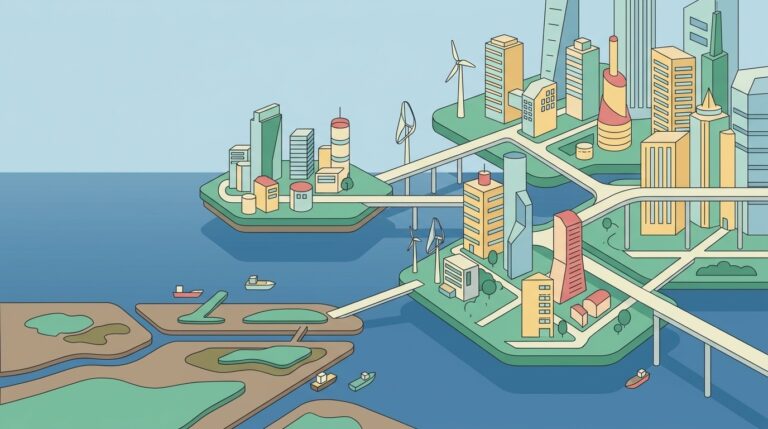
- K-Culture Moment: In modern K-Beauty and wellness culture, 회복력 (resilience/recovery power) is used to talk about skin barrier healing. But in urban planning, it refers to a city’s capacity to bounce back from natural disasters. Busan’s revolutionary floating city project, Oceanix Busan, is hailed as a prime example of building 기후 회복력.
- Editor’s Insight: 기후 means “climate,” and 회복력 combines 회복 (recovery) with 력 (power/force). It is the ultimate buzzword in modern green tech conferences in Seoul.
- Situation Spectrum:
- Friends (Casual): 🚫
- Workplace Colleagues (Semi-formal): ⚠️
- Academic/Professional/Adults (Formal): ✅
- 🤔 Think About It: 회복 implies returning to a original, healthy state. Can a city ever truly “return” to its original state after a climate crisis, or does 회복력 mean adapting to a new normal?
Phase 3: Textbook vs. Real-Life Korean
Let’s look at how native professionals actually speak compared to dry, academic textbooks.
Comparing Urban Flood Defense Discussions
- 📖 Textbook Korean: “정부는 해수면 상승에 대비하여 연안 지대의 구조물들을 보강해야 합니다.” (The government must reinforce structures in coastal zones to prepare for sea-level rise.)
- 🗣️ Real-Life Korean: “이제는 단순히 둑만 쌓을 게 아니라, 해상 도시 같은 혁신적인 대안을 검토해야 할 때입니다.” (Now, instead of just building seawalls, it’s time to review innovative alternatives like floating cities.)
- 💡 Why is it different?: Textbook Korean relies on passive, prescriptive grammar (~해야 합니다). Real-life professional Korean uses active, persuasive metaphors and references to cutting-edge projects like 해상 도시 (floating cities) to drive the point home.
Expressing Urgency
- 📖 Textbook Korean: “해안 도시의 침수 피해가 심각하게 우려되는 상황입니다.” (Damage from inundation in coastal cities is seriously feared.)
- 🗣️ Real-Life Korean: “기후 위기 대책을 미루다가는 남해안 일대가 통째로 물에 잠길 판이에요.” (If we delay climate crisis measures, the entire southern coast is on the verge of being completely submerged.)
- 💡 Why is it different?: The slang/idiomatic phrase ~할 판이다 (to be on the verge of an undesirable state) adds visceral urgency that formal textbooks often strip away for the sake of neutrality.
Phase 4: Cultural Context — K-Culture Deep Dive
4-1. Non-Verbal Nuance: The Eco-Friendly ‘Nunchi’ (눈치)
When discussing environmental policies or climate crises in Korea, 눈치 (Nunchi – social intuition) is vital. If you are in a corporate or governmental meeting, directly blaming industries or current administrations for slow 침수 대책 is considered highly undiplomatic. Instead, use passive phrasing or collective responsibility. Rather than saying “Your company didn’t prepare,” suggest “기후 회복력 확보를 위해 함께 노력해야 할 때입니다” (It is time for us to work together to secure climate resilience).
4-2. The K-Travel Connection: Oceanix Busan
Did you know that Busan is slated to host the world’s first prototype of a floating city? Partnering with UN-Habitat, Oceanix Busan is designed to rise with the sea level, making it a flood-proof ecosystem.
If you travel to Busan, you can visit the 영도 (Yeongdo) district or the 해운대 (Haeundae) coastal pathways to see current flood barrier constructions.
3 Survival Phrases for Eco-Conscious Travelers in Coastal Korea:
1. 🇰🇷 “여기 해일 대피소가 어디에 있나요?”
– (yeo-gi hae-il dae-pi-so-ga eo-di-e in-na-yo?)
– Where is the tsunami/storm surge shelter here?
2. 🇰🇷 “침수 위험 지역 표시판이 있습니까?”
– (chim-su wi-hyeom ji-yeok pyo-si-pan-i it-seup-ni-ka?)
– Is there a sign indicating flood-prone zones?
3. 🇰🇷 “태풍 경보가 발령되었을 때 어떻게 해야 하나요?”
– (tae-pung gyeong-bo-ga bal-ryeong-doe-eot-eul ttae eo-tteo-ke hae-ya ha-na-yo?)
– What should I do if a typhoon warning is issued?
Phase 5: Practical Roleplay Scenario
Scenario A: The Climate Adaptation Symposium in Busan
Setting: A sleek conference hall overlooking the Gwangan Bridge in Busan. The air is charged with intellectual energy as international urban planners and Korean marine engineers discuss coastal resilience.
Characters:
* YOU (Environmental Consultant): Passionate about ecological restoration and sustainable architecture.
* 민우 (Min-woo, 38, Busan Port Authority Planner): Pragmatic, focus-oriented, but open to innovative green solutions.
Dialogue:
민우: 해수면 상승 속도가 예상보다 빨라져서 해운대 일대 침수 대책을 전면 수정해야 할 것 같습니다. 🌊
(haesumyeon sangseung sokdoga yesangboda ppalarjyeoseo haeundae iltae chimsudaechaegeul jeonmyeon sujeonghaeya hal geot gatseupnida.)
(Eng: The sea-level rise is accelerating faster than expected, so it looks like we must completely revise our Haeundae inundation countermeasures.)
YOU: 단순한 콘크리트 장벽으로는 한계가 있습니다. 기후 회복력을 높이기 위해 친자연적 해안공학 공법을 적용하면 어떨까요?
(dansunhan konkureteu jangbyeogeuro-neun hangyega itseupnida. gihuhwoebokryeogeul nopigi wihae chinjayeonjeok haeangonghak gongbeobeul jeogyonghamyeon eotteolkkayo?)
(Eng: Simple concrete barriers have their limits. What if we apply nature-based coastal engineering methods to improve climate resilience?)
민우: 자연 친화적 공법이요? 예를 들면 어떤 것들이 있을까요?
(jayeon chinhwajeok gongbeobiyo? yedeulmyeon eotteon geotdeuri isseulkkayo?)
(Eng: Nature-friendly methods? What kind of examples do you have in mind?)
🔀 Your Turn! Choose your strategic response:
* A) “그냥 나무를 많이 심으면 됩니다.” (We can just plant lots of trees. – Too simplistic for a C2 expert.)
* B) “서해안의 갯벌처럼 자연 방파제 역할을 할 수 있는 해안 습지를 복원해야 합니다.” (We must restore coastal wetlands that can act as natural breakwaters, similar to the West Coast mudflats.)
* C) “정부 예산을 더 많이 확보해야 합니다.” (We need to secure more government budget. – Pragmatic, but avoids the scientific question.)
✅ Best Choice: B — Pointing out Korea’s unique ecosystem, the 갯벌 (tidal flats), shows both cultural awareness and highly sophisticated, domain-specific ecological knowledge.
Continuing the Dialogue (If you chose B):
민우: 아! 갯벌 복원이라니, 아주 설득력 있는 대안이네요. 마침 정부에서도 연안 습지 조성 사업에 관심이 많습니다. 🌾
(ah! gaetbeol bogwonirani, aju seoldeungnyeok inneun daeanineyo. machim jeongbueseodo yeonan seupji joseong sabeop-e gwansimi manhseupnida.)
(Eng: Ah! Restoring tidal flats is a very persuasive alternative. Conveniently, the government is also highly interested in coastal wetland creation projects.)
YOU: 맞습니다. 습지는 파도의 에너지를 흡수할 뿐만 아니라 탄소 흡수원 역할도 하니까요.
(matseupnida. seupjineun pado-ui eneojireul heupsu-hal ppunman anira tanso heupsu-won yeokhwaldo hanikkayo.)
(Eng: Precisely. Wetlands not only absorb wave energy but also act as blue carbon sinks.)
민우: 네, 단순한 방조제 건설보다 훨씬 지속 가능한 침수 대책이 될 것 같습니다.
(ne, dansunhan bangjoje geonseolboda hwolsin jisok ganeunghan chimsudaechaegi doel geot gatseupnida.)
(Eng: Yes, it sounds like it will be a much more sustainable flood countermeasure than just constructing simple seawalls.)
Phase 6: 10-Second Shadowing Drill
Practice this sentence to sound like a sophisticated eco-diplomat. Focus on the intonation / pauses!
😤 (With conviction & authority):
“해수면 상승에 / 대응하려면 / 단순히 방벽을 쌓는 것을 넘어 / 지속 가능한 / 생태계를 구축해야 합니다.”
(hae-su-myeon sang-seung-e / dae-eung-ha-ryeo-myeon / dan-sun-hi bang-byeog-eul ssat-neun geot-eul neo-meo / ji-sok ga-neung-han / saeng-tae-gye-reul gu-chuk-hae-ya hap-ni-da.)Translation: “To respond to sea-level rise, we must go beyond simply building barriers and construct a sustainable ecosystem.”
Phase 7: K-Culture Mini-Dictionary
| Word | Romanization | English | Cultural Context |
|---|---|---|---|
| 1. 해상 도시 | haesang dosi | Floating City | Refers to cutting-edge offshore cities like the one planned in Busan to combat sea-level rise. |
| 2. 방파제 | bangpaje | Breakwater | Built to shield ports from waves; in K-dramas, walking or drinking beer along the coastal 방파제 is a classic melancholy trope. |
| 3. 갯벌 | gaetbeol | Mudflats / Tidal Flats | Korea’s western and southern mudflats are UNESCO World Heritage sites, functioning as natural buffers against storm surges. |
| 4. 물때 | multtae | Tide schedule / Tide window | Understanding “the time of the tide.” Crucial for coastal residents, fishermen, and modern marine engineers alike. |
Phase 9: Critical Thinking — “One Step Deeper”
Industrial Expansion vs. Ecological Reclamation
For decades, South Korea actively pursued massive 간척 사업 (land reclamation projects), such as the famous Saemangeum Seawall, transforming wetlands into industrial and agricultural land. However, with the onset of the climate crisis and accelerated 해수면 상승, the paradigm is rapidly shifting.
Today, Korea is learning to transition from “dominating nature” to “coexisting with the marine environment.” This ecological pivot reflects a broader socio-cultural transition: moving from the hyper-speed, growth-at-all-costs industrial mindset (빨리빨리 문화) to a reflective, sustainable future focused on 상생 (symbiosis/mutual prosperity).
💬 Your Turn: How does your home country handle coastal protection? Is the government relying more on concrete engineering (seawalls) or ecological restoration (wetlands)? Let’s discuss in the comments below!
Phase 10: FAQ & Common Pitfalls
- Q: Is there a difference between 방파제 (bangpaje) and 방조제 (bangjoje)?
- Yes! A 방파제 (breakwater) is built in the open water to reduce the force of waves entering a harbor. A 방조제 (seawall/dyke) is a massive barrier constructed along the shoreline to block high tides and prevent land inundation. Don’t mix them up in professional engineering meetings!
- Q: Can I use the term 침수 (chimsu) for any kind of water spill?
- No. 침수 is specifically used for large-scale flooding, such as a city street submerging, a basement floor flooding during rain, or land drowning. If you spill water on your desk, use 물공포 (spilled water) or simply 물을 쏟았어요 (I spilled water).
- ❌ Avoid this mistake: Do not say “바다가 올라가요” (The ocean is going up) for sea-level rise. Always use the professional term 해수면 상승 (sea-level rise).
Phase 11: Summary & Action Items
One-Liner Summary
To protect our coastal future from 해수면 상승, we must implement proactive 침수 대책 that foster deep-green 기후 회복력.
Your Action Mission:
- 🥉 Bronze: Record yourself saying the Phase 6 Shadowing Drill three times.
- 🥈 Silver: Write a 3-sentence opinion in Korean about floating cities using the words 해상 도시 and 기후 회복력.
- 🥇 Gold: Search for a Korean news article about “부산 해상도시” (Busan Floating City) and identify three new environmental terms!
Phase 12: Interactive Challenge Quiz
1. Fill in the blank:
기후 변화로 인해 전 세계의 ( )이/가 매년 수 밀리미터씩 높아지고 있습니다.
* A) 강수량 (Precipitation)
* B) 해수면 (Sea level)
* C) 염도 (Salinity)
2. True or False?
In Korean, a 방조제 is primarily built to block massive coastal tides, while 갯벌 acts as a natural, ecological alternative to these barriers.
* Answer: True / False
3. Choose the most appropriate word for: “An urban plan designed to prevent a coastal city from drowning under storm surges.”
- A) 환경 정화 (Environmental cleanup)
- B) 기후 회복력 (Climate resilience)
- C) 연안 침수 대책 (Coastal inundation countermeasures)
[Quiz Answers & Explanations]
- B — The rising sea level is written as 해수면.
- True — Tidal flats (갯벌) are indeed nature’s flood barriers!
- C — 연안 침수 대책 specifically targets coastal flooding defenses.
How did you do? Share your score and questions in the comments below! See you in the next lesson of Daily Hangul!
Frequently Asked Questions (FAQ)
Q: What does "침수 대책 (浸水 rooster/對策)" mean in Korean and how do you pronounce it?
A: In Korean, "침수 대책 (浸水 rooster/對策)" is pronounced [chim-su dae-chaek] and means: Inundation countermeasures / Flood response plan
Q: What does "해수면 상승 (海水面 上昇)" mean in Korean and how do you pronounce it?
A: In Korean, "해수면 상승 (海水面 上昇)" is pronounced [hae-su-myeon sang-seung] and means: Sea-level rise
Q: What does "기후 회복력 (氣候 回復力)" mean in Korean and how do you pronounce it?
A: In Korean, "기후 회복력 (氣候 回復力)" is pronounced [gi-hu hoe-bok-ryeok] and means: Climate resilience






