

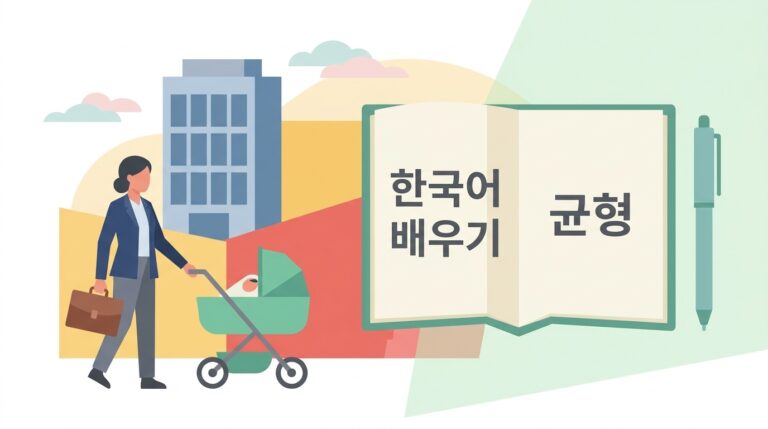
Beyond the K-Drama Glamour: Navigating Parental Leave (육아 휴직) and Career Breaks (경력 단절) in Korea
안녕하세요! Welcome back to Daily Hangul, your premium guide to the pulse of real Korean life and language. I’m your senior editor, sharing insights from years of teaching and living in the heart of Seoul.
Have you ever watched a modern K-Drama where the female lead—despite holding a prestigious degree—struggles to find a job because she has a multi-year gap on her resume spent raising her child? This is the heartbreaking reality of 경단녀 (gyeongdannyeo), a word you won’t easily find in basic textbooks, but one that is at the center of Korea’s most critical social debates today.
To reach a C1 level of Korean fluency, you must look past simple greetings and dive deep into these systemic, cultural conversations. Today, we’re dissecting the vocabulary of family, career survival, and societal shifts in South Korea.
Phase 2: Core Expressions Deep Dive
1. 육아휴직
- Pronunciation: [yuga-hyujik] | yoo-gah-hyoo-jeek
- Meaning: Parental Leave (Childcare Leave)
- K-Culture Moment: In office-themed K-Dramas like Misaeng or Agency, requesting 육아휴직 is often depicted as a high-stakes dramatic moment. Even though it’s a legal right, characters often face silent pressure from upper management.
- Editor’s Insight: Legally, Korean parents are entitled to up to one year of paid leave. However, the corporate pressure of 눈치 (nunchi – reading the room) often makes employees hesitate to take it. When speaking about it, use the verb 쓰다 (sseuda – to use) rather than the bureaucratic 신청하다 (sincheonghada – to apply) for a more natural, conversational flow.
- Situation Spectrum:
- Friends (Casual): ✅
- Colleagues (Semi-formal): ✅
- Superiors (Formal): ✅
🤔 Think About It: While male parental leave (아빠 육아휴직) is heavily promoted by the government to combat the low birth rate, why do you think many men still worry about the professional “unseen penalty” of taking it?
2. 경단녀 (경력 단절 여성)
- Pronunciation: [gyeong-dannyeo] | gyung-dahn-nyuh
- Meaning: A Career-Interrupted Woman (Literal: Career-disrupted woman)
- K-Culture Moment: This word is the central theme of the popular drama Romance Is a Bonus Book (로맨스는 별책부록), where the protagonist tries to re-enter the corporate world after years of raising her daughter.
- Editor’s Insight: This is a portmanteau of 경력 (gyeongnyeok – career) + 단절 (danjeol – disruption) + 여성 (yeoseong – woman). It is a highly sensitive and frequently discussed demographic term in Korean economic and social news.
- Situation Spectrum:
- Friends (Casual): ✅
- Colleagues (Semi-formal): ✅
- Superiors (Formal): ✅
🤔 Think About It: The existence of a specific single word (경단녀) to describe this demographic reveals how widespread this structural issue is. Does your native language have a equivalent noun, or does it require a full sentence to explain?
3. 독박육아
- Pronunciation: [dok-bak-yuga] | dohk-bahk-yoo-gah
- Meaning: Sole/Solo parenting; carrying the entire parenting burden alone
- K-Culture Moment: You’ll hear this constantly on parenting reality shows like The Return of Superman or in late-night community forums when one partner vents about their spouse always working late (야근 – yageun).
- Editor’s Insight: This combines 독박 (dokbak – a slang term from the Korean card game Go-Stop, meaning to take all the losses/penalties yourself) with 육아 (yuga – childcare). It has a strong, expressive, slightly bitter nuance. Use it to vent to close colleagues or friends, but avoid it in formal HR meetings.
- Situation Spectrum:
- Friends (Casual): ✅
- Colleagues (Semi-formal): ⚠️
- Superiors (Formal): 🚫
🤔 Think About It: How does the intense collective work culture (회식 culture, late-night overtime) in Korea inadvertently force one parent into 독박육아?
Phase 3: Textbook vs. Real Korean
- Describing returning to work after childbirth:
- 📖 Textbook: 저는 출산 후 직장으로 복귀했습니다. (I returned to my workplace after childbirth.)
- 🗣️ Real Korean: 저 드디어 경단녀 탈출했어요! (I finally escaped the ‘career-interrupted’ trap!)
- 💡 Why it’s different: While the textbook sentence is grammatically correct, modern women use the active phrase “경단녀 탈출” (escaping the career-interruption status) to celebrate their hard-won return to the workforce, showing active agency.
- Discussing work-life balance:
- 📖 Textbook: 일과 삶의 균형을 유지하고 싶습니다. (I want to maintain a balance between work and life.)
- 🗣️ Real Korean: 저한테는 워라밸이 제일 중요해요. (For me, work-life balance is the most important.)
- 💡 Why it’s different: “워라밸” (Wo-Ra-Bael) is a widely accepted buzzword that represents a massive generational shift in Korea away from unconditional corporate loyalty.
Phase 4: Cultural Deep Dive
4-1. The Art of “Nunchi” (눈치) in requesting leave
In Korean corporate settings, asking for parental leave is not just an administrative task; it is a delicate dance of 눈치 (nunchi). Even if laws guarantee the leave, asking for it requires showing deep consideration for your team’s workload. It is customary to schedule a private coffee chat with your manager rather than sending a sudden email, using softened, indirect verbs like ~하게 되었습니다 (It has come to be that I will…) to minimize perceived disruption.
4-2. K-Drama vs. Reality
In dramas, characters who face discrimination for taking leave often find poetic justice or land a perfect new job immediately. In reality, the return to work is a grind. Many mothers opt for 시간선택제 (sigansuntaekje – flexible part-time hours) or fight for 칼퇴 (kaltoe – leaving on the dot) to avoid 독박육아, navigating a daily tightrope between being a dedicated employee and a present parent.
Phase 5: Practical Roleplay Scenario
Scenario A: After-Hours Coffee with a Colleague
Setting: A quiet cafe near Yeouido (Seoul’s finance hub) at 5:30 PM. You (a foreign manager at a Korean firm) are chatting with Ji-won (34, a talented senior designer who recently returned from parental leave).
YOU: 지원 씨, 오늘 얼굴이 조금 피곤해 보여요. 무슨 일 있어요?
(Ji-won, you look a bit tired today. Is everything okay?)
지원: 아, 티가 많이 나요? 요즘 남편 바빠서 맨날 독박육아 하느라 잠을 못 잤어요. 😴
(Ah, is it that obvious? My husband has been so busy lately, so I’ve been doing solo parenting every day and couldn’t sleep.)
YOU: 아… 남편분이 계속 야근하시는군요. 혼자 애 보느라 진짜 힘들겠어요.
(Ah… your husband keeps working overtime. It must be so hard watching the baby alone.)
지원: 네, 복귀한 지 얼마 안 돼서 회사 일 적응하는 것도 정신없는데… 조금 지치네요.
(Yeah, since it hasn’t been long since I returned, adapting to work is overwhelming too… I’m a bit exhausted.)
YOU: 휴직 전보다 일하시는 게 훨씬 더 힘들어지신 것 같아요.
(It seems working has become much harder for you than before your leave.)
지원: 맞아요. 한국에서는 경력 단절 안 되려고 복직했는데, 일이랑 육아 둘 다 잘하는 건 불가능한가 봐요.
(Exactly. I returned to work in Korea to avoid a career break, but I guess doing well in both work and parenting is impossible.)
YOU: 에이, 지원 씨 일 정말 잘하시잖아요. 너무 무리하지 마세요. 혹시 도움이 필요하면 언제든 말씀해 주시고요.
(Come on, Ji-won, you do great work. Don’t push yourself too hard. If you need any help, please let me know anytime.)
지원: 고마워요. 요즘 팀원들 눈치 보느라 칼퇴하기도 미안했는데, 그렇게 말씀해 주시니 큰 힘이 되네요. 🥺
(Thank you. Lately, I’ve felt bad leaving on the dot because I was reading the team’s room, but hearing you say that gives me great strength.)
🔀 Your Turn! How do you reply to keep the connection warm?
- A) “네, 힘내시고 내일 봐요!” (Polite but dismissive. Misses the chance to build deeper rapport.)
- B) “눈치 보지 마세요! 법적으로 칼퇴할 수 있잖아요!” (Too direct. Ignores the reality of Korean corporate culture.)
- C) “무슨 눈치예요. 지원 씨 일당백이잖아요! 일 다 끝났으면 당당하게 들어가세요!” (Encouraging and recognizes her value using local idiom.)
✅ Best Choice: C
Reasoning: Calling her 일당백 (ildangbaek – a person worth a hundred others) praises her competence, and assuring her she can leave proudly helps relieve her “nunchi” burden.
Phase 6: 10-Second Shadowing Drill
Practice saying this naturally to express empathy to a working parent in Korea:
😊 눈치 보지 말고 / 육아휴직을 / 자유롭게 / 쓸 수 있는 / 문화가 / 되었으면 / 좋겠어요.
(nun-chi bo-ji mal-go / yu-ga-hyu-ji-geul / ja-yu-rop-ge / sseul su in-neun / mun-hwa-ga / doe-eot-seu-myeon / jo-get-seo-yo.)
[Intonation Guide: Put stress on ‘눈치’ and ‘자유롭게’. Say it with a warm, hopeful tone.]
Phase 7: K-Culture Mini Dictionary
- 경단녀 (Gyeongdannyeo)
- Meaning: Career-interrupted woman.
- Context: Highly discussed socio-economic demographic representing systemic challenges for working mothers in Korea.
- 독박육아 (Dokbakyuga)
- Meaning: Solo parenting burden.
- Context: A highly empathetic slang term used when one partner bears the entire weight of raising a child due to the other’s work obligations.
- 칼퇴 (Kaltoe)
- Meaning: “Knife-cut” sharp departure from work (leaving exactly on time).
- Context: The ideal daily goal for any modern working parent in Korea.
- 워라밸 (Worabael)
- Meaning: Work-life balance.
- Context: A vital lifestyle trend championed by younger generations to combat burnout.
Phase 8: Traveler & Expat Survival Kit
If you are living, working, or raising a family in South Korea, keep these survival phrases close:
🆘 Survival Phrase #1
– 🇰🇷 “아이 때문에 정시 퇴근해보겠습니다.” (ai ttaemune jeongsi toegeunhaebogetseumnida.)
– 🗣️ I must leave on time today because of my child.
– 📍 When to use: Politely leaving the office without looking uncommitted.🆘 Survival Phrase #2
– 🇰🇷 “육아휴직 신청 절차가 어떻게 되나요?” (yugahyujik sincheong jeolchaga eotteoke doenayo?)
– 🗣️ What is the application process for parental leave?
– 📍 When to use: When consulting with HR (인사과 – insagwa).
📌 Editor’s Note: When living in Korea as an expat family, use the government app 정부24 (Government 24) to check if you qualify for childcare subsidies (아동수당 – adongsudang).
Phase 9: Critical Thinking Corner
🧠 Think Deeper:
South Korea’s birth rate is currently the lowest in the world, yet its corporate culture remains deeply rooted in overtime and intense dedication. This creates a cultural clash: the government desperately urges citizens to have babies, while traditional corporate structures make doing so a high-risk gamble for one’s career. To speak Korean at a C1 level, you must understand this fundamental paradox.
💬 Your Turn: How does your home country balance career growth with parental rights? Share your thoughts in the comments below! (Feel free to try writing in Korean!)
Phase 10: FAQ & Common Mistakes
- Q: Is calling someone a ‘경단녀’ offensive?
- A: It is a standard sociological term used in news and public discussions. However, addressing someone directly as a “경단녀” during a conversation might sound like you are labeling or pitying them. Instead, say “경력 단절 기간이 있으셨군요” (You had a period of career interruption) to remain polite and professional.
- ❌ Common Mistake: Confusing 출산휴가 (chulsan-hyuga) and 육아휴직 (yuga-hyujik).
- 출산휴가 is maternity leave specifically surrounding the physical act of childbirth (usually 90 days), while 육아휴직 is the longer-term parental leave (up to 1 year) meant for raising the child.
Phase 11: Action Items
- 🥉 Bronze: Say the shadowing sentence from Phase 6 out loud three times in front of a mirror.
- 🥈 Silver: Watch a clip of Romance Is a Bonus Book and try to catch when they use the words 경력 and 경단녀.
- 🥇 Gold: The next time a Korean coworker has to leave early for their kid, warmly say: “눈치 보지 말고 얼른 들어가세요!”
Phase 12: Interactive Quiz
1. Which word best describes the situation where one parent has to raise the child entirely alone because the other is too busy working?
– A) 워라밸
– B) 독박육아
– C) 육아휴직
2. True or False: “경단녀” is a slang word used exclusively on the streets of Hongdae and is inappropriate for news broadcasts.
(Answer: False. It is an official demographic term frequently used in economic policy debates and news broadcasts.)
[Answers: 1: B, 2: False]
Frequently Asked Questions (FAQ)
Q: What does "육아휴직" mean in Korean and how do you pronounce it?
A: In Korean, "육아휴직" is pronounced [yuga-hyujik] and means: Parental Leave (Childcare Leave)
Q: What does "경단녀 (경력 단절 여성)" mean in Korean and how do you pronounce it?
A: In Korean, "경단녀 (경력 단절 여성)" is pronounced [gyeong-dannyeo] and means: A Career-Interrupted Woman (Literal: Career-disrupted woman)
Q: What does "독박육아" mean in Korean and how do you pronounce it?
A: In Korean, "독박육아" is pronounced [dok-bak-yuga] and means: Sole/Solo parenting; carrying the entire parenting burden alone







