

Eat Like a Local: How to Review Korean Convenience Store Dosirak and Gimbap Like a Pro
안녕하세요! Welcome back to Daily Hangul. I’m your Head Editor and your local guide to the delicious, fast-paced, and incredibly convenient world of South Korea. Today, we are diving deep into the ultimate holy grail of Korean busy life: the convenience store (편의점 – pyeon-ui-jeom).
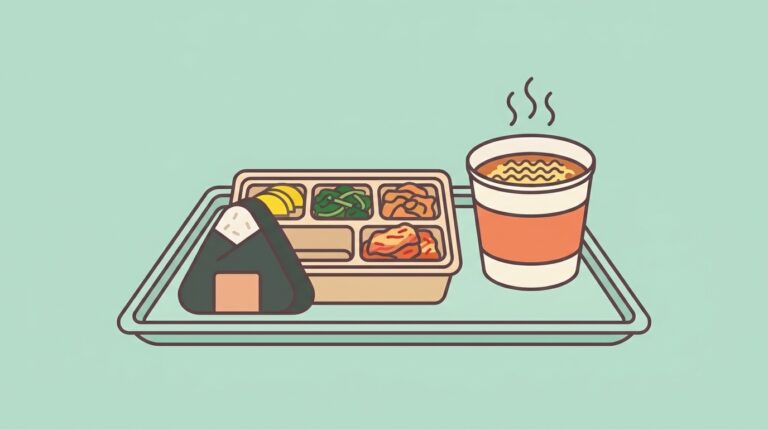
If you have ever watched a K-Drama, you’ve definitely seen this scene: the main characters sitting outside a convenience store under a plastic parasol on a chilly night, sharing a steaming cup of instant ramyun, a triangle gimbap (삼각김밥 – samgak-gimbap), or a beautifully packed lunchbox (도시락 – dosirak). It looks cozy, comforting, and incredibly delicious.
But here is the catch. When you try these foods and want to share your experience with your Korean friends or post a review on social media, simply saying “맛있어요 (masisseoyo – It’s delicious)” feels a bit too textbook, doesn’t it?
As a B2 (Intermediate) learner, you are ready to express finer nuances. You want to describe how the food tastes, how much value you got for your money, and use the exact slang words that young Koreans use online. Today, we’ll teach you how to review Korean convenience store food like an absolute insider. Let’s dig in! 🥢
Phase 2: Core Expressions Deep Dive
Here are three essential intermediate-level expressions you need to know to review your convenience store feasts.
1. 가성비 최고다
- Pronunciation: [gaseongbi choegoda] / gah-sung-bee chwey-go-dah
- Meaning: “Best value for money” (Literal: “Cost-performance ratio is the best”)
- K-Culture Moment: You will see this expression splashed across Korean YouTube food reviews and blogs. When a student on a tight budget finds a 5,000 KRW (approx. $4 USD) lunchbox containing pork bulgogi, fried kimchi, fish cakes, and rice, they’ll sigh with relief and say: “와, 역시 편의점 도시락은 가성비 최고다!”
- Editor’s Insight: 가성비 (gaseongbi) is a portmanteau of 가격 (price), 성능 (performance), and 비율 (ratio). While “성능” usually refers to machines, Koreans use it for food quality too. It means you feel like you cheated the system by getting such great food for so cheap!
- Situation Spectrum:
- Friends (Casual): ✅
- Co-workers (Semi-formal): ✅
- Boss / Elders (Formal): ⚠️ (Slightly casual, but acceptable in light conversations)
- 🤔 Think About It: Why is the concept of ‘가성비’ so dominant among younger generations in Korea today? How does it reflect the economic realities of modern Seoul?
2. 혜자스럽다
- Pronunciation: [hye-ja-seu-reop-da] / hyeh-jah-seu-rup-dah
- Meaning: “Incredibly generous in portion and quality for a cheap price”
- K-Culture Moment: This is one of Korea’s most famous modern slang words. It originates from a popular convenience store lunchbox line endorsed by veteran Korean actress Kim Hye-ja (김혜자). The food was so incredibly packed and cheap that her name became a literal adjective meaning “generous.” (Conversely, the opposite is “창렬스럽다” – meaning stingy or overpriced!)
- Editor’s Insight: By adding “-스럽다” (having the quality of) to “혜자,” you create a living piece of modern Korean pop-culture linguistics. Use this, and your Korean friends will look at you with wide, impressed eyes.
- Situation Spectrum:
- Friends (Casual): ✅
- Co-workers (Semi-formal): ⚠️
- Boss / Elders (Formal): 🚫
- 🤔 Think About It: Can you think of any celebrity in your home country whose name became a common adjective in everyday language? What does this say about the power of brand endorsement in Korea?
3. 속이 꽉 찼다
- Pronunciation: [sogi kkwak chatda] / so-ghee kkwak chaht-dah
- Meaning: “Packed with fillings” (Literal: “The inside is tightly filled”)
- K-Culture Moment: This is the ultimate compliment for a 김밥 (gimbap). Cheap gimbap often has too much rice and very little filling. But when you bite into a premium convenience store gimbap and see a beautiful cross-section stuffed with tuna mayo, pickled radish, and carrots, you say this with pure joy.
- Editor’s Insight: 속 means “inside” or “stomach/heart,” and 꽉 차다 means “to be packed tight.” You can also use this metaphorically for a person who is mature and full of substance (속이 꽉 찬 사람).
- Situation Spectrum:
- Friends (Casual): ✅
- Co-workers (Semi-formal): ✅
- Boss / Elders (Formal): ✅
- 🤔 Think About It: Why do you think food aesthetics, like the perfectly packed cross-section of a gimbap, are so highly valued in Korean social media culture?
Phase 3: Textbook vs Real Korean
Let’s compare how a textbook teaches you to review food versus how real Koreans actually say it.
- Describing Spicy Gimbap:
- 📖 Textbook: “이 김밥은 아주 매워요.” (This gimbap is very spicy.)
- 🗣️ Real Korean: “이 김밥, 매콤하면서 중독성 있네요!” (This gimbap is pleasantly spicy and so addictive!)
- 💡 Why is it different?: Intermediate speakers use “매콤하다” (pleasant, appetizing spiciness) instead of just “매우다” (which can sound like painful heat), and “중독성 있다” (addictive) to show they can’t stop eating it.
- Commenting on a Lunchbox’s Quality:
- 📖 Textbook: “편의점 도시락이 맛있고 저렴합니다.” (Convenience store lunchboxes are delicious and cheap.)
- 🗣️ Real Korean: “요즘 편의점 도시락 진짜 고퀄이에요.” (Convenience store lunchboxes these days are seriously high-quality.)
- 💡 Why is it different?: Modern Korean combines “고” (高 – High) with the English word “Quality” (퀄리티) to create the slang “고퀄” (go-kwol). It sounds much more natural and trendy than “저렴합니다.”
Phase 4: Cultural Context — K-Culture Deep Dive
4-1. The Art of Convenience Store Etiquette (눈치 – Nunchi)
When eating inside a Korean convenience store, you must employ 눈치 (nunchi)—the Korean art of reading the room.
Unlike in some Western countries, convenience store staff in Korea do not bus your tables. There is always a designated self-trash-sorting station (분리수거 – bunrisugeo). You are expected to wipe down the table if you spilled any soup, throw away liquids in the designated sink, and separate plastics, paper, and food waste. Leaving your table messy is considered extremely rude!
4-2. The “Pyeon-Sik” (편식) Trend
In K-Dramas like Welcome to Samdal-ri or My Mister, we often see characters finding solace in a simple convenience store meal. In Korea, eating alone (혼밥 – honbap) used to carry a slight social stigma, but the convenience store has transformed it into a trendy lifestyle. Today, people love inventing new recipes by mixing different CVS products—like mixing Mark Meal (마크정식), a famous combination of instant spaghetti, tteokbokki, and string cheese popularized by a K-Pop fan!
Phase 5: Interactive Roleplay Scenario
Scenario A: Late-Night Convenience Store Run
- Setting: Friday night, 11:30 PM. Outside a brightly lit GS25 in Hongdae. You and your Korean classmate, Yujin, are looking for a quick bite after a long study session.
- Characters:
- YOU: An exchange student who is hungry but budget-conscious.
- Yujin (유진): 21-year-old college student, a self-proclaimed convenience store foodie.
Dialogue:
유진: 아, 오늘 공부하느라 진짜 하얗게 불태웠다. 배고파 죽겠어! 😫
(Ah, oneul gongbuhaneura jinjja hayake bultaewotda. Baegopa jukgesseo!)
[Translation: Ah, I really burned myself out studying today. I’m starving to death!]
(🎭 Stage Direction: Yujin stretches her arms and points toward the neon GS25 sign)
YOU: 저도요! 우리 저기 편의점 가서 도시락이나 김밥 먹을래요?
(Jeodoyo! Uri jeogi pyeonui-jeom gaseo dosiragina gimbap meogeullaeyo?)
[Translation: Me too! Shall we go to that convenience store over there and have a lunchbox or gimbap?]
유진: 콜! 요즘 편의점 도시락 신제품 진짜 많이 나왔거든. 🍱
(Kol! Yojeum pyeonui-jeom dosirak sinjepum jinjja mani nawotgeodeun.)
[Translation: Deal! A lot of new convenience store lunchboxes came out lately.]
(Inside the store, standing in front of the refrigerated open shelf)
유진: 와, 이 제육볶음 도시락 봐봐. 반찬이 여섯 개나 되는데 4,800원밖에 안 해.
(Wa, i jeyuk-bokkeum dosirak bwabwa. Banchani yeoseot gaena doeneunde sacheon-palbaek-won-bakke an hae.)
[Translation: Woah, look at this spicy pork lunchbox. It has six side dishes but only costs 4,800 won.]
🔀 YOUR TURN! How do you reply?
– A) “아, 그렇군요. 정말 쌉니다.” (Ah, I see. It is very cheap.) [Too textbook!]
– B) “대박, 진짜 혜자스럽네요! 가성비 최고예요.” (Wow, that’s seriously generous! The value is the best.) [Perfect intermediate slang!]
– C) “이거 맛없을 것 같아요.” (I think this will taste bad.) [Too direct and dampens the mood!]
✅ Best Choice: B — Why? Using “혜자스럽다” and “가성비” shows you understand modern youth slang and appreciate the portion size.
(Continuing with Choice B)
유진: 맞지? 완전 혜자지! 난 이거 먹을래. 너는 뭐 먹을 거야?
(Matji? Wanjeon hyejaji! Nan igeo meogeullae. Neoneun mwo meogeul geoya?)
[Translation: Right? Totally Hyeja! I’m having this. What are you going to eat?]
YOU: 저는 참치마요 삼각김밥이랑 이 불닭볶음면 먹을래요.
(Jeoneun chamchi-mayo samgak-gimbap-irang i buldak-bokkeum-myeon meogeullaeyo.)
[Translation: I’ll have the tuna mayo triangle gimbap and this Buldak spicy noodles.]
유진: 오, 너 불닭 먹을 수 있어? 완전 매울 텐데!
(O, neo buldak meogeul su isseo? Wanjeon maeul tende!)
[Translation: Oh, you can eat Buldak? It’s going to be super spicy!]
YOU: 괜찮아요! 삼각김밥이랑 같이 먹으면 매콤하면서 딱 맛있어요.
(Gwenchanayo! Samgak-gimbap-irang gachi meogeumyeon maekomhamyeonseo ttak masisseoyo.)
[Translation: It’s okay! If I eat it with the triangle gimbap, it’s nicely spicy and just perfect.]
Phase 6: 10-Second Shadowing Drill
Practice speaking like a native! Pay attention to the pauses (/) and try to mimic the emotion.
- 😊 우와, / 이 도시락 / 진짜 혜자스럽다!
(Uwa, / i dosirak / jinjja hyejaseoreopda!)
Emotion: Expressive, pleasantly surprised.
Meaning: “Wow, this lunchbox is incredibly generous!” -
😤 삼각김밥은 / 전자레인지에 / 딱 20초만 / 돌려야 해요!
(Samgak-gimbabeun / jeonjareinjie / ttak isip-choman / dollyeoya haeyo!)
Emotion: Passionate, giving an essential food tip.
Meaning: “You must microwave the triangle gimbap for exactly 20 seconds!”
Phase 7: K-Culture Mini Dictionary
- 혜자스럽다 (hyejaseoreopda)
- Meaning: Incredibly generous in portion size and quality relative to price.
- 맵찔이 (maepjjiri)
- Meaning: Slang for someone who cannot eat spicy food well. (e.g., “나 완전 맵찔이야” – I am a total spicy-wimp).
- 삼각김밥 (samgak-gimbap)
- Meaning: Triangle-shaped gimbap wrapped in crispy seaweed.
- 편맥 (pyen-maek)
- Meaning: Portmanteau of 편의점 (convenience store) + 맥주 (beer). Drinking canned beer outside a CVS.
Phase 8: Traveler’s Survival Kit
If you find yourself in a Korean convenience store, here are three survival phrases you will definitely use:
🆘 Survival Phrase #1
– 🇰🇷 “젓가락 챙겨주세요.” (jeotgarak chaenggyeojuseyo.)
– 🗣️ English Pronunciation: jut-gah-rahk chaeng-gyuh-joo-seh-yo
– 📍 When to use: When purchasing instant noodles or lunchboxes and the cashier forgets to give you chopsticks.
– 💡 Pro Tip: In Korea, plastic bags cost around 100 KRW. They will ask “봉투 필요하세요?” (Do you need a bag?). If you do, say “네, 주세요” (Yes, please).🆘 Survival Phrase #2
– 🇰🇷 “전자레인지 어디 있어요?” (jeonjareinji eodi isseyo?)
– 🗣️ English Pronunciation: jun-jah-reyn-jee uh-dee eet-suh-yo
– 📍 When to use: To find the microwave to heat up your lunchbox or gimbap.🆘 Survival Phrase #3
– 🇰🇷 “이거 카드 되나요?” (igeo kadeu doenayo?)
– 🗣️ English Pronunciation: ee-guh kah-deu dwey-nah-yo
– 📍 When to use: Asking if they accept credit cards (though 99.9% of Korean stores do!).
Phase 9: Critical Thinking Corner — “Go One Step Deeper”
In many Western countries, grab-and-go convenience food is often seen as a desperate, unhealthy last resort. However, in Korea, the convenience store lunchbox represents a highly competitive culinary market where major companies collaborate with Michelin-starred chefs and famous food critics to create gourmet-level fast meals.
This reflects a deeper societal trait: Palli-Palli (빨리빨리 – fast, fast) culture mixed with high aesthetic standards. Koreans refuse to sacrifice food quality just because they are in a hurry.
💬 Your Turn: How is convenience store food perceived in your country? Is it considered a cheap last resort, or are there gourmet options like in Korea? Let us know in the comments below!
Phase 10: FAQ & Common Mistakes
- Q: Can I use “혜자스럽다” in a professional business setting?
- A: Probably not. It is highly colloquial slang. Instead, use “가성비가 아주 좋습니다” (The cost-performance ratio is very good) or “구성 대비 가격이 저렴합니다” (The price is low compared to the composition).
- Q: Do I need to microwave gimbap?
- A: Yes! But only for 15-20 seconds. If you microwave it too long, the seaweed (김 – gim) will lose its crunch and get soggy.
⚠️ Common Mistake: Leaving plastic wrapping on the triangle gimbap seaweed.
– How to avoid: Look at the numbers printed on the plastic! Pull tab 1 straight down, then pull side 2, and finally side 3. It takes practice, but once you master it, you’ll feel like a true Korean!
Phase 11: Summary & Action Items
- One-Liner Summary: To review convenience store food like a local, look for 가성비 (value), praise generous portions as 혜자스럽다, and check if the gimbap is 속이 꽉 찼다!
Action Mission 3-Steps:
- 🥉 Bronze: Look up a picture of a Korean “삼각김밥” online and practice saying the opening steps out loud in Korean.
- 🥈 Silver: Write a mock-review of your favorite fast-food item in the comments using the word 가성비.
- 🥇 Gold: Next time you are in Korea (or an Asian supermarket), buy a gimbap, heat it up for 20 seconds, and post a photo captioning it: “속이 꽉 찼다!”
Phase 12: Quiz — Interactive Challenge
1. Which slang word is used to describe an exceptionally generous portion of food for a cheap price?
– A) 창렬스럽다
– B) 혜자스럽다
– C) 고퀄이다
– D) 매콤하다
2. Fill in the blank: “이 김밥은 삼천 원인데 __________ 최고예요!” (This gimbap is 3,000 won, the value for money is the best!)
– Answer: (가성비)
3. True or False: You should leave your trash on the table inside the convenience store for the staff to clean up.
– Answer: (False! You must practice ‘nunchi’ and sort your trash at the recycling station.)
(Answers: 1-B, 2-가성비, 3-False)
Frequently Asked Questions (FAQ)
Q: What does "가성비 최고다" mean in Korean and how do you pronounce it?
A: In Korean, "가성비 최고다" is pronounced [gaseongbi choegoda] and means: "Best value for money" (Literal: "Cost-performance ratio is the best")
Q: What does "혜자스럽다" mean in Korean and how do you pronounce it?
A: In Korean, "혜자스럽다" is pronounced [hye-ja-seu-reop-da] and means: "Incredibly generous in portion and quality for a cheap price"
Q: What does "속이 꽉 찼다" mean in Korean and how do you pronounce it?
A: In Korean, "속이 꽉 찼다" is pronounced [sogi kkwak chatda] and means: "Packed with fillings" (Literal: "The inside is tightly filled")







