

Hello! I am your lead editor at Daily Hangul, your veteran tutor and local culture navigator.
Have you ever been scrolling through Instagram or Weverse, and suddenly your favorite K-Pop idol posts a selfie with a completely shaved head? 🥺 The comment section is flooded with crying emojis, and fans are wishing them a safe return. Or maybe you’ve watched a K-Drama where the male lead tearfully looks in the mirror as a barber shaves off his stylish hair, while a melancholy acoustic song plays in the background.
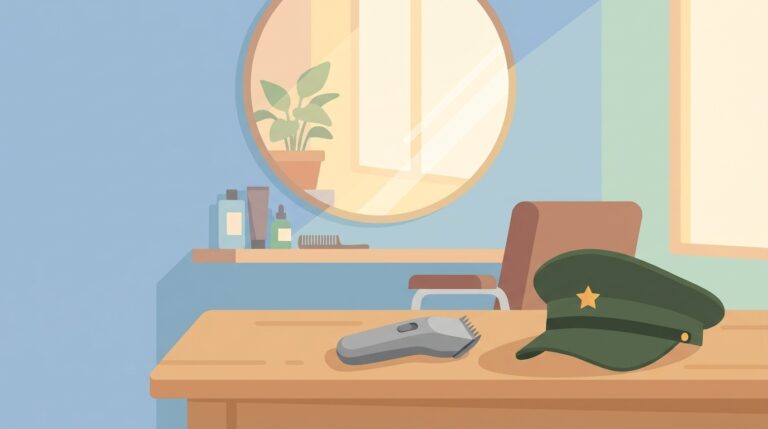
In Korea, shaving your head isn’t just a fashion statement—it is a powerful cultural symbol. For Korean men, it almost always means one thing: Military Enlistment (입대).
Today, we are going to dive into the Korean military culture through the lens of ‘getting a haircut’ (머리 깎기). Whether you want to understand what your favorite idols are going through, or you just want to get a short haircut in Korea without people asking, “Are you going to the army?”… this guide is for you!
Phase 2: Core Expressions — The “Buzz Cut” Vocabulary
Here are the most important phrases you need to know about getting this specific haircut.
1. 반삭해 주세요 (Please give me a buzz cut)
- Pronunciation: [ban-sa-kae ju-se-yo]
Sound-alike guide: ‘ban’ (like a ban on something) + ‘sa-kae’ (sounds a bit like sake, the Japanese drink). The ‘k’ sound smoothly moves to the next syllable!- Meaning:
- Literal: Please do a half-shave.
- Real Nuance: Please give me a buzz cut.
- K-Culture Moment: This is the exact phrase a soon-to-be soldier says to the hairdresser. In Korea, soldiers don’t shave their heads completely bald; they leave a few millimeters of hair. That’s why it’s called ‘half-shaved’ (반삭).
- Editor’s Insight: If a guy gets this haircut out of nowhere, his friends will immediately gasp and ask, “Are you enlisting?!” It’s almost exclusively associated with the military (or sometimes, a very serious apology or protest in news broadcasts).
- Situation Spectrum:
- To a hairdresser (Service staff): ✅
- To a friend (Casual): 🚫 (Use “나 반삭할 거야” – I’m going to get a buzz cut)
- 🤔 Think About It: Hair holds a lot of meaning in East Asian culture. Historically, cutting one’s hair was seen as a huge sacrifice. Do you have a specific haircut in your country that symbolizes a major life change?
2. 군대 가요 (I’m going to the military)
- Pronunciation: [gun-dae ga-yo]
- Meaning:
- Literal/Real Nuance: I am going to the military. / I’m enlisting.
- K-Culture Moment: You’ll hear this at a farewell drinking party (회식). The soon-to-be soldier will say this, and everyone will pour him a shot of Soju, pat his back, and say “Good luck!”
- Editor’s Insight: The word 군대 (gun-dae) means military. When you add 가요 (ga-yo, go), it’s the most natural, everyday way to say you are enlisting.
- Situation Spectrum:
- Friends (Casual): ✅ (Say: “나 군대 가” – na gun-dae ga)
- Acquaintances (Semi-formal): ✅
- Boss/Elders (Formal): ⚠️ (Better to say: “저 군대 갑니다” – jeo gun-dae gam-ni-da)
- 🤔 Think About It: Why do Koreans just say “I go to the military” instead of “I am enlisting” in daily conversation? Korean loves simplicity in spoken language!
3. 머리 깎았어요? (Did you cut your hair?)
- Pronunciation: [meo-ri kka-kka-sseo-yo?]
Sound-alike guide: The ‘ㄲ’ (kk) is a strong, tense sound. Imagine a tightly wound spring snapping!- Meaning:
- Literal: Did you cut/shave your hair?
- K-Culture Moment: When friends see the newly shaved head, they will excitedly rub it (like rubbing a lucky egg) and ask this playfully.
- Editor’s Insight: Interestingly, for women or regular haircuts, we use ‘머리 잘랐어요?’ (jal-la-sseo-yo). But for extremely short hair, shaving, or men’s clippers, we often use ‘깎다’ (kkak-da).
Phase 3: Textbook vs. Real Korean
Let’s see how these expressions change from your textbook to the streets of Seoul!
[Telling someone you are enlisting]
* 📖 Textbook Korean: 저는 다음 주에 입대합니다. (I will enlist next week.)
* 🗣️ Real Korean: 저 다음 주에 군대 가요. (I’m going to the army next week.)
* 💡 Why the difference?: ‘입대’ (Enlistment) is a formal Sino-Korean word used in news or official documents. In real life, everyone just says “군대 가다” (go to the army).
[Reacting to a friend’s buzz cut]
* 📖 Textbook Korean: 머리가 아주 짧네요. (Your hair is very short.)
* 🗣️ Real Korean: 헐, 너 머리 왜 그래? 군대 가? (Omg, what’s wrong with your hair? Are you going to the army?)
* 💡 Why the difference?: A sudden buzz cut is a huge shock! Friends will playfully tease them rather than making a polite observation.
(Bottom Note: Since you are learning at the A2 level, stick to ‘군대 가요’ to sound natural without being too informal!)
Phase 4: Cultural Context — K-Culture Deep Dive
4-1. Non-Verbal Cues: The “Egg” Head Rub
When a Korean man shaves his head for the military, there is a funny non-verbal tradition. His close friends will gather around and take turns rubbing his freshly shaved head! It feels fuzzy, like a tennis ball or a kiwi. It’s a sign of affection and playful teasing. However, never do this unless you are very close friends.
4-2. The K-Pop Connection: The Farewell V-Live
If you are a K-Pop fan, you know the drill. A few days before an idol’s enlistment, they will turn on a live stream. They usually wear a beanie. Mid-broadcast, they take off the beanie to reveal their 반삭 (buzz cut).
Fans call this the ‘알밤’ (al-bam, chestnut) or ‘계란’ (gye-ran, egg) look. The idol will shyly rub their own head, saying “어색해요” (eo-sae-kae-yo – It feels awkward). This shared moment helps fans process the sadness of the upcoming 18-month hiatus.
Phase 5: Real-life Roleplay Scenario
Setting: A local men’s hair salon (often called a ‘Barbershop’ or ‘Blue Club’ in Korea) in Sinchon, Seoul.
Characters:
– YOU: A foreign exchange student in Korea. Summer is coming, and you want a super short, cool haircut.
– Barber (사장님): A friendly Korean man in his 50s holding hair clippers.
Barber: 어서 오세요! 어떻게 잘라 드릴까요? ✂️
(eo-seo o-se-yo! eo-tteo-ke jal-la deu-ril-kka-yo?)
[Welcome! How would you like it cut?]
YOU: 머리 짧게 잘라 주세요.
(meo-ri jjal-ge jal-la ju-se-yo.)
[Please cut my hair short.]
Barber: (Grabs the clippers with a serious face) 학생, 혹시… 군대 가요? 🇰🇷
(hak-saeng, hok-si… gun-dae ga-yo?)
[Student, by any chance… are you going to the military?]
🔀 Your Turn! How will you respond?
– A) 네, 군대 가요. (Yes, I’m going to the military. – Wait, are you really?)
– B) 아니요! 그냥 더워서요. (No! Just because it’s hot.)
– C) 반삭해 주세요! (Please give me a buzz cut!)✅ Best Choice: B — If you aren’t actually going to the Korean military, you must clarify this! Otherwise, the barber might shave it too short, assuming you need standard military regulations. “더워서요” (Because it’s hot) is the perfect, natural excuse for a short summer cut.
Phase 6: 10-Second Shadowing Drill
Let’s practice speaking with the right emotion and rhythm! Follow the slashes (/) for pauses.
- 😊 Friendly/Casual: 저 다음 주에 / 군대 가요!
(jeo da-eum ju-e / gun-dae ga-yo!) - 😢 Sad/Nostalgic: 머리 / 깎기 싫어요…
(meo-ri / kkak-ki si-reo-yo…) - 💇♂️ Polite to Barber: 조금만 / 다듬어 주세요.
(jo-geum-man / da-deu-meo ju-se-yo. – Please just trim it a little.)
Phase 7: K-Culture Mini Dictionary
Here are some essential military & haircut keywords you’ll see in K-dramas:
1. 입대
* Romanization: ip-ttae
* English: Enlistment
* Context: The formal act of joining the military. Often seen in news headlines about celebrities.
2. 훈련소
* Romanization: hul-lyeon-so
* English: Boot camp / Training center
* Context: The first 5 weeks of military service. The most famous one is in Nonsan (논산).
3. 고무신을 거꾸로 신다
* Romanization: go-mu-si-neul geo-kku-ro sin-da
* English: To wear rubber shoes backwards
* Context: A famous idiom. It means a girlfriend breaks up with her boyfriend while he is in the military.
4. 제대 / 전역
* Romanization: je-dae / jeo-nyeok
* English: Discharge (from military)
* Context: The happy day they finish their 18 months of service! Fans celebrate this hugely.
Phase 8: Traveler’s Survival Kit (Hair Salon Edition)
Even if you aren’t going to the military, you might need a haircut while traveling in Korea! Here is your cheat sheet.
🆘 Survival Phrases for the Hair Salon
– 🇰🇷 “다듬어만 주세요.” (da-deu-meo-man ju-se-yo)
– Meaning: Please just trim it. (Prevents them from cutting too much!)
– 🇰🇷 “사진처럼 해주세요.” (sa-jin-cheo-reom hae-ju-se-yo)
– Meaning: Please make it look like this picture.
– 🇰🇷 “앞머리 잘라 주세요.” (am-meo-ri jal-la ju-se-yo)
– Meaning: Please cut my bangs.📌 Editor’s Travel Note:
– Show, Don’t Tell: The best way to get a haircut in Korea as a foreigner is to bring 3 reference photos on your phone.
– No Tipping: Korean hair salons do not accept tips! The price on the menu is the final price.
– Kakao Hairshop: If you live in Korea, you can use the ‘Kakao Hairshop’ app to book and pre-pay for English-speaking salons in Hongdae or Itaewon.
Phase 9: Critical Thinking — “One Step Deeper”
🧠 Think Deeper: Language & Collective Identity
In Korea, the military is a shared experience for almost all healthy adult men. Because of this, the language around it is deeply communal. When a celebrity enlists, the media doesn’t just say “He is going to the military”; they say “Our nation’s son is fulfilling his duty.” The shaved head is a visual equalizer—whether you are a global K-Pop superstar, an actor, or a college student, you all get the exact same ‘반삭’ (buzz cut) and eat the same food in the training center. This creates a powerful sense of bonding (정) and shared hardship among Korean men.
💬 Your Turn: Does your country have mandatory military service? If not, what is a shared “coming-of-age” experience that everyone in your culture goes through? Let me know in the comments!
Phase 10: FAQ & Avoiding Common Mistakes
Q: “If my Korean friend tells me he is enlisting, should I say ‘Congratulations’?”
A: NO! 🚫 Please do not say “축하해요” (Congratulations). While fulfilling military duty is honorable, it is also 18 months of hard work away from family, friends, and freedom. Most young men are a bit sad or anxious about going.
❌ Common Mistake: Saying “군대 가는 거 축하해요!” (Congrats on going to the army!)
✅ Do this instead: Say “건강하게 잘 다녀와요!” (geon-gang-ha-ge jal da-nyeo-wa-yo! – Go and return safely in good health!) This is the ultimate, most heartwarming response.
Q: “Can I touch an idol’s buzzed head if I ever meet them before enlistment?”
A: Absolutely not. Personal space is strictly respected. Only their bandmates or closest friends have the privilege of the “egg rub”!
Phase 11: Summary & Action Items
- One-Liner Summary: In Korea, asking for a buzz cut (반삭) is deeply tied to military enlistment (군대 가요), a major cultural milestone.
Action Mission:
– 🥉 Bronze (Solo): Stand in front of a mirror and practice saying “머리 짧게 잘라 주세요” 3 times.
– 🥈 Silver (Online): Find a photo of your favorite K-pop idol in their military buzz cut and leave a comment: “건강하게 잘 다녀와요!”
– 🥇 Gold (Real Life): Next time you visit a hair salon, show the stylist a picture and say, “사진처럼 해주세요!”
Phase 12: Interactive Quiz!
1. You are at a hair salon in Korea. You want to keep your current style but just make it slightly shorter. What should you say?
– A) 반삭해 주세요 (Buzz cut please)
– B) 군대 가요 (I’m enlisting)
– C) 다듬어만 주세요 (Just a trim, please)
2. True or False: K-Culture Edition
“When a Korean friend says they are going to the military, the best response is ‘축하해요 (Congratulations)!'”
– True / False
(Answers: 1. C – A will leave you with no hair! 2. False – Always wish them health and safety, not congratulations!)
Frequently Asked Questions (FAQ)
Q: What does "반삭해 주세요 (Please give me a buzz cut)" mean in Korean and how do you pronounce it?
A: In Korean, "반삭해 주세요 (Please give me a buzz cut)" is pronounced [ban-sa-kae ju-se-yo] and means: Literal: Please do a half-shave.
Q: What does "군대 가요 (I'm going to the military)" mean in Korean and how do you pronounce it?
A: In Korean, "군대 가요 (I'm going to the military)" is pronounced [gun-dae ga-yo] and means: Literal/Real Nuance: I am going to the military. / I'm enlisting.
Q: What does "머리 깎았어요? (Did you cut your hair?)" mean in Korean and how do you pronounce it?
A: In Korean, "머리 깎았어요? (Did you cut your hair?)" is pronounced [meo-ri kka-kka-sseo-yo?] and means: Literal: Did you cut/shave your hair?







