

Phase 1: Empathy (The “I Can Feel My Heartbeat in My Ears” Moment)
Hello! This is your Lead Editor at Daily Hangul. 👋
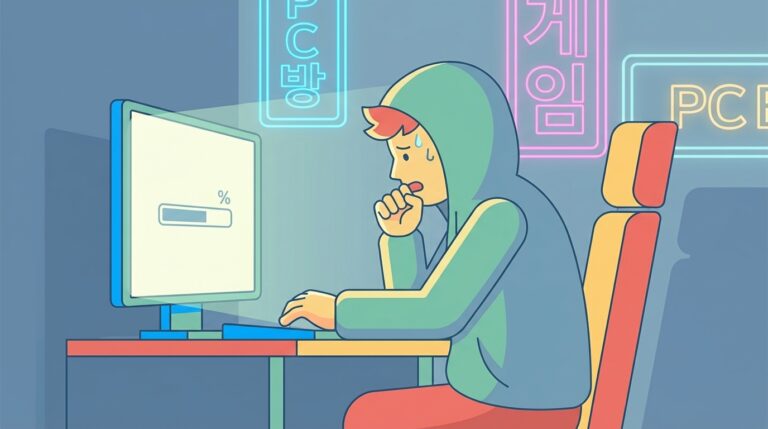
Imagine this: It’s 7:58 PM on a Friday. You are sitting in a dimly lit Korean PC Bang (PC cafe), staring at the glowing monitor. At exactly 8:00 PM, tickets for your favorite K-Pop group’s Seoul concert will drop. Your hands are sweaty, your leg is bouncing up and down uncontrollably, and your friend next to you is muttering something under their breath.
If you look up the word “nervous” in a dictionary, you’ll probably find 긴장하다 (ginjanghada) or 불안하다 (buranhada). But does “I’m feeling a bit anxious” truly capture the sheer terror and adrenaline of a Korean Ticketing War? Not at all!
In Korean, we have incredibly specific and vivid expressions to describe different flavors of anxiety, nervousness, and suspense. Knowing these nuances will take your Korean from a textbook B1 to a culturally fluent B2. You won’t just be speaking Korean; you’ll be feeling it. Let’s dive into the words Koreans actually use when they are on the verge of a mental breakdown!
Phase 2: Core Expressions Deep Dive
1. 조마조마하다
- Pronunciation: jo-ma-jo-ma-ha-da [Sounds like the rhythmic, suspenseful beating of a fast heart]
- Meaning: (Literal) To be anxious / (Real nuance) To be on pins and needles, waiting in suspense for an outcome.
- K-Culture Moment: You know that moment in a K-Drama where the male lead is running to the airport to stop the female lead from boarding her flight? As a viewer, you are gripping your pillow, thinking, “Will he make it?!” That exact feeling is 조마조마하다. It’s an anxiety mixed with suspense.
- Editor’s Insight: We don’t use this when we are generally stressed about life. We use it when a specific, immediate result is hanging in the balance.
- Situation Spectrum:
- Casual (Friends): ✅
- Semi-formal (Coworkers): ✅
- Formal (Boss/Elders): ⚠️ (A bit too expressive, but okay if talking about a shared suspenseful event)
- 🤔 Think About It: Why does Korean use so many repeated words (reduplication) like 조마조마, 두근두근, or 덜덜? How do these “sound words” (ideophones) make the emotion feel more physical compared to your native language?
2. 초조하다
- Pronunciation: cho-jo-ha-da [The sharp ‘ch’ sound feels like a ticking clock running out of time]
- Meaning: (Literal) To be fretful / (Real nuance) To be restless and impatient due to anxiety.
- K-Culture Moment: You ordered food via a delivery app, and the status says “Arriving in 5 minutes,” but 20 minutes have passed. You keep looking out the window and checking your phone. This restless, pacing-around type of anxiety is 초조하다.
- Editor’s Insight: If 조마조마하다 is about the suspense of an outcome, 초조하다 is about the anxiety of time running out. It’s a very “Pali-Pali” (hurry up) emotion.
- Situation Spectrum:
- Casual (Friends): ✅
- Semi-formal (Coworkers): ✅
- Formal (Boss/Elders): ⚠️
- 🤔 Think About It: Does the fast-paced nature of modern society create more situations where we feel “초조하다”?
3. 심장이 쫄깃해지다
- Pronunciation: sim-jang-i jjol-git-hae-ji-da [Jjol-git sounds like stretching something chewy, like a gummy bear]
- Meaning: (Literal) The heart becomes chewy / (Real nuance) To be thrilled, nerve-wracking, or at the edge of your seat.
- K-Culture Moment: Watching the final penalty shootout of the World Cup with your Korean friends at a chicken and beer (Chimaek) pub. Every time the player kicks the ball, your heart “tightens and stretches.”
- Editor’s Insight: This is an incredibly common and trendy B2/C1 slang. It turns a scary/nervous situation into something slightly entertaining or thrilling.
- Situation Spectrum:
- Casual (Friends): ✅
- Semi-formal (Coworkers): ✅ (Often used in fun team environments)
- Formal (Boss/Elders): 🚫 (Too informal and slangy)
- 🤔 Think About It: Koreans love “chewy” (쫄깃한) food textures like tteokbokki and naengmyeon. Isn’t it fascinating that we apply our favorite food texture to a feeling of thrilling anxiety?
Phase 3: Textbook vs. Real Korean
[Situation 1: Waiting for an important exam/interview result]
* 📖 Textbook: 결과가 걱정됩니다. (I am worried about the results.)
* 🗣️ Real Korean: 아, 피 말려 진짜… (Ah, it’s drying my blood, seriously…)
* 💡 Why the difference?: “피 말리다” (blood drying) physically describes the exhaustion of extreme anxiety. Koreans love visceral, body-related metaphors to express intense emotions.
[Situation 2: Freaking out because you made a huge mistake]
* 📖 Textbook: 저는 지금 매우 당황스럽고 불안합니다. (I am very panicked and anxious right now.)
* 🗣️ Real Korean: 완전 멘붕이야. 어떡해?! (I’m in complete “men-bung”. What do I do?!)
* 💡 Why the difference?: “멘붕” (멘탈 붕괴 – Mental Breakdown) is a staple internet slang that became mainstream. It perfectly captures the chaos of panic and anxiety in just two syllables.
Bottom Note: At the B2 level, injecting phrases like “피 말려” or “멘붕” into your casual conversations will immediately make Koreans think, “Wow, where did you learn that?!”
Phase 4: Cultural Context — K-Culture Deep Dive
4-1. Non-Verbal Cues of Anxiety
In Korea, emotions aren’t just spoken; they are worn on the body. But be careful!
* 다리 떨기 (Leg Shaking): When Koreans get nervous or impatient (초조할 때), they often unconsciously shake their legs. However, elders hate this! There is a famous superstition: “다리 떨면 복 나간다” (If you shake your leg, your good luck will fall out). If you are nervous in a job interview, plant your feet firmly on the ground!
* 눈치 (Nunchi): If someone around you is clearly 초조하다 (e.g., sighing, checking their watch), good Nunchi dictates that you don’t bother them with trivial questions. Read the room!
4-2. The “Ticketing” Culture (피켓팅)
If you are a K-Pop fan, you know this anxiety. Koreans call it 피켓팅 (Pi-keting), a portmanteau of 피 (Blood) and 티켓팅 (Ticketing). It refers to the blood-bath competition of booking concert tickets. The Korean internet infrastructure is so fast, and the “Pali-Pali” culture is so ingrained, that concert tickets for big idols sell out in milliseconds. The feeling of watching the purple “waiting room” loading bar on Interpark Ticket is the ultimate definition of 조마조마하다.
Phase 5: Real-Life Roleplay Scenario
- Setting: 7:59 PM. A PC Bang in Sinchon. You and your Korean friend Min-su are sitting in front of high-speed gaming monitors. The Interpark clock is ticking down to 8:00 PM for the BTS reunion concert.
- Characters:
- YOU: An international fan experiencing Korean PC Bang ticketing for the first time.
- Min-su (28): Your Korean friend, a veteran at “Blood-Ticketing.”
Min-su: 야, 1분 남았어. 새로고침 누를 준비 해! 🕒
(Ya, ilbun namasseo. Saerogochim nureul junbi hae!)
[Hey, 1 minute left. Get ready to hit refresh!]
(🎭 Stage Direction: Min-su’s leg is bouncing up and down like a jackhammer)
YOU: 아, 내 마우스 쥔 손에 땀 나. 너무 떨려!
(A, nae mauseu jwin sone ttam na. Neomu tteollyeo!)
[Ah, my hand holding the mouse is sweating. I’m so nervous!]
Min-su: 30초! 아 씨, 나도 다리 떨려. 복 나가면 안 되는데.
(Samsip-cho! A ssi, nado dari tteollyeo. Bok nagamyeon an doeneunde.)
[30 seconds! Ah darn, my legs are shaking too. I shouldn’t lose my luck.]
YOU: 10, 9, 8… 어? 화면이 멈췄어!
(Sip, gu, pal… Eo? Hwamyeoni meomchwosseo!)
[10, 9, 8… Huh? The screen froze!]
Min-su: 대기열 5만 명 떴어! 절대 새로고침 누르지 마!!
(Daegiyeol oman myeong tteosseo! Jeoldae saerogochim nureuji ma!!)
[The queue is at 50,000! Do NOT hit refresh!!]
🔀 Your Turn! How do you express your extreme suspense?
– A) “결과가 무척 걱정되네요.” (The result is very worrying.)
– B) “아 진짜, 기다리는 거 너무 초조해!”
– C) “대박, 심장 쫄깃해져!”✅ Best Choice: C (Or B). C perfectly captures the thrilling, agonizing suspense of waiting in a virtual queue. It shows you are engaged in the adrenaline of the moment.
⚠️ Choice A Analysis: Sounds like a news anchor reporting on the economy. Too formal and detached for a PC Bang!
Phase 6: 10-Second Shadowing Drill
Practice expressing anxiety with the right intonation! Pay attention to the pauses (/) and the emotion tags.
- 🥺 Whining slightly: 아 진짜 / 너무 초조해서 / 미칠 것 같아.
(A jinjja / neomu chojohaeseo / michil geot gata.)
[Ah seriously, I’m so restless I think I’ll go crazy.] - 😤 Dramatic suspense: 결과 나올 때까지 / 조마조마해서 / 혼났네!
(Gyeolgwa naol ttaekkaji / jomajomahaeseo / honnanne!)
[I was so on edge until the results came out, it was tough!] - 😊 Thrilled: 와, 방금 그 장면 / 완전 / 심장 쫄깃했어!
(Wa, banggeum geu jangmyeon / wanjeon / simjang jjolgit-haesseo!)
[Wow, that scene just now was totally nerve-wracking/thrilling!]
Phase 7: K-Culture Mini Dictionary
1. 피켓팅
* Romanization: pi-ket-ting
* English: Blood-ticketing
* Context: The fiercely competitive culture of booking concert or sports tickets in Korea.
2. 멘붕
* Romanization: men-bung
* English: Mental Breakdown
* Context: Used when you are so shocked, panicked, or anxious that your brain stops working. A very common everyday slang.
3. 다리 떨기
* Romanization: dari tteolgi
* English: Leg shaking
* Context: A physical manifestation of being 초조하다 (restless). Culturally frowned upon in formal settings due to superstitions about shaking off good luck.
4. 빨리빨리
* Romanization: ppalli-ppalli
* English: Hurry up / Fast-fast
* Context: The core ethos of modern Korean society. This cultural speed is often the root cause of feeling 초조하다 when things don’t happen instantly.
Phase 8: Traveler Survival Kit
What if your anxiety isn’t about K-pop, but because you are lost in the massive labyrinth of Seoul Station?
🆘 Survival Phrases for Travel Anxiety
– 🇰🇷 “길을 잃었는데, 도와주실 수 있나요?” (Gireul ileonneunde, dowajusil su innayo?)
– 🗣️ English: I’m lost, could you help me?
– 📍 Use it at: Subway stations, complex streets like Myeongdong.
- 🇰🇷 “제가 지금 좀 당황해서 그런데…” (Jega jigeum jom danghwanghaeseo geureonde…)
- 🗣️ English: I’m a bit panicked right now, so… (Use this to explain why you might be struggling with words)
- 📍 Use it at: Police stations, help desks, or when speaking to a stranger.
📌 Editor’s Travel Note:
If you are lost and anxious, look for people in their 20s or 30s. They are more likely to speak some English and will almost always pull out Naver Map (네이버 지도) on their phones to guide you. Don’t be afraid to ask for help; Koreans are generally very sympathetic to lost travelers!
Phase 9: Critical Thinking — “One Step Deeper”
🧠 Think Deeper: Language & Societal Speed (빨리빨리 Culture)
Why are there so many nuanced words for anxiety and impatience in Korean? Korea went from a war-torn country to a global economic powerhouse in just a few decades. This miraculous growth was fueled by the “빨리빨리 (Ppalli-Ppalli / Hurry-Hurry)” culture. Because everything—from food delivery to internet speed—happens instantly, the baseline tolerance for waiting is very low. Thus, feeling 초조하다 (restless) is a collective daily experience. The language simply evolved to reflect a society that is always in a rush, always waiting for the next immediate result.💬 Your Turn: Does your culture value speed like Korea, or is it more relaxed? How does that affect your language when you are feeling impatient? Share your thoughts in the comments!
Phase 10: FAQ & Avoiding Common Mistakes
Q: Can I tell my boss “부장님, 저 지금 너무 초조해요” (Boss, I’m so restless right now)?
A: Probably not! While grammatically correct, telling a superior about your restless anxiety can make you seem unprofessional or unstable. Instead, use a softer, more objective phrase like “결과가 어떻게 될지 긴장되네요” (I am tense about what the result will be).
❌ Common Mistake #1: Confusing 당황하다 and 불안하다.
* 당황하다 (Flustered/Panicked): You spilled coffee on your laptop. (Sudden surprise + panic)
* 불안하다 (Anxious/Uneasy): You are waiting for the laptop repair shop to call you back. (Lingering worry)
❌ Common Mistake #2: Using 심장이 쫄깃하다 in serious situations.
Do NOT say “심장이 쫄깃해져요” while waiting for a medical test result. It is meant for entertaining or thrilling anxiety (like movies, games, or sports), not life-and-death situations.
Phase 11: Summary & Action Items
One-Liner Summary: Use 조마조마하다 for suspenseful outcomes, 초조하다 for restless impatience, and 심장이 쫄깃하다 for a thrilling rush!
🚀 Your Action Missions:
* 🥉 Bronze (Solo): Say “아, 진짜 조마조마하네!” out loud 3 times the next time you are waiting for a website to load.
* 🥈 Silver (Online): Leave a comment on a suspenseful K-Drama clip on YouTube using “심장 쫄깃해져요!”
* 🥇 Gold (Real World): The next time you are with a Korean friend and waiting for something exciting, show off your vocabulary by saying, “우리 너무 초조해하지 말고 기다려보자!” (Let’s not be too restless and just wait!)
🎬 K-Culture Mission: Watch an episode of a Korean thriller or survival show (like Squid Game or Physical: 100). Every time a character looks nervous, guess whether they are feeling 조마조마하다 or 초조하다!
Phase 12: Quiz — Interactive Challenge
1. Situational Judgment: You are waiting for your friend who is 30 minutes late. Your movie starts in 5 minutes. Which expression fits best?
– A) 아, 너무 당황스러워.
– B) 아, 진짜 초조하네.
– C) 아, 심장이 쫄깃해져.
2. True or False – K-Culture Edition: It is considered totally normal and polite to shake your legs (다리 떨기) during a business meeting to show you are paying attention.
– A) True
– B) False
(Check the answers below!)
👀 Click here for Answers
1. B) 아, 진짜 초조하네. (You are running out of time and getting restless. ‘A’ is for sudden panic, and ‘C’ is for a fun thrill.)
2. B) False. Shaking legs is culturally considered bad luck (“복 나간다”) and looks highly unprofessional in Korea!
Frequently Asked Questions (FAQ)
Q: What does "조마조마하다" mean in Korean and how do you pronounce it?
A: In Korean, "조마조마하다" is pronounced [jo-ma-jo-ma-ha-da [Sounds like the rhythmic, suspenseful beating of a fast heart] and means: (Literal) To be anxious / (Real nuance) To be on pins and needles, waiting in suspense for an outcome.
Q: What does "초조하다" mean in Korean and how do you pronounce it?
A: In Korean, "초조하다" is pronounced [cho-jo-ha-da [The sharp 'ch' sound feels like a ticking clock running out of time] and means: (Literal) To be fretful / (Real nuance) To be restless and impatient due to anxiety.
Q: What does "심장이 쫄깃해지다" mean in Korean and how do you pronounce it?
A: In Korean, "심장이 쫄깃해지다" is pronounced [sim-jang-i jjol-git-hae-ji-da [Jjol-git sounds like stretching something chewy, like a gummy bear] and means: (Literal) The heart becomes chewy / (Real nuance) To be thrilled, nerve-wracking, or at the edge of your seat.







