

Phase 1: Empathy (Immersive Opening)
Hello! I’m your Daily Hangul editor.
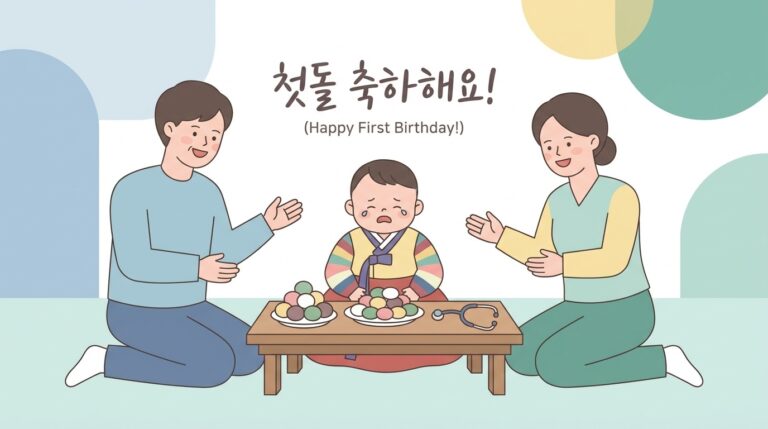
Picture this: You’ve been invited to your Korean coworker’s baby’s Doljanchi (1st birthday party). You are sitting at a beautifully decorated banquet table, enjoying the premium buffet. The highlight of the event, the Doljabi (where the baby picks an object that predicts their future), is about to begin. The MC has everyone hyped up. But suddenly… the star of the show bursts into tears!
The baby is wailing, the heavy traditional Hanbok looks uncomfortable, and the parents freeze, looking incredibly stressed and frantic. You want to say something to comfort them, but your mind goes blank. Saying “Don’t cry” to the baby feels useless, and asking the parents “Why are they crying?” feels rude.
If you don’t know what to say in this moment, you might just sit there awkwardly. But if you know the right Korean phrases, you can instantly relieve the parents’ stress, save their ‘face,’ and prove you have top-tier Nunchi (social sense).
This guide is based on real moments our expat students have experienced at Korean family events. Let’s dive in!
Phase 2: Core Expressions Deep Dive
Here are the top 3 life-saving phrases you need when a baby causes a scene.
1. 낯을 가리나 봐요 (They must be shy around strangers)
- Pronunciation: nacheul garina bwayo. [nat (like knot) – eul – ga-ri-na – bwa-yo]
- Meaning: Literal: It seems they distinguish faces. / Real nuance: Oh, they must be scared of strangers.
- K-Culture Moment: At a Doljanchi, there are hundreds of unfamiliar faces staring at the baby. Using this phrase provides a perfectly reasonable, empathetic excuse for the baby’s crying, taking the blame off the parents’ “parenting skills.”
- Editor’s Insight: This phrase is magical. It says, “It’s not your fault, the baby is just overwhelmed by all these new people.” It’s the ultimate comfort blanket for a stressed Korean mom or dad.
- Situation Spectrum:
- Casual friends: ✅
- Coworkers (Semi-formal): ✅
- Boss/Elders (Formal): ✅
- 🤔 Think About It: Why do Koreans often use “~나 봐요” (It seems like…) instead of directly saying “He is shy”? How does this indirectness show politeness in Korean culture?
2. 우는 것도 너무 귀여워요 (Even their crying is so cute)
- Pronunciation: uneun geotdo neomu gwiyeowoyo. [u-neun – geot-do – neo-mu – gwi-yeo-wo-yo]
- Meaning: Literal: Crying thing is also very cute. / Real nuance: Aw, they’re cute even when they cry. Don’t stress!
- K-Culture Moment: When the dad is profusely apologizing to the guests for the delay, someone from the crowd shouting this with a warm smile instantly changes the mood from tense to heartwarming.
- Editor’s Insight: You are validating the child. By praising the baby even in a “bad” moment, you assure the parents that the guests are enjoying themselves regardless of the chaos.
- Situation Spectrum:
- Casual friends: ✅
- Coworkers (Semi-formal): ✅
- Boss/Elders (Formal): ⚠️ (Use with a soft tone, otherwise might sound too casual)
- 🤔 Think About It: In many cultures, a crying baby in public is a nuisance. Here, we try to reframe it as “cute.” Is there a similar way to defuse social tension in your home country?
3. 졸린가 봐요 (They must be sleepy)
- Pronunciation: jollinga bwayo. [jol-lin-ga – bwa-yo]
- Meaning: Literal: It seems they are sleepy.
- K-Culture Moment: Just like expression #1, this gives the baby a valid “excuse.” Babies sleep a lot, so assuming they are tired is the safest, most empathetic guess you can make.
- Editor’s Insight: Often combined with the word “아이고” (Aigo – Oh my). “아이고, 졸린가 봐요~” is the ultimate veteran guest reaction.
- Situation Spectrum:
- Casual friends: ✅
- Coworkers (Semi-formal): ✅
- Boss/Elders (Formal): ✅
- 🤔 Think About It: Notice the pattern? We are making excuses for the baby. This collective effort to protect the family’s dignity is a huge part of Korean communal culture.
Phase 3: Textbook vs. Real Korean
[Situation 1: When the baby starts crying]
* 📖 Textbook Korean: 아기가 왜 웁니까? (Why is the baby crying?)
* 🗣️ Real Korean: 아이고, 애기가 놀랐나 봐요~ (Oh my, the baby must be startled~)
* 💡 Why is it different?: Asking “why” sounds interrogative and blames the parents. “놀랐나 봐요” (must be startled) shows empathy for the baby’s perspective.
[Situation 2: Telling the parents not to worry]
* 📖 Textbook Korean: 걱정하지 마세요. (Do not worry.)
* 🗣️ Real Korean: 애기들 다 그렇죠 뭐~ 천천히 하세요. (All babies are like that~ Take your time.)
* 💡 Why is it different?: Shared experience (“All babies are like that”) builds solidarity. “Take your time” relieves the immense time pressure the parents feel during a rented venue event.
Bottom Note: For B1 learners, mastering the indirect ending
~나 봐요(it seems/I guess) is your golden ticket to sounding like a native, polite, and emotionally intelligent speaker.
Phase 4: Cultural Context — K-Culture Deep Dive
4-1. Non-verbal Elements (The Art of Nunchi)
When you use these phrases, your body language is just as important.
– Don’t stare intensely: Staring directly at a crying baby will only make them cry harder! Avert your eyes slightly, give a soft smile to the parents, and wave your hand dismissively to show “It’s no big deal.”
– Nunchi step-back: If the parents are sweating and trying to calm the baby, take a literal step back to give them physical space to breathe.
4-2. K-Drama Connection: The “Face” of the Family
Have you ever watched a K-Drama where a family event (a wedding, a memorial, or a Doljanchi) turns into absolute chaos? (Think of Reply 1988 or Hospital Playlist).
In Korean culture, these milestone events are less about the individual and more about the family’s Che-myeon (체면 – Face/Dignity). The parents have invited their boss, their in-laws, and distant relatives. A crying baby feels like a failure to host a “perfect” event. When you step in and say, “우는 것도 귀여워요” (Even crying is cute), you aren’t just complimenting the baby; you are actively protecting the parents’ social standing in front of their strict mother-in-law or company boss!
Phase 5: Real-world Roleplay Scenario
Setting: Saturday afternoon, 1 PM. A fancy hotel banquet hall in Seoul. The buffet smells like delicious Galbi. Your team leader, Jihoon, is hosting his son’s Doljanchi. The baby, wearing a heavy silk Hanbok, has just seen the crowd and is wailing at the top of his lungs.
Characters:
– YOU: An expat working in Seoul, attending your first Korean family event.
– Jihoon (34): Your team leader. He looks exhausted, sweating in his suit, bouncing the baby trying to quiet him down.
Dialogue:
Jihoon: 아… 정말 죄송합니다. 애기가 갑자기 우네요. 😓
(a… jeongmal joesonghamnida. aegiga gapjagi uneyo.)
[Ah… I’m so sorry. The baby is crying all of a sudden.]
(🎭 Stage Direction: Jihoon bows slightly to you and the other coworkers, looking embarrassed.)
YOU: 에이, 아니에요 팀장님!
(ei, anieyo timjangnim!)
[Hey, not at all, Team Leader!]
Jihoon: 돌잡이 해야 하는데, 분위기를 다 망치네요. 하하…
(doljabi haeya haneunde, bunwigireul da mangchineyo. haha…)
[We need to do the Doljabi, he’s ruining the mood. Haha…]
🔀 Your Turn! How should you respond?
– A) 네, 애기가 참 시끄럽네요. (Yes, the baby is quite loud.)
– B) 빨리 돌잡이 시작하세요! (Hurry up and start the Doljabi!)
– C) 아이고, 낯을 가리나 봐요. 우는 것도 귀여워요! (Oh my, he must be shy. Even his crying is cute!)✅ Best Choice: C — Reason: You immediately excuse the baby’s behavior (shy) and follow up with a compliment to defuse Jihoon’s embarrassment.
⚠️ Choice A & B Analysis: Choice A is incredibly rude and will ruin your relationship with your boss. Choice B adds unnecessary pressure to an already stressed parent.
Jihoon: 그렇게 말씀해 주셔서 감사합니다. 조금만 기다려 주세요.
(geureoke malsseumhae jusyeoseo gamsahamnida. jogeumman gidaryeo juseyo.)
[Thank you for saying that. Please wait just a little bit.]
YOU: 천천히 하세요! 저희는 음식 먹고 있을게요. 🍽️
(cheoncheonhi haseyo! jeohuineun eumsik meokgo isseulgeyo.)
[Take your time! We will be eating the food.]
Bonus Roleplay: The KTX Train (Travel)
You are on the KTX bullet train to Busan. It’s quiet, but a baby in the row next to you starts crying. The mother looks terrified and starts apologizing to everyone.
Mom: 죄송합니다, 죄송합니다…
(joesonghamnida, joesonghamnida…)
[I’m sorry, I’m sorry…]
YOU: 괜찮아요. 애기가 피곤한가 봐요.
(gwaenchanayo. aegiga pigonhanga bwayo.)
[It’s okay. The baby must be tired.]
(Give her a warm, reassuring smile. You just made her day!)
Phase 6: 10-Second Shadowing Drill
Read this out loud to practice the empathetic tone. Pause where you see the /!
🥺 아이고, / 낯을 / 가리나 봐요~ (aigo, / nacheul / garina bwayo~)
😊 우는 것도 / 너~무 / 귀여워요! (uneun geotdo / neo~mu / gwiyeowoyo!)
Phase 7: K-Culture Mini Dictionary
1. 돌잔치
* Romanization: doljanchi
* English: A baby’s first birthday party.
* Context: A major life milestone in Korea, traditionally celebrating the survival of a child past their first year (which was rare in ancient times). Guests give gold rings or cash.
2. 돌잡이
* Romanization: doljabi
* English: The fortune-telling draw.
* Context: The climax of the party. The baby is placed in front of items (money, string, stethoscope, gavel). What they grab predicts their future (wealth, long life, doctor, judge).
3. 체면
* Romanization: che-myeon
* English: Face / Dignity / Social standing.
* Context: The underlying reason why parents stress so much at public events. Saving face for oneself and protecting others’ face is crucial in Korean interactions.
4. 아이고
* Romanization: aigo
* English: Oh my! / Sigh / Ouch.
* Context: The most versatile interjection. Used for surprise, empathy, exhaustion, or pain. Adding this before a sentence softens the blow and adds emotional depth.
Phase 8: Traveler’s Survival Kit
Even if you aren’t attending a Doljanchi, you will encounter babies on subways, in cafes, and at parks while traveling in Korea.
🆘 Survival Phrases for K-Travelers (Baby Edition)
– 🇰🇷 “몇 개월이에요?” (myeot gaeworieyo?)
– 🗣️ Pronunciation: myut-gae-wol-ee-ae-yo?
– 📍 Where to use: Parks, cafes when making small talk with a proud parent.
– 💡 Meaning: “How many months old are they?” (Koreans count baby age in months!)
- 🇰🇷 “너무 예뻐요!” (neomu yeppeoyo!)
- 🗣️ Pronunciation: neo-mu yep-peo-yo!
- 📍 Where to use: Anytime you see a cute baby.
- 💡 Meaning: “So pretty/cute!” (Can be used for both boys and girls).
📌 Editor’s Travel Note
– Look, don’t touch: In the past, Korean grandmothers might touch a cute baby’s cheeks in public. Do not do this today. Modern Korean parents are very protective of hygiene and personal space. Admire the baby from a distance!
– No Kids Zones: Be aware that some cafes and restaurants in Korea are “No Kids Zones” (노키즈존) to maintain a quiet atmosphere. Always check map apps (Naver Map/Kakao Map) before visiting.
Phase 9: Critical Thinking Corner — “One Step Deeper”
🧠 Think Deeper: Language, Empathy, and Community (눈치)
Have you noticed that all of the phrases we learned today are about making excuses for the baby? We say “they must be sleepy” or “they must be shy” rather than just saying “It’s okay.” This reflects a deep layer of Korean communal culture. In Western cultures, independence is key, but in Korea, society is highly relational. A parent’s embarrassment is felt by the whole group. By offering a logical, external reason for the baby’s crying (tiredness, strangers), you are actively doing the emotional labor to restore harmony and protect the parents’ Che-myeon (face). Your words aren’t just communication; they are a social shield.
💬 Your Turn:
In your culture, how do people react when a baby cries loudly at a wedding or a big event? Do people ignore it, complain, or try to help? Share in the comments!
Phase 10: FAQ & Avoiding Misunderstandings
Q: Should I bring a gift to a Doljanchi?
Yes! The traditional gift is a Dolbanji (돌반지 – a 24k gold ring for the baby). However, nowadays, handing the parents a white envelope with crisp cash (usually 50,000 KRW to 100,000 KRW) is perfectly acceptable and highly appreciated.
Q: Can I use “우는 것도 너무 귀여워요” to my boss?
Maybe. If your boss is very strict and much older, it might sound a tiny bit too casual. In that case, stick to the safer: “아이고, 애기가 놀랐나 봅니다” (Oh, it seems the baby is startled – using the formal ~봅니다 ending).
❌ Common Mistake #1: Offering unsolicited parenting advice (e.g., “Maybe he is hungry, you should feed him.”)
✅ Do this instead: Stick to empathetic guessing (“He must be tired”). Never tell the parents what to do in front of guests.
Phase 11: Summary & Action Items
- One-Liner Summary: When a baby cries at a Korean event, use indirect guessing (
~나 봐요) to comfort the parents and protect their dignity. -
Action Mission:
- 🥉 Bronze (Solo): Look in the mirror, smile warmly, and say “아이고, 졸린가 봐요~” 3 times.
- 🥈 Silver (Online): Find a YouTube vlog of a Korean Doljanchi and leave a comment: “우는 것도 너무 귀여워요!”
- 🥇 Gold (Real World): If you hear a baby crying on public transport in Korea, catch the parent’s eye and mouth “괜찮아요” (It’s okay) with a warm smile.
- K-Culture Mission: Search “Doljabi moments” on YouTube. Watch what items the babies grab, and notice how the parents react!
Phase 12: Quiz — Interactive Challenge
1. Situational Judgment:
You are at a colleague’s Doljanchi. The baby is crying loudly because of the loud MC. What is the most culturally appropriate thing to say to the stressed mom?
– A) “음악이 너무 시끄럽네요.” (The music is too loud.)
– B) “애기가 낯을 가리나 봐요. 천천히 하세요.” (The baby must be shy. Take your time.)
– C) “우유 줘야 하는 거 아니에요?” (Shouldn’t you give him milk?)
Click for the Answer
Answer: B. You provide an empathetic excuse and relieve her time pressure. ‘A’ criticizes the event planning, and ‘C’ is unsolicited advice.
2. True or False – K-Culture Edition:
It is considered polite to go up and pinch the cheeks of a cute Korean baby you don’t know to show affection.
Click for the Answer
Answer: False! While older generations might have done this, modern parents heavily dislike strangers touching their children due to boundaries and hygiene. Compliment them verbally from a distance!
Great job today! You are now officially a certified Nunchi master for Korean family events. See you in the next Daily Hangul lesson!
Frequently Asked Questions (FAQ)
Q: What does "낯을 가리나 봐요 (They must be shy around strangers)" mean in Korean and how do you pronounce it?
A: In Korean, "낯을 가리나 봐요 (They must be shy around strangers)" is pronounced [nacheul garina bwayo. [nat (like knot] and means: Literal: It seems they distinguish faces. / Real nuance: Oh, they must be scared of strangers.
Q: What does "우는 것도 너무 귀여워요 (Even their crying is so cute)" mean in Korean and how do you pronounce it?
A: In Korean, "우는 것도 너무 귀여워요 (Even their crying is so cute)" is pronounced [uneun geotdo neomu gwiyeowoyo. [u-neun - geot-do - neo-mu - gwi-yeo-wo-yo] and means: Literal: Crying thing is also very cute. / Real nuance: Aw, they're cute even when they cry. Don't stress!
Q: What does "졸린가 봐요 (They must be sleepy)" mean in Korean and how do you pronounce it?
A: In Korean, "졸린가 봐요 (They must be sleepy)" is pronounced [jollinga bwayo. [jol-lin-ga - bwa-yo] and means: Literal: It seems they are sleepy.







