

Phase 1: Empathy (The Moment You Need This)
Hello! I am your Daily Hangul Editor, your local Korean friend and veteran tutor.
Imagine this: You are watching a K-Drama. The main characters just finished eating delicious Samgyeopsal (pork belly) and drinking Soju. Suddenly, the rich CEO dramatically pulls out a sleek black credit card and says, ‘I will pay for everything!’ It looks so cool, right?
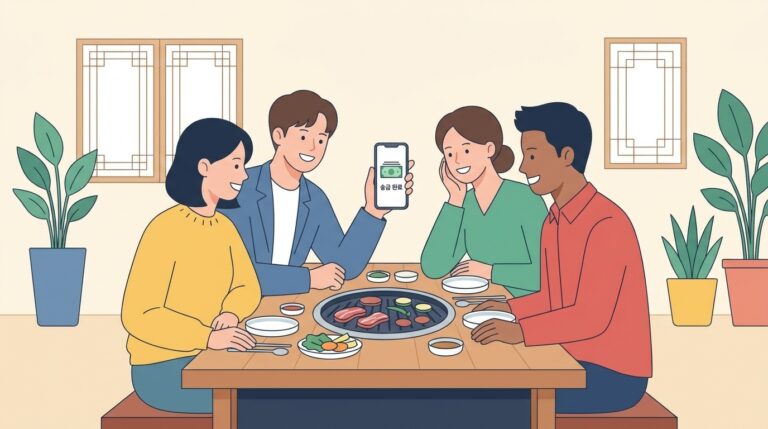
But wait… what happens when you go out with your Korean friends in real life? While older generations still fight over who gets to pay the bill, younger Koreans love to split it evenly! And when the bill is split, someone has to pay first, and the rest have to ‘send money’ (송금 – song-geum) to that person’s bank account.
If you don’t know how to say ‘Give me your account number’ or ‘I sent the money,’ you might find yourself awkwardly holding cash while everyone else is already walking out. Do not worry! This guide is based on real questions from my A1 beginner students. Today, we will learn how to send money and split the bill like a true Seoulite!
Phase 2: Core Expressions Deep Dive
Here are the absolute must-know survival phrases for sending money.
1. 계좌번호 주세요 (Account number, please)
- Pronunciation: gye-jwa-beon-ho ju-se-yo [Sounds like: geh-jwa-bun-ho joo-seh-yo]
- Meaning: Literal: ‘Give me account number’ / Real nuance: ‘Please let me know your bank account number so I can transfer my share.’
- K-Culture Moment: You just finished a group dinner. One person paid for the whole table with their card. You pull out your phone, open your banking app, and confidently say this phrase.
- Editor’s Insight: ‘계좌’ (gye-jwa) means ‘account’. It might sound a bit difficult to pronounce at first, but it is the magic word for transferring money in Korea!
- Situation Spectrum:
- Friends (Casual): ✅ (Say: 계좌번호 알려줘!)
- Coworkers (Semi-formal): ✅ (Perfect to use)
- Boss/Elders (Formal): ⚠️ (Better to say: 계좌번호 알려주시면 송금하겠습니다 – ‘If you let me know, I will transfer it’)
- 🤔 Think About It: Why do Koreans share bank account numbers so easily? In many Western countries, giving out a bank account number feels risky. But in Korea, it is as common as sharing a phone number! Does your culture use bank transfers for splitting dinner bills?
2. 돈 보냈어요 (I sent the money)
- Pronunciation: don bo-naess-eo-yo [Sounds like: dohn boh-ness-uh-yo]
- Meaning: Literal: ‘Money sent’ / Real nuance: ‘I just transferred the money to you.’
- K-Culture Moment: Right after you type in the account number and hit ‘send’ on your Toss or KakaoPay app, you show the confirmation screen and say this with a smile.
- Editor’s Insight: Keep it simple! You don’t need to use the complex dictionary word ‘송금했습니다’ (I have remitted the funds). Just say ‘돈’ (money) + ‘보냈어요’ (sent).
- Situation Spectrum:
- Friends (Casual): ✅ (Say: 돈 보냈어!)
- Coworkers (Semi-formal): ✅
- Boss/Elders (Formal): 🚫 (Use: 송금해 드렸습니다)
- 🤔 Think About It: In Korean, we often drop the subject ‘I’ (저는). The context makes it obvious who sent the money. Does your native language always require you to say ‘I’?
3. 얼마예요? (How much is it?)
- Pronunciation: eol-ma-ye-yo? [Sounds like: uhl-mah-yeh-yo?]
- Meaning: ‘How much is it?’
- K-Culture Moment: Whether you are at a traditional market buying Tteokbokki, or asking your friend how much you owe them for the taxi ride, this is your #1 survival question.
- Editor’s Insight: This phrase is incredibly versatile. Use it anywhere, anytime money is involved.
- Situation Spectrum:
- Friends (Casual): ✅ (Say: 얼마야?)
- Coworkers (Semi-formal): ✅
- Boss/Elders (Formal): ✅
- 🤔 Think About It: Notice how the sentence ends in ‘yo’ (요)? Adding ‘yo’ instantly makes your Korean polite and safe to use with strangers!
Phase 3: Textbook vs. Real Korean
[Situation 1: Asking for Bank Details]
* 📖 Textbook Korean: 당신의 계좌 번호는 무엇입니까? (What is your account number?)
* 🗣️ Real Korean: 계좌번호 알려주세요~ (Please let me know your account number~)
* 💡 Why is it different?: Using ‘당신’ (you) sounds very aggressive or awkward in real Korean. We prefer soft, indirect requests.
[Situation 2: Announcing You Paid Your Share]
* 📖 Textbook Korean: 제가 돈을 송금했습니다. (I have remitted the money.)
* 🗣️ Real Korean: 방금 보냈어요! 확인해 보세요. (I just sent it! Check it out.)
* 💡 Why is it different?: ‘송금’ (remittance) is a formal Hanja (Chinese character) word used by banks. Everyday people just say ‘보내다’ (to send).
Phase 4: Cultural Context — K-Culture Deep Dive
4-1. Non-Verbal Communication: The ‘Screen Show’
When you say ‘돈 보냈어요’ (I sent the money), it is common Korean courtesy to briefly turn your smartphone screen toward the person to show the ‘Transfer Complete’ (송금 완료) checkmark. It builds trust, and they do not have to nervously check their own banking app immediately. It is a modern example of Korean ‘Nunchi’ (reading the room)!
4-2. K-Food Connection: The Evolution of Paying
In old Korean dramas, you might see grandfathers loudly arguing at the restaurant counter, physically fighting over who gets to pay the bill. This ‘I will treat you’ culture is deeply tied to Korean ‘Jeong’ (정 – warmth/affection).
However, in modern Seoul cafes and restaurants, younger generations prefer exactness. They use terms like ‘엔빵’ (N-ppang), which means splitting the bill by ‘N’ number of people. KakaoPay even has a built-in ‘Split the Bill’ button that does the math and requests the exact amount from your friends’ chat room automatically!
Phase 5: Real-Life Roleplay Scenario
Setting: Friday night, 8:00 PM. A noisy, smoke-filled Korean BBQ restaurant in Gangnam. You are sitting with your Korean coworker after a team dinner.
Characters:
– YOU: A beginner Korean learner, living in Seoul for just 1 month.
– Minsu (32): Your friendly Korean coworker who just paid for the meal with his card.
Dialogue:
Minsu: 아~ 배부르다. 가실까요? 😊
(Ah~ baebureuda. Gasilkkayo?)
[Ah~ I am full. Shall we go?]
(🎭 Stage Direction: Minsu puts his credit card back into his wallet)
YOU: 네! 너무 맛있었어요. 그런데 오늘 얼마 나왔어요?
(Ne! Neomu masisseosseoyo. Geureonde oneul eolma nawasseoyo?)
[Yes! It was so delicious. By the way, how much did it come out to today?]
Minsu: 에이, 괜찮아요. 오늘은 제가 쏠게요!
(Ei, gwaenchanayo. Oneureun jaega ssolgeyo!)
[Hey, it’s okay. I will treat you today!]
🔀 Your Turn! How will you respond?
– A) ‘아, 감사합니다! 잘 먹었습니다!’ (Oh, thank you! I ate well!)
– B) ‘아니에요, 반반 내요. 계좌번호 주세요!’ (No, let’s split it. Give me your account number!)
– C) ‘대박! 진짜요?’ (Awesome! Really?)✅ Best Choice: B — Reason: In Korea, it is polite to refuse at least once when someone offers to pay. Offering to split (반반 내요) shows you are considerate. If Minsu insists again, then you can happily accept and say option A!
⚠️ Choice A Analysis: It is fine, but accepting too quickly without offering to pay might seem slightly impolite in a professional setting.
(Assuming you chose B and Minsu agrees to split)
Minsu: 알겠어요. 그럼 각자 2만 원씩 낼까요?
(Algesseoyo. Geureom gakja iman wonssik naelkkayo?)
[Okay. Then shall we pay 20,000 won each?]
YOU: 네, 계좌번호 주세요.
(Ne, gyejwabeonho juseyo.)
[Yes, give me your account number, please.]
Minsu: 카카오뱅크 3333-12… 여기요.
(Kakaobaengkeu 3333-12… yeogiyo.)
[KakaoBank 3333-12… Here you go.]
YOU: 잠시만요… 네, 돈 보냈어요!
(Jamsimanyo… Ne, don bonaesseoyo!)
[Just a moment… Yes, I sent the money!]
Minsu: 네, 확인했습니다. 다음에 또 같이 먹어요!
(Ne, hwaginhamseumnida. Daeume tto gachi meogeoyo!)
[Yes, I checked it. Let’s eat together again next time!]
YOU: 좋아요! 다음에는 제가 살게요.
(Joayo! Daeumeneun jaega salgeyo.)
[Sounds good! Next time, I will buy.]
Phase 6: 10-Second Shadowing Drill
Let’s practice the flow of sending money. Read aloud and follow the pauses (/):
- 📱 Asking for the account:
😊 민수 씨, / 계좌번호 / 주세요!
(minsu ssi, / gye-jwa-beon-ho / ju-se-yo!) -
💸 Confirming the transfer:
😊 방금 / 돈 보냈어요! / 확인해 보세요.
(bang-geum / don bo-naess-eo-yo! / hwa-gin-hae bo-se-yo.)
(Tip: Say it brightly while looking at your friend, then look down at your phone!)
Phase 7: K-Culture Mini Dictionary
1. 더치페이 (Dutch Pay)
* Romanization: deochi-pei
* English: Splitting the bill
* Context: Derived from ‘Going Dutch’. It is the most common word for splitting the bill in Korea.
2. 엔빵 (N-ppang)
* Romanization: en-ppang
* English: Splitting evenly by ‘N’ people
* Context: A popular slang term among younger generations. ‘N’ stands for the number of people, and ‘ppang’ means to divide.
3. 계좌이체 (Gyejwa iche)
* Romanization: gye-jwa i-che
* English: Bank transfer / Wire transfer
* Context: The formal banking term you will see on ATM screens and banking apps.
4. 눈치 (Nunchi)
* Romanization: nun-chi
* English: Situational awareness / Reading the room
* Context: The Korean superpower of sensing what others feel. Offering to split the bill before someone asks is a great sign of ‘quick Nunchi’ (눈치가 빠르다).
Phase 8: Traveler’s Survival Kit
If you are traveling in Korea, you might not have a Korean bank account to wire money. But you will definitely need to use banks or ATMs! Here is your survival guide.
🆘 Survival Phrase #1
– 🇰🇷 ‘현금 인출기 어디에 있어요?’ (hyeon-geum in-chul-gi eo-di-e isseo-yo?)
– 🗣️ English: Where is the ATM?
– 📍 Where to use: Convenience stores, subway stations, banks.🆘 Survival Phrase #2
– 🇰🇷 ‘카드 결제 되나요?’ (ka-deu gyeol-je doe-na-yo?)
– 🗣️ English: Do you accept credit cards?
– 📍 Where to use: Traditional markets, small street food vendors.📌 Editor’s Travel Note
– Card Heaven: Korea is a cashless society! 99% of places accept cards, even for a $1 coffee.
– Street Food: However, for street food in places like Myeongdong or Gwangjang Market, it is best to carry some Cash (현금 – hyeon-geum).
– Tip Culture: There is NO tipping in Korea! If you leave money on the table, the staff might chase you down the street thinking you forgot your change!
Phase 9: Critical Thinking — ‘One Step Deeper’
Food & Identity: From ‘I’ll Pay’ to ‘Let’s Split’
🧠 Think Deeper:
In the past, Korean food culture was all about ‘Jjigae’ (stews) shared from one big pot. Because we shared the food collectively, paying the bill was also seen as a collective responsibility—usually taken on by the oldest person or the host. It was a sign of love and care. However, as modern society becomes more individualistic, and apps like KakaoPay make transfers instant, the ‘Dutch pay’ culture has become the standard for younger generations. It removes the burden of owing someone a meal and keeps relationships clean and equal.💬 Your Turn: How does your culture handle the dinner bill? Do friends fight to pay, or do you calculate everything down to the last cent? Share in the comments!
Phase 10: FAQ & Avoiding Mistakes
Q: ‘Can I use KakaoPay or Toss as a tourist?’
No. Unfortunately, to use Korean money transfer apps, you need a Korean bank account and an ARC (Alien Registration Card). If you are a tourist, carry cash or use a travel card (like Namane or T-Money) to pay your friends back!
Q: ‘If someone older says they will pay, should I keep insisting on paying my share?’
If a much older person or a boss says ‘I will treat you’ (내가 살게), say ‘Thank you, let’s split it’ ONCE. If they say ‘No, no, it is my treat’, just bow slightly and say ‘잘 먹겠습니다!’ (I will eat well!). Do not force them to take your money; it can hurt their pride.
❌ Common Mistake #1: Saying ‘현금 주세요’ (Give me cash) instead of ‘계좌번호 주세요’ (Give me account number).
✅ How to fix it: If you ask for cash, your Korean friend will be very confused because no one carries cash anymore! Always ask for the account number (계좌번호) instead.
Phase 11: Summary & Action Items
- One-Liner Summary: In Korea, sending money and splitting bills is instant and easy; just say ‘계좌번호 주세요’ (Account number, please) and ‘돈 보냈어요’ (I sent the money)!
-
Action Mission 3 Steps:
- 🥉 Bronze (Solo): Say ‘돈 보냈어요!’ out loud 3 times while pretending to tap your phone screen.
- 🥈 Silver (Online): Find a Korean K-pop or K-drama clip on YouTube where characters eat together. Comment ‘계좌번호 주세요!’ as a joke!
- 🥇 Gold (Real Life): Next time you eat out with a Korean friend, offer to split the bill using today’s phrases.
- K-Culture Mission:
Next time you watch a modern K-Drama, look closely at the cafe or restaurant scenes. Watch how quickly friends transfer money to each other using their phones before even leaving the table!
Phase 12: Quiz — Interactive Challenge
1. You want to ask your friend for their bank details to send them money. Which phrase should you use?
A) 현금 어디 있어요? (Where is the cash?)
B) 계좌번호 주세요. (Give me your account number.)
C) 제가 쏠게요! (I will treat you!)
2. True or False: If you enjoy a meal at a Korean restaurant, you should leave a 15% tip to show your appreciation.
3. Fill in the Blank:
You just transferred your share of the BBQ dinner on your phone. You look at your friend and say: ‘돈 (________)!’ (I sent the money!).
(Scroll down for answers!)
…
…
…
[Answers]
1. B (A asks for cash, C means you are paying for everyone!)
2. False (Korea does not have a tipping culture. Paying the exact amount on the bill is perfect!)
3. 보냈어요 (bo-naess-eo-yo)
Frequently Asked Questions (FAQ)
Q: What does "계좌번호 주세요 (Account number, please)" mean in Korean and how do you pronounce it?
A: In Korean, "계좌번호 주세요 (Account number, please)" is pronounced [gye-jwa-beon-ho ju-se-yo [Sounds like: geh-jwa-bun-ho joo-seh-yo] and means: Literal: 'Give me account number' / Real nuance: 'Please let me know your bank account number so I can transfer my share.'
Q: What does "돈 보냈어요 (I sent the money)" mean in Korean and how do you pronounce it?
A: In Korean, "돈 보냈어요 (I sent the money)" is pronounced [don bo-naess-eo-yo [Sounds like: dohn boh-ness-uh-yo] and means: Literal: 'Money sent' / Real nuance: 'I just transferred the money to you.'
Q: What does "얼마예요? (How much is it?)" mean in Korean and how do you pronounce it?
A: In Korean, "얼마예요? (How much is it?)" is pronounced [eol-ma-ye-yo? [Sounds like: uhl-mah-yeh-yo?] and means: 'How much is it?'







