

Phase 1: Empathy & K-Culture Cold Open
Hello! Daily Hangul Editor here.
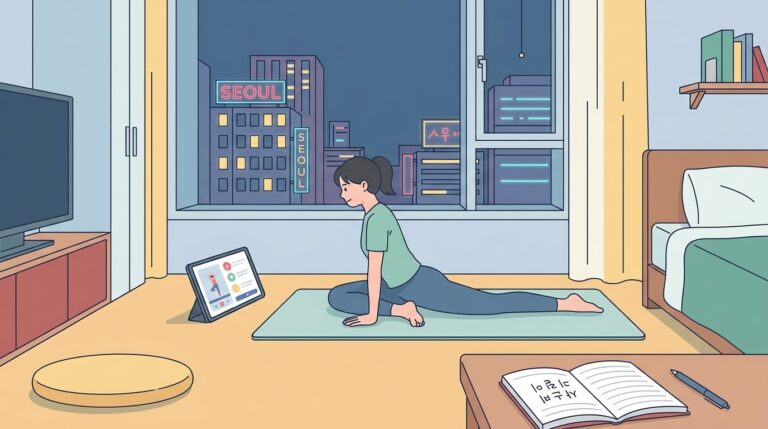
Picture this K-Drama trope: The protagonist, a hyper-busy office worker living in a cozy Seoul officetel, comes home exhausted after a long day of dealing with their strict boss. But instead of crashing on the bed, they unroll a pastel-colored yoga mat, fire up a fitness app on their tablet, and start fiercely doing planks while a hyper-energetic Korean trainer yells, “Just 10 more seconds!” from the screen.
If you’ve been keeping up with Korean culture, you might have noticed an explosion in this lifestyle over the past few years. It’s called 홈트 (Homt)—short for Home Training. But it’s not just about doing push-ups in your living room; it’s a massive cultural phenomenon tied to the MZ generation’s obsession with 갓생 (God-saeng), or living an incredibly productive, exemplary life.
At a C2 level, you already know how to say “I exercise” (저는 운동을 합니다). But if you want to sound like a local chatting at a trendy cafe in Seongsu-dong, or understand the flood of hashtags on Korean Instagram, you need to master the highly specific, slightly intense, and totally fun vocabulary surrounding Korea’s home workout app culture.
Let’s dive into the words that will make your Korean friends go, “Wait, how do you know that?!”
Phase 2: Core Expressions Deep Dive
1. 홈트 (Homt)
- Pronunciation: [Hom-teu] The ‘o’ is a short, round ‘o’ like in ‘home’, and ‘teu’ uses that classic Korean ‘으’ vowel—imagine the disgusted sound you make when stepping in wet gum: “eugh.”
- Meaning: Home Training (Literal) vs. Working out at home using apps or YouTube (Real nuance).
- K-Culture Moment: You’ll see this everywhere from K-Pop idols doing V-Live broadcasts in their dorms saying “오늘 틈새 홈트 했어요” (I did a quick ‘homt’ in my spare time today) to app advertisements promising you a ‘body profile’ ready physique.
- Editor’s Insight: Koreans love abbreviating everything. We don’t say “집에서 운동해요” (I exercise at home) anymore. “홈트” is used as both a noun and a verb stem (홈트하다).
- Situation Spectrum:
- Casual (Friends): ✅ “너 오늘 홈트할 거야?”
- Semi-formal (Co-workers): ✅ “요즘 홈트 앱 구독해서 운동하고 있어요.”
- Formal (Boss/Elders): ⚠️ (They might not know the abbreviation; better to say 집에서 운동합니다).
- 🤔 Think About It: Why do Koreans prefer “Home Training” over “Home Workout”? The word ‘training’ (트레이닝) in Korean carries a heavier nuance of systematic, goal-oriented effort rather than just moving your body. How does your native language distinguish between casual exercise and serious training?
2. 오운완 (O-un-wan)
- Pronunciation: [O-un-wan]
- Meaning: “오늘 운동 완료” (Today’s workout complete).
- K-Culture Moment: This is the ultimate hashtag. After finishing a home workout app routine, the app usually gives a ‘completion stamp’ screen. Koreans screenshot this and post it to Instagram stories with #오운완.
- Editor’s Insight: This word is the backbone of the ‘certification’ (인증) culture. It’s not enough to just work out; you must prove to the digital world that you were disciplined today.
- Situation Spectrum:
- Casual: ✅
- Semi-formal: ⚠️ (Used playfully among young co-workers)
- Formal: 🚫
- 🤔 Think About It: Does posting a workout screenshot make you more accountable, or is it just a performance? The Korean “인증샷” (proof shot) culture is deeply tied to communal validation.
3. 근손실 (Geun-son-sil)
- Pronunciation: [Geun-son-shil]
- Meaning: Muscle loss.
- K-Culture Moment: You are out drinking with a friend who loves working out. They look at their watch and say, “I need to go home and do my app workout right now. I’m getting geun-son-sil!”
- Editor’s Insight: Originally a medical/bodybuilding term, it is now used as a dramatic, humorous exaggeration by the general public. If someone skips a protein shake or misses one day of their home training app, they dramatically cry, “Ah! My geun-son-sil!”
- Situation Spectrum:
- Casual: ✅
- Semi-formal: ✅ (Great for an ice-breaking joke)
- Formal: 🚫
Phase 3: Textbook vs. Real Korean
At a C2 level, you need to transition from perfectly grammatical sentences to idiomatically natural ones.
[Situation 1: Asking if someone worked out today]
* 📖 Textbook: 오늘 집에서 운동을 하셨습니까?
* 🗣️ Real Korean: 오늘 오운완 하셨어요? (Or casually: 오늘 오운완?)
* 💡 Why the difference?: Social media hashtags dictate real-life vocabulary for the MZ generation, turning acronyms into standard conversational verbs.
[Situation 2: Expressing muscle fatigue after a hard app workout]
* 📖 Textbook: 다리 근육이 너무 아픕니다.
* 🗣️ Real Korean: 와, 오늘 홈트 하체 루틴에 영혼까지 털렸어.
* 💡 Why the difference?: “털리다” (to be robbed/shaken off) is the ultimate slang for being physically or mentally exhausted. It adds a dramatic flair that “아프다” (hurts) completely lacks.
[Situation 3: Encouraging a friend to exercise]
* 📖 Textbook: 우리 건강을 위해 열심히 운동합시다.
* 🗣️ Real Korean: 득근합시다! / 우리도 갓생 살아야지.
* 💡 Why the difference?: 득근 (Deuk-geun – Gaining muscle) is a playful blessing among fitness enthusiasts. “갓생” (God-saeng) taps into the broader cultural desire to be highly productive.
Phase 4: Cultural Context — K-Culture Deep Dive
4-1. Non-Verbal Cues: The Art of “Injeung” (인증)
When you use these expressions, especially anything related to apps and workouts, it is almost mandatory to involve a smartphone visually. If a Korean friend says “오운완!”, they will likely hold up their phone showing their Apple Watch rings closed, or their home training app’s calendar full of checkmarks. It’s an unspoken rule: pics or it didn’t happen.
4-2. K-Culture Connection: The “God-saeng” (갓생) Phenomenon
Home training apps surged in popularity not just because of the pandemic, but because of the 갓생 (God + Saeng/Life) trend. Young Koreans, frustrated by astronomical housing prices and intense job markets, found solace in micro-achievements. You might not be able to buy an apartment in Gangnam, but you can control closing your activity rings every day.
Fitness apps gamify this process. When you watch K-vloggers on YouTube, their routines often include waking up at 6 AM, drinking lukewarm water, unrolling the mat, doing a 20-minute app workout, and checking off a to-do list. Knowing the word “홈트” connects you directly to this socio-economic coping mechanism of modern Korean youth.
Phase 5: Interactive Roleplay Scenario
Setting: It’s Friday, 7 PM. You are at a sleek, minimalist cafe in Yeouido with two Korean friends from your language exchange group. Everyone is exhausted from the workweek, sipping on their iced Americanos.
Characters:
* YOU: An expat who recently downloaded a Korean home workout app.
* Ji-eun (28): A hardcore “God-saeng” liver. Her smartwatch is her best friend.
* Min-su (30): The guy who pays for a gym membership but never goes.
Dialogue:
지은: 아, 진짜 피곤하다. 그래도 집에 가서 씻고 바로 홈트 켜야지.
(Ah, jinjja pigonhada. Geuraedo jibe gaseo ssitgo baro homteu kyeoyaji.)
[Ah, I’m so tired. But still, I need to go home, wash up, and turn on my homt app right away.]
민수: 지은아, 넌 진짜 대단하다. 나는 헬스장 6개월 끊어놓고 기부천사 됐는데.
(Jieun-a, neon jinjja daedanhada. Naneun helseujang yuk-gaewol kkeunheo-noko gibucheonsa dwaenneunde.)
[Ji-eun, you’re amazing. I bought a 6-month gym membership and became a ‘donation angel’ (someone who pays but never goes).]
(🎭 Stage Direction: Min-su laughs self-deprecatingly while stirring his coffee)
지은: 헬스장 가는 것보다 홈트 앱으로 매일 20분 꾸준히 하는 게 낫다니까? XX앱 진짜 좋아. 알람도 오고.
(Helseujang ganeun geotboda homteu aebeuro maeil isip-bun kkujeunhi haneun ge natdanikka? XXaep jinjja joa. Allamdo ogo.)
[I’m telling you, doing 20 minutes consistently on a homt app is better than going to the gym. The XX app is so good. It even sends alarms.]
YOU: 저도 요즘 그 앱으로 홈트 시작했어요! 퇴근하고 하니까 딱 좋더라고요.
(Jeodo yojeum geu aebeuro homteu sijakaesseoyo! Toegeunhago hanikka ttak joteoragoyo.)
[I actually started doing homt with that app lately too! It’s perfect to do after work.]
지은: 헐, 진짜요? 그럼 우리 홈트 앱 친구 맺고 서로 오운완 인증할래요?
(Heol, jinjjayo? Geureom uri homteu aep chingu maetgo seoro ounwan injeunghallaeyo?)
[Wait, really? Then do you want to add each other as friends on the app and authenticate our ‘ounwan’ together?]
🔀 Your Turn! How do you respond?
– A) “좋아요! 매일 인증샷 보낼게요.” (Sure! I’ll send proof shots every day.)
– B) “아… 저는 혼자 하는 게 편해서요. 죄송합니다.” (Ah… I prefer doing it alone. Sorry.)
– C) “콜! 만약에 인증 안 하면 벌금 내기 어때요?” (Deal! How about a penalty fee if we fail to authenticate?)✅ Best Choice for a C2 Insider: C — “콜!” (Call/Deal!) followed by suggesting a playful penalty (벌금) perfectly matches the Korean competitive but friendly “God-saeng” culture. It shows you completely grasp the social dynamics of accountability.
⚠️ Choice B Analysis: While grammatically flawless, refusing directly can disrupt the “kibun” (mood/harmony). If you really want to decline, Koreans usually use an excuse like “제가 요즘 야근이 너무 많아서 민폐될까 봐요” (I have so much overtime lately, I’m afraid I’ll be a burden).
Phase 6: 10-Second Shadowing Drill
Repeat this sentence focusing on the confident, determined tone.
😤 이번 달은 / 기필코 / 홈트 앱으로 / 오운완 / 성공할 거야!
(ibeon dareun / gipilko / homteu aebeuro / ounwan / seong-gonghal geoya!)
“This month, I will by all means succeed in completing my daily workouts via the homt app!”
- Intonation Guide: Emphasize 기필코 (by all means) by stretching the second syllable slightly (기-피일-코). Pause briefly at the slashes to build dramatic tension, ending with a strong, definitive tone.
Phase 7: K-Culture Mini Dictionary
Here are 4 advanced keywords essential for navigating Korean fitness and leisure culture:
1. 갓생 (God-saeng)
* Romanization: Gat-saeng
* English: A diligent, productive life.
* Context: A compound of ‘God’ and ‘Saeng’ (life in Hanja). It represents focusing on small, daily productive habits (like studying, saving money, or doing homt) rather than grand, unattainable goals.
2. 바프 / 바디프로필 (Ba-peu / Body Profile)
* Romanization: Bapeu
* English: Professional fitness photoshoot.
* Context: A massive trend where ordinary people diet and exercise rigorously for months to take studio photos of their peak physique. Many home training apps use “Ba-peu prep” as a marketing hook.
3. 작심삼일 (Jak-sim-sam-il)
* Romanization: Jak-sim-sam-il
* English: Short-lived resolve (Literally: A firm resolution lasting only three days).
* Context: A highly common four-character idiom (Saja-seongeo) used when someone downloads a fitness app on January 1st and deletes it by January 4th.
4. 득근 (Deuk-geun)
* Romanization: Deuk-geun
* English: Gaining muscle.
* Context: A clever spin on “득템” (getting a good item). Used as a farewell greeting among gym bros or fitness app communities: “오늘도 득근하세요!” (May you gain muscles today!).
Phase 8: Traveler Survival Kit (Fitness Edition)
Even if you rely on home training apps, sometimes as a traveler, you want to hit a local Korean gym (헬스장 – helseujang) or a Pilates studio. Here is what you need to know.
🆘 Survival Expressions
– 🇰🇷 “하루 일일권 이용 가능한가요?” (haru irilgwon iyong ganeunghangayo?)
– 🗣️ English: Can I use a one-day pass?
– 📍 Where to use: At the front desk of any fitness center.
– 💡 Pro Tip: Say “일일권” (one-day pass) confidently. It’s the exact industry term.📌 Editor’s Travel Note
– Indoor Shoes (실내용 운동화): This is crucial! Korean gyms heavily enforce a strict “indoor shoes only” policy. You cannot wear the sneakers you wore outside on the streets into the gym. You must bring a clean pair in your bag to change into.
– Workout Clothes (운동복): Many local Korean gyms provide uniform workout shirts and shorts for a small fee or for free. It’s part of the hyper-convenient culture!
Phase 9: Critical Thinking — “One Step Deeper”
🧠 Think Deeper: Media vs Reality & The Pressure of “God-Saeng”
Korean media and social algorithms constantly push the image of the perfect “갓생” (God-saeng). You see influencers waking up at 5 AM, completing an intense home training routine, meditating, and studying before a 9-to-5 job. While home training apps democratize fitness by making it accessible and cheap, they also tap into a hyper-competitive society’s anxiety. Even in “leisure” and “hobbies,” Koreans often feel the pressure to be productive, to optimize their time, and to have visible proof (인증) of their self-improvement. Is doing yoga in your living room a true moment of relaxation, or just another task on the endless checklist of modern Korean survival?
💬 Your Turn: Does your culture have a similar obsession with “productive leisure” or “hustle culture” when it comes to fitness? Or is exercise viewed purely as a way to unwind? Share your thoughts in the comments!
Phase 10: FAQ & Avoiding Mistakes
Q: Can I use #오운완 on my company’s Slack channel if we have a fitness group?
Yes! Actually, using #오운완 in a company wellness channel is highly encouraged and makes you look like a trendy, energetic team player.
Q: Is the word ‘헬창’ (Hel-chang) okay to use?
Caution. ‘헬창’ originally meant a gym addict (with a slightly vulgar suffix). While it has been reclaimed playfully by fitness YouTubers, at a C2 level, you should know it’s not polite. Do not call your boss or a stranger a 헬창. Stick to “운동 마니아” (workout maniac) in formal settings.
❌ Common Mistake #1: Translating “I work out at home” literally as “저는 집에서 훈련해요.” (훈련 refers to military or professional sports training).
✅ Do this instead: Say “저 요즘 홈트해요.” It sounds 100x more natural.
Phase 11: Summary & Action Items
- One-Liner Summary: Ditch the textbook phrases and embrace the MZ generation’s hyper-productive fitness culture by using “홈트” and certifying your “오운완!”
Action Mission:
* 🥉 Bronze (Solo): Look at your own workout history today and say “오운완 성공!” out loud in front of the mirror.
* 🥈 Silver (Online): Post a picture of your workout mat, running shoes, or fitness app screenshot on your social media with the hashtag #오운완 and #홈트.
* 🥇 Gold (Real World): Text a Korean friend or language partner: “요즘 날씨도 추운데 우리 같이 홈트 앱으로 오운완 인증할래?” (It’s getting cold these days, wanna authenticate ‘ounwan’ together using a homt app?)
Special K-Culture Mission:
Go to Instagram or TikTok and search the hashtag #홈트루틴 (Homt routine) or #오운완. Look at the aesthetic of the videos and the captions. Notice how many of them mention ‘갓생’!
Phase 12: Quiz — Interactive Challenge
1. Situational Judgment:
You just finished a brutal 45-minute core workout on a Korean fitness app. You want to text your Korean friend to express how exhausted you are. Which phrase is the most natural for a C2 speaker?
* A) 코어 근육이 많이 아픕니다.
* B) 오늘 코어 루틴에 영혼까지 털렸어.
* C) 나는 갓생을 살았습니다.
2. True or False – K-Culture Edition:
If you visit a Korean gym while traveling, it is completely fine to wear the same sneakers you wore outside on the subway, as long as they look clean. (T/F)
3. Fill in the Blank:
When someone starts a home workout program but quits after three days, you can use the four-character idiom: “역시 운동은 ________ 이지!”
(Answers: 1. B – ‘영혼까지 털렸어’ is the perfect dramatic slang. 2. False – You MUST bring dedicated indoor shoes (실내용 운동화). 3. 작심삼일)
Frequently Asked Questions (FAQ)
Q: What does "홈트 (Homt)" mean in Korean and how do you pronounce it?
A: In Korean, "홈트 (Homt)" is pronounced [Hom-teu] and means: Home Training (Literal) vs. Working out at home using apps or YouTube (Real nuance).
Q: What does "오운완 (O-un-wan)" mean in Korean and how do you pronounce it?
A: In Korean, "오운완 (O-un-wan)" is pronounced [O-un-wan] and means: "오늘 운동 완료" (Today's workout complete).
Q: What does "근손실 (Geun-son-sil)" mean in Korean and how do you pronounce it?
A: In Korean, "근손실 (Geun-son-sil)" is pronounced [Geun-son-shil] and means: Muscle loss.






