

Phase 1: Empathy (The Friday Night Panic)
Hello! I’m your Daily Hangul Editor, your local Korean friend and veteran tutor.
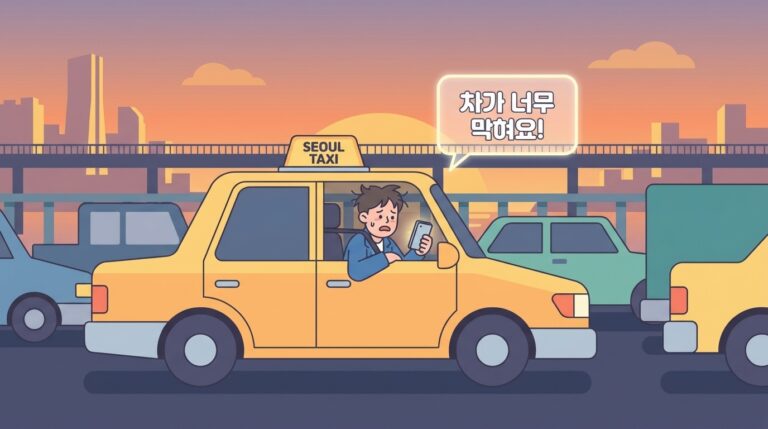
Picture this: It’s 6:30 PM on a Friday. You’re invited to your very first Korean team dinner (회식, hoesik) at a famous BBQ joint in Gangnam. You got off work, hopped into a taxi, and thought, ‘I’ll be there in 15 minutes.’ But then… you see the glowing red taillights stretching endlessly across the Han River bridge. The taxi isn’t moving. You are officially stuck in Seoul’s notorious rush-hour traffic.
You check your watch. 6:45 PM. You need to text your Korean colleagues, but what do you say? Translating ‘I will be late because of traffic’ feels a bit too direct, almost aggressive in Korean. In K-Dramas, whenever a character is stuck in a taxi, they don’t just say ‘I am late.’ They use a very specific, soft, and indirect expression to save face and show consideration.
Today, we are going to learn how to master the art of the ‘soft excuse’ using the B1 grammar point: 추측과 예상 (Guessing and Expecting). By the end of this guide, you’ll know exactly how to navigate a delay without losing your cool—or your 눈치 (Nunchi)!
Phase 2: Deep Dive into Core Expressions
Let’s break down the exact phrase you need when you’re stuck in traffic.
1. 차가 막혀서
- Pronunciation: chaga makhyeoseo [cha-ga mak-kyeo-seo]
- Meaning: Lit. Because the car(s) are blocked. / Real nuance: Because traffic is bad…
- K-Culture Moment: This is the ultimate Seoulite excuse. Whether you’re taking a taxi or a bus, ‘차가 막히다’ (traffic is blocked) shifts the blame from you to the city’s infrastructure. It’s the perfect opener for an apology.
- Editor’s Insight: Notice how Koreans don’t say ‘I am stuck.’ We say ‘The cars are blocked.’ It’s a subtle way of expressing that the situation is out of your control.
- Situation Spectrum:
- Casual (Friends): ✅
- Semi-formal (Co-workers): ✅
- Formal (Boss/Elders): ⚠️ (Better to add ‘죄송하지만’ – I’m sorry but… in front of it!)
- 🤔 Think About It: Why do you think the Korean language prefers passive structures (like ‘the road is blocked’) over active ones (‘I am stuck’) when explaining a problem?
2. 제시간에 못 올지도 몰라(요)
- Pronunciation: jesigane mot oljido molla(yo) [je-si-gan-e mot ol-ji-do mol-la-yo]
- Meaning: Lit. I don’t know if I can’t come on time. / Real nuance: I might not be able to arrive on time.
- K-Culture Moment: You’re texting a friend who is already at the cafe. You are 100% sure you will be late, but saying ‘I will be 20 minutes late’ sounds too blunt. So, you soften the blow with ‘-(으)ㄹ지도 몰라요’ (I might…). It mentally prepares the other person without sounding harsh.
- Editor’s Insight: The grammar -(으)ㄹ지도 모르다 means ‘might’ or ‘may.’ It’s the ultimate tool for Nunchi. It shows you feel bad about the situation and are gently breaking the bad news.
- Situation Spectrum:
- Casual (Friends): ✅ (Drop the ‘요’: 못 올지도 몰라)
- Semi-formal (Co-workers): ✅ (Keep the ‘요’: 못 올지도 몰라요)
- Formal (Boss/Elders): 🚫 (Too casual. Use ‘조금 늦을 것 같습니다’ – I think I will be a little late.)
- 🤔 Think About It: In your native language, do you soften bad news when you are late, or do you prefer to state the exact time you will arrive?
Phase 3: Textbook vs. Real Korean
Let’s see how this plays out in real life compared to what you might see in a textbook.
[Situation 1: Texting your friend that you’re stuck in traffic]
* 📖 Textbook Korean: 저는 교통 체증 때문에 늦겠습니다. (I will be late due to traffic congestion.)
* 🗣️ Real Korean: 아, 차 짱 막혀! 제시간에 못 갈지도 몰라. 😭 (Ah, traffic is crazy! I might not make it on time.)
* 💡 Why it’s different: ‘교통 체증’ (traffic congestion) is a news anchor’s vocabulary. ‘차 막히다’ is what 99% of Koreans say every day.
[Situation 2: Telling your co-workers to start eating without you]
* 📖 Textbook Korean: 식사를 먼저 시작하십시오.
* 🗣️ Real Korean: 저 차가 막혀서 좀 늦을지도 몰라요. 먼저 드시고 계세요! (I might be a bit late because of traffic. Please go ahead and eat first!)
* 💡 Why it’s different: Korean dining culture values eating together. If you are late, it’s polite to explicitly tell them to start without you (‘먼저 드시고 계세요’), otherwise, they might wait for you while the meat burns!
Bottom Note: For B1 (Pre-Intermediate) learners, combining -아/어서 (reason) with -(으)ㄹ지도 몰라요 (guessing) is a fantastic way to instantly upgrade your Korean from ‘robotic’ to ‘fluent and considerate.’
Phase 4: Cultural Context — K-Culture Deep Dive
4-1. The Non-Verbal ‘Nunchi’ of Being Late
When you use this expression, timing is everything. In Korea, sending a text before the agreed time is crucial. If you are supposed to meet at 7:00 PM, texting at 7:05 PM saying ‘차가 막혀서…’ is a huge Nunchi fail.
Pro Tip: Send a screenshot of your map app showing the red traffic line! It proves you aren’t just making an excuse.
4-2. K-Drama Connection: The Han River Bridge Sprint
Have you ever noticed a trope in K-Dramas where the main character is in a taxi, aggressively looking at their watch, and then suddenly yells, ‘기사님, 여기서 세워주세요!’ (Driver, please pull over here!)? They then proceed to run across a bridge to meet their true love.
This dramatic scene exists because Seoul’s traffic (especially across the Han River bridges during sunset) is legendary. The clash between Korea’s 빨리빨리 (Ppalli-ppalli / Hurry up) culture and an unmoving traffic jam creates the ultimate dramatic tension. But in reality? Please don’t run on the highway. Just text them: ‘차가 막혀서 제시간에 못 올지도 몰라요.’
Phase 5: Real-Life Roleplay Scenario
Setting: Friday, 6:45 PM. You are in a taxi stuck on Teheran-ro (Gangnam’s busiest street) heading to a team dinner. Your co-worker, Min-su (32, friendly and humorous), is already at the restaurant.
YOU: (Looking at the GPS, realizing it will take 30 more minutes)
YOU: 민수 씨, 어디예요? 도착했어요?
(Minsu ssi, eodiyeyo? Dochakaesseoyo?)
[Min-su, where are you? Did you arrive?]
Min-su: 네, 저 벌써 도착해서 고기 굽고 있어요! 어디쯤이에요? 🥩
(Ne, jeo beolsseo dochakaeseo gogi gupgo isseoyo! Eodijjeumieyo?)
[Yes, I already arrived and am grilling the meat! Whereabouts are you?]
YOU: 저는 아직 택시 안이에요…
(Jeoneun ajik taeksi anieyo…)
[I am still in the taxi…]
Min-su: 헉, 지금 강남 엄청 막히죠?
(Heok, jigeum Gangnam eomcheong makhijyo?)
[Gasp, Gangnam is super jammed right now, isn’t it?]
🔀 Your Turn! How should you respond?
– A) 저는 차가 막혀서 30분 늦습니다. (I am 30 minutes late due to traffic.)
– B) 차가 너무 막혀서 제시간에 못 갈지도 몰라요. 먼저 드시고 계세요! (Traffic is too bad, I might not make it on time. Please eat first!)
– C) 택시 기사님이 너무 느려요. (The taxi driver is too slow.)✅ Best Choice: B — It explains the situation softly (‘-(으)ㄹ지도 몰라요’) and shows consideration by telling them not to wait.
⚠️ Choice A & C Analysis: A is too robotic and sounds like a military report. C shifts the blame uncomfortably to a specific person, which isn’t the polite Korean way to make an excuse.
Min-su: 아유, 천천히 와요! 고기 남겨놓을게요. 조심히 오세요!
(Ayu, cheoncheonhi wayo! Gogi namgyeonoeulgeyo. Josimhi oseyo!)
[Aw, take your time! I’ll save some meat for you. Come safely!]
Phase 6: 10-Second Shadowing Drill
Let’s practice the rhythm of a perfect apology. Follow the slash marks for pausing, and try to match the emotion tag!
🥺 아, 죄송해요. / 차가 너무 막혀서 / 제시간에 못 갈지도 몰라요.
(Ah, joesonghaeyo. / chaga neomu makhyeoseo / jesigane mot galjido mollayo.)
Tip: Drag out the ‘너~무’ (too much) slightly to emphasize how bad the traffic is!
Phase 7: K-Culture Mini Dictionary
1. 눈치
* Romanization: nunchi
* English: Social intelligence / Reading the room
* Context: The quintessential Korean social skill. Knowing when to send an apology text before someone gets annoyed is having ‘good nunchi.’
2. 빨리빨리
* Romanization: ppalli-ppalli
* English: Hurry, hurry / Quick culture
* Context: The driving force behind modern Korea. It’s why Koreans get particularly stressed when stuck in slow-moving traffic.
3. 회식
* Romanization: hoesik
* English: Company dinner
* Context: A gathering of colleagues after work, usually involving lots of food and alcohol. Being late to a formal hoesik requires a very polite apology.
4. 지옥철
* Romanization: jiokcheol
* English: Hell train (Jiok = Hell, Cheol = Subway)
* Context: During rush hour, avoiding traffic by taking the subway often means getting squished in the ‘hell train.’
Phase 8: Traveler’s Survival Kit
If you’re visiting Korea, getting stuck in a taxi is almost a rite of passage. Here are survival phrases you need when the meter keeps ticking but the car isn’t moving.
🆘 Survival Expressions for the Taxi
– 🇰🇷 “기사님, 여기서 그냥 내려주세요.” (Gisanim, yeogiseo geunyang naeryeojuseyo.)
– 🗣️ English: Driver, please just drop me off here.
– 📍 When to use: When you realize walking the rest of the way is faster than sitting in traffic.
- 🇰🇷 “도착하려면 얼마나 걸려요?” (Dochakaryeomyeon eolmana geollyeoyo?)
- 🗣️ English: How long will it take to arrive?
- 📍 When to use: When you need to calculate exactly how late you will be to text your friend.
📌 Editor’s Travel Note
– App Tip: Always use KakaoT to hail a taxi, and Naver Map or KakaoMap for navigation. Google Maps does not work well for driving/walking directions in Korea!
– Subway vs Taxi: On Friday nights between 6 PM and 9 PM, always choose the subway. The ‘Hell Train’ might be crowded, but it’s guaranteed to get you there on time.
Phase 9: Critical Thinking Corner — “A Step Deeper”
Language & Power: The Culture of Indirectness
Why does Korean have so many grammar points dedicated to ‘guessing’ or ‘softening’ facts, like -(으)ㄹ지도 모르다 (might) or -것 같다 (seems like)?
In Korean culture, maintaining a harmonious atmosphere and protecting the listener’s 기분 (gibun – feelings/mood) is highly valued. Being overly direct—especially with bad news like being late—can be perceived as aggressive or lacking empathy. By saying “I might not arrive on time” instead of “I will not arrive on time,” you leave a tiny window of hope, showing that you are still trying your best to get there. It’s not about lying; it’s about linguistic politeness.
💬 Your Turn: Does your culture prefer direct communication when delivering bad news, or do you also use ‘softening’ phrases to protect feelings? Share your thoughts in the comments!
Phase 10: FAQ & Avoiding Mistakes
Q: Can I say ‘제시간에 못 갈지도 몰라요’ to my boss?
A: No. While it has ‘요’ (polite form), the grammar itself is a bit too casual for strict workplace hierarchy. To a boss, it’s safer to use the more formal expression: “차가 막혀서 조금 늦을 것 같습니다. 죄송합니다.” (Traffic is heavy so it seems I will be a little late. I apologize.)
Q: What if I am taking the subway, not a taxi?
A: You can swap ‘차가 막혀서’ (traffic is jammed) with ‘지하철을 놓쳐서’ (I missed the subway) or ‘길을 잃어서’ (I got lost).
❌ Common Mistake #1: Translating ‘I can’t come’ literally to “저는 못 와요.”
✅ Do this instead: ‘오다’ means ‘to come’ (toward the speaker). If you are moving toward the listener, you must use ‘가다’ (to go). So, say “제시간에 못 갈지도 몰라요.” (I might not be able to go on time.)
Phase 11: Summary & Action Items
- One-Liner Summary: Soften the blow of being late by blaming the traffic with “차가 막혀서 제시간에 못 갈지도 몰라요.” (I might not make it on time because of traffic.)
Action Mission:
– 🥉 Bronze (Solo): Stand in front of a mirror, look convincingly worried, and practice the shadowing drill phrase 3 times.
– 🥈 Silver (Online): Go to your favorite K-Pop idol’s Weverse or YouTube video and leave a playful comment: “팬미팅에 늦을지도 몰라요!” (I might be late to the fan meeting!)
– 🥇 Gold (Real World): Next time you are running slightly behind to meet a Korean friend, text them this exact phrase and watch them praise your natural Korean skills!
K-Culture Mission:
Open a Korean map app (like Naver Map) right now. Set the departure to ‘Gangnam Station’ and arrival to ‘Hongdae Station’. Check the estimated time by car vs. subway. You’ll instantly understand why this expression is so important!
Phase 12: Interactive Quiz — Test Your Nunchi!
1. (Situational) You are 10 minutes late to a casual lunch with a close Korean friend because of traffic. What should you text them?
A. 늦어서 죄송합니다.
B. 차 막혀서 늦을지도 몰라! 먼저 먹고 있어.
C. 나는 교통 체증에 갇혔다.
2. (Fill in the Blank) You want to tell your boss you will be late.
“부장님, 차가 _____ 조금 늦을 것 같습니다.”
A. 막혀서
B. 매워서
C. 아파서
3. (True or False – K-Culture Edition)
If you are stuck in traffic in a taxi in Seoul and realize you’ll be terribly late, it is culturally acceptable to ask the driver to let you out near a subway station so you can take the train instead. (T / F)
🚨 Click here for Answers!
- B – A is too formal for a friend. C is robotic and sounds like a translation app. B is perfectly natural!
- A – 막혀서 (blocked/jammed). 매워서 means ‘spicy’, and 아파서 means ‘sick’.
- True! It happens all the time. Just say “기사님, 가까운 지하철역에서 내려주세요!” (Driver, please drop me off at a nearby subway station!).
Frequently Asked Questions (FAQ)
Q: What does "차가 막혀서" mean in Korean and how do you pronounce it?
A: In Korean, "차가 막혀서" is pronounced [chaga makhyeoseo [cha-ga mak-kyeo-seo] and means: Lit. Because the car(s) are blocked. / Real nuance: Because traffic is bad...
Q: What does "제시간에 못 올지도 몰라(요)" mean in Korean and how do you pronounce it?
A: In Korean, "제시간에 못 올지도 몰라(요)" is pronounced [jesigane mot oljido molla(yo] and means: Lit. I don't know if I can't come on time. / Real nuance: I might not be able to arrive on time.







