

안녕하세요! Hello! Daily Hangul Editor here.
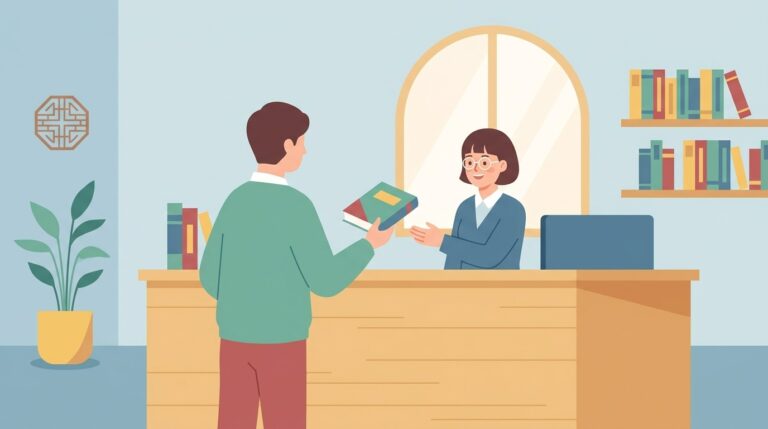
Imagine a classic K-Drama scene: bright sunlight filtering through large library windows, the main characters reaching for the same book, and a hushed, romantic whisper. But let’s cut to reality—what happens when you just need to return a book, but you’re standing in front of the Korean librarian completely frozen?
Returning a book seems like a simple task (just drop it in a box, right?), but doing it in a new language can feel intimidating. What if it’s overdue? What if you need to hand it directly to the staff? Knowing the right phrases will not only save you from awkward silence but also make you look like a confident, respectful local! This guide is based on real questions from our A2 beginner students who wanted to navigate Korean public libraries like pros.
Phase 2: Core Expressions Deep Dive
1. 책 반납할게요. (I will return this book.)
- Pronunciation: chaek bannapalgeyo (check ban-nahp-hahl-geh-yo)
- Meaning: Literal: I will return the book. / Real nuance: Here is the book for return.
- K-Culture Moment: You’ll use this straight-to-the-point phrase at the library counter. In Korea, speed and efficiency (빨리빨리 – ppalli-ppalli) are key!
- Editor’s Insight: It sounds active and polite. Instead of just handing over the book in silence, you are stating your clear intention to the librarian.
- Situation Spectrum:
- Casual (Friends): ✅
- Semi-formal (Staff/Clerks): ✅
- Formal (Boss/Elders): ⚠️ (Use ‘반납하겠습니다’ for super formal, but ‘할게요’ is perfectly fine for everyday public interactions).
- 🤔 Think About It: Why do Koreans state their intention (‘I will do X’) rather than just saying ‘Here you go’? It shows respect for the other person’s role by clarifying exactly what you need from them!
2. 무인 반납기 어디에 있어요? (Where is the automated return machine?)
- Pronunciation: muin bannapgi eodie isseoyo? (moo-een ban-nahp-gee uh-di-eh iss-uh-yo?)
- Meaning: Where is the unmanned return machine?
- K-Culture Moment: Korea is the land of automation! From cafes to convenience stores and libraries, ‘무인‘ (unmanned) kiosks are everywhere.
- Editor’s Insight: ‘무인’ (muin) literally means ‘no people.’ If the library is closed or you are in a rush, look for this machine!
- Situation Spectrum:
- Semi-formal: ✅ (Perfect for asking staff or security guards).
- 🤔 Think About It: How has automation changed the way we interact in public spaces? Are there many ‘무인’ machines in your home country?
3. 연체료 얼마예요? (How much is the late fee?)
- Pronunciation: yeoncheryo eolmayeyo? (yeon-che-ryo ul-mah-ye-yo?)
- Meaning: How much is the late fee?
- K-Culture Moment: Asking about money is universal, but here’s a fun fact—many Korean public libraries don’t charge money for late books! (Read on to find out what they do instead).
- Editor’s Insight: This phrase uses the magic travel survival phrase ‘얼마예요?‘ (How much is it?). Just attach what you are paying for to the front!
- Situation Spectrum:
- Semi-formal: ✅
Phase 3: Textbook vs. Real Korean
[Handing the book to the librarian]
* 📖 Textbook Korean: 이 책을 반납하겠습니다. (I will return this book.)
* 🗣️ Real Korean: 반납이요~ (Return, please.) + handing it over with two hands
* 💡 Why is it different?: Adding ‘~이요 (iyo)‘ to a noun is the ultimate Korean life hack for quick, polite requests in busy places! It saves time while keeping things respectful.
[Asking for the drop-box]
* 📖 Textbook Korean: 책 반납 상자가 어디에 있습니까? (Where is the book return box?)
* 🗣️ Real Korean: 무인 반납기 어딨어요? (Where is the automated machine?)
* 💡 Why is it different?: Koreans prefer specific technical terms (무인 반납기) over general words (상자 – box), and they love shrinking ‘어디에 있어요’ into the faster, blended sound ‘어딨어요‘.
Phase 4: K-Culture Deep Dive
4-1. Non-Verbal Communication: The ‘Two-Hand’ Rule
When returning a book to the librarian, always use both hands (or support your right arm slightly with your left hand). In Korean culture, handing something over with one hand to someone you don’t know (or someone older) can seem a bit rude. A slight head nod (목례) will make you look incredibly polite!
4-2. The K-Travel Connection: Starfield Library & Study Culture
Have you seen the massive, glowing bookshelf inside a mall on Instagram? That’s 별마당 도서관 (Starfield Library) in COEX, Seoul! While it’s mostly a cultural space where you read on-site (no borrowing), you will still see locals using proper library etiquette.
If you visit local public libraries (like the Seoul Metropolitan Library), you’ll experience a very serious study culture. The reading rooms (열람실) are so quiet you can hear a pin drop. This is where your 눈치 (Nunchi – reading the room) skills truly shine!
Phase 5: Real-Life Roleplay Scenario
Setting: A quiet Tuesday afternoon at a local Seoul public library. The scent of old paper fills the air. You walk up to the counter to return a book you forgot about over the weekend.
Characters:
– YOU: A foreign resident trying your best to navigate Korean library rules.
– Jiyoung (사서 – Librarian): Efficient, polite, scanning barcodes at lightning speed.
Jiyoung: 안녕하세요, 반납 도와드릴까요? 😊
(annyeonghaseyo, bannap dowadeurilkkayo?)
[Hello, shall I help you with the return?]
YOU: 네, 여기요. 이 책 반납할게요. 📚
(ne, yeogiyo. i chaek bannapalgeyo.)
[Yes, here you go. I will return this book.]
(🎭 Stage Direction: You hand the book over using both hands with a slight bow)
Jiyoung: 네, 잠시만요… 아, 고객님. 이틀 연체되셨네요. 💻
(ne, jamsimanyo… a, gogaengnim. iteul yeonchedoesyeonneyo.)
[Yes, one moment… Ah, customer. It is two days overdue.]
🔀 Your Turn! How do you respond?
– A) 헉, 죄송합니다! 연체료 얼마예요? (Gasp, I’m sorry! How much is the late fee?)
– B) 아, 그래요? 몰랐어요. (Ah, really? I didn’t know.)
– C) 책 드렸잖아요~ (But I gave you the book~)✅ Best Choice: A — Apologizing first and politely asking for the fee is the most natural response.
⚠️ Choice B & C Analysis: Choice B sounds a bit unapologetic. Choice C is very rude and will definitely get you some bad ‘Nunchi’ stares!
YOU: 헉, 죄송합니다! 연체료 얼마예요? 😥
(heok, joesonghamnida! yeoncheryo eolmayeyo?)
[Gasp, I’m sorry! How much is the late fee?]
Jiyoung: 연체료는 없습니다. 대신 이틀 동안 대출 정지입니다. 🚫
(yeoncheryoneun eopseumnida. daesin iteul dongan daechul jeongji-imnida.)
[There is no late fee. Instead, borrowing is suspended for two days.]
YOU: 아하, 다행이네요. 감사합니다! 수고하세요~ 👋
(aha, dahaeng-ineyo. gamsahamnida! sugohaseyo~)
[Aha, that’s a relief. Thank you! Keep up the good work~]
Phase 6: 10-Second Shadowing Drill
Let’s practice the rhythm and intonation! Follow the slash marks for pauses.
😊 저기요, / 이 책 / 반납하려고 하는데요.
(jeogiyo, / i chaek / bannaparyeogo haneundeyo.)
[Excuse me, / this book / I intend to return it.]
Phase 7: K-Culture Mini Dictionary
1. 눈치 (nunchi)
* English: Social situational awareness / Reading the room
* Context: If the library is dead silent, having ‘nunchi’ means putting your phone on silent mode without anyone telling you to.
2. 사서 (saseo)
* English: Librarian
* Context: The professional who manages the library. In Korea, this is a highly respected public servant position.
3. 연체 (yeonche)
* English: Overdue / Late
* Context: Used not just for books, but for late bills, rent, or credit cards. A vital adulting word!
4. 대출 정지 (daechul jeongji)
* English: Borrowing suspension
* Context: Instead of late fees (money), Korean public libraries often block you from borrowing books for the exact number of days you were late.
Phase 8: Traveler’s Survival Kit
🆘 Survival Phrases for the Library/Cafe
– 🇰🇷 “이거 어디에 놔요?” (igeo eodie nwayo?)
– 🗣️ English Guide: [ee-guh uh-di-eh nwa-yo?]
– 📍 Where to use: Libraries, cafes, or food courts when you don’t know where the return tray is.
– 💡 Pro Tip: Point to the item you are holding while asking! It makes your intention 100% clear.📌 Editor’s Travel Note
– Finding a Library: Use apps like KakaoMap or Naver Map and search “도서관” (doseogwan). They are great, free spots to cool down in the summer or warm up in the winter!
– Access: While you need a resident card to borrow books, anyone can enter public libraries and read books inside for free.
Phase 9: Critical Thinking Corner — “One Step Deeper”
Media vs. Reality: The K-Drama Library
🧠 Think Deeper:
In K-Dramas, libraries are often romantic spots where characters whisper flirtatiously across bookshelves or share earphones. In reality, Korean public libraries have a very intense, strict study culture. Many young adults spend hours there studying for notoriously difficult civil service exams (공무원 시험). Whispering, clicking your pen, or even unzipping your bag too loudly might get you a sharp glare! The contrast between the romanticized media depiction and the highly competitive reality offers a fascinating glimpse into modern Korean society.💬 Your Turn: Does your country’s library have a strict, silent study culture, or is it more of a community gathering space? Share in the comments!
Phase 10: FAQ & Avoiding Misunderstandings
- Q: Can I just leave the book on the counter and walk away?
A: No! Either hand it directly to the librarian (wait for them to scan it) or put it in the designated ‘반납함’ (Return box). - Q: Can I drink coffee in a Korean public library?
A: Generally, NO. Most public libraries only allow water in sealed tumblers. If you want coffee while reading, you need to go to a ‘북카페’ (Book Cafe) instead!
❌ Common Mistake: Saying “책 줄게요” (I will give you the book).
✅ Do this instead: Say “반납할게요” (I will return it). ‘반납’ is the specific, correct vocabulary for returning borrowed items.
Phase 11: Summary & Action Items
- One-Liner Summary: Returning a book in Korea is all about the magical word ‘반납 (bannap)‘ and using both hands!
-
Action Mission 3 Steps:
- 🥉 Bronze (Solo): Say “이 책 반납할게요” to yourself in the mirror 3 times using the two-hand gesture.
- 🥈 Silver (Online): Leave a comment below using the word “무인” (unmanned) in an English sentence!
- 🥇 Gold (Real Life): Next time you visit a cafe or library in Korea, ask “이거 어디에 놔요?” when returning your items!
- K-Culture Mission:
Go to Google Maps or Naver Maps, find “Starfield Library (별마당 도서관)” in Seoul, and drop a street view pin. Look at the massive bookshelves and imagine where you would return a book!
Phase 12: Quiz — Interactive Challenge
1. Situational Judgment: You are returning a book to the librarian. What is the most natural and polite way to do it?
A) Toss it on the desk and say “반납!”
B) Hand it over with two hands and say “반납이요~”
C) Hide it in a random shelf.
(Answer: B — Polite, efficient, and uses the two-hand rule!)
2. True or False: If you return a book late to a Korean public library, you always have to pay a massive cash fine.
(Answer: False! Many public libraries use a ‘borrowing suspension’ (대출 정지) system instead of taking your money.)
3. Fill in the Blank: Where is the unmanned return machine?
-> ( _______ ) 반납기 어디에 있어요?
(Answer: 무인 – muin)
Frequently Asked Questions (FAQ)
Q: What does "책 반납할게요. (I will return this book.)" mean in Korean and how do you pronounce it?
A: In Korean, "책 반납할게요. (I will return this book.)" is pronounced [chaek bannapalgeyo (check ban-nahp-hahl-geh-yo] and means: Literal: I will return the book. / Real nuance: Here is the book for return.
Q: What does "무인 반납기 어디에 있어요? (Where is the automated return machine?)" mean in Korean and how do you pronounce it?
A: In Korean, "무인 반납기 어디에 있어요? (Where is the automated return machine?)" is pronounced [muin bannapgi eodie isseoyo? (moo-een ban-nahp-gee uh-di-eh iss-uh-yo?] and means: Where is the unmanned return machine?
Q: What does "연체료 얼마예요? (How much is the late fee?)" mean in Korean and how do you pronounce it?
A: In Korean, "연체료 얼마예요? (How much is the late fee?)" is pronounced [yeoncheryo eolmayeyo? (yeon-che-ryo ul-mah-ye-yo?] and means: How much is the late fee?







