

Phase 1: Empathy (Immersive Opening)
Hello there! I’m the lead editor of Daily Hangul.
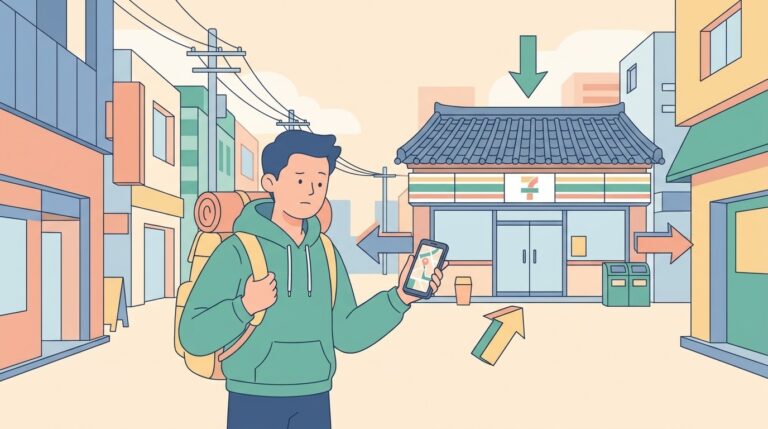
Picture this: You are standing right in the middle of Hongdae, Seoul. The neon signs are flashing, street buskers are singing the latest K-Pop hits, and your stomach is rumbling for some Korean BBQ. Your smartphone map app literally says “You have arrived” at the famous restaurant, but… all you see is a makeup store. You text your Korean friend, and they reply:
“I’m right 앞 (ap) of the station! Come to the 옆 (yeop) of the cafe!”
Wait, what? Where on earth is ap? Is yeop across the street?
If you’ve ever felt completely lost in Korea despite having a map, you are not alone! Korean cities are densely packed, and navigating often relies on finding relative locations—”front of this,” “back of that,” “next to here”—rather than north, south, east, or west.
By mastering just three tiny, one-syllable words today, you won’t just stop getting lost; you’ll understand exactly how to direct a Seoul taxi driver like a true local. Let’s dive in! (Yes, this guide is completely based on the tears and triumphs of my real beginner students!)
Phase 2: Deep Dive into Core Expressions
Let’s look at the absolute “holy trinity” of Korean locations.
1. 앞
- Pronunciation: ap [Sounds like the ‘up’ in ‘cup’, but stop your breath right at the ‘p’ without popping it!]
- Meaning: Front / In front of
- K-Culture Moment: You’ve definitely seen this K-Drama trope: The main character is furiously chasing after their love interest. They jump into a taxi and point frantically, shouting, “기사님! 저 차 앞(ap)으로 가주세요!” (Driver! Please go in front of that car!).
- Editor’s Insight: This word feels very ‘immediate’. When you say ap, it means directly in your line of sight.
- Situation Spectrum:
- Casual with friends: ✅
- Semi-formal (co-workers): ✅
- Formal (boss/elders): ✅ (It’s a universal direction word!)
- 🤔 Think About It: Why do Koreans so often set their meeting spots as “역 앞” (in front of the subway station)? What does this say about the public transportation culture in Korea compared to your home country?
2. 뒤
- Pronunciation: dwi [Say ‘twee’ like a tweeting bird, but make the ‘t’ softer, like a ‘d’. D-wee!]
- Meaning: Back / Behind
- K-Culture Moment: Imagine you are at a crowded BTS or BLACKPINK concert. Fans are pushing forward. You’ll hear the staff or other fans yelling, “위험하니까 뒤(dwi)로 가주세요!” (It’s dangerous, please step back!).
- Editor’s Insight: Dwi implies stepping away, hiding, or the unseen space. It’s often used when looking for bathrooms, which are frequently hidden behind (dwi) the building in Korea!
- Situation Spectrum:
- Casual with friends: ✅
- Semi-formal: ✅
- Formal: ✅
- 🤔 Think About It: In English, doing something “behind my back” has a negative, deceitful nuance. Does dwi carry the same weight in Korean? (Hint: Usually, it’s just a literal physical space!)
3. 옆
- Pronunciation: yeop [Say ‘yup’, but again, hold that ‘p’ tight inside your mouth. Don’t let the air out!]
- Meaning: Side / Next to
- K-Culture Moment: The ultimate K-Drama confession scene by the Han River. The male lead looks deeply into the female lead’s eyes and whispers, “내 옆(yeop)에 있어.” (Stay by my side.) Swoon!
- Editor’s Insight: Yeop is an intimate space. In a crowded cafe, finding an empty seat yeop-e (next to) the window is the ultimate victory.
- Situation Spectrum:
- Casual: ✅
- Semi-formal: ✅
- Formal: ✅
- 🤔 Think About It: In some cultures, sitting right “next to” someone at a restaurant is only for couples, while friends sit across from each other. In Korea, how do you think seating arrangements reflect relationships?
Phase 3: Textbook vs. Real Korean
Books teach you the formal way, but the streets of Seoul speak a different language!
[Situation 1: Directing a Taxi Driver]
* 📖 Textbook Korean: 저기 편의점 앞에 세워 주십시오. (Please stop in front of the convenience store over there.)
* 🗣️ Real Korean: 기사님, 저 편의점 앞이요! (Gisanim, jeo pyeonuijeom apiyo! – Driver, the front of that convenience store!)
* 💡 Why the difference?: Palli-palli (Hurry-hurry) culture! In a moving taxi, dropping verbs and just shouting the noun + location + “iyo” is the most efficient and natural way to communicate.
[Situation 2: Texting a Friend at a Crowded Cafe]
* 📖 Textbook Korean: 저는 카운터 옆에 있습니다. (I am next to the counter.)
* 🗣️ Real Korean: 나 카운터 옆! (Na kaunteo yeop! – Me, counter side!)
* 💡 Why the difference?: Texting culture is all about speed. Dropping the subject “I” and the verb is standard among friends.
Bottom Note: For absolute beginners (A1), adding “~에 있어요” (-e isseoyo = is at) to these words is the safest, most polite bet. Example: 앞에 있어요 (ap-e isseoyo – I am in front).
Phase 4: Cultural Context — K-Culture Deep Dive
4-1. Non-Verbal Cues: The Art of Pointing
When pointing to the 앞 (front) or 옆 (side), never use just one index finger, especially toward an older person! In Korea, pointing with one finger can seem aggressive. Instead, use your entire open hand, palm facing up slightly, to gesture toward the direction. It instantly makes you look polite and culturally attuned!
4-2. K-Travel Connection: The Subway Survival Maze
Seoul’s subway system is world-class, but the stations are massive. When meeting someone, Koreans almost never say “Let’s meet on the north side.” They say, “Let’s meet in front of Exit 9” (9번 출구 앞 – gubeon chulgu ap).
If you get lost inside a station, look for a convenience store like CU or GS25. They are perfect landmarks. If a friend asks where you are, just look around and find the nearest store, and say: “GS25 앞!”
Phase 5: Real-Life Roleplay Scenario
Scenario A: The Hongdae Maze
- Setting: Friday night, 7:30 PM. Hongik University Station, Exit 9. It is packed with hundreds of people. You are looking for your Korean language exchange partner.
- Characters:
- YOU: A beginner Korean learner, slightly overwhelmed by the crowd.
- Min-su (25): Your energetic Korean friend.
Min-su: (On a phone call) 여보세요! 어디예요?
(Yeoboseyo! Eodiyeyo?)
[Hello! Where are you?]
YOU: 저 9번 출구 앞에 있어요! 사람 너무 많아요!
(Jeo gubeon chulgu ap-e isseoyo! Saram neomu manayo!)
[I am in front of Exit 9! There are too many people!]
Min-su: 아! 저도 출구 근처예요. 올리브영 보여요?
(Ah! Jeodo chulgu geuncheoyeyo. Ollibeuyeong boyeoyo?)
[Ah! I am near the exit too. Do you see Olive Young?]
YOU: 네! 올리브영 앞에 있어요.
(Ne! Ollibeuyeong ap-e isseoyo.)
[Yes! I am in front of Olive Young.]
Min-su: 저는 올리브영 옆에 있는 카페에 있어요!
(Jeoneun ollibeuyeong yeop-e inneun kape-e isseoyo!)
[I am at the cafe next to Olive Young!]
🔀 Your Turn! How do you reply?
– A) “아니요, 못 가요.” (No, I can’t go.)
– B) “아! 네, 지금 갈게요!” (Ah! Okay, I’ll go right now!)
– C) “너 어디야?” (Where are you? – Informal)✅ Best Choice: B — Acknowledging the location and saying you are moving is the most natural flow.
⚠️ Choice C Analysis: Dropping formalities (Banmal) in a crowded, stressful situation can sound rude if you aren’t extremely close friends. Keep it polite with ‘yo’!
Scenario B: The K-Food Restaurant Bonus
(You are inside a packed Korean BBQ restaurant. The waiter brings a steaming bowl of Kimchi stew.)
Waiter: 찌개 나왔습니다. 어디 놓을까요?
(Jjigae nawatseumnida. Eodi noeulkkayo?)
[The stew is out. Where should I put it?]
YOU: 제 옆에 놔주세요!
(Je yeop-e nwajuseyo!)
[Please put it next to me!]
Phase 6: 10-Second Shadowing Drill
Practice saying these out loud. Pay attention to the pauses (/) and the emotion tags!
- 😤 (Urgently looking for a friend):
저 / 편의점 / 앞에 있어요!
(jeo / pyeonuijeom / ap-e isseoyo!) - 🥺 (Romantic K-Drama whisper):
내 / 옆에 / 앉아.
(nae / yeop-e / anja.) - 😥 (Nervous in a taxi):
기사님, / 저기 / 뒤에 / 세워주세요.
(gisanim, / jeogi / dwi-e / sewojuseyo.)
Phase 7: K-Culture Mini Dictionary
Here are some essential location-related cultural keywords you need to know:
1. 길치
* Romanization: gilchi
* English: Someone who is bad with directions (Sense of direction-blind)
* Context: A very common, self-deprecating slang. If you get lost, just laugh and say, “제가 길치예요” (I am bad with directions). Koreans will instantly sympathize!
2. 핫플
* Romanization: hatpeul
* English: Hot place (Trendy spot)
* Context: Short for “Hot Place”. Usually cafes, pop-up stores, or restaurants that are going viral on Instagram.
3. 출구
* Romanization: chulgu
* English: Exit
* Context: The absolute anchor of Korean navigation. Subway exits are numbered. Everything in Seoul revolves around 몇 번 출구 (which number exit).
4. 눈치
* Romanization: nunchi
* English: Social awareness / Reading the room
* Context: Knowing where to sit (front, back, or side of someone) in a Korean meeting or dinner is all about nunchi. Generally, the deepest seat facing the door is for the oldest or highest-ranking person!
Phase 8: Traveler Survival Kit
If you are traveling to Korea, you must memorize these three lifesavers when dealing with locations:
🆘 Survival Expression #1: “Where is the bathroom?”
– 🇰🇷 “화장실 어디예요?” (Hwajangsil eodiyeyo?)
– 📍 Where to use: Cafes, subway stations, restaurants.
– 💡 Pro Tip: Often, the answer will be “나가서 오른쪽/왼쪽” (Go out and turn right/left). If you don’t understand, just look for the key holder! In Korea, you often have to take a physical key with a huge plushie attached to it to go to an outside bathroom.🆘 Survival Expression #2: “Right here in front, please.”
– 🇰🇷 “여기 앞이요.” (Yeogi apiyo.)
– 📍 Where to use: Taxis!
– 💡 Pro Tip: Say this when you see your destination. The driver will pull over safely.🆘 Survival Expression #3: “Next to [Place]”
– 🇰🇷 “[Place] 옆에 있어요.” ([Place] yeop-e isseoyo.)
– 📍 Where to use: On the phone, looking for a friend.
– 💡 Pro Tip: Just say “Starbucks yeop-e isseoyo.” There’s always a Starbucks nearby in Seoul!📌 Editor’s Travel Note:
Google Maps does NOT work well for walking directions in Korea due to national security laws. You must download KakaoMap or Naver Map. They will literally show you which 앞 (front) or 옆 (side) of the building the entrance is located!
Phase 9: Critical Thinking Corner — “One Step Deeper”
Space and Community (공간과 공동체)
🧠 Think Deeper:
Have you noticed that Koreans rarely use exact street names or cardinal directions (North/South) when navigating daily life? Instead, locations are described relative to landmarks (e.g., “next to the bank”, “in front of the school”). This reflects a deeply relational culture. In Korea, space isn’t just an empty grid on a map; it’s defined by what exists there and the community’s shared knowledge. To navigate Korea, you don’t just learn directions; you learn the neighborhood’s landmarks, effectively becoming part of that local community’s mindset.💬 Your Turn: How do people give directions in your country? Do you use exact street names, or do you point out the local McDonald’s? Tell me in the comments!
Phase 10: FAQ & Common Mistakes
Q1: Can I just shout “Ap!” or “Dwi!” by itself?
Editor’s Answer: MAYBE. If you are with very close friends, yes. But normally, you need to attach the location particle ~에 (-e). So it becomes 앞에 (ap-e), 뒤에 (dwi-e), 옆에 (yeop-e).
Q2: Is it okay to use these words with elders?
Editor’s Answer: YES. These are neutral direction words. There is no “polite” version of “front” or “back.” Just make sure the end of your sentence is polite (ending in ~요 or ~습니다).
❌ Common Mistake #1: Pronouncing the “p” in ap or yeop like an English speaker.
✅ Do this instead: In English, when you say “cup,” you open your lips at the very end to release air. In Korean, when you say “ap,” your lips must stay glued together at the end. Try saying “up” but freeze your mouth shut. That’s the authentic sound!
Phase 11: Summary & Action Items
✨ One-Liner Summary: To survive in Korea, remember: ap (Front), dwi (Back), yeop (Side)!
Your Action Mission:
– 🥉 Bronze (Solo): Stand in your room. Point in front of you and say “ap-e!”, point behind you and say “dwi-e!”, point to your side and say “yeop-e!” Do it 3 times.
– 🥈 Silver (Online): Find a photo of your favorite K-Pop idol or K-Drama actor. Write in the comments who is standing yeop-e (next to) them!
– 🥇 Gold (Real Life): Next time you take a taxi or Uber, gently whisper “여기 앞이요” (Yeogi apiyo) to yourself as you arrive. Feel the K-Drama main character energy!
Phase 12: Quiz — Interactive Challenge
Test your new survival skills!
1. Situational Judgment:
You are in a taxi in Seoul. You see your hotel right up ahead. What is the most natural thing to say to the driver?
– A) 호텔 옆에. (Hotel yeop-e.)
– B) 기사님, 여기 앞이요! (Gisanim, yeogi apiyo!)
– C) 저는 뒤에 있습니다. (Jeoneun dwi-e itseumnida.)
2. Fill in the Blank:
Your friend texts you: “Where are you?” You are waiting right next to the GS25 convenience store.
“나 GS25 [ ____ ]!”
– A) 앞
– B) 뒤
– C) 옆
3. True or False – K-Culture Edition:
In Korea, it is considered perfectly polite to point directions with one index finger right toward an older person’s face. (True / False)
(Answers: 1. B – “Right in front here!”, 2. C – yeop means side/next to, 3. False – Always use an open hand!)
Did you enjoy this lesson? Don’t forget to bookmark this page for your next trip to Korea. See you in the next Daily Hangul post!
Frequently Asked Questions (FAQ)
Q: What does "앞" mean in Korean and how do you pronounce it?
A: In Korean, "앞" is pronounced [ap [Sounds like the 'up' in 'cup', but stop your breath right at the 'p' without popping it!] and means: Front / In front of
Q: What does "뒤" mean in Korean and how do you pronounce it?
A: In Korean, "뒤" is pronounced [dwi [Say 'twee' like a tweeting bird, but make the 't' softer, like a 'd'. D-wee!] and means: Back / Behind
Q: What does "옆" mean in Korean and how do you pronounce it?
A: In Korean, "옆" is pronounced [yeop [Say 'yup', but again, hold that 'p' tight inside your mouth. Don't let the air out!] and means: Side / Next to







