

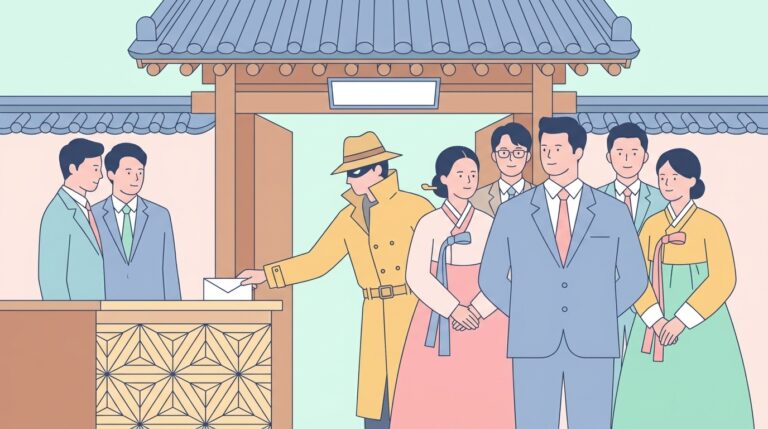
Undercover at a Korean Wedding: The Secret World of Fake Guests
Phase 1: Empathy (Welcome to the Drama)
Hello! I’m your Daily Hangul Editor.
Imagine this: You’re watching a K-Drama. The female lead is standing in front of a grand, luxurious wedding hall. Her ex-boyfriend is getting married, and to avoid looking pitiful, she hired a tall, handsome guy to pretend to be her new boyfriend. We all know this trope, right?
But did you know that in real-life Korea, you can actually hire people to pretend to be your friends at your wedding? Welcome to the fascinating world of 하객 알바 (Hagaek Alba)—the wedding guest part-time job!
For B2 learners, exploring this quirky cultural phenomenon isn’t just about learning new words; it’s a masterclass in understanding 체면 (Chemyeon – saving face), a concept deeply rooted in Korean society. If you ever attend a Korean wedding, or even take on one of these secret missions yourself, these phrases and cultural insights will help you blend in perfectly. Let’s go undercover!
Phase 2: Core Expressions Deep Dive
If you’re working as a fake guest, or even just attending as a real distant acquaintance, these are the top B2-level phrases you need to master.
1. 신부 측 지인으로 왔어요.
- Pronunciation: Sinbu cheuk jiineuro wasseoyo. [Sin-boo cheuk jee-in-eu-ro wa-sseo-yo.]
- Meaning: I came as an acquaintance of the bride. (Literal: I came to the bride’s side as an acquaintance.)
- K-Culture Moment: When you enter a Korean wedding, the first thing you see are two separate desks taking money—one for the groom (신랑 측) and one for the bride (신부 측). They will ask how you know the couple.
- Editor’s Insight: The word ‘지인 (acquaintance)’ is a brilliant B2 vocabulary word. It’s perfectly vague. If you say you are a ‘친구 (friend)’, people might ask how you met. ‘지인’ creates a safe, respectful distance.
- Situation Spectrum:
- Casual (Close friends): 🚫 (Too formal)
- Semi-formal (Coworkers/Acquaintances): ✅
- Formal (Elders/Superiors): ✅
- 🤔 Think About It: Why is the distinction between ‘friend’ and ‘acquaintance’ so important in Korean society? How does language help maintain emotional distance?
2. 얼굴만 비추고 갈게.
- Pronunciation: Eolgulman bichugo galge. [Eol-gul-man bee-choo-go gal-gge.]
- Meaning: I’ll just show my face and leave.
- K-Culture Moment: Korean weddings are notoriously fast—often lasting only 30 to 60 minutes. Many busy Koreans attend multiple weddings on a weekend. Saying “I’ll just show my face” means you are showing your sincerity by physically appearing, handing in the envelope, and perhaps skipping the meal.
- Editor’s Insight: This phrase is extremely common among colleagues. It shows that despite a busy schedule, you are putting in the effort to fulfill your social duty.
- Situation Spectrum:
- Casual (Friends): ✅
- Semi-formal (Colleagues): ✅
- Formal (Bosses/Elders): ⚠️ (Better to say: “잠깐 들러서 인사만 드리고 가겠습니다” – I will just stop by to say hello and leave.)
- 🤔 Think About It: Is “showing up” more important than staying for the whole event in your culture? Why is physical presence highly valued in Korea?
3. 티 안 나게 자연스럽게 행동해.
- Pronunciation: Ti an nage jayeonseureopge haengdonghae. [Tee an na-ge ja-yeon-seu-reop-ge haeng-dong-hae.]
- Meaning: Act naturally so it doesn’t show. / Don’t make it obvious.
- K-Culture Moment: The agency manager whispering to you right before you walk into the wedding hall to do your “fake guest” job. You have to smile, wave at the bride, and pretend you’ve known her for years!
- Editor’s Insight: The phrase “티 나다” (to be obvious/noticeable) is an essential B2 expression. It is used in everything from makeup (“Your makeup is too obvious”) to lying (“It’s obvious you’re lying”).
- Situation Spectrum:
- Casual (Friends): ✅
- Semi-formal (Coworkers): ⚠️
- Formal (Boss/Elders): 🚫
- 🤔 Think About It: What kind of non-verbal cues would “make it obvious” (티 나게 하다) that you don’t belong at a Korean gathering?
Phase 3: Textbook vs. Real Korean
Let’s see how textbook Korean differs from the real slang used in the wedding halls of Gangnam.
[Giving the Wedding Gift]
* 📖 Textbook Korean: 결혼을 진심으로 축하합니다. (Gyeolhoneul jinsimeuro chukahamnida. / Congratulations sincerely on your wedding.)
* 🗣️ Real Korean: 결혼 축하해! 이거 약소하지만… (Gyeolhon chukahae! Igeo yakssohajiman… / Congrats! This is small but…) (Handing the envelope)
* 💡 Why the difference?: Humility is a core virtue. Even if you put a large sum of money in the envelope, calling your gift “small” (약소하다) is the standard polite way to present it.
[Taking Photos Before the Ceremony]
* 📖 Textbook Korean: 사진을 같이 찍읍시다. (Sajineul gachi jjigeupsida. / Let’s take a picture together.)
* 🗣️ Real Korean: 신부 대기실 가서 빨리 사진 찍자! (Sinbu daegisil gaseo ppalli sajin jjigja! / Let’s go to the bride’s waiting room and quickly take a pic!)
* 💡 Why the difference?: In Korea, guests visit the bride in a special room (신부 대기실) before the ceremony starts. If you don’t take a photo here, it’s like you didn’t attend!
Bottom Note: For B2 learners, casually dropping words like ‘신부 대기실’ (Bride’s waiting room) or ‘약소하지만’ (It’s small, but…) will make native speakers jaws drop with admiration.
Phase 4: Cultural Context — K-Culture Deep Dive
4-1. Non-verbal Elements & Nunchi (눈치)
When handing over your 축의금 (Chuguigeum – Congratulatory money), use two hands to pass the envelope to the person at the desk. Do not try to hand it directly to the bride or groom; they don’t carry purses on their big day! Also, practice good Nunchi: If there’s a long line to take a photo with the bride, be quick. Say congratulations, snap the picture, and make way for the next group.
4-2. The “Minpye” Guest (민폐 하객) Tropes in K-Dramas
Have you ever seen a K-Drama where a jealous ex-girlfriend shows up to a wedding wearing a bright, flashy white dress? She is what Koreans call a 민폐 하객 (Minpye Hagaek – Nuisance Guest). In Korean wedding etiquette, the bride is the only one who should wear white. Guests intentionally wear muted colors—navy, black, beige, or grey—so the bride stands out in photos. If you’re doing a “Hagaek Alba” and show up in a white lace dress, you’ll be fired immediately!
Phase 5: Real-Life Roleplay Scenario
Setting: Saturday, 1:00 PM. A glamorous wedding hall in Yeouido. You are working as a “fake guest” for the bride. You’ve just arrived and met with the Part-time Coordinator.
Characters:
– YOU: A B2 Korean learner and undercover wedding guest. Your alias is “Alex from the English study group.”
– 팀장 (Team Leader – 40s): The agency manager. Sharp, quick, and highly professional.
Dialogue:
팀장: 알렉스 씨, 오늘 역할 숙지하셨죠? 신부 측 지인이에요.
(Allekseu ssi, oneul yeokal sukjihasyeotjyo? Sinbu cheuk jiinieyo.)
[Translation] Alex, you’ve memorized your role today, right? You’re an acquaintance of the bride.
YOU: 네! 예전 영어 스터디에서 알게 된 지인이라고 할게요.
(Ne! Yejeon yeongeo seuteodieseo alge doen jiinirago halgeyo.)
[Translation] Yes! I’ll say I’m an acquaintance from her old English study group.
팀장: 좋아요. 티 안 나게 자연스럽게 행동하세요. 식권은 봉투 내면 받을 수 있어요.
(Joayo. Ti an nage jayeonseureopge haengdonghaseyo. Sikgwoneun bongtu naemyeon badeul su isseoyo.)
[Translation] Good. Act naturally so it’s not obvious. You can get the meal ticket when you hand in the envelope.
(🎭 Stage Direction: The wedding ceremony ends, and it’s time for group photos. The photographer calls for “Friends and Colleagues of the Bride!”)
팀장 (Whispering): 알렉스 씨, 지금이에요! 나가서 사진 찍으세요.
(Allekseu ssi, jigeumieyo! Nagaseo sajin jjigeuseyo.)
[Translation] Alex, now’s the time! Go out and take the picture.
🔀 Your Turn! How should you behave?
– A) Run up and stand directly next to the bride, making a V-sign.
– B) Walk up quietly, stand in the back row, and smile politely.
– C) Shout “I’m actually a part-timer!” and ruin the wedding.✅ Best Choice: B — Reason: As a fake guest, your job is to make the group look large and full, but you must NEVER steal the spotlight or block the real friends.
⚠️ Choice A Analysis: Standing directly next to the bride is reserved for absolute best friends. Doing this as a part-timer is a huge Nunchi fail.
Phase 6: 10-Second Shadowing Drill
Practice this phrase like you’re a secret agent getting briefed before a mission!
🤫 티 안 나게 / 자연스럽게 / 행동해. (Ti an nage / jayeonseureopge / haengdonghae.)
(Emotion tag: 🤫 Whispering, urgent but calm)
😊 결혼 / 진심으로 / 축하해! (Gyeolhon / jinsimeuro / chukahae!)
(Emotion tag: 😊 Bright, warm, smiling brightly for the camera)
Phase 7: K-Culture Mini Dictionary
1. 하객 (Hagaek)
* Romanization: hagaek
* English: Wedding/Event Guest
* Context: The term used specifically for guests attending ceremonies like weddings.
2. 축의금 (Chuguigeum)
* Romanization: chuguigeum
* English: Congratulatory money
* Context: In Korea, you rarely buy wedding gifts (like toasters or blenders). Cash in a white envelope is the absolute standard.
3. 식권 (Sikgwon)
* Romanization: sikgwon
* English: Meal ticket
* Context: When you hand your envelope at the desk, they hand you a meal ticket for the buffet. No ticket, no buffet!
4. 민폐 하객 (Minpye Hagaek)
* Romanization: minpye hagaek
* English: Nuisance guest
* Context: Someone who breaks wedding etiquette, like wearing a white dress or getting too drunk.
Phase 8: Traveler Survival Kit
Even if you aren’t a fake guest, you might be invited to a Korean wedding. Here’s your survival kit!
🆘 Survival Phrases #1
– 🇰🇷 “신부 대기실이 어디예요?” (Sinbu daegisiri eodiyeyo?)
– 🗣️ English: Where is the bride’s waiting room?
– 📍 Where to use: In the lobby of the wedding hall.
– 💡 Pro Tip: Go there first! If you miss the bride before the ceremony, you won’t get a personal photo.🆘 Survival Phrases #2
– 🇰🇷 “식권 두 장 주세요.” (Sikgwon du jang juseyo.)
– 🗣️ English: Please give me two meal tickets.
– 📍 Where to use: At the money desk, if you brought money for yourself and a plus-one.📌 Editor’s Travel Note
– Envelopes: You don’t need to buy one beforehand! Wedding halls always have white envelopes and pens prepared at desks in the lobby.
– ATMs: Forgot cash? Don’t panic. Almost all Korean wedding halls have an ATM installed in the lobby for exactly this reason.
Phase 9: Critical Thinking Corner — “A Step Deeper”
🧠 Think Deeper: Media vs. Reality & The Power of “Chemyeon”
Why does the “Hagaek Alba” (fake guest) industry exist at all? In Western cultures, an intimate wedding with 30 close friends is often seen as romantic. However, in traditional Korean society, a wedding isn’t just about the couple—it is a public event for the parents. The number of guests reflects the family’s social standing and network. A lack of guests can be seen as a loss of 체면 (Chemyeon – face/dignity). By hiring guests, families protect their social image. However, modern younger generations are increasingly pushing back against this, opting for “스몰 웨딩” (small weddings) with only genuine friends.
💬 Your Turn: Does your culture have the concept of “saving face” when it comes to major family events like weddings? Share your thoughts in the comments!
Phase 10: FAQ & Mistake Prevention
Q: Can I wear black to a Korean wedding? Is it bad luck?
A: Actually, navy, dark grey, and black are the preferred colors! Unlike some Western traditions where black is for funerals, in Korea, dark suits and dresses are considered polite because they make the bride’s white dress pop in group photos.
Q: How much money should I put in the envelope?
A: For an acquaintance, 50,000 KRW is standard. For a friend, 100,000 KRW. For best friends, 200,000+. Crucial rule: The amount should ideally be an odd number (3, 5, 7) or end in a zero (10, 20), as odd numbers traditionally symbolize positive energy in Korea.
❌ Common Mistake #1: Handing the envelope directly to the Bride or Groom.
✅ Do this instead: Give it to the family members sitting at the long tables (축의금 데스크) outside the wedding hall.
Phase 11: Summary & Action Items
- One-Liner Summary: Surviving a Korean wedding (or a part-time gig as a guest) requires knowing “Nunchi,” securing your meal ticket, and never outshining the bride.
-
Action Mission 3 Steps:
- 🥉 Bronze: Say “얼굴만 비추고 갈게” out loud 3 times with a busy, apologetic face.
- 🥈 Silver: Leave a comment on this post using the word “지인” (acquaintance) in a Korean sentence.
- 🥇 Gold: Next time you attend any formal gathering, practice your Nunchi—observe who gives up the spotlight and who takes it.
- K-Culture Mission: Watch a K-Drama wedding scene today! Look closely at the lobby—can you spot the long tables with white envelopes? Can you spot the “Bride’s Waiting Room”?
💬 Did you learn something new today? If you were hired as a fake guest, do you think you could act naturally without getting caught? Let me know below!
Phase 12: Quiz — Interactive Challenge
1. Situational Judgment: You arrive at the wedding hall. You don’t know the bride very well. What is the BEST phrase to use when they ask how you know her at the money desk?
– A) 베프예요! (Bepeuyeyo! – I’m her best friend!)
– B) 신부 측 지인으로 왔어요. (Sinbu cheuk jiineuro wasseoyo. – I came as an acquaintance of the bride.)
– C) 알바하러 왔어요. (Albahareo wasseoyo. – I came here to do my part-time job.)
2. True or False — K-Culture Edition:
– You should wear a beautiful, bright white dress to a Korean wedding to look your best for the photos. (T / F)
– It is perfectly acceptable to give 50,000 KRW in the congratulatory envelope for a standard acquaintance. (T / F)
(Answers: 1. B – Keep that polite distance! / 2. False – NEVER wear white! True – 50k KRW is the golden standard for acquaintances.)
Frequently Asked Questions (FAQ)
Q: What does "신부 측 지인으로 왔어요." mean in Korean and how do you pronounce it?
A: In Korean, "신부 측 지인으로 왔어요." is pronounced [Sinbu cheuk jiineuro wasseoyo. [Sin-boo cheuk jee-in-eu-ro wa-sseo-yo.] and means: I came as an acquaintance of the bride. (Literal: I came to the bride's side as an acquaintance.)
Q: What does "얼굴만 비추고 갈게." mean in Korean and how do you pronounce it?
A: In Korean, "얼굴만 비추고 갈게." is pronounced [Eolgulman bichugo galge. [Eol-gul-man bee-choo-go gal-gge.] and means: I'll just show my face and leave.
Q: What does "티 안 나게 자연스럽게 행동해." mean in Korean and how do you pronounce it?
A: In Korean, "티 안 나게 자연스럽게 행동해." is pronounced [Ti an nage jayeonseureopge haengdonghae. [Tee an na-ge ja-yeon-seu-reop-ge haeng-dong-hae.] and means: Act naturally so it doesn't show. / Don't make it obvious.







