

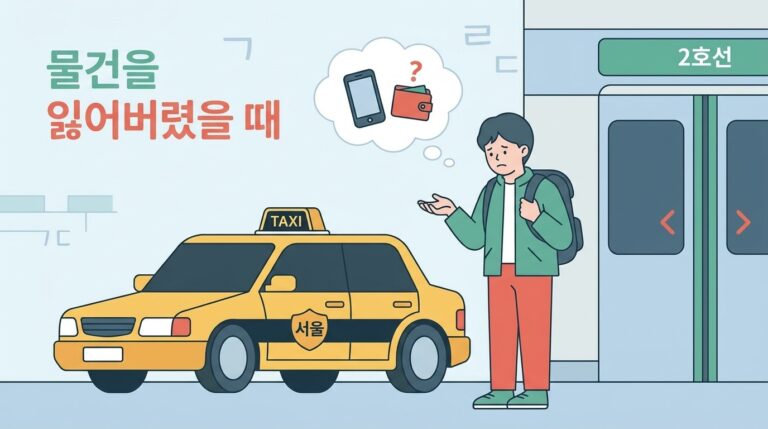
Phase 1: Empathy & The “Oops” Moment
Hello! I’m the lead editor of Daily Hangul.
Picture this: You just stepped out of a Seoul taxi. The door closes automatically. You reach into your pocket to grab your phone to check a map app… and your pocket is completely empty. Panic sets in. It’s a classic K-Drama scene where the protagonist frantically chases down the car, waving their arms. But you? You’re frozen on the sidewalk in Myeongdong.
Losing an item while traveling is terrifying. But here’s the good news: Korea is famous for its “K-Conscience” (people leaving laptops on cafe tables!). If you lose something in a taxi, subway, or restaurant, there is a very high chance you will get it back—if you know how to ask for it.
Many textbooks teach you to say, “I lost my bag” (제 가방을 잃어버렸어요). But if you say this to a Lost and Found center, it sounds too broad. Real Koreans use completely different phrases to track down their belongings. Let’s dive into the B1-level expressions that will save the day (and your wallet).
Phase 2: Deep Dive into Core Expressions
1. 제가 물건을 두고 내려서요.
- Pronunciation: Je-ga mul-geo-neul du-go nae-ryeo-seo-yo. [‘으’ sounds like the disgusted sound you make when stepping in gum]
- Meaning: (Literal) I put my item down and got off. vs (Real Nuance) I accidentally left my belongings behind (on the train/bus/taxi).
- K-Culture Moment: This is the universal opening line when calling the subway or bus lost and found. It implies an honest mistake rather than “I lost it completely and have no idea where it is.”
- Editor’s Insight: By combining ‘두다’ (to leave/put) and ‘내리다’ (to get off), you accurately describe the action. Ending with ‘-서요’ softens the sentence, making it sound polite and mildly apologetic, which naturally invites the listener to help you.
- Situation Spectrum:
- Casual (to friends): ✅ (물건 두고 내렸어!)
- Semi-formal (Station staff): ✅
- Formal (Police report): ✅
- 🤔 Think About It: Why do Koreans prefer saying “I left it behind” instead of “I lost it”? Could it be that specifying how you lost it makes the search process more efficient and cooperative?
2. 혹시 지갑 들어온 거 있나요?
- Pronunciation: Hok-si ji-gap deu-reo-on geo in-na-yo?
- Meaning: (Literal) By any chance, is there a wallet that came in? vs (Real Nuance) Has a wallet been turned in?
- K-Culture Moment: Imagine calling a busy cafe or a police station. Rather than demanding, “Do you have my wallet?”, Koreans ask if the item has “walked in” (들어오다).
- Editor’s Insight: Using ‘들어오다’ (to come in) to refer to a lost item being handed over by a good Samaritan is a very native B1-level habit. It takes the accusatory tone out of the question.
- Situation Spectrum:
- Casual (to friends): 🚫 (Friends don’t run a lost & found!)
- Semi-formal (Cafe staff/Subway): ✅
- Formal (Police officer): ✅
- 🤔 Think About It: In your native language, do you talk about lost items as if they move on their own (like “did it turn up?”)?
3. 언제쯤 찾으러 가면 될까요?
- Pronunciation: Eon-je-jjeum cha-jeu-reo ga-myeon doelkka-yo?
- Meaning: (Literal) Around when would it be okay if I go to find it? vs (Real Nuance) What time should I come by to pick it up?
- K-Culture Moment: You finally found it! The staff has your passport. Before you rush over like an action hero, you use this polite phrase to respect the staff’s schedule.
- Editor’s Insight: The grammar
-(으)면 되다(it will be fine if…) combined with the soft question ending-(으)ㄹ까요?creates the ultimate polite request. You are asking for their permission/convenience, not just stating your arrival. - Situation Spectrum:
- Casual (to friends): ⚠️ (A bit too formal)
- Semi-formal (Staff/Police): ✅
- Formal (Boss/Elders): ✅
Phase 3: Textbook vs. Real Korean
[Describing How You Lost It]
* 📖 Textbook Korean: 가방을 잃어버렸습니다. (I lost my bag.)
* 🗣️ Real Korean: 가방을 두고 내렸어요. / 놓고 왔어요. (I left my bag behind / I left it and came here.)
* 💡 Why the difference?: “잃어버리다” implies you don’t know where it went. “두고 내리다” pinpoints exactly that you left it on transportation.
[Asking if they have it]
* 📖 Textbook Korean: 제 지갑이 거기에 있습니까? (Is my wallet there?)
* 🗣️ Real Korean: 혹시 (검은색 지갑) 들어온 거 있나요? (By any chance, did a (black wallet) get turned in?)
* 💡 Why the difference?: Asking “is it there” can accidentally sound like you are accusing the staff of keeping it. “들어오다” frames it as a community effort.
[Telling them you will go get it]
* 📖 Textbook Korean: 제가 거기로 가겠습니다. (I will go there.)
* 🗣️ Real Korean: 지금 찾으러 가도 될까요? (Is it okay if I go pick it up now?)
* 💡 Why the difference?: Korean culture highly values ‘Nunchi’ (reading the room). Asking for permission is always preferred over declaring your actions.
Bottom Note: For B1 learners, mastering verbs like ‘두고 내리다’ (leave behind on transport) and ‘놓고 오다’ (leave behind at a place) will instantly make you sound like a local resident, not a tourist!
Phase 4: Cultural Context — K-Culture Deep Dive
4-1. Non-Verbal Cues: The Art of Apologetic Gratitude
When calling or visiting a lost and found (유실물 센터), the tone is crucial. Koreans naturally adopt a slightly apologetic but deeply grateful tone. When you receive your item, do not just snatch it and say “Thanks.” It is standard to bow slightly, receive the item with two hands, and say, “정말 감사합니다!” (Thank you so much!). It acknowledges the effort someone took to turn it in.
4-2. K-Travel Link: The Power of LOST112 and CCTV
Have you noticed how many CCTVs there are in Korea? In K-Dramas, detectives are always checking “블랙박스” (car dashcams) and street cameras. This isn’t fiction! Because of this surveillance infrastructure—and a strong cultural norm—stolen items are incredibly rare.
If you lose something in Korea, the first survival tip isn’t to give up; it’s to go to LOST112 (The Police Lost & Found Portal). Also, if you lose something on the subway, don’t just say “Line 2.” Try to remember the carriage number (e.g., 4-2) painted on the floor where you boarded. Station staff can radio ahead and have someone literally grab your bag at the next stop!
Phase 5: Real-Life Roleplay Scenario
Setting: Monday morning. You took the Line 2 Subway (the green line) to Gangnam after a busy weekend trip. You arrive at the office, but your Airpods are missing. You left them on the train! You nervously call the subway’s customer service.
Characters:
* YOU: An expat working in Seoul, hoping your expensive earbuds aren’t gone forever.
* 역무원 (Station Staff): A polite but busy subway employee.
Dialogue:
역무원: 네, 2호선 고객센터입니다.
(Ne, ihoseon gogaek senteo-imnida.)
[Yes, Line 2 Customer Center.]
YOU: 저기… 제가 전철에 이어폰을 두고 내려서요.
(Jeogi… je-ga jeoncheore ieoponeul du-go nae-ryeo-seo-yo.)
[Excuse me… I accidentally left my earphones on the train.]
역무원: 아, 네. 혹시 몇 시쯤 어디서 내리셨나요?
(A, ne. hok-si myeot sijjum eodiseo naerisyeonnayo?)
[Ah, yes. Around what time and where did you get off?]
YOU: 아침 8시 반쯤 강남역에서 내렸어요. 하얀색 에어팟이에요.
(Achim yeodeolsi banjjeum gangnamyeogeseo naeryeosseoyo. hayansaek eeopasieyo.)
[I got off at Gangnam Station around 8:30 AM. It’s white AirPods.]
역무원: 잠시만요… 아, 방금 비슷한 물건이 강남역 유실물 센터로 들어왔네요.
(Jamsimanyo… A, banggeum biseutan mulgeoni gangnamyeok yusilmul senteoro deureowatneyo.)
[Please wait a moment… Ah, a similar item just came into the Gangnam Station Lost & Found.]
🔀 Your Turn! How do you reply?
* A) 내놔요! 내 거 맞아요. (Give it! It’s mine.)
* B) 아, 진짜요? 언제쯤 찾으러 가면 될까요?
* C) 감사합니다! 내일 갈게요.✅ Best Choice: B — “Ah, really? Around what time should I go pick it up?” This is the perfect polite response.
⚠️ Choice A Analysis: NEVER say this. “내놔요” means “Hand it over” and sounds like a villain in a K-Drama demanding ransom.
역무원: 오늘 밤 10시 전까지 신분증 가지고 오시면 됩니다.
(Oneul bam yeolsi jeonkkaji sinbunjeung gajigo osimyeon doemnida.)
[You can come with your ID before 10 PM tonight.]
YOU: 네, 너무 감사합니다! 이따가 갈게요.
(Ne, neomu gamsahamnida! ittaga galgeyo.)
[Yes, thank you so much! I will go there later.]
Phase 6: 10-Second Shadowing Drill
Practice speaking like a native! Follow the slashes (/) to pause naturally, and match the emotion.
🥺 (Desperate but polite)
저기요… / 제가 전철에 / 가방을 / 두고 내려서요.
(Jeogiyo… / je-ga jeoncheore / gabangeul / du-go nae-ryeo-seo-yo.)
😊 (Relieved)
정말요? / 그럼 제가 / 언제쯤 / 찾으러 가면 될까요?
(Jeongmallyo? / geureom je-ga / eon-je-jjeum / cha-jeu-reo ga-myeon doelkka-yo?)
Phase 7: K-Culture Mini Dictionary
Here are 4 essential words to navigate lost and found situations in Korea:
1. 유실물 센터
* Romanization: yusilmul senteo
* English: Lost and Found Center
* Context: Used heavily by public transport systems (subway, KTX, airports). ‘유실물’ refers to items that were dropped or left behind by mistake.
2. 분실물
* Romanization: bunsinmul
* English: Lost item
* Context: A more general term for something you lost. You will often see boxes marked ‘분실물 보관함’ (Lost Item Storage) at cafes or school offices.
3. 종점
* Romanization: jongjeom
* English: Final stop / Terminus
* Context: If you leave something on a bus, the driver usually takes it to the “jongjeom” at the end of the route. You might have to travel there to retrieve it!
4. 신분증
* Romanization: sinbunjeung
* English: Identification card
* Context: You cannot claim a lost item without proving who you are. Always bring your ARC (Alien Registration Card) or Passport to the police or station.
Phase 8: Traveler’s Survival Kit
🆘 Essential Survival Phrases: Emergency & Lost Items
* 🇰🇷 “경찰서가 어디에 있나요?” (gyeongchalseoga eodie innayo?)
* 🗣️ Meaning: Where is the police station?
* 📍 Where to use: Asking locals if you need to file a formal report.
- 🇰🇷 “이거 누가 흘리고 갔어요.” (igeo nuga heulligo gasseoyo.)
- 🗣️ Meaning: Someone dropped/left this here.
- 📍 Where to use: Be the good K-Citizen! Say this to staff when you find someone else’s item.
📌 Editor’s Travel Note
* Important Apps: Download the LOST112 app (National Police Agency Lost and Found). You can search by category, color, and location to see if someone handed in your item!
* Who to call?: For emergencies, call 112 (Police). But for general lost items on the street, call 120 (Dasan Call Center) for multi-language help in Seoul, or visit the nearest local police box (파출소).
Phase 9: Critical Thinking — “One Step Deeper”
🧠 Think Deeper: Media vs Reality — The “K-Conscience”
If you watch Korean news or YouTube, you might see social experiments where people leave their wallets on a bench and nobody takes them. In reality, Korea is an extremely high-trust society when it comes to personal belongings like laptops, phones, and wallets. This is partly due to the massive network of CCTVs (which act as a deterrent) and a strong cultural taboo against taking what isn’t yours. However, there is a funny exception: Umbrellas. If you leave a cheap convenience store umbrella outside a shop on a rainy day, it will likely vanish in 5 minutes! Why do people respect a $2,000 laptop but steal a $3 umbrella? It highlights the difference between perceived “high value personal property” and “communal disposable items.”💬 Your Turn: How does your culture handle lost items? Are people quick to turn them in? Let us know in the comments!
Phase 10: FAQ & Mistake Prevention
- Q: “Can I use 반말 (casual language) when describing my item if I am in a panic?”
- A: No. No matter how stressed you are, always use
존댓말(formal language) with police or station staff. Dropping honorifics when panicked makes you seem rude, not urgent.
- A: No. No matter how stressed you are, always use
- Q: “If I lose my phone, can the police track its GPS?”
- A: Usually, no. The police cannot instantly track a phone via GPS just because you lost it, due to privacy laws. Your best bet is calling it or checking LOST112.
❌ Common Mistake: Demanding the item with “주세요” (Give it to me).
✅ Do This Instead: Say “찾으러 왔어요” (I came to pick it up). It sounds much more cooperative and polite.
Phase 11: Summary & Action Items
- One-Liner Summary: Instead of saying “I lost it,” tell Koreans exactly where you left it by using “두고 내려서요” and ask to come pick it up politely!
-
Action Missions:
- 🥉 Bronze (Solo): Say “제가 지갑을 두고 내려서요” out loud 3 times in front of a mirror, practicing your apologetic face.
- 🥈 Silver (Online): Visit the LOST112 website (it has an English option) and try searching for “wallet” (지갑) just to see how the system works.
- 🥇 Gold (Real Life): Next time you find an item left behind in a cafe, give it to the barista and say, “누가 두고 갔어요” (Someone left this).
- K-Culture Mission: Watch a K-Drama on Netflix this week. Can you spot a scene where someone visits a local police box (파출소)? Notice how they bow when they receive help!
Phase 12: Interactive Quiz
1. Situational Judgment: You left your bag in a Kakao Taxi. You finally get in touch with the driver. What is the most natural thing to say?
* A) 기사님 가방 내놔요! (Driver, give me the bag!)
* B) 기사님, 제가 택시에 가방을 두고 내려서요.
* C) 경찰을 부르겠습니다. (I will call the police.)
2. Fill in the Blank:
“혹시 분실물 _____ 거 있나요?”
(By any chance, did any lost items come in?)
* A) 먹은 (eaten)
* B) 나간 (gone out)
* C) 들어온 (come in)
3. True or False – K-Culture Edition:
In Korea, it is culturally acceptable to steal an umbrella from a convenience store stand if it’s raining heavily, but laptops are strictly off-limits. (True / False)
(Answers: 1. B, 2. C, 3. False – while umbrella theft happens as a funny cultural irony, it’s still legally theft and not “acceptable”!)
Frequently Asked Questions (FAQ)
Q: What does "제가 물건을 두고 내려서요." mean in Korean and how do you pronounce it?
A: In Korean, "제가 물건을 두고 내려서요." is pronounced [Je-ga mul-geo-neul du-go nae-ryeo-seo-yo. ['으' sounds like the disgusted sound you make when stepping in gum] and means: (Literal) I put my item down and got off. vs (Real Nuance) I accidentally left my belongings behind (on the train/bus/taxi).
Q: What does "혹시 지갑 들어온 거 있나요?" mean in Korean and how do you pronounce it?
A: In Korean, "혹시 지갑 들어온 거 있나요?" is pronounced [Hok-si ji-gap deu-reo-on geo in-na-yo?] and means: (Literal) By any chance, is there a wallet that came in? vs (Real Nuance) Has a wallet been turned in?
Q: What does "언제쯤 찾으러 가면 될까요?" mean in Korean and how do you pronounce it?
A: In Korean, "언제쯤 찾으러 가면 될까요?" is pronounced [Eon-je-jjeum cha-jeu-reo ga-myeon doelkka-yo?] and means: (Literal) Around when would it be okay if I go to find it? vs (Real Nuance) What time should I come by to pick it up?







