

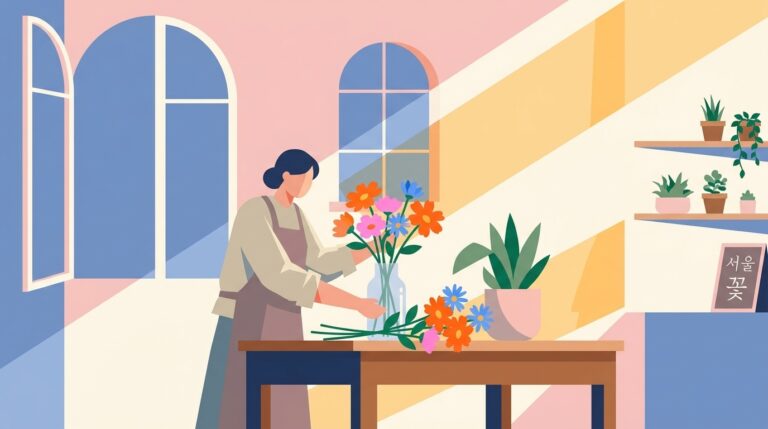
Greeting: “Hello! I’m your Daily Hangul Editor.”
Welcome to a sunlight-filled studio in Yeonnam-dong. You’re attending a trendy One-Day Class (원데이 클래스) for floral arrangement—a massive weekend trend among Millennials and Gen Z in Seoul. The instructor, wearing a minimalist linen apron, looks at your bouquet and says something that isn’t in your textbook: “여백의 미를 좀 더 살려볼까요?” (Shall we bring out the beauty of empty space a bit more?)
If you’re at the C1 level, simply saying “이 꽃 예뻐요” (This flower is pretty) isn’t enough anymore. You need the vocabulary to express delicate aesthetics, textures, and vibes. In Korea, floral design isn’t just about bundling flowers together; it’s heavily influenced by traditional art concepts, K-Beauty color palettes, and the deep cultural desire for ‘healing’ (힐링).
Today, we are going beyond the textbook. As a veteran tutor who has explored every aesthetic café and flower market in Seoul, I’ll teach you how to speak like a true local florist. Let’s dive in!
Phase 2: Deep Dive into Core Expressions
1. 색감이 쨍하네요 (The colors are vivid/popping)
- Pronunciation: [saekgami jjaenghaneyo]
- Sound-alike guide: ‘jj’ sounds like the tense ‘j’ in “jump” with a sharp exhale, and ‘aeng’ sounds like “ang” in “anger”.
- Meaning: Literal: The sense of color is glaring. / Real nuance: The colors are incredibly vivid, intense, and eye-catching.
- K-Culture Moment: You’ll hear this constantly in K-Beauty when YouTubers review lip tints, or when fans describe the vibrant aesthetics of a K-Pop music video. In a florist shop, it’s used to describe highly saturated, fresh flowers like bright coral peonies or deep blue delphiniums.
- Editor’s Insight: 쨍하다 originally describes a blindingly bright sun, but modern Koreans use it to describe anything with a high-contrast, striking visual appeal. It implies the color is so vibrant it almost ‘hits’ your eyes in a good way.
- Situation Spectrum:
- Casual (Friends): ✅ (완전 쨍하다!)
- Semi-formal (Colleagues/Shop staff): ✅ (색감이 참 쨍하네요.)
- Formal (Elders/Boss): ⚠️ (A bit too trendy; use ‘색이 아주 선명합니다’ instead.)
- 🤔 Think About It: Korean is incredibly rich in onomatopoeia and mimetic words (words that mimic sounds or feelings). Why do you think Koreans use a word that sounds like a sharp collision (쨍!) to describe visual beauty?
2. 여백의 미 (The beauty of empty space)
- Pronunciation: [yeobaegui mi]
- Sound-alike guide: ‘yeo’ like “yuh”, ‘baek’ like “back”, ‘ui’ like “we”, ‘mi’ like “me”.
- Meaning: Literal/Real nuance: The beauty of empty (negative) space.
- K-Culture Moment: If you watch historical K-Dramas, traditional Korean ink paintings always leave large portions of the paper blank. This is 여백의 미. Modern Korean florists apply this by not overstuffing a vase, allowing a single delicate branch to stand out against the empty air.
- Editor’s Insight: This isn’t just an art term; it’s a philosophy. It’s the elegance of restraint. When you tell a florist “여백의 미를 살려주세요” (Please highlight the beauty of empty space), they will instantly recognize your high-level cultural understanding.
- Situation Spectrum:
- Casual (Friends): ✅
- Semi-formal (Colleagues): ✅
- Formal (Elders/Boss): ✅ (Highly respected phrase)
- 🤔 Think About It: Leaving things unsaid or undone is often valued in Korean culture, deeply connected to Nunchi (reading the room without words). Does your culture have a concept of “less is more”?
3. 물이 올랐어요 (Reached its peak / Full of vitality)
- Pronunciation: [muri ollasseoyo]
- Sound-alike guide: ‘mu’ like “moo”, ‘ri’ like a soft ‘d’ combined with ‘ree’, ‘ol’ like “bowl”.
- Meaning: Literal: The water has risen. / Real nuance: The flowers have drawn up the water and look perfectly plump and vibrant. Metaphorically: Reaching one’s prime or peak beauty.
- K-Culture Moment: You’ve conditioned the flowers, and an hour later, the drooping tulips are standing straight up. The florist smiles and says, “물이 예쁘게 올랐네요.” But wait! You’ll also see this in K-Drama comments: “여주인공 미모에 물이 올랐다” (The female lead’s beauty has reached its absolute peak).
- Editor’s Insight: It’s a beautiful metaphor bridging nature and human vitality. It means something is at its absolute best state, glowing with life.
- Situation Spectrum:
- Casual (Friends): ✅
- Semi-formal (Colleagues): ✅
- Formal (Elders/Boss): ⚠️ (Fine for flowers, but don’t use it to describe your boss’s looks!)
- 🤔 Think About It: Associating ‘water’ (hydration/flow) with ‘youth/beauty’ is common. How do you describe a flower (or a person) coming back to life in your native language?
Phase 3: Textbook vs. Real Korean
Let’s upgrade your C1 vocabulary from technically correct to naturally sophisticated.
[Describing the condition of a flower]
* 📖 Textbook Korean: 이 꽃은 아주 신선합니다. (This flower is very fresh.)
* 🗣️ Real Korean: 이 꽃 상태 완전 싱싱하네요! (The condition of this flower is totally crisp/fresh!)
* 💡 Why the difference?: Koreans love using the word ‘상태’ (condition) for everyday objects. Plus, the mimetic word ‘싱싱하다’ gives a visceral, crisp feeling that ‘신선하다’ (a more formal Sino-Korean word) lacks.
[Instructing the arrangement]
* 📖 Textbook Korean: 꽃을 앞쪽으로 놓으세요. (Place the flowers to the front.)
* 🗣️ Real Korean: 꽃 얼굴이 앞을 보게끔 꽂아주세요. (Arrange them so the ‘face’ of the flower is looking forward.)
* 💡 Why the difference?: Personification! Florists universally refer to the blooming center of a flower as its ‘얼굴’ (face). Using ‘-게끔’ adds a sophisticated instructional nuance.
[Discussing the overall vibe]
* 📖 Textbook Korean: 분위기가 좋습니다. (The atmosphere is good.)
* 🗣️ Real Korean: 무드가 너무 고급스러워요. (The mood is so luxurious/elegant.)
* 💡 Why the difference?: The Korean aesthetic industry heavily borrows English words (무드 for mood, 쉐입 for shape) combined with high-end descriptors like ‘고급스럽다’.
Bottom Note: At the C1 level, blending native mimetic words (싱싱하다, 쨍하다) with elegant Sino-Korean phrases (여백의 미, 고급스럽다) is the key to sounding like an educated native speaker.
Phase 4: Cultural Context — K-Culture Deep Dive
4-1. Non-Verbal Floristry Nuances
In a Korean florist class, watch the hands. When handing scissors or a finished bouquet to the instructor or a classmate, always use two hands (or support your right arm with your left hand). Also, notice the Nunchi during a group class: Koreans rarely dominate the instructor’s time. They observe others’ arrangements silently and offer subtle compliments like “어머, 톤이 너무 예뻐요” (Oh, the tone is so pretty).
4-2. K-Culture Connection: The ‘Flower Language’ (꽃말) Trope
If you’ve watched K-Dramas like Crash Landing on You or Goblin, you know that flowers in Korea are rarely just flowers. They are vehicles for hidden messages. The concept of 꽃말 (kkotmal, flower language) is incredibly popular.
When buying flowers, Koreans often ask the florist: “이 꽃 꽃말이 뭐예요?” (What is the meaning of this flower?). For example, giving a Lisianthus (리시안셔스) means “Unchanging love,” while a yellow tulip can mean “Hopeless love.” In a florist class, understanding the kkotmal adds a layer of emotional storytelling to your arrangement, making you look like a true romantic K-Drama protagonist.
Phase 5: Real-Life Roleplay Scenario
Setting: A sunlit floral studio in Apgujeong. Saturday afternoon. Jazz is playing softly in the background. The air smells heavily of eucalyptus. You are standing at a wooden table with pruning shears.
Characters:
* YOU: An expat who loves Korean aesthetics and wants to make a bouquet for a friend’s exhibition.
* Ji-yoon (28): The trendy, softly-spoken florist instructor.
Dialogue:
Ji-yoon: 이쪽 장미들 물이 아주 예쁘게 올랐죠? 메인 꽃으로 쓰기 딱 좋을 거예요.
(ijjok jangmideul muri aju yeppeuge ollatjyo? mein kkocheuro sseugi ttak joeul geoyeyo.)
[Translation] These roses have drawn up the water beautifully, haven’t they? They’ll be perfect to use as the main flowers.
(🎭 Stage Direction: Ji-yoon points to a bucket of vivid coral roses)
YOU: 네, 색감이 정말 쨍하고 예쁘네요. 이걸로 중심을 잡아볼게요.
(ne, saekgami jeongmal jjaenghago yeppeuneyo. igeollo jungsimeul jababolgeyo.)
[Translation] Yes, the colors are really vivid and pretty. I’ll establish the center with these.
Ji-yoon: 좋아요. 장미 얼굴이 살짝 사선으로 앞을 보게끔 꽂아주세요.
(joayo. jangmi eolguri saljjak saseoneuro apeul bogekkeum kkojajuseyo.)
[Translation] Great. Please arrange them so the ‘faces’ of the roses look forward at a slight angle.
YOU: 이렇게요? 생각보다 줄기를 다루는 게 쉽지 않네요.
(ireokeyo? saenggakboda julgireul daruneun ge swipji anneyo.)
[Translation] Like this? Handling the stems isn’t as easy as I thought.
Ji-yoon: 처음엔 다 그래요. 어머, 근데 스파이럴(spiral) 형태를 너무 잘 잡으셨는데요? 빈 공간이 조금 있는데, 필러(filler) 꽃을 더 채워드릴까요?
(cheoeumen da geuraeyo. eomeo, geunde seupaireol hyeongtaereul neomu jal jabeusyeonneundeyo? bin gonggani jogeum inneunde, pilleo kkocheul deo chaewodeurilkkayo?)
[Translation] Everyone is like that at first. Oh my, but you’ve held the spiral shape so well! There’s a bit of empty space, shall I fill it with more filler flowers for you?
🔀 Your Turn! How do you reply to sound like a culturally fluent C1 speaker?
* A) 아니요, 괜찮습니다. 이대로 놔두세요. (Too blunt and rigid.)
* B) 음… 저는 여백의 미를 살리고 싶어서, 이대로 마무리하는 편이 좋을 것 같아요. (Culturally rich and elegant.)
* C) 헐 대박! 쌤 진짜 친절하시네요. 근데 안 주셔도 돼요. (Too slangy for an aesthetic florist class.)✅ Best Choice: B. Using “여백의 미” explains why you are declining in a deeply artistic way. Ending with “~하는 편이 좋을 것 같아요” (I think it would be better to…) is the ultimate C1 Korean polite softening strategy.
Phase 6: 10-Second Shadowing Drill
Practice reading this aloud to master the flow and emotion of an advanced speaker. Follow the pauses (/) and the emotion tags!
- 😊 밝고 우아하게 (Brightly and elegantly):
선생님, / 저는 꽉 찬 느낌보다는 / 여~~~백의 미를 / 살려서 꽂고 싶어요.
(seonsaengnim, / jeoneun kkwak chan neukkimbodaneun / yeo~~~baegui mireul / sallyeoseo kkotgo sipeoyo.) -
🥺 감탄하며 (With admiration):
어머, / 이 작약 / 색감이 너무 쨍하고 / 물이 잘 올랐네요!
(eomeo, / i jagyak / saekgami neomu jjaenghago / muri jal ollanneyo!)
Phase 7: K-Culture Mini Dictionary
Here are the essential cultural keywords for navigating Korean hobbies:
1. 원데이 클래스 (One-Day Class)
* Romanization: wondei keullaeseu
* English: One-day workshop/class
* Context: A cornerstone of modern Korean dating and hobby culture. Instead of committing to months of classes, busy Seoulites take single-session classes (baking, perfumery, floristry) to destress and get great Instagram photos.
2. 힐링 (Healing)
* Romanization: hilling
* English: Healing / Relaxing
* Context: In the hyper-competitive, pali-pali (hurry hurry) society of Korea, any activity that brings peace of mind—like arranging flowers or drinking tea—is intensely marketed as “힐링”.
3. 인증샷 (Injeung-syat)
* Romanization: injeungsyat
* English: Proof shot / Photo for social media
* Context: After a florist class, the instructor will always prepare a beautifully lit corner for you to take an injeung-syat of your work to post on Instagram.
4. 꽃말 (Kkotmal)
* Romanization: kkotmal
* English: Flower language / Meaning of flowers
* Context: A heavily romanticized concept in Korea. Buying flowers without knowing the kkotmal is considered a rookie mistake in Korean dating culture.
Phase 8: Traveler’s Survival Kit
Even if you aren’t taking a class, you might want to buy flowers for a friend or a K-Pop idol’s birthday cafe event while visiting Korea.
🆘 Survival Phrases for Buying Flowers
* 🇰🇷 “선물용인데, 5만 원 예산으로 알아서 예쁘게 해주실 수 있나요?”
* (seonmuryonginde, oman won yesaneuro araseo yeppeuge haejusil su innayo?)
* “It’s for a gift. Can you make it pretty within a 50,000 KRW budget?” (Using 알아서 – “up to your discretion” – is a very native way to trust the expert).
* 🇰🇷 “이 꽃은 며칠 정도 가나요?”
* (i kkocheun myeochil jeongdo ganayo?)
* “How many days will this flower last?”
* 🇰🇷 “들고 가기 편하게 쇼핑백에 담아주세요.”
* (deulgo gagi pyeonhage syopingbaege damajuseyo.)
* “Please put it in a shopping bag so it’s easy to carry.”📌 Editor’s Travel Note:
* Where to go: Skip the expensive boutiques if you want raw experience. Visit the Yangjae Flower Market (양재꽃시장) or the Express Bus Terminal Underground Flower Market (고속터미널 꽃시장 – best visited after midnight) for a true bustling local vibe.
* Bargaining: Not acceptable in boutique florist shops. However, at the wholesale midnight markets, asking “조금만 깎아주시면 안 돼요?” (Can’t you give me a little discount?) with a smile might get you a few extra stems!
Phase 9: Critical Thinking Corner — “One Step Deeper”
🧠 Think Deeper: Language in the Global Era & The “Healing” Phenomenon
If you look at the vocabulary used in Korean florist shops—무드 (mood), 쉐입 (shape), 피치 톤 (peach tone), 힐링 (healing)—you’ll notice an overwhelming amount of Konglish and English loanwords. Why has this happened? As Korea globalized, Western aesthetics became highly coveted. Using English loanwords in design and lifestyle sectors artificially elevates the perceived “luxury” and modernity of the service. Furthermore, the obsession with “힐링” (healing) through gardening reveals the flip side of Korea’s economic miracle: in a society driven by extreme efficiency and burnout, interacting with slow-growing, silent plants is a desperate psychological necessity, not just a hobby.
💬 Your Turn: Does your culture mix foreign words to make things sound more “luxurious”? And how do people in your country seek “healing” from daily stress? Share in the comments!
Phase 10: FAQ & Preventing Misunderstandings
Q: “Can I use ‘여백의 미’ to describe a person’s minimalist outfit?”
Yes! It’s actually a great compliment for someone wearing a very clean, minimalist, high-end fashion look without flashy logos. It shows you appreciate their sophisticated restraint.
Q: “At a flower market, is it okay to touch the flowers?”
No. This is a huge faux pas. The natural oils on human hands can damage the petals. Always point and say, “저것 좀 보여주세요” (Please show me that one) instead of grabbing the stems yourself.
❌ Common Mistake #1: Translating “I want this flower” directly to “저는 이 꽃을 원해요.” (Sounds like a robot in a dramatic movie).
✅ Do this instead: “이 꽃으로 해주세요” (Please do it with this flower) or “이 꽃을 메인으로 쓰고 싶어요” (I want to use this flower as the main one).❌ Common Mistake #2: Confusing ‘쨍하다’ (vivid/bright) with ‘찡하다’ (a feeling of emotional touching/heartache).
✅ Do this instead: Remember the sharp ‘jj-aeng’ for colors, and the soft ‘jj-ing’ for when a K-Drama makes you want to cry!
Phase 11: Summary & Action Items
One-Liner Summary: Elevate your aesthetic Korean vocabulary by mastering 쨍하다 (vividness), 여백의 미 (negative space), and 물이 오르다 (peak vitality) to sound like a sophisticated Seoulite.
Your Action Missions:
* 🥉 Bronze (Solo): Look at a plant or flower near you right now and describe its condition out loud using “물이 올랐네요” or “싱싱하네요.”
* 🥈 Silver (Online): Go to Instagram, search the hashtag #연남동꽃집 (Yeonnam-dong florist). Find a bouquet you like and leave a comment: “색감이 너무 쨍하고 예뻐요!”
* 🥇 Gold (Real Life): Next time you visit Korea (or a local Korean-owned shop), buy a single flower and ask the florist: “이 꽃 꽃말이 뭐예요?” (What is the flower language of this flower?)
K-Culture Mission: Watch an episode of a Korean reality dating show (like Transit Love or Heart Signal). Notice how often they go to ‘One-Day Classes’ (like pottery or floristry) on their dates. Pay attention to how they subtly compliment each other’s work!
What’s your favorite flower, and what is its ‘꽃말’ (meaning)? Let us know in the comments below! 👇
Phase 12: Interactive Challenge Quiz
Q1. Situational Judgment:
You are taking a florist class. Your arrangement looks a bit too crowded, and you want to ask the instructor to help you make it look more minimalist and elegant. What should you say?
* A) “다 빼주세요.” (Take everything out.)
* B) “여백의 미를 좀 살리고 싶어요.” (I want to bring out the beauty of empty space.)
* C) “물이 너무 올랐어요.” (The water has risen too much.)
Q2. Fill in the Blank:
You are admiring a K-Pop idol’s deeply saturated red stage outfit.
“와, 이번 의상 완전 색감이 ( )네!”
Q3. True or False – K-Culture Edition:
In Korea, it is completely normal and expected to ask a florist about the “flower language” (꽃말) before buying a bouquet for a romantic partner. (T/F)
👀 Click here for answers!
Q1 Answer: B. ‘여백의 미’ perfectly communicates the desire for an elegant, less-crowded aesthetic. ‘A’ is too aggressive.
Q2 Answer: 쨍하(다). ‘쨍하네’ fits perfectly for highly saturated, vivid colors.
Q3 Answer: True. The meaning behind the flower is often considered just as important as its aesthetic beauty in Korean dating culture!
Frequently Asked Questions (FAQ)
Q: What does "색감이 쨍하네요 (The colors are vivid/popping)" mean in Korean and how do you pronounce it?
A: In Korean, "색감이 쨍하네요 (The colors are vivid/popping)" is pronounced [saekgami jjaenghaneyo] and means: a key conversational Korean expression covered in this lesson.
Q: What does "여백의 미 (The beauty of empty space)" mean in Korean and how do you pronounce it?
A: In Korean, "여백의 미 (The beauty of empty space)" is pronounced [yeobaegui mi] and means: a key conversational Korean expression covered in this lesson.
Q: What does "물이 올랐어요 (Reached its peak / Full of vitality)" mean in Korean and how do you pronounce it?
A: In Korean, "물이 올랐어요 (Reached its peak / Full of vitality)" is pronounced [muri ollasseoyo] and means: a key conversational Korean expression covered in this lesson.







