

Phase 1: Empathy (The Immersive Open)
Hello, language enthusiasts! I’m the Lead Editor at Daily Hangul, your veteran tutor and local cultural navigator.
Imagine this: You are at a trendy café in Yeonnam-dong. It’s your first time meeting a group of Korean friends you connected with online. The vibe is great, iced Americanos are on the table, and suddenly, someone leans in, narrows their eyes, and says, “Let me guess… You’re totally a Type A, right?”
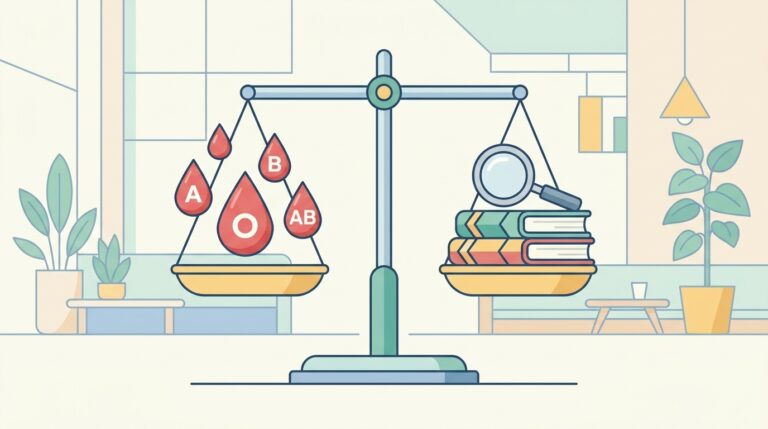
If you’ve watched enough early 2000s K-Dramas or hung out with Koreans in their 30s and older, you’ve likely encountered this. The “Blood Type Personality Theory” (혈액형 성격설) was once the absolute king of Korean icebreakers. As someone learning Korean at a C2 (Advanced) level, and perhaps harboring a healthy dose of scientific skepticism, you might want to scream, “That has zero scientific basis!”
But wait! In Korea, how you debunk a myth is just as important as the facts themselves. Bursting the bubble too aggressively can ruin the kibun (mood/feelings). Today, we’re going to learn how to politely, wittily, and fluently navigate this pseudo-science using high-level Korean, proving that you’re not just fluent in the language, but a true master of the culture.
Phase 2: Core Expressions Deep Dive
Let’s upgrade your skepticism from a blunt “I don’t believe you” to witty, native-level banter.
1. 혈액형 성격설은 대표적인 유사과학 아닌가요?
- Pronunciation: [Hyeoraekyeong seonggyeokseoreun daepyojogin yusagwahak aningayo?]
- Sound-alike guide: ‘Hyeol’ sounds like “hyul” with a soft L. ‘Yusa’ sounds like “you-sah.”
- Meaning: (Literal) Isn’t blood type personality theory a representative pseudoscience? / (Real nuance) Come on, we all know blood type personalities are totally unscientific, right?
- K-Culture Moment: Picture a blind date (소개팅). Your date brings up blood types, and you say this with a playful smile. It shows you’re smart but keeps the conversation engaging.
- Editor’s Insight: The word 유사과학 (pseudoscience) is the golden key here. It immediately signals that you possess a C2 vocabulary. By phrasing it as a question (“~아닌가요?”), you soften the blow, turning a debate into a friendly discussion.
- Situation Spectrum:
- Friends (Casual): ✅ (Perfect for playful debates)
- Coworkers (Semi-formal): ✅ (Great for showing intellect politely)
- Elders/Bosses (Formal): ⚠️ (Might sound a bit “know-it-all” depending on your tone)
- 🤔 Think About It: Why do you think adding “~아닌가요?” (Isn’t it…?) softens a statement in Korean? How does your native language cushion intellectual disagreements?
2. 그거 다 귀에 걸면 귀걸이, 코에 걸면 코걸이잖아요.
- Pronunciation: [Geugeo da gwie geolmyeon gwigeori, koe geolmyeon kogeorijanayo.]
- Sound-alike guide: ‘Gwi’ sounds like “gwee” (rhymes with tree). ‘Ko’ is just “ko.”
- Meaning: (Literal) If you hang it on the ear, it’s an earring; if you hang it on the nose, it’s a nose ring. / (Real nuance) It’s all just the Barnum effect (open to interpretation).
- K-Culture Moment: You’re at a company dinner (회식). Your boss says, “You’re very detail-oriented, must be Type A!” You laugh and drop this classic idiom. They will instantly respect your deep grasp of Korean idioms.
- Editor’s Insight: This is the ultimate C2 idiom for the “Barnum Effect” or confirmation bias. It means a theory is so vague it can apply to anything. Using this will literally make native speakers’ jaws drop.
- Situation Spectrum:
- Friends (Casual): ✅
- Coworkers (Semi-formal): ✅
- Elders/Bosses (Formal): ✅ (Older generations love it when foreigners use proverbs appropriately!)
- 🤔 Think About It: Proverbs often reveal a culture’s worldview. What does this idiom say about the Korean perspective on flexible rules or vague definitions?
3. 에이, 요즘 누가 혈액형을 물어봐요? 대세는 MBTI죠!
- Pronunciation: [Ei, yojeum nuga hyeoraekyeongeul mureobwayo? Daeseneun MBTI-jyo!]
- Sound-alike guide: ‘Ei’ is a drawn-out “ayyy” to show playful dismissal.
- Meaning: (Literal) Hey, who asks about blood types these days? The main trend is MBTI! / (Real nuance) Blood types are so 2010. Let’s talk about MBTI instead!
- K-Culture Moment: You want to redirect the conversation from pseudo-science to a more modern (albeit still scientifically debated) cultural phenomenon.
- Editor’s Insight: 대세 (daese) means “the mainstream” or “the big trend.” Koreans are incredibly trend-sensitive. By playfully calling blood types outdated, you gracefully exit the pseudo-science debate and enter the hottest current topic in Korea.
- Situation Spectrum:
- Friends (Casual): ✅
- Coworkers (Semi-formal): ✅
- Elders/Bosses (Formal): ⚠️ (Elders might not know what MBTI is!)
- 🤔 Think About It: MBTI has almost completely replaced blood types in Korea. Why is the Korean society so drawn to categorizing personalities?
Phase 3: Textbook vs. Real Korean
[Situation 1: Expressing Disbelief in Pseudoscience]
* 📖 Textbook Korean: 저는 혈액형 성격설을 믿지 않습니다. (I do not believe in the blood type personality theory.)
* 🗣️ Real Korean: 에이, 그거 완전 바넘 효과(Barnum effect)잖아요~ (Come on, that’s totally the Barnum effect~)
* 💡 Why the difference?: The textbook version sounds like a robot testifying in court. Adding “에이” (playful dismissal) and “~잖아요” (as you know) makes it conversational and inclusive.
[Situation 2: When Someone Stereotypes You]
* 📖 Textbook Korean: 당신의 생각은 편견입니다. (Your thought is a prejudice.)
* 🗣️ Real Korean: 완전 일반화의 오류 아니에요? 저 사실 O형이에요! (Isn’t that a total fallacy of generalization? I’m actually Type O!)
* 💡 Why the difference?: Calling someone prejudiced is highly confrontational. “일반화의 오류” (fallacy of generalization) sounds smarter and less personal, especially when followed by a plot twist about your real blood type!
Bottom Note: At the C2 level, you aren’t just communicating facts; you are managing the social atmosphere. Use high-level vocabulary (유사과학, 일반화) but soften it with casual grammar structures (아니에요?, ~잖아요).
Phase 4: Cultural Context — K-Culture Deep Dive
4-1. Non-Verbal Cues: The Art of Nunchi
When debunking a myth in Korea, your non-verbal cues must scream, “I respect you, but I disagree with the theory.”
– The “Laugh and Deflect”: Never maintain a cold, unblinking stare while delivering scientific facts. Smile, tilt your head slightly, and use a light-hearted tone.
– The Hand Wave: Gently waving one hand in front of your chest while saying “에이~” (Eyyy~) is the quintessential Korean gesture for polite, friendly disagreement.
4-2. K-Culture Connection: K-Drama & The “Type B Bad Boy”
If you want to truly flex your cultural knowledge, bring up the infamous 2005 rom-com movie “My Boyfriend is Type B” (B형 남자친구).
In the early 2000s, K-Media perpetuated the stereotype that Type B men were selfish, hot-headed, but irresistibly charming “bad boys.” Meanwhile, Type A people were painted as timid perfectionists who hold grudges (소심하다).
Critical Viewpoint: While these tropes made for dramatic K-Drama storylines, they actually caused real-life prejudices. People used to avoid dating Type B men! Mentioning this movie is a great way to subtly critique how media influences public belief, proving your advanced cultural literacy.
Phase 5: Interactive Roleplay Scenario
Setting: Saturday night, 9 PM at a lively Guesthouse party in Jeju Island. You are sitting in a circle with a mix of travelers. The ice-breaking games have started, and the topic turns to personalities.
Characters:
– YOU: A C2 Korean learner, friendly but a logical skeptic.
– Min-ji (28): A bubbly Korean traveler who loves astrology, MBTI, and blood types.
Dialogue:
Min-ji: (Observing you carefully) 진짜 꼼꼼하신 것 같아요. 혹시 A형이세요? 🩸
(Jinjja kkomkkomhasin geot gatayo. Hoksi A-hyeongiseyo?)
[You seem really meticulous. Are you by any chance Type A?]
YOU: 네? 제가요? (Ne? Jaegayo?)
[Excuse me? Me?]
Min-ji: 네! A형들이 원래 엄청 계획적이고 섬세하잖아요. 딱 A형 재질이신데!
(Ne! A-hyeongdeuri wollae eomcheong gyehoekjeogigo seomsehajanayo. Ttak A-hyeong jaejirisinde!)
[Yes! Type A’s are naturally very planned and delicate. You totally give off Type A vibes!]
🔀 Your Turn! How do you respond?
– A) “혈액형 성격설은 과학적 근거가 없는 유사과학입니다.” (Blood type theory is pseudoscience with no scientific basis.)
– B) “아, 그거 완전 귀에 걸면 귀걸이, 코에 걸면 코걸이잖아요~ 저 사실 B형이에요!”
(Ah, that’s totally an ‘earring if on the ear, nose ring if on the nose’ situation~ I’m actually Type B!)
– C) “제 혈액형은… 당신의 이상형? 😉” (My blood type is… your ideal type?)
✅ Best Choice: B — Why? It uses a high-level idiom to debunk the theory (Barnum effect) but immediately follows up with your actual blood type to keep the game fun. It’s the perfect balance of skepticism and social grace.
⚠️ Choice A Analysis: Grammatically flawless, but a major party pooper. You will kill the kibun instantly.
⚠️ Choice C Analysis: A legendary cheesy pun (이상형 sounds like a blood type). Funny if you are incredibly close, but might make Min-ji cringe at a first meeting!
Phase 6: 10-Second Shadowing Drill
Master the rhythm of polite skepticism! Follow the slashes for pauses and the tags for emotion.
😆 에이~ / 혈액형은 / 완전 옛날식이죠! / 요즘 / 대세는 / MBTI잖아요~
(Ei~ / hyeoraekyeongeun / wanjeon yennalsigijyo! / Yojeum / daeseneun / MBTI-janayo~)
[Come on~ / blood types are / totally old-school! / These days / the trend is / MBTI~]
Phase 7: K-Culture Mini Dictionary
1. 유사과학 (Yusagwahak)
* English: Pseudoscience
* Context: A crucial C2 vocabulary word. Used to describe blood type theories, fan death (선풍기 괴담), and other culturally ingrained but unscientific beliefs.
2. 팩폭 (Paek-pok)
* English: Fact-bombing (telling the harsh truth)
* Context: Slang for stating cold, hard facts that might hurt someone’s feelings or burst their bubble. If you debunk blood types too hard, Koreans might say, “아파요, 팩폭 하지 마세요!” (It hurts, stop fact-bombing!)
3. 과몰입 (Gwamorip)
* English: Over-immersion / Taking something too seriously
* Context: Used when someone is way too obsessed with MBTI or blood types. “MBTI 과몰입러” means someone who judges everything based on MBTI.
4. 소심하다 (Sosimhada)
* English: Timid / Easily hurt (holding a grudge)
* Context: The ultimate stereotype for Type A individuals in Korea. If you are Type A, Koreans will jokingly warn others not to upset you because you’ll “hold onto it forever.”
Phase 8: Traveler’s Survival Kit
Even as a traveler, you’ll encounter categorization culture at hostels, language exchanges, or bars. Here is your social survival kit.
🆘 Survival Phrases for Socializing
– 🇰🇷 “아, 저는 그런 거 잘 안 믿어요~” (Ah, jeoneun geureon geo jal an mideoyo~)
– 🗣️ English: Ah, I don’t really believe in that kind of stuff~
– 📍 Where to use: Hostels, language exchanges, casual drinks.
– 💡 Pro Tip: Always drag out the end of the sentence (“믿어요~”) with a smile. It turns a rejection into a soft, friendly boundary.📌 Editor’s Travel Note: The Ice-Breaking Shift
– The Shift: If you visit Korea today, you will notice people rarely ask for blood types anymore. The new king of icebreakers is MBTI.
– Survival Tactic: Memorize your 4-letter MBTI type (e.g., INFP, ESTJ). Even if you are a skeptic of both, simply saying “저는 INFP예요” acts as a social passport in Korea, instantly making locals feel closer to you.
Phase 9: Critical Thinking — “One Step Deeper”
Media vs Reality & Language of Rapport
Why do Koreans, despite living in a hyper-modern, tech-savvy society, cling so tightly to pseudo-scientific categorizations like Blood Types or MBTI? It’s not because they lack scientific education. Korea is a High-Context Society (고맥락 사회) that highly values rapid integration into a group (소속감).
When meeting strangers, the sheer volume of polite speech levels (높임말) and hierarchical rules can create a stiff atmosphere. Categorization acts as a social lubricant. By saying, “Ah, you’re a Type B, no wonder you’re so energetic!”, they are essentially saying, “I see you, I understand your character, and we are now closer.” It reduces the cognitive load of navigating a stranger’s personality from scratch.
🧠 Think Deeper: As a skeptic, you might view categorization as prejudice. But in Korea, it is an invitation to connect. How do you balance your scientific worldview with a culture’s desire for rapid social bonding?
💬 Your Turn: Does your culture have a similar ‘unscientific’ social lubricant (like Zodiac signs)? How do people react if you publicly debunk it? Share in the comments!
Phase 10: FAQ & Avoiding Common Mistakes
Q: “Is it rude to tell an elder that their belief is pseudo-science?”
A: MAYBE. At a C2 level, you know that how you say it matters more than what you say. If a 60-year-old taxi driver tells you you act like a Type O, just smile and say, “아, 정말요? 감사합니다” (Oh, really? Thank you). Debunking it with words like “유사과학” to an elder can be seen as overly argumentative (말대꾸).
Q: “Can I use ‘팩폭’ in formal settings?”
A: NO. ‘팩폭’ is slang. Do not use it in a business meeting or an academic presentation.
❌ Common Mistake #1: Treating a casual icebreaker like a formal debate.
✅ Do this instead: Read the room (Nunchi). If they are just making small talk, use the “귀걸이 코걸이” idiom to lightly brush it off instead of citing scientific journals.❌ Common Mistake #2: Confusing 일반화 (Generalization) with 합리화 (Rationalization).
✅ Do this instead: When criticizing stereotypes, use “일반화의 오류” (Fallacy of generalization).
Phase 11: Summary & Action Items
One-Liner Summary: To gracefully debunk blood type myths without killing the vibe, use advanced idioms like “귀에 걸면 귀걸이” and smoothly pivot the topic to modern trends like MBTI.
Action Mission 3 Steps:
– 🥉 Bronze: Stand in front of a mirror and practice saying, “혈액형 성격설은 대표적인 유사과학 아닌가요?” with a warm, friendly smile.
– 🥈 Silver: Go to a Korean language forum (or Reddit’s r/Korean) and write a short paragraph about why you prefer MBTI over blood types using today’s C2 vocabulary.
– 🥇 Gold: The next time a Korean asks you a stereotypical question, playfully deflect it using the “귀걸이 코걸이” idiom!
K-Culture Mission:
Search YouTube for clips of the movie “B형 남자친구” (My Boyfriend is Type B). Try to pick out the societal stereotypes presented in the movie and analyze why they wouldn’t fly in today’s society!
Engagement: What is your actual blood type, and what is your MBTI? Do you think either of them accurately describes you? Let’s discuss in the comments below! 👇
Phase 12: Quiz — Interactive Challenge
1. Situational Judgment:
You are at a casual dinner with Korean coworkers. One of them says, “You’re so outgoing, you must be an O type!” You want to politely show off your C2 Korean while dismissing the idea. What is the best response?
– A) 아닙니다. 그것은 유사과학입니다. (No. That is pseudoscience.)
– B) 에이, 요즘 누가 혈액형을 믿어요~ 대세는 MBTI죠!
– C) 네, 저는 O형입니다. 질문 있습니까?
2. Fill in the Blank:
혈액형 성격설은 과학적 근거가 없는 대표적인 [ ]입니다.
(Hint: Pseudoscience)
3. True or False — K-Culture Edition:
In 2024, Blood Type is still the most popular question young Koreans ask to break the ice on a blind date. (T/F)
(Answers: 1. B / 2. 유사과학 / 3. False – MBTI has largely taken over!)
Frequently Asked Questions (FAQ)
Q: What does "혈액형 성격설은 대표적인 유사과학 아닌가요?" mean in Korean and how do you pronounce it?
A: In Korean, "혈액형 성격설은 대표적인 유사과학 아닌가요?" is pronounced [Hyeoraekyeong seonggyeokseoreun daepyojogin yusagwahak aningayo?] and means: a key conversational Korean expression covered in this lesson.
Q: What does "그거 다 귀에 걸면 귀걸이, 코에 걸면 코걸이잖아요." mean in Korean and how do you pronounce it?
A: In Korean, "그거 다 귀에 걸면 귀걸이, 코에 걸면 코걸이잖아요." is pronounced [Geugeo da gwie geolmyeon gwigeori, koe geolmyeon kogeorijanayo.] and means: a key conversational Korean expression covered in this lesson.
Q: What does "에이, 요즘 누가 혈액형을 물어봐요? 대세는 MBTI죠!" mean in Korean and how do you pronounce it?
A: In Korean, "에이, 요즘 누가 혈액형을 물어봐요? 대세는 MBTI죠!" is pronounced [Ei, yojeum nuga hyeoraekyeongeul mureobwayo? Daeseneun MBTI-jyo!] and means: a key conversational Korean expression covered in this lesson.







